Showing posts sorted by relevance for query zacharias. Sort by date Show all posts

Monday, May 25, 2015

Giandomenico


Drawings by Giandomenico Tiepolo (1727-1804), son of the preeminently famous ceiling muralist Giambattista Tiepolo (1696-1770). Giandomenico, too, covered many a ceiling with skyscapes full of flying or floating creatures, immune to gravity. Father and son both left thousands of sketches. Above, Giandomenico's blindfolded Cupid with celestial companions. Below, a sequence with pastoral lovers Angelica & Medoro.  


The Tiepolos were inclined to introduce flying figures even where the situation might not traditionally be thought to require them.

Announcement to Zacharias of the Birth of John the Baptist (His Son)

The Flight into Egypt Guided by Angels (personally supervised by God the Father)

St. James Taken to Heaven

Standing Figure in Clouds

Masqueraders

Monkey Swinging on a Parapet

Punchinello Riding an Ass

Punchinello's Last Illness


All drawings from collections at the Morgan Library in New York.

Friday, October 11, 2019

Carved Wooden Figures (15th-17th centuries) in Vienna

Tilman Riemenschneider
Adam
ca. 1495-1505
pear wood statuette
Kunsthistorisches Museum, Vienna

Peter Flötner
Adam
ca. 1525
boxwood statuette
Kunsthistorisches Museum, Vienna

Conrad Meit
Adam
ca. 1530-35
boxwood statuette
Kunsthistorisches Museum, Vienna

Conrad Meit
Eve
ca. 1530-35
boxwood statuette
Kunsthistorisches Museum, Vienna

Anonymous Sculptor working in Germany
Adam
ca. 1565-1600
pear wood statuette
Kunsthistorisches Museum, Vienna

Anonymous Sculptor working in Germany
Eve
ca. 1565-1600
pear wood statuette
Kunsthistorisches Museum, Vienna

Anonymous Sculptor working in Germany
Study-Figure for Human Proportions - Male
ca. 1550
boxwood statuette
Kunsthistorisches Museum, Vienna

Anonymous Sculptor working in Germany
Study-Figure for Human Proportions - Female
ca. 1550
boxwood statuette
Kunsthistorisches Museum, Vienna

Anonymous Sculptor working in Germany
Figure of Christ
(from a group representing The Flagellation)
ca. 1600
boxwood statuette
Kunsthistorisches Museum, Vienna

Zacharias Hegewald
Dead Christ
ca. 1630
limewood relief
Kunsthistorisches Museum, Vienna

"Regional availability played a large part in determining which wood was chosen for a sculpture, though the properties of individual trees was also a factor.  The hardness of a wood depends on the density of its grain.  Softwoods from evergreens such as cedar and pine are coarse, less dense and easier to carve, whereas hardwoods from deciduous trees, such as oak, boxwood, walnut and limewood, are harder but more durable and allow more elaborate carving and finer details.  In southern Germany, sculptors favoured limewood, but oak was more widely used in northern Germany, the Netherlands, northern France and England.  Walnut was used in Burgundy and France, but in Italy, Spain and the Alpine regions pine or poplar were more popular.  Wood is carved in a similar way to stone.  The design is drawn on a split tree-trunk, the size of which usually determines the dimensions of the finished sculpture, though extra sections can be pieced in.  The form of the sculpture is roughly carved with a broad axe and then shaped with tools such as the narrow axe, flat-headed chisels, gouges and skew-bladed firmers (a kind of chisel with a hooked end used for cutting folds in drapery).  After carving, the surface is normally smoothed with sandpaper or other abrasives."

– from curator's notes at the Victoria & Albert Museum

Hans Peisser
Cleopatra
ca. 1550
pear wood statuette
Kunsthistorisches Museum, Vienna

Daniel Mauch
Group of Erotes
ca. 1520-30
pear wood statuette
Kunsthistorisches Museum, Vienna

attributed to Michel Erhart
Allegory of Transience
(young woman, young man, and old woman)
ca. 1470-80
painted linden wood statuette
Kunsthistorisches Museum, Vienna

Hans Leinberger
Figure of Death
before 1519
pear wood statuette
Kunsthistorisches Museum, Vienna

Monday, April 29, 2019

Massimo Stanzione (1585-1656) - Naples

Massimo Stanzione
Sacrifice to Bacchus
ca. 1634
oil on canvas
Museo del Prado, Madrid

Massimo Stanzione
Judith with the Head of Holofernes
1640
oil on canvas
Metropolitan Museum of Art, New York

Massimo Stanzione
The Birth of John the Baptist announced to Zacharias
ca. 1635
oil on canvas
Museo del Prado, Madrid

Massimo Stanzione
 John the Baptist taking leave of his Family
ca. 1635
oil on canvas
Museo del Prado, Madrid

Massimo Stanzione
Beheading of John the Baptist
ca. 1635
oil on canvas
Museo del Prado, Madrid

"Although Neapolitan artists stuck tenaciously to the various facets of Caravaggism – epitomized by the names of Battistello Caracciolo, Jusepe de Ribera, and Artemisia Gentileschi – the swing towards Bolognese classicism from the mid 1630s on is a general phenomenon.  . . .  The most important caposcuola of the mid century, Massimo Stanzione (1586-1656) turned in a similar direction.  His early development is still unclear, but his Caravaggism is allied to that of Simon Vouet, Carlo Saraceni, and Artemisia rather than to that of Caracciolo and Ribera.  In his best works, belonging to the decade 1635-45, he displays a distinct sense for subtle chromatic values, melodious lines, gracefully built figures, and mellow and lyrical expressions.  Stanzione was famed as the 'Neapolitan Guido Reni'.  . . .  He mediates between the art of the older generation and that of his pupil Bernardo Cavallino."

– Rudolf Wittkower, Art and Architecture in Italy 1600-1750, originally published in 1958, revised by Joseph Connors and Jennifer Montagu and reissued by Yale University Press in 1999

Massimo Stanzione
Adoration of the Magi
before 1656
oil on canvas
private collection

Massimo Stanzione
Lot and his Daughters
before 1656
oil on canvas
Galleria Nazionale di Cosenza

Massimo Stanzione
Bathsheba Bathing
ca. 1620-30
oil on canvas
private collection

Massimo Stanzione
Sacrifice of Moses
ca. 1628-30
oil on canvas
Museo di Capodimonte, Naples

Massimo Stanzione
Massacre of the Innocents
ca. 1625-50
oil on canvas
Schloss Rohrau, Austria

Massimo Stanzione
Penitent Magdalen
before 1656
oil on canvas
Museo Nazionale d'Arte, Matera

Massimo Stanzione
Woman in Neapolitan Costume
ca. 1635
oil on canvas
Fine Arts Museums of San Francisco

Massimo Stanzione
St Agnes
ca. 1635-40
oil on canvas
Museu Nacional d'Art de Catalunya, Barcelona

Massimo Stanzione
Cleopatra
ca. 1630-50
oil on canvas
Hermitage, Saint Petersburg

Paintings at the Hermitage in Saint Petersburg generally retain the old-school European brown-gravy look that prevailed in most western museums up through World War I.  Centuries of dirty varnish counted as "patina" and were regarded as inextricable from Old Master status.  Nowadays in America, in Britain, Germany and Italy such varnishes tend to be routinely stripped off as thoroughly as possible.  In France, Spain and Russia identical layers of old varnish are – to varying degrees – respected and preserved.  The French in particular argue that top layers of glazes applied by artists to classical oil paintings are of such inherent fragility that they demand a protective varnish coating, and that a conservator who attempts to strip the painting back to its "original appearance" runs too great a risk of taking some of the actual painting off along with the varnish.  Certainly the fragile glazes that finished off Stanzone's Cleopatra [directly above] can be supposed to be safe under their heavy dark varnish. Safe, but no longer visible.

Massimo Stanzione
Apollo and Daphne
before 1656
drawing
Morgan Library, New York

Friday, March 3, 2017

Renaissance Paintings at the Hermitage

Jacopo Tintoretto
St George and the Dragon
1543-44
oil on canvas
Hermitage, Saint Petersburg

follower of Domenico Beccafumi
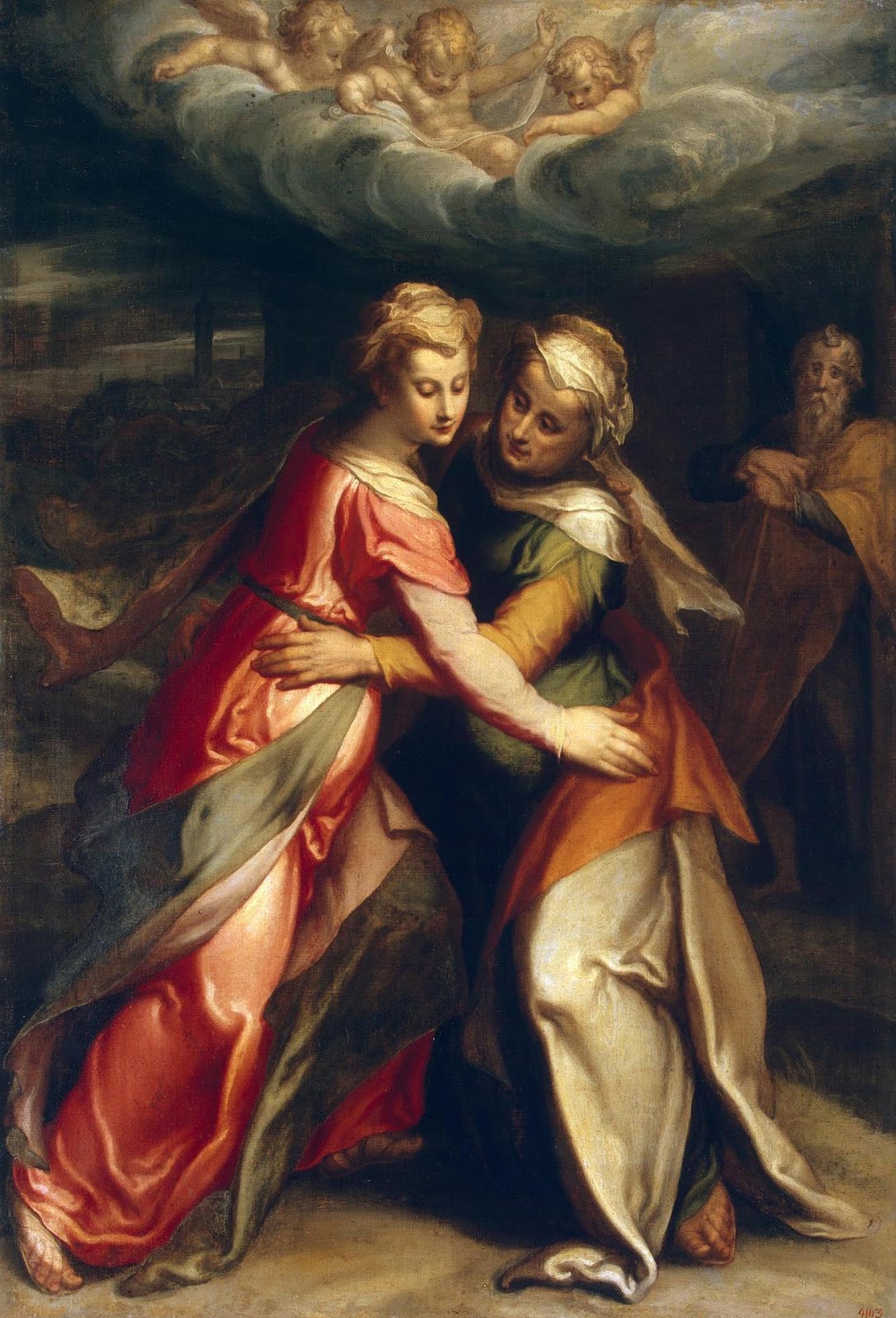
Visitation
ca. 1550
oil on canvas
Hermitage, Saint Petersburg

"And the Angel answered and said unto her, The Holy Ghost shall come upon thee, and the power of the Highest shall overshadow thee: therefore also that holy thing which shall be born of thee shall be called the Son of God. And, behold, thy cousin Elisabeth, she hath also conceived a son in her old age: and this is the sixth month with her, who was called barren. For with God nothing shall be impossible. And Mary said, Behold the handmaid of the Lord; be it unto me according to thy word. And the angel departed from her. And Mary arose in those days, and went in to the hill country with haste, into a city of Juda; and entered into the house of Zacharias, and saluted Elisabeth. And it came to pass, that, when Elisabeth heard the salutation of Mary, the babe leaped in her womb; and Elisabeth was filled with the Holy Ghost: and she spake out with a loud voice, and said, Blessed art thou among women, and blessed is the fruit of thy womb. And whence is this to me, that the mother of my Lord should come to me? For, lo, as soon as the voice of thy salutation sounded in mine ears, the babe leaped in my womb for joy."

– from the Gospel of Luke, translated into English in 1611

Paris Bordone
Holy Family with St Catherine
1520-22
oil on canvas
Hermitage, Saint Petersburg

Catharina van Hemessen
Self-portrait
1548
oil on canvas
Hermitage, Saint Petersburg

Lorenzo Lotto
Madonna della Grazie
before 1556
oil on canvas
Hermitage, Saint Petersburg

Palma il Vecchio
Portrait of a man
ca. 1512-15
oil on canvas
Hermitage, Saint Petersburg

Ridolfo Ghirlandaio
Holy Family with St John the Baptist
16th century
oil on panel
Hermitage, Saint Petersburg

Giorgione
Judith
1504
oil on canvas
Hermitage, Saint Petersburg

Paolo Veronese
Lamentation
ca. 1576-82
oil on canvas
Hermitage, Saint Petersburg

Garofalo
Allegory of Old and New Testaments
ca. 1528-31
oil on canvas
Hermitage, Saint Petersburg

Garofalo
Christ Carrying the Cross, with St Veronica
ca. 1528-31
oil on canvas
Hermitage, Saint Petersburg

Palma il Giovane
St Sebastian
1590s
oil on canvas
Hermitage, Saint Petersburg

Adam Elsheimer
St Christopher
1598-99
oil on copper
Hermitage. Saint Petersburg

Jacopo Tintoretto
Birth of St John the Baptist
1550s
oil on canvas
Hermitage, Saint Petersburg