Showing posts sorted by relevance for query JUDAS. Sort by date Show all posts

Tuesday, August 13, 2019

François-Joseph Heim (1787-1865) - Académie Painter

François-Joseph Heim
Theseus, vanquisher of the Minotaur
1807
oil on canvas
École des Beaux-Arts, Paris

François-Joseph Heim - Born near Belfort in 1787, died in Paris in 1865.  This clever painter commenced work when eight years old and gained the first prize for drawing in Strasbourg before he was eleven.  He was a pupil of François-André Vincent in 1803, his people having sent him to Paris to receive the best instruction they could afford.  In 1807 he won a prize at the Académie with a picture of Theseus and the Minotaur [above], and a travelling scholarship with which he went to Rome.  On his return to Paris he carried off the gold medal at the Académie, became a full member in 1829, and a professor in 1831.  He was appointed painter to the Institut de France and exhibited over sixty portraits of members, the drawings for which are now in the Louvre.  His historical and religious paintings were very attractive. 

– excerpted from the Catholic Encyclopedia (1907-1914)

François-Joseph Heim
Victory of Judas Maccabeus
1809
drawing
private collection

François-Joseph Heim
The Bloody Robe of Joseph brought to Jacob
1817
oil on canvas
Musée du Louvre

François-Joseph Heim
Study for The Sack of Jerusalem by the Romans
1824
oil on canvas
Jewish Museum, New York

François-Joseph Heim
The Sack of Jerusalem by the Romans
1824
oil on canvas
Metropolitan Museum of Art, New York

François-Joseph Heim
Study for Portrait of M. de Gestin
ca. 1822
drawing
Morgan Library, New York

François-Joseph Heim
Madame Adélaїde
(Princess Adélaїde d'Orléans, 1777-1847)
drawing made ca. 1835
heliogravure by Jules-Adolphe Chauvet made ca. 1890
British Museum

François-Joseph Heim
Vesuvius receiving from Jupiter the Fire which will consume Herculaneum, Pompeii and Stabies
1826
oil on panel, installed on the ceiling of the Gallery of Charles X
Musée du Louvre

François-Joseph Heim
Vesuvius receiving from Jupiter the Fire which will consume Herculaneum, Pompeii and Stabies
1826
oil on panel, installed on the ceiling of the Gallery of Charles X
Musée du Louvre

François-Joseph Heim
King Charles X distributing Awards to Artists at the Close of the Salon of 1824
1827
oil on canvas
Musée du Louvre

François-Joseph Heim
King Louis-Philippe opening the Galerie des Batailles, Versailles
1837
oil on canvas
Château de Versailles

François-Joseph Heim
Study for The Martyrdom of St Hippolytus
before 1865
oil on canvas
Metropolitan Museum of Art, New York

François-Joseph Heim
Study for The Toilette of Venus
before 1865
drawing
British Museum

François-Joseph Heim
Battle Scene
before 1865
drawing
Metropolitan Museum of Art, New York

François-Joseph Heim
Defeat of the Cimbri and the Teutons by Marius
ca. 1853
oil on canvas
Harvard Art Museums

Thursday, November 7, 2019

Renaissance and Mannerist Drawings (Sixteenth Century)

Giovanni Agostino da Lodi
St John the Baptist
ca. 1500
drawing
Getty Museum, Los Angeles

Cesare da Sesto
The Swooning Virgin supported by Three Holy Women,
and Three Studies of Men (recto)

ca. 1510
drawing
Getty Museum, Los Angeles

Cesare da Sesto
St George and the Dragon
(verso of The Swooning Virgin)

ca. 1510
drawing
Getty Museum, Los Angeles

attributed to Polidoro da Caravaggio
Study of a Statue of Pan
ca. 1520-30
drawing
Minneapolis Institute of Art

Jacopo Pontormo
Christ before Pilate
1522-23
drawing
Art Institute of Chicago

Giulio Romano
Head of Bearded Man
ca. 1530
drawing
Art Institute of Chicago

Pordenone
God the Father supported by Angels
ca. 1530
drawing
Detroit Institute of Arts

The Argument

On the way to the village store
I drive through a down-draft
from the neighbor's chimney.
Woodsmoke tumbles from the eaves
backlit by sun, reminding me
of the fire and sulfur of Grandmother's
vengeful God, the one who disapproves
of jeans and shorts for girls,
dancing, strong waters, and adultery.

A moment later the smoke enters
the car, although the windows are tight,
insinuating that I might, like Judas,
and the foolish virgins, and the rich
young man, have been made for unquenchable
fire. God will need something to burn
if the fire is to be unquenchable.

"All things work together for the good
for those who love God," she said
to comfort me at Uncle Hazen's funeral,
where Father held me up to see
the maroon gladiolus that trembled
as we approached the bier, the elaborate
shirred satin, brass fittings, anything,

oh, anything but Uncle's squelched
and made-up face.
"No! NO! How is it good to be dead?"
I cried afterward, wild-eyed and flushed.
"God's ways are not our ways,"
she said then out of pity
and the wish to forestall the argument.

– Jane Kenyon (1993)

Parmigianino
Portrait of Bearded Man (possibly poet Giorgio Anselmi)
ca. 1530-35
drawing
Metropolitan Museum of Art, New York

follower of Michelangelo
Anatomical Study of Leg 
ca. 1540-50
drawing
Art Institute of Chicago

Marco Pino
Battle of Nude Men
ca. 1545-50
drawing
Los Angeles County Museum of Art

Baccio Bandinelli
First Family before a Shelter
1547-48
drawing
(formerly in the collection of Everhard Jabach)
Art Institute of Chicago

Giuseppe Salviati
Cloelia fleeing from the Etruscan King Porsena
ca. 1550-60
drawing
National Galleries of Scotland

Federico Zuccaro
St Catherine in Prison converting the Empress Faustina
flanked by St Saturnius and St Simon

ca. 1570-71
drawing
(modello for fresco)
Art Institute of Chicago

follower of Luca Cambiaso
Abduction of Dejanira by the Centaur Nessus
ca. 1575
drawing
Art Institute of Chicago

Monday, July 27, 2026

Visual Preferences (20th Century: 1941)

Anonymous Artist
Know the Facts!
1941
screenprint (WPA poster)
Art Institute of Chicago

Robert Brackman
Portrait of arts patron Abby Aldrich Rockefeller
1941
oil on canvas
Art Museums of Colonial Williamsburg, Virginia

Mstislav Dobuzhinsky
Stage Design for Ballet Imperial by George Balanchine
1941
watercolor on paper
McNay Art Museum, San Antonio, Texas

Max Ernst
Day and Night
1941
oil on canvas
Menil Collection, Houston

William Austin Kienbusch
Interior - Studio
1941
oil on canvas
Portland Museum of Art, Maine

Henri Matisse
Woman with Drawing
1941
drawing
Nasher Museum of Art, Durham, North Carolina

Guillermo Meza
Adam and Eve
1941
oil on canvas
Blanton Museum of Art, Austin, Texas

Pablo O'Higgins
Judas
1941
watercolor on paper
Dallas Museum of Art

Pablo Picasso
Seated Woman
1941
oil on canvas
Pinakothek der Moderne, Munich

Eric Ravilious
Shelling by Night
1941
watercolor on paper
Tate Britain

Anton Refregier
Building the Mission Dolores - 1776
1941
watercolor and tempera on board
(competition design for Rincon Annex mural, San Francisco)
Loeb Art Center, Vassar College, Poughkeepsie, New York

Anton Refregier
Building the Golden Gate Bridge - 1933
1941
watercolor and tempera on board
(competition design for Rincon Annex mural, San Francisco)
Loeb Art Center, Vassar College, Poughkeepsie, New York

William Roberts
The Control Room
1941
oil on canvas
Salford Museum and Art Gallery, Manchester

Miklós Suba
York Street / Flint Street Corner (House in Shadow)
1941
oil on panel
McNay Art Museum, San Antonio, Texas

Graham Sutherland
Devastation 1941 - East End - Burnt Paper - Warehouse
1941
gouache and pastel on paper
Tate Britain

Jacques Villon
Caliban
1941
drypoint
Clark Art Institute, Williamstown, Massachusetts

from Academic Graffiti

George Herbert
Once tried ordering sherbet
On Salisbury Plain:
He ordered in vain.

          *          *          *

Sir Rider Haggard
Was completely staggered
When his bride-to-be
Announced, "I AM SHE!"

          *          *          *

Thomas Hardy
Was never tardy
When summoned to fulfill
The Immanent Will.

          *          *          *

No one could ever inveigle
Georg Wilhelm Friedrich Hegel
Into offering the slightest apology
For his Phenomenology.

          *          *          *

When Karl Marx
Found the phrase "financial sharks,"
He sang a Te Deum
In the British Museum.

          *          *          *

Mr. Robert Liston
Used his saw like a piston:
He was that elated
When he amputated.

– W.H. Auden (1952-70)

Wednesday, November 2, 2016

Contemporary Opinion about Ludovico Carracci

Ludovico Carracci
St Jerome translating the Bible
1591
oil on canvas
Chiesa di San Martino Maggioire, Bologna

"Ludovico was more prolific and fertile in invention, far surpassing the other two, and for this reason they would turn to him when there was a need, for he was always able to think up dozens of variations on a single idea. Furthermore, his way of painting was bolder and more resolute, whereas neither Agostino nor Annibale in his later years was ever satisfied with a work, and would keep returning to it and correcting it. Ludovico surpassed everyone in depicting hands and feet, and made them so technically perfect, and so graceful, whatever the pose or view, that I am emboldened to say that no other master has ever matched him, which explains why the phrase the beautiful hands of Ludovico has become a byword in every school of painting. No one was better than Ludovico at discovering the poses that were most perfectly suited and particular to the action that was being represented, so that if someone attempted to come up with a variation, a better one could not be found. See for instance the majestic gesture with which Saint Jerome, in the altarpiece in S. Martino Maggiore [above], brandishes his quill as he asks for divine inspiration, his noble head turned to the heavens, and his left hand resting on his open book, a pose that Guido in his sketches tried in vain to vary in many different ways but always fell back upon in the end ..."

– from The Life of the Carracci by Carlo Cesare Malvasia, originally published in Italian in 1678, translated into English in 2000 with commentary by Anne Summerscale (Pennsylvania State University Press)

Ludovico Carracci
St Sebastian thrown into the Cloaca Maxima
ca, 1612

drawing
Louvre

Ludovico Carracci
St Sebastian thrown into the Cloaca Maxima
1612
oil on canvas
Getty Museum, Los Angeles

Ludovico Carracci
Alexander and Thais burning Persepolis
ca. 1592
drawing
National Gallery of Art, Washington DC

Luodvico Carracci
Alexander and Thais burning Persepolis
ca. 1592
fresco
Palazzo Francia, Bologna

And the King seized a flambeau with zeal to destroy
Thais led the way,
To light him to his prey,
And, like another Helen, fir'd another Troy.                                 

– from Alexander's Feast, or, The Power of Music : an ode in honor of St Cecilia's Day, 1697 by John Dryden

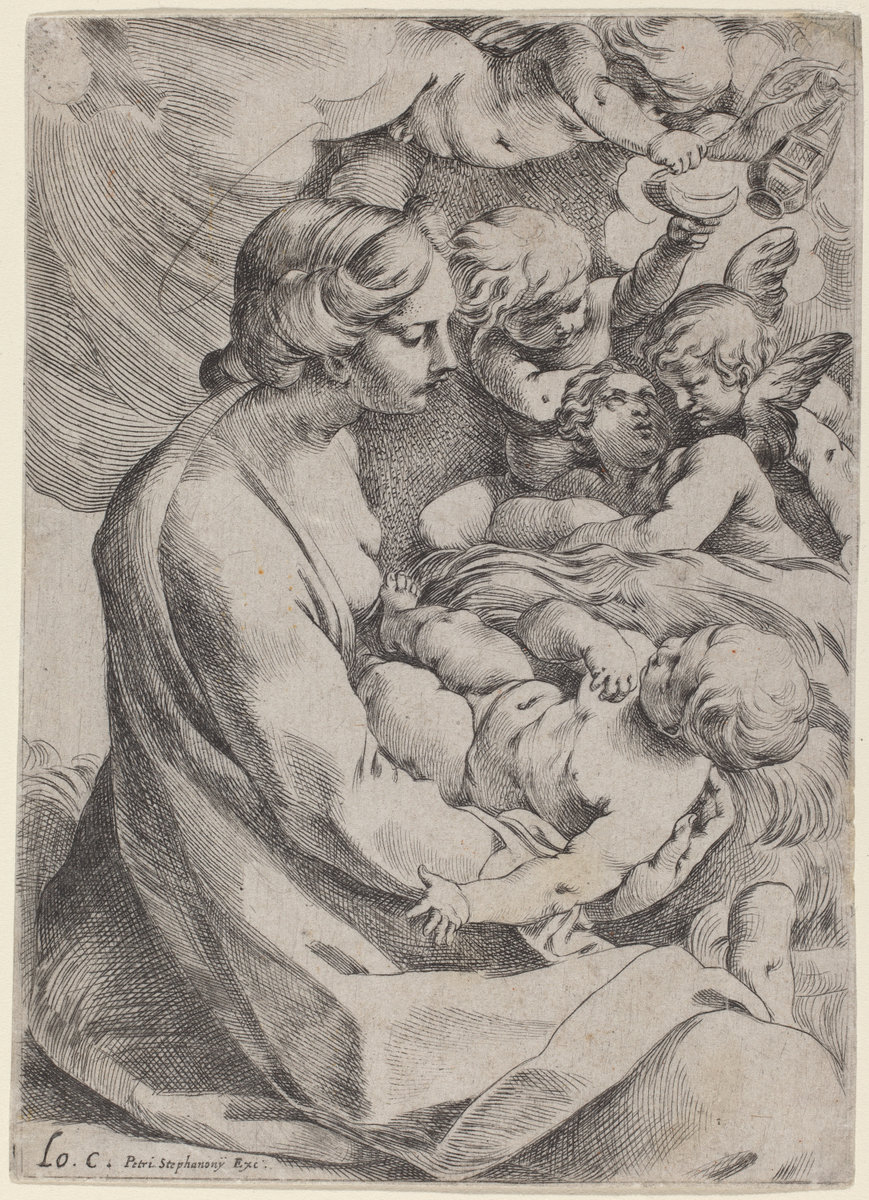
Ludovico Carracci
Madonna & Child with Angels
ca. 1595-1610
drawing
British Museum

Ludovico Carracci
Madonna & Child with Angels
ca. 1595-1610
etching , engraving
National Gallery of Art, Washington DC

Ludovico Carracci
Portrait of an old woman
ca. 1590
oil on canvas
Palazzo d'Accursio, Bologna

Ludovico Carracci
Portrait of a widow
1588-89
oil on canvas
private collection

Ludovico Carracci
Birth of the Virgin
1605-07
oil on canvas
Pinacoteca Nazionale di Bologna

Ludovico Carracci
Kiss of Judas
1589-90
oil on canvas
Princeton University Art Museum

Ludovico Carracci
St Peter in penitence 
ca. 1613
oil on canvas
private collection

Ludovico Carracci
The Crowning with Thorns
1595
oil on canvas
Pinacoteca Nazionale di Bologna

Ludovico Carracci
The Trinity with the Dead Christ
ca. 1590
oil on canvas
Pinacoteca Vaticana

Ludovico Carracci
Ascension
1597
oil on   canvas
Chiesa di Santa Cristina, Bologna
 
Ludovico Carracci
Paradiso
1616
oil on canvas
Chiesa di San Paolo Maggiore, Bologna

Among music-making angels in Ludovico'a painted vision of Paradise (above) there is a partly-shaded figure in blue at upper left reaching out with clashing cymbals. At lower right, an angel in white prepares to play a flute while his neighbor sends a divine column of air into the workings of a slide trombone.