Showing posts with label 1890s. Show all posts

Sunday, February 25, 2024

Visual Relics (1890-1900)

Käthe Kollwitz
Self Portrait
ca. 1891-92
drawing
Art Institute of Chicago

Adolph Menzel
Study of a Woman
1893
drawing
Cleveland Museum of Art, Ohio

Simeon Solomon
The Moon and Sleep
1894
oil on canvas
Tate Gallery

Jean Delville
The Age of Splendor
1894
oil on canvas
Musée Fin-de-Siècle, Brussels

Pierre Bonnard
La Revue Blanche (cover)
1894
lithograph
Milwaukee Art Museum

James Ensor
The Cathedral
1896
hand-colored etching
Milwaukee Art Museum

Paul-César Helleu
Madame Marthe Letellier
1895
pastel on canvas
Minneapolis Institute of Art

Edgar Degas
After the Bath
1896
pastel
Getty Museum, Los Angeles

Alphonse Mucha
Sarah Bernhardt
in Lorenzaccio by Alfred de Musset,
Théâtre de la Renaissance

ca. 1896
lithograph
Cleveland Museum of Art, Ohio

Alphonse Mucha
Zodiaque (La Plume)
1896-97
lithograph
Art Institute of Chicago

Alphonse Mucha
Sarah Bernhardt in
Ilsee, Princesse de Tripoli

by Edmond Rostand
1897
lithograph
Cleveland Museum of Art, Ohio

Alphonse Mucha
Papier JOB Cigarette
1898
lithograph
Nelson-Atkins Museum of Art,
Kansas City, Missouri

Alphonse Mucha
Study of Sarah Bernhardt
ca. 1898
drawing
Art Institute of Chicago

Maximilien Luce
Country Scene with Three Houses and Trees
ca. 1900
oil on canvas
Yale University Art Gallery

Odilon Redon
Vase of Flowers
ca. 1900
pastel
Milwaukee Art Museum

John Frederick Peto
Books on a Table
ca. 1900
oil on canvas
Nelson-Atkins Museum of Art, Kansas City, Missouri

But then Aeneas' pain, unmerited,
distresses Venus; with a mother's care
she plucks – from Cretan Ida – dittany, 
a stalk with leaves luxuriant and shaggy
and purple flowers, a plant not unfamiliar
to wild goats when they are wounded by winged arrows.
This, Venus, with black mist to hide her face,
now carries down; with this she medicates
in secret, waters poured in gleaming vats;
she steeps the plant and sprinkles healing juices
of scented panacea and ambrosia.
And old Iapyx, unaware of this,
then bathes Aeneas' wound with that same liquid.
And suddenly all pain fled from his body,
and all the blood held fast in that deep wound;
and following Iapyx' hand, the arrow,
unforced, fell out; fresh strength returned to him.

– Venus magically heals Aeneas, from Book XII of Virgil's Aeneid, translated by Allen Mandelbaum (1971)

Friday, November 24, 2023

Visual Relics (1892-1899)

Emily K. Herron
Jeff
ca. 1893
cyanotype
Chrysler Museum of Art, Norfolk, Virginia

Charles Porter Brown 
Composite Portrait
ca. 1894
gelatin silver print
Los Angeles County Museum of Art

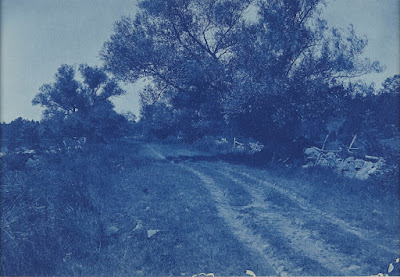
Arthur Wesley Dow
Landscape
ca. 1895
cyanotype
Princeton University Art Museum

Frederick H. Evans
Lincoln Cathedral - Stairway in S.W. Turret
1895
platinum print
Chrysler Museum of Art, Norfolk, Virginia

Frederick H. Evans
Kelmscott Manor - In the Attics
ca. 1896
platinum print
Chrysler Museum of Art, Norfolk, Virginia

Frederick H. Evans
Lincoln Cathedral from the Castle
1898
platinum print
Chrysler Museum of Art, Norfolk, Virginia

F. Holland Day
Beauty is Truth, Truth Beauty
ca. 1896-97
photogravure
Art Institute of Chicago

F. Holland Day
Head of Christ
1898
platinum print
Art Institute of Chicago

Thomas Eakins
Portrait of Jennie Dean Lershaw
ca. 1897
platinum print
Princeton University Art Museum

Thomas Eakins
Cook Cousins in Classical Costumes,
Eakins's Chestnut Street Studio, Philadelphia

ca. 1892
platinum print
Getty Museum, Los Angeles

Lumière Brothers
Gold Bangles set with Gems
ca. 1898
autochromes (stereograph)
Getty Museum, Los Angeles

Wilhelm von Gloeden
Untitled (Girl posed as Madonna)
ca. 1898
albumen print
Chrysler Museum of Art, Norfolk, Virginia

Wilhelm von Gloeden
Youth posed with Classical Props on a Bank, Taormina
ca. 1898
albumen print
Chrysler Museum of Art, Norfolk, Virginia

Frank Eugene
Portrait of Miss Jones
1899
platinum print
Art Institute of Chicago

Herbert Arthur Hess
In Arcadia
1899
platinum print
Princeton University Art Museum

Alphonse Mucha
Model wearing Tiara
ca. 1899
gelatin silver print
Getty Museum, Los Angeles

from Castles and Distances

         From blackhearted water colder
Than Cain's blood, and aching with ice, from a gunmetal bay
   No one would dream of drowning in, rises
   The walrus: head hunched from the oxen shoulder,
      The serious face made for surprises
         Looks with a thick dismay

         At the camera lens which takes
Him in, and takes him back to cities, to volleys of laughter
   In film palaces, just as another, brought
   By Jonas Poole to England for the sakes
      Of James the First and his court, was thought
         Most strange, and died soon after.

– Richard Wilbur (1950)

Sunday, October 10, 2021

Georges de Feure (Fin de Siècle Paris)

Georges de Feure
Fonty - Concert Européen - Tous les Soirs
1890
lithograph (poster)
Bibliothèque Nationale, Paris

Georges de Feure
La Dépêche
1902
lithograph (poster)
Bibliothèque Nationale, Paris

Georges de Feure
Salon des Cent
1895
lithograph (poster)
Bibliothèque Nationale, Paris

Georges de Feure
Jane Derval - Folies Bergère
1904
lithograph (poster)
Bibliothèque Nationale, Paris

Georges de Feure
La Loїe Fuller
dans sa création nouvelle, Salomé

1895
lithograph (poster)
Bibliothèque Nationale, Paris

Georges de Feure
Marjolaine
1896
lithograph (poster)
Bibliothèque Nationale, Paris

Georges de Feure
Paris-Almanach
1894
lithograph (poster)
Bibliothèque Nationale, Paris

Georges de Feure
L'Horloge
1894
lithograph (poster)
Bibliothèque Nationale, Paris

Georges de Feure
Edmée Lescot - Casino de Paris
1890
lithograph (poster)
Bibliothèque Nationale, Paris

Georges de Feure
Le Meilleur des Thés
Société des Palais Indiens

1896
lithograph (poster)
Bibliothèque Nationale, Paris

Georges de Feure
La Source du Mal
1894
lithograph
Metropolitan Museum of Art, New York

Georges de Feure
Design for Hallway with Wrought-Iron Details
ca. 1925
watercolor
Metropolitan Museum of Art, New York

Georges de Feure
Designs for Wardrobe, Chair, Bureau and Washstand
ca. 1925
watercolor
Metropolitan Museum of Art, New York

Georges de Feure
Fashion Illustration
1903
watercolor
private collection

Georges de Feure
Le Cirque Corvi
ca. 1893
gouache and watercolor
Clark Art Institute, Williamstown, Massachusetts

"Georges Joseph Van Sluyters, better known as Georges de Feure, was born in Paris in 1868 into a Belgian and Dutch family.  In 1870, during the Franco-Prussian war, the family moved to Amsterdam.  In 1886 De Feure was accepted at the Royal Academy of Fine Arts in Amsterdam, but left in dissatisfaction after a short time and returned to Paris.  In 1890 he settled in Montmartre and became a student of Jules Chéret.  During the next decade De Feure produced a stream of popular lithographic posters, while also painting independently and illustrating books.  In 1903 he mounted retrospective exhibitions in Paris and several other European cities.  After 1910 he began to design sets and costumes for theater productions, as well as jewelry, ceramics, and interiors.  Yet by the time the Great Depression hit, the artist's style had fallen out of fashion, and he descended into poverty, dying in 1943 during the Paris Occupation."

– from biographical notes published by Galerie des Modernes, Paris

Thursday, September 16, 2021

Franz von Stuck (Munich's Painter Prince)

Franz von Stuck
Cover of Pan
1895
lithograph
Universitäts Bibliothek, Heidelberg

Franz von Stuck
The Lost (Faun in Snow)
1891
oil on canvas
Belvedere Palace, Vienna

Franz von Stuck
Expulsion from Paradise
ca. 1890
oil on canvas
Musée d'Orsay, Paris

Franz von Stuck
Pietà
1891
oil on canvas
Städel Museum, Frankfurt

Franz von Stuck
Chasse Fantastique
1890
oil on canvas
Villa Stuck, Munich

Franz von Stuck
Mermaid
1891
oil on panel
private collection

Franz von Stuck (designer)
Dancers
1897-98
bronze relief
Villa Stuck, Munich

Franz von Stuck
Self Portrait in the Studio
1905
oil on canvas
Alte Nationalgalerie, Berlin

Franz von Stuck
The Walk
1903
oil on canvas
Museum Georg Schäfer, Schweinfurt

Franz von Stuck
The Seesaw
1898
oil on canvas
Villa Stuck, Munich

Franz von Stuck
The Struggle for Woman
1905
oil on panel
Hermitage, Saint Petersburg

Franz von Stuck
Salome
1906
oil on canvas
Lenbachhaus, Munich

Franz von Stuck
The Sin
1893
oil on canvas
Neue Pinakothek, Munich

Franz von Stuck
The Sin
1912
oil on canvas
Alte Nationalgalerie, Berlin

Franz von Stuck
The Sin (detail)
1912
oil on canvas
Alte Nationalgalerie, Berlin

"Though he was a professor at Munich's Akademie der Bildenden Künste, the art of Franz von Stuck marked a departure from both the Academic and Realist styles that had dominated European art during the second half of the 19th century.  "When choosing my subject matter, I seek to render only the purely human, the eternally valid," said the artist in an interview in 1912, and overarching themes of Stuck's work include preoccupations with love, lust, violence and chaos, often explored through a mythological or allegorical lens.  . . .  A founder-member of Munich's Secession, the city's premier avant-garde artists' association, in 1892, Stuck's career bridged the progressive and official sides of Munich's art world.  His success during the 1890s and first decade of the new century was such that he was able to construct a palatial villa in Munich, which is now a museum dedicated to his work.  . . .  Though by the beginning of the First World War Stuck's signature style would come to be regarded as excessive and vulgar, his interest in extreme emotional states and his expressive manipulation of color, space, and form were eminently modern.  . . .  For much of the last century art historians disregarded Stuck's work, and Symbolism generally, as an aberration in the narrative which connects 19th and 20th century painting, but recent studies have finally begun to acknowledge the innovation and importance of Munich's "painter prince" in the development of modern art."

– from a biographical sketch published by Christie's, London