Showing posts with label Athens. Show all posts

Friday, August 11, 2023

At Home and Abroad with Girault de Prangey

Joseph-Philibert Girault de Prangey
Autoportrait
1840
daguerreotype
Getty Museum, Los Angeles

Joseph-Philibert Girault de Prangey
Portrait of a Woman holding a Flower
1842
daguerreotype
Metropolitan Museum of Art, New York

Joseph-Philibert Girault de Prangey
Portrait of Mme Annette Langerrois
ca. 1842-44
daguerreotype
Bibliothèque nationale de France

Joseph-Philibert Girault de Prangey
Portrait of Two Women
ca. 1842-55
daguerreotype
Bibliothèque nationale de France

Joseph-Philibert Girault de Prangey
Study of a Tree
1841
daguerreotype
Bibliothèque nationale de France

Joseph-Philibert Girault de Prangey
Cedars of Lebanon
1844
daguerreotype
Bibliothèque nationale de France

Joseph-Philibert Girault de Prangey
Cathédrale Notre Dame, Paris
1841
daguerreotype
Bibliothèque nationale de France

Joseph-Philibert Girault de Prangey
At Sea, on board the ship Le Chaillé
ca. 1842-43
daguerreotype
Bibliothèque nationale de France

Joseph-Philibert Girault de Prangey
Arch of Constantine, Rome
1842
daguerreotype
private collection

Joseph-Philibert Girault de Prangey
Reliefs at Base, Arch of Constantine, Rome
1842
daguerreotype
private collection

Joseph-Philibert Girault de Prangey
Ponte Rotto, Rome
1842
daguerreotype
Metropolitan Museum of Art, New York

"When Girault photographed the Ponte Rotto, the oldest stone bridge in Rome, only two of its original five arches remained standing, and locals used it as a fishing pier. Built over the Tiber [as the Pons Aemilius] in the second century BC, it had suffered serious damage from generations of flooding.  At the end of the nineteenth century one of the arches was demolished [the perpetrators of that atrocity now slowly roasting in Hell] to make room for a new bridge, leaving the single arch that survives today." 

Joseph-Philibert Girault de Prangey
Temple of Castor and Pollux, Rome
1842
daguerreotype
Metropolitan Museum of Art, New York

Joseph-Philibert Girault de Prangey
Vase, Basilica di Santa Cecilia in Trastevere, Rome
1842
daguerreotype
Metropolitan Museum of Art, New York

Joseph-Philibert Girault de Prangey
Temple of Artemis, Sardis
1843
daguerreotype
Getty Museum, Los Angeles

Joseph-Philibert Girault de Prangey
Greco-Roman Theater Capital, Miletus
1843
daguerreotype
Metropolitan Museum of Art, New York

Joseph-Philibert Girault de Prangey
Caryatid on the Erechtheum, Athens
1842
daguerreotype
Metropolitan Museum of Art, New York

Joseph-Philibert Girault de Prangey
Temple of Olympian Zeus, Athens
1842
daguerreotype
private collection

Joseph-Philibert Girault de Prangey never exhibited his pioneering daguerreotypes, nor, dying without heirs, did he make any provision for their survival.  Most of the small metal plates, stored in small wooden boxes, lingered in his abandoned villa until their accidental discovery decades later by a neighboring landowner.  The majority are now in public institutions, but the example directly above, dating from the artist's 1842 sojourn in Athens, made its way to auction in 2003.  At that time, with the fame of Girault at last established, it commanded a hammer price of $922,488.      

Wednesday, July 5, 2023

Pictures of the Built World

Richard Phené Spiers
The Propylaea, Athens
ca. 1880
watercolor on paper
Royal Academy of Arts, London

Jean-Pierre Hoüel
Ruins of the Temple of Concord at Agrigento
ca. 1776
gouache on paper
Musée du Louvre

Anonymous Photographer
Catherine Gide with her father André Gide at Paestum
1950
photograph
Fondation Catherine Gide, Olten, Switzerland

John Aldridge
Palazzo San Boldo, Venice
1963-64
oil on canvas
Royal Academy of Arts, London

Michele Marieschi
Capriccio with Obelisk and Gothic Edifice
ca. 1740-45
oil on canvas
Gallerie dell'Accademia, Venice

James Holland
Venice - Narrow Canal
ca. 1840-50
oil on panel
The Potteries Museum and Art Gallery,
Stoke-on-Trent

Wilfrid De Glehn
Venetian Doorway
1913
oil on canvas
private collection

Jean-Baptiste Lallemand
Arch of Constantine and the Colosseum, Rome
ca. 1750
drawing
Musée du Louvre

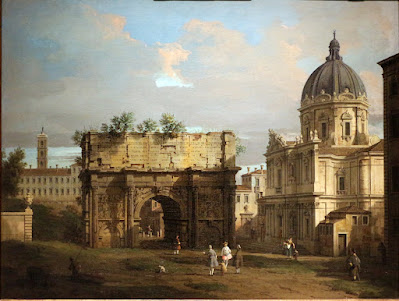
Canaletto
Arch of Septimius Severus, Rome
ca. 1743
oil on canvas
Cincinnati Art Museum, Ohio

Charles Michel-Ange Challe
Architectural Capriccio with the Roman Pantheon
ca. 1742-49
drawing
Musée du Louvre

Ferdinando Partini
View of the Pantheon, Rome
1794
oil on canvas
Metropolitan Museum of Art, New York

Hubert Robert
Bathers
ca. 1785
oil on canvas
Cincinnati Art Museum, Ohio

Jenaro Pérez-Villaamil
Seville Cathedral
1835
oil on canvas
Fundación Banco Santander, Madrid

Joseph Mallord William Turner
Durham Cathedral
1798-99
watercolor
Royal Academy of Arts, London

William Strudwick
Water Gate of York House, London
before 1882
carbon print
Royal Academy of Arts, London

Charles Maresco Pearce
Le pavillon bleu
1926
oil on canvas
Ferens Art Gallery, Kingston upon Hull

Estrangement in Athens

Mount Olympus held nothing for them.
No occasion of theirs could provoke
Magniloquent debate. Nor act require
That attic of gods to come swooping
Onto the field, swaying the battle.
Only the great booming of the ferry
As it shouldered alongside the pier;
Only the waitress counting their
Saucers: it was this April morning
That swung them by their heels.
What was missing was the impersonal,
The fated, a visionary marble address,
The goddess skimming over blue water
To whisper good news, or some stud,
Swan, or bull brimming with light.
Not a wingèd foot. Only Love,
Recently decamped, hovered above
The table, ready to be splendid.
But their ten years' war had ended.

– Brian Culhane (2008)

Sunday, September 19, 2021

Themistocles von Eckenbrecher (Athenian Ruins)

Themistocles von Eckenbrecher
Athens – Acropolis
1890
drawing
National Gallery of Art, Washington DC

Themistocles von Eckenbrecher
Athens – Acropolis from the West
1890
drawing
National Gallery of Art, Washington DC

Themistocles von Eckenbrecher
Athens – Temple of Hyphaestus 
1890
drawing
National Gallery of Art, Washington DC

Themistocles von Eckenbrecher
Athens – Parthenon from the East
1890
drawing
National Gallery of Art, Washington DC

Themistocles von Eckenbrecher
Athens – Parthenon Interior
1890
drawing
National Gallery of Art, Washington DC

Themistocles von Eckenbrecher
Athens – Propylaeum
1890
drawing
National Gallery of Art, Washington DC

Themistocles von Eckenbrecher
Athens – Propylaeum from the East
1890
drawing
National Gallery of Art, Washington DC

Themistocles von Eckenbrecher
Athens – Erechtheion
1890
drawing
National Gallery of Art, Washington DC

Themistocles von Eckenbrecher
Athens – Temple of Nike
1890
drawing
National Gallery of Art, Washington DC

Themistocles von Eckenbrecher
Athens – Temple of Olympian Zeus
1890
drawing
National Gallery of Art, Washington DC

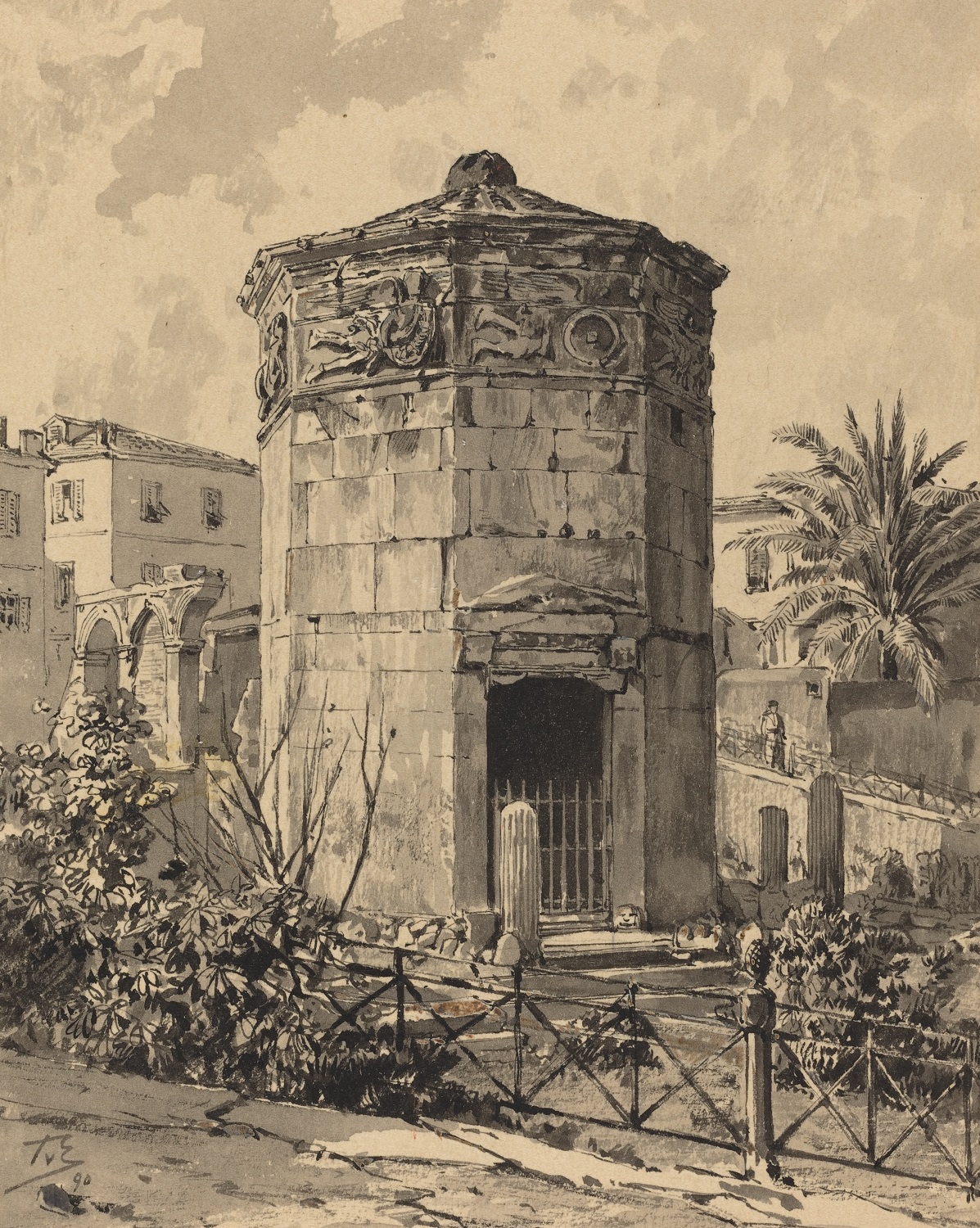
Themistocles von Eckenbrecher
Athens – Tower of Winds
1890
drawing
National Gallery of Art, Washington DC

Themistocles von Eckenbrecher
Athens – Hadrian's Arch
1890
drawing
National Gallery of Art, Washington DC

Themistocles von Eckenbrecher
Athens – Monument of Philopappos
1890
drawing
National Gallery of Art, Washington DC

Themistocles von Eckenbrecher
Athens – Market Gate
1890
drawing
National Gallery of Art, Washington DC

Themistocles von Eckenbrecher
Athens – Monument of Lysicrates
1890
drawing
National Gallery of Art, Washington DC

"Karl Paul Themistocles von Eckenbrecher was a German landscape and marine artist active in the late 19th and early 20th centuries.  Born to a German father and Italian mother while they were traveling in Athens, he was largely schooled by private tutors, as they traveled and moved often. The family eventually moved to Düsseldorf, where von Eckenbrecher was able to study with noted professor of landscape painting Oswald Achenbach."

– from a biographical sketch published by Pictorem, Montreal

Saturday, December 28, 2019

Athenian Artifacts / Scenery Reproduced by Artists

Harry Ralph Ricardo
Study of Ionic Capital from the Temple of Athena Nike, Athens
ca. 1845-47
drawing
British Museum

Harry Ralph Ricardo
Study of Volute from the Portico of the Erechtheum, Athens
ca. 1845-47
drawing
British Museum

Themistocles von Eckenbrecher
View of the Parthenon from the East
1890
drawing
National Gallery of Art, Washington DC

Themistocles von Eckenbrecher
View of the Parthenon from its Interior
1890
drawing
National Gallery of Art, Washington DC

Greek Architecture

Not magnitude, not lavishness,
But Form – the Site;
Not innovating wilfulness,
But reverence for the Archetype.

– Herman Melville (1891)

Jean-Baptiste Carpeaux
Studies of Horses from the Parthenon Pediments
1871
drawing
Getty Museum, Los Angeles

Richard Dalton
Riders from the West Frieze of the Parthenon
1750
drawing
British Museum

Richard Dalton
Riders from the West Frieze of the Parthenon
1750
drawing
British Museum

Richard Dalton
Figures from the West Frieze of the Parthenon
and Surviving Sculpture Fragments on the East Pediment (before removal by Lord Elgin)
1750
drawing
British Museum

Théodore Caruelle d'Aligny
The Acropolis of Athens
1845
etching
Art Institute of Chicago

Finalities

Plunged in fear and suspicions,
with agitated minds and frightened eyes,
we melt, and plan how to act
in order to avoid the certain
danger so frightfully menacing us.
And yet we err, it is not in our paths;
the messages were false alarms,
(or else we did not hear, or fully understand them).
Another catastrophe, that we never imagined,
suddenly, torrentially falls upon us,
and unprepared – there is no more time – carries us off.

– C.P. Cavafy (1911), translated by Rae Dalven (1961)

William Gell
The Parthenon, Athens
1801
drawing
British Museum

Walter Hege
The Erechtheum - Porch of the Maidens
ca. 1928
gelatin silver print
Art Institute of Chicago

Walter Hege
Fragment of Parthenon Frieze - Horsebreaker
ca. 1928-29
gelatin silver print
Art Institute of Chicago

Francis Bedford
Fragments of Parthenon Frieze
ca. 1870
albumen print
National Galleries of Scotland

Dimitrios Constantin
Fragment of Parthenon Frieze
1865
albumen silver print
Getty Museum, Los Angeles