Showing posts with label Caravaggio. Show all posts

Saturday, June 13, 2020

Matthias Stom (ca. 1600-ca. 1650) - Northerner Painting in Italy

Matthias Stom
Adoration of the Magi
ca. 1630-35
oil on canvas
Nationalmuseum, Stockholm

Matthias Stom
Judgment of Solomon
ca. 1640
oil on canvas
Currier Museum of Art, Manchester, New Hampshire

Matthias Stom
King David
ca. 1633-39
oil on canvas
Musée des Beaux-Arts de Marseilles

Matthias Stom
Christ at the Column
ca. 1635
oil on canvas
Rhode Island School of Design Museum, Providence

Matthias Stom
Calling of Matthew
ca. 1629
oil on canvas
Fine Arts Museums of San Francisco
(Palace of the Legion of Honor)

"Few seventeenth-century documents comment on Matthias Stom's life or works. Those contemporary sources that do exist consistently give the artist's name as 'Stom' although he is also traditionally referred to as Matthias Stomer. A reference of 1630-32 records that Matteo Stom, Flemish painter, thirty years old, was living in the parish of San Nicola in Arcione in Rome. From this it can be deduced that Stom was a northern artist, born around 1600, who had established himself in Rome by 1630. His stylistic indebtedness to the art of both the Utrecht Caravaggists (Gerrit van Honthorst, Dirck van Baburen and Hendrick ter Brugghen) and various Antwerp artists suggests that he was born and trained in southern Holland. Later documents, such as the 1648 inventory of the collection of Don Antonio Ruffo, Duke of Messina, place Stom in Sicily, where he seems to have moved permanently sometime after 1632, following a stay of undetermined length in Naples. The hallmark of Stom's art is his personal interpretation of the Caravaggesque idiom. This stylistic vocabulary, learned initially from the Northern followers of Caravaggio and then experienced firsthand in Rome, was further enhanced by Stom's access to the later works of Caravaggio decorating churches in Naples and Sicily."

– adapted from curator's notes at the Fine Arts Museums of San Francisco

Matthias Stom
Adoration of the Shepherds
ca. 1633-39
oil on canvas
Temple Newsam House, Leeds

Matthias Stom
Christ before Annas
ca. 1630-50
oil on canvas
Campion Hall, University of Oxford
 
Matthias Stom
Ecce Homo
ca. 1630-45
oil on canvas
Rijksmuseum, Amsterdam

Matthias Stom
Supper at Emmaus
ca. 1633-39
oil on canvas
Museo Thyssen-Bornemisza, Madrid

Matthias Stom
Christ crowned with Thorns
ca. 1633-39
oil on canvas
Norton Simon Museum, Pasadena

Matthias Stom
Incredulity of Thomas
ca. 1641-49
oil on canvas
Museo del Prado, Madrid

Matthias Stom
Salome receives the Head of John the Baptist
ca. 1630-32
oil on canvas
National Gallery, London

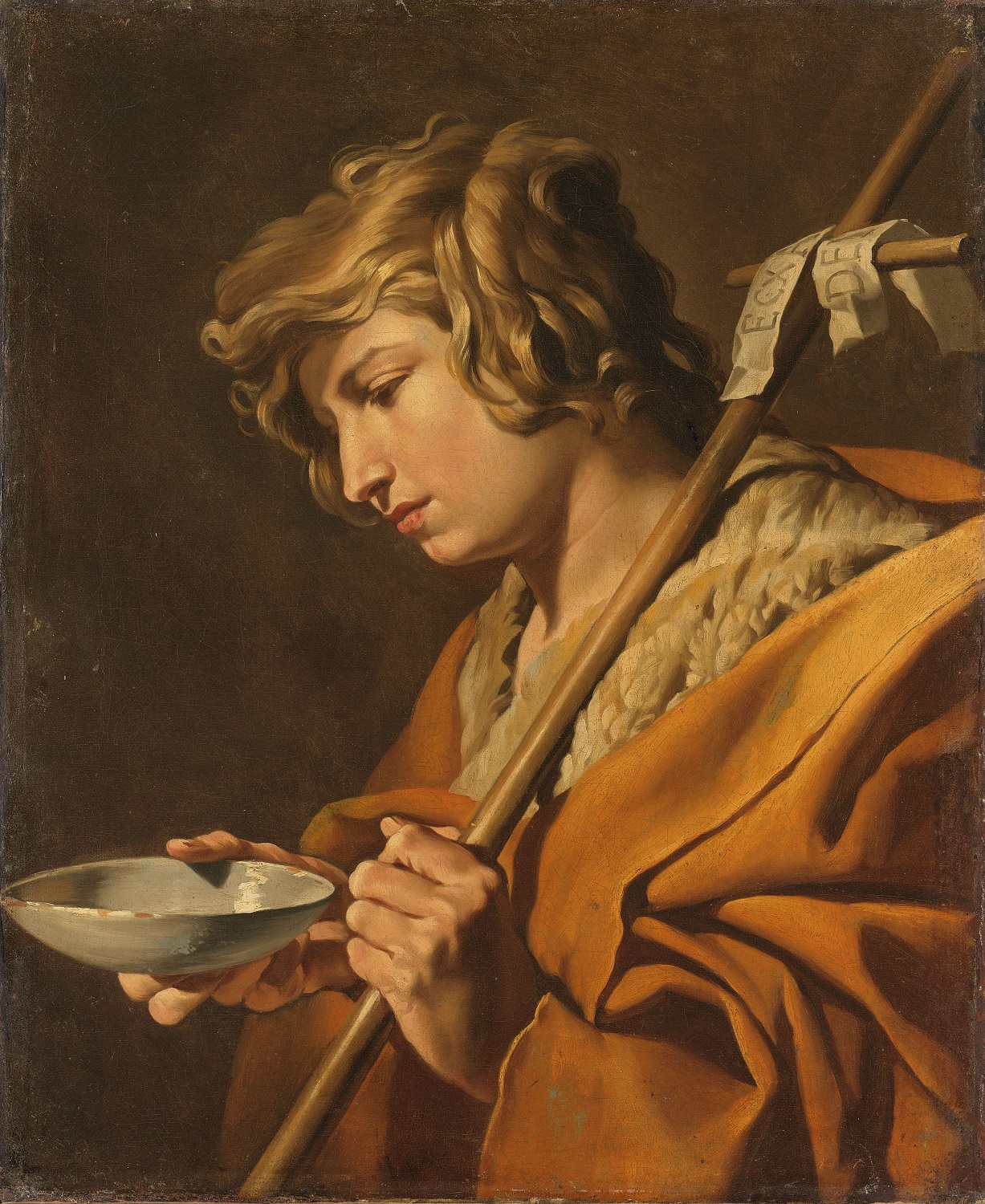
Matthias Stom
St John the Baptist
ca. 1630-45
oil on canvas
Rijksmuseum, Amsterdam
 
Matthias Stom
Judgment of Solomon
ca. 1638-42
oil on canvas
Museum of Fine Arts, Houston

attributed to Matthias Stom
Man with Glass of Wine, Pipe and Fiddle
ca. 1630-50
oil on canvas
National Trust, Kingston Lacy, Dorset

Saturday, April 21, 2018

Posthumous Impact of Caravaggio

Giulio Cesare Procaccini
Raising of the Cross
ca. 1615-20
oil on canvas
National Galleries of Scotland

Marcantonio Bassetti
Dead Christ supported by the Virgin and Mary Magdalene
ca. 1616
oil on black marble (pietra da paragone)
Fitzwilliam Museum, Cambridge

Orazio Borgianni
St Christopher carrying the infant Christ
ca. 1615
oil on canvas
National Galleries of Scotland

"Despite van Mander's disparaging assessment of Caravaggio's bellicose character ("Mars and Venus have never been good friends"), the biographer nevertheless praised the living painter's wondrous manner as "one for our young artists to follow."  Caravaggio [1573-1610] became an international figure worthy of emulation.  His early works were touchstones for artists who visited Rome, from Simon Vouet and Valentin de Boulogne to ter Brugghen and Honthorst.  Rubens, Rembrandt, Ribera, Nicolas Regnier,  Georges de la Tour, and many others responded directly or indirectly to this legacy.  . . .  Today, the scores of Caravaggisti exhibitions and intact princely Roman collections with "tenebristic" paintings covering the walls attest to Caravaggio's impact.  Yet there was also a tremendous critical backlash in Rome after his death.  The emulation of Caravaggio by a generation of young painters became one of the leitmotifs of the criticism waged against Caravaggio by Giulio Mancini, Giovanni Baglione, and Giovan Pietro Bellori in the following decades."

– Todd P. Olson, from Caravaggio's Pitiful Relics (Yale University Press, 2014) 

Hendrick ter Brugghen
Beheading of St John the Baptist
ca. 1617-20
oil on canvas
National Galleries of Scotland

Giovanni Serodine
The Tribute Money
ca. 1620-30
oil on canvas
National Galleries of Scotland

Guercino
Betrayal of Christ
before 1621
oil on canvas
Fitzwilliam Museum, Cambridge

Pietro Novelli
Cain killing Abel
ca. 1625-50
oil on canvas
National Galleries of Scotland

Anonymous Italian painter working in Emilia
Deliverance of St Peter by the Angel
ca. 1625-50
oil on canvas
National Galleries of Scotland

Guido Reni
Joseph and Potiphar's Wife
1625-26
oil on canvas
Fitzwilliam Museum, Cambridge

Jan Lievens
Portrait of a young man in fancy dress
ca. 1631
oil on canvas
National Galleries of Scotland

Francesco Furini
St Sebastian
ca. 1633
oil on canvas
National Galleries of Scotland

Simon Vouet
Entombment
ca. 1635-38
oil on panel
Fitzwilliam Museum, Cambridge

Jan Baptist Weenix
Rest on the Flight into Egypt
ca. 1647-50
oil on canvas
Philadelphia Museum of Art

Jan Miel
Veneration of St Lambert
ca. 1648
oil on canvas (modello for fresco executed in Rome)
Fitzwilliam Museum, Cambridge

Friday, May 12, 2017

Georges de La Tour (1593-1652)

Georges de La Tour
Peasant couple eating peas
ca. 1620-25
oil on canvas
Gemäldegalerie, Berlin

Georges de La Tour
Blind Musician
ca. 1620-30
oil on canvas
Prado, Madrid

"Little is known of Georges de La Tour's life.  By 1620 he was established at the prosperous town of Lunéville, where he specialized in religious and genre scenes.  . . .  La Tour's early mode typifies the Mannerist style of Nancy.  By the 1620s, however, he had come into contact with the art of Caravaggio, probably through prints or paintings by northern artists such as Gerrit van Honthorst and Hendrick ter Brugghen.  Lit by crisp daylight, La Tour's works from this period are characterized by their still atmosphere and meticulous rendering of ornament and textures.

Increasingly, La Tour was drawn to candlelight scenes in which a single flame created an atmosphere of otherworldly calm.  He gradually simplified forms until, in his late works, all masses were reduced to simple, almost geometrical shapes.  After his death, La Tour passed into virtual oblivion for almost three centuries.  In 1915 a German scholar recognized La Tour's style in several pictures that had been variously ascribed to Spanish, Dutch, and other French artists."

– curator's notes from the Getty Museum

Georges de La Tour
The Fortune Teller
1630s
oil on canvas
Metropolitan Museum of Art, New York

Georges de La Tour
The Cheat with the Ace of Clubs
ca. 1630-34
oil on canvas
Kimbell Art Museum, Fort Worth, Texas

Georges de La Tour
St Jerome
1630 35
oil on canvas
Musée de Grenoble

Georges de La Tour
The Musicians' Brawl
ca. 1635-40
oil on canvas
Getty Museum, Los Angeles

Georges de La Tour
St Sebastian tended by St Irene
ca. 1630-35
oil on canvas
Kimbell Art Museum, Fort Worth, Texas

"The style of Caravaggio admits of two different, one can almost say opposite, interpretations.  Some of his followers, particularly the Neapolitans, emphasized the dramatic and horrific qualities in his painting, and adapted the manner to gruesome renderings of martyrdoms in which every unpleasant detail is recorded with fidelity and heightened by chiaroscuro.  La Tour in his mature works seeks in Caravaggio exactly the opposite qualities.  He does not imitate his rendering of detail, and he avoids depiction of the disagreeable details.  Notice, for instance, that in the St Sebastian there is no blood and no anguish; the saint lies motionless and apparently dead, but with hardly a trace of his martyrdom.  The forms are generalized to their greatest simplicity, and all violence, all movement even, are eliminated, so that the picture takes on a quality of stillness and of silence rarely to be found in the visual arts."

 Anthony Blunt, from Art and Architecture in France, 1500-1700, first published in 1953 as part of the Pelican History of Art, revised by Richard Beresford for the 5th edition, published by Yale University Press, 1999

Georges de La Tour
Dream of St Joseph
ca. 1630-45
oil on canvas
Musée des Beaux-Arts de Nantes

Georges de La Tour
Penitent Magdalene
ca. 1635-40
oil on canvas
National Gallery of Art, Washington DC

Georges de La Tour
Penitent Magdalene
ca. 1638-40
canvas
Los Angeles County Museum of Art

Georges de La Tour
Penitent Magdalene
ca. 1640
oil on canvas
Metropolitan Museum of Art, New York

Georges de La Tour
The Newborn
1640s
oil on canvas
Musée des Beaux-Arts de Rennes

Georges de La Tour
St Joseph, carpenter
1640s
oil on canvas
Louvre

Georges de La Tour
Adoration of the Shepherds
ca. 1645
canvas
Louvre

Georges de La Tour
St Thomas
before 1652
oil on canvas
National Museum of Western Art, Tokyo

"A certain number of artists were only rediscovered because of a memorable exhibition held in 1934, titled Les Peintures de la Réalité.  No more eloquent rebuttal could be made of the mistaken idea that all seventeenth-century art involved classical idealization.  It was crucial to recall the existence of an art attentive to everyday life, to poverty, care-worn faces, coarse delights, and humble apathy.  Yet it is impossible to categorize such work as belonging either to the raw Caravaggism that was on the ascendant from Seville to the Netherlands, or to the bambocciate fashionable in France and Italy.  They are, at best, an extension of those trends cast in another light, another nature, another perception  a transposition of familiar objects."

 André Chastel, from French Art: the Ancien Régime, 1620-1775, translated by Deke Dusinberre (Flammarion, 1996)

Saturday, January 21, 2017

Caravaggisti at the Hermitage

Nicolas Régnier
St John the Baptist in the Wilderness
ca. 1615-20
oil on canvas
Hermitage, Saint Petersburg

Curators at the Hermitage in Saint Petersburg place this group of 17th-century Italian paintings within a so-called "Roman School" whose practitioners were committed to the most advanced and adventurous taste, as understood in their day. After the death of Caravaggio in 1610, many Roman artists successfully adapted the same range of pictorial idiosyncracies he had brought into fashion.

Nicolas Régnier
Apollo
ca. 1615-20
oil on canvas
Hermitage, Saint Petersburg

Nicolas Tournier
Lute Player
mid-17th century
oil on canvas
Hermitage, Saint Petersburg

Giovanni Lanfranco
Annunciation
ca. 1615-16
oil on copper
Hermitage, Saint Petersburg

Antiveduto Grammatica
Mary Magdalene at the Empty Tomb
ca. 1620-25
oil on canvas
Hermitage, Saint Petersburg

Anonymous Follower of Caravaggio
Bacchus
ca. 1615-30
oil on canvas
Hermitage, Saint Petersburg

Orazio Gentileschi
Cupid and Psyche
before 1639
oil on canvas
Hermitage, Saint Petersburg

Domenico Fetti
Burial of an Executed Criminal
before 1623
oil on panel
Hermitage, Saint Petersburg

Domenico Fetti
Healing of Tobit
1621-22
oil on panel
Hermitage, Saint Petersburg

Cavaliere d'Arpino
St Clare at the Siege of Assisi
before 1640
oil on panel
Hermitage, Saint Peteresburg

Pier Francesco Mola
The Prodigal Son
ca. 1645-50
oil on canvas
Hermitage, Saint Petersburg

Pier Francesco Mola
St Jerome
ca. 1652
oil on canvas
Hermitage, Saint Petersburg

Pier Francesco Mola
Landscape with figures
ca. 1645-47
oil on canvas
Hermitage, Saint Petersburg

Pier Francesco Mola
Narcissus
ca. 1645-47
oil on canvas
Hermitage, Saint Petersburg

I am grateful to the State Hermitage Museum in Saint Petersburg for making reproductions available.