Showing posts with label Chicago. Show all posts

Tuesday, November 19, 2019

Luscious European Tapestries (15th-18th centuries)

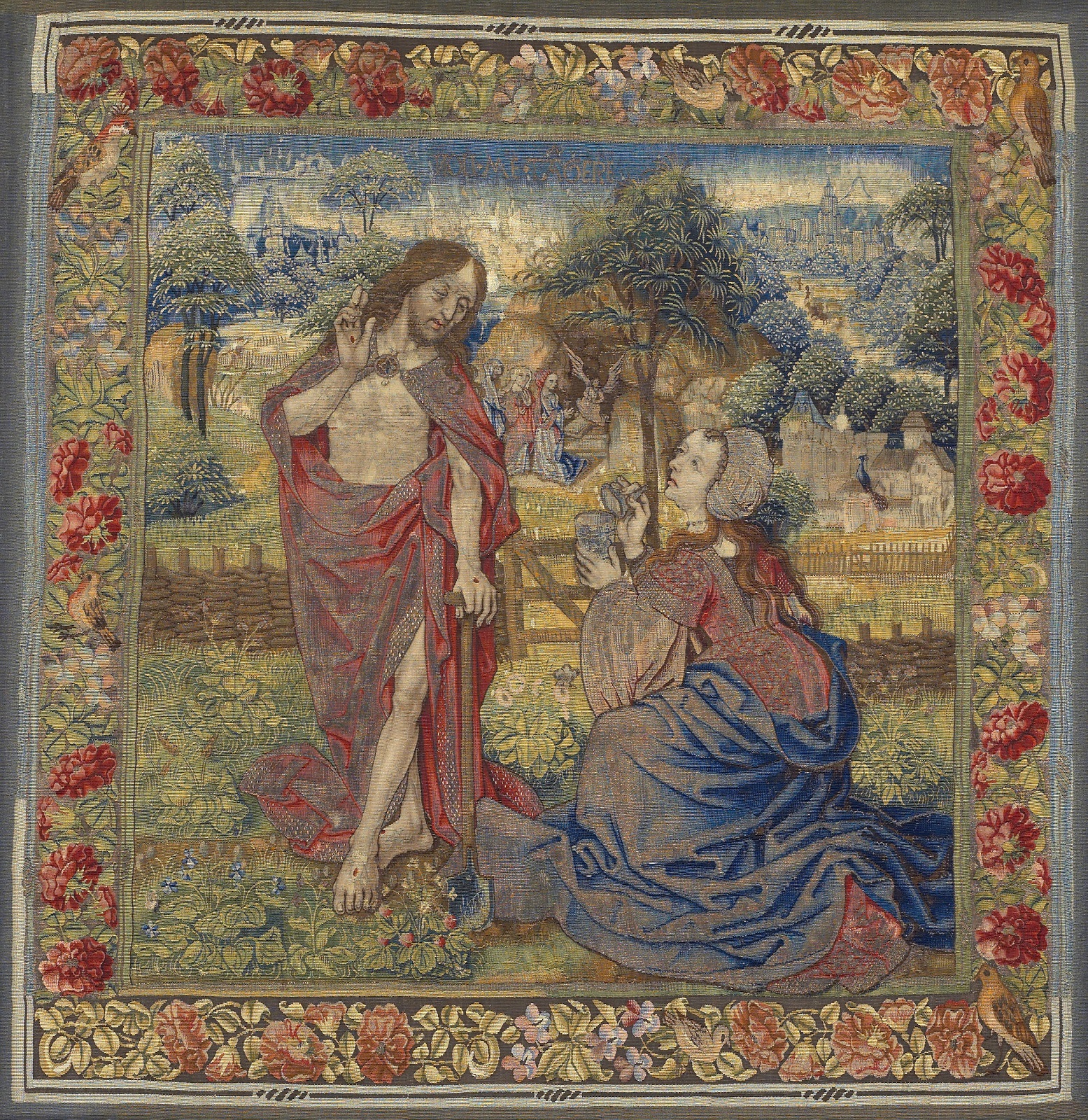
Unknown Workshop in Flanders
Noli me tangere
ca. 1485-1500
wool and silk tapestry
Art Institute of Chicago

Unknown Workshop in Flanders
Bear Hunt and Falconry (fragment)
ca. 1525
wool and silk tapestry
Art Institute of Chicago

Unknown Workshop in Flanders
Pomona surprised by Vertumnus and other Suitors
ca. 1535-40
wool and silk tapestry
Art Institute of Chicago

Manufacture Royale d'Aubusson
Apollo exposing Mars and Venus to the Ridicule of the Olympians
ca. 1650
wool and silk tapestry
Art Institute of Chicago

Unknown Workshop in Flanders
Meeting of Jacob and Rebecca, and Isaac blessing Jacob
ca. 1660
wool and silk tapestry
Art Institute of Chicago

Michiel Coxie (designer)
Diversion of the Euphrates
(from The Story of Cyrus)
ca. 1670
wool and silk tapestry, woven in Brussels
Art Institute of Chicago

Michiel Coxie (designer)
Cyrus defeats Spargapises
(from The Story of Cyrus)
ca. 1670
wool and silk tapestry, woven in Brussels
Art Institute of Chicago

"The word tapestry is now widely used to describe a range of textiles, including needlepoint and certain mechanically woven, ribbed fabrics, but historically and technically it designates a figurative weft-faced textile woven by hand on a loom.  In European practice, the loom consists of two rollers, between which plain warp threads (the load-bearing threads) are stretched.  . . .  Depending on the orientation of the loom, the warps are stretched vertically on a high-warp loom or horizontally on a low-warp loom; in both cases, the weaver works on the reverse side of the tapestry.  The warps are arranged so there is a small space between the even and odd warps, called the shed, through which the weaver passes the colored weft threads that are wrapped around a handheld shuttle  . . .  By varying the colors of the weft, the weaver creates a pattern or figurative image.  Between 1400 and 1530, Flemish weavers developed the ability to reproduce an extraordinary range of surface textures and painterly effects through the use of finer and finer interlocking triangles of color (hatchings or hachures), the juxtaposition of different materials, and the use of different techniques to link the weft threads."

"In European medieval and Renaissance practice, the design was invariably copied from a full-scale colored pattern, known as the cartoon, a practice that continues to this day.  Before starting work, the weaver traces the pattern from the cartoon onto the bare warps.  . . .  Production was a labor-intensive process requiring the participation of many skilled weavers for the execution of large tapestries.  On the basis of both modern practice and documented production, it is generally estimated that weavers could produce up to one square yard of coarse tapestry per month.  High quality production, with a finer warp and weft count, was much slower, yielding perhaps half a square yard or less per month."

"The quality of a tapestry depends mainly on four variable factors: the quality of the cartoon from which it is copied; the skill of the weavers at translating the design into woven form; the fineness of the weave (the number of warps per centimeter and the grade of the weft, which directly affect the precision of detail and the pictorial quality of the tapestry); and the quality of the materials from which it is made.  . . .  Wool, generally from England or Spain, was the principal material used for warps and most of the weft.  Finer-quality pieces also incorporated silk (from Italy or Spain), and the finest included silver- and gilt-metal-wrapped silk thread (from Venice or Cyprus).  Documents relating to the levy charged for different grades of tapestry imported to England during the first half of the sixteenth century indicate that tapestry woven with silk cost four times more than that woven with coarse wool.  The inclusion of metallic thread increased the cost by a factor of twenty over tapestry woven with coarse wool alone."

– from an essay by Thomas P. Campbell on the Heilbrunn Timeline of Art History at the Metropolitan Museum of Art, New York

Charles Le Brun (designer)
The Offering of the Boar's Head
(from The Story of Meleager and Atalanta)
ca. 1673-86
wool and silk tapestry, woven in Brussels
Art Institute of Chicago

David Teniers III (designer)
September and October
(from The Twelve Months of the Year)
after 1675
wool and silk tapestry, woven in Brussels
Art Institute of Chicago

Lodewijk van Schoor and Pieter Spierinckx (designers)
Abundantia
(from The Four Continents and Related Allegories)
ca. 1680-1700
wool and silk tapestry, woven in Brussels
Art Institute of Chicago

Unknown Workshop in Flanders
Orpheus playing the Lyre to Hades and Persephone
ca. 1685
wool and silk tapestry
Art Institute of Chicago

Charles Le Brun (designer)
Autumn
(from The Seasons)
ca. 1700-1720
wool and silk tapestry
Manufacture Royale des Gobelins
Art Institute of Chicago

Charles Le Brun (designer)
Winter
(from The Seasons)
ca. 1700-1720
wool and silk tapestry
Manufacture Royale des Gobelins
Art Institute of Chicago

Manufacture Royale d'Aubusson
Arrival of Telemachus on Calypso's Island
(after an engraving by François Boucher)
1776
wool and silk tapestry
Art Institute of Chicago

Manufacture Royale d'Aubusson
Fall of Phaeton
(after an etching by Antonio Tempesta)
1776
wool and silk tapestry
Art Institute of Chicago

Saturday, November 16, 2019

Photographic Prints in Museums (1843-2015)

Berenice Abbott
The Wing
1946
gelatin silver print
Art Institute of Chicago

Lewis Carroll
Margaret Frances Langton Clarke
1864
albumen print
Art Institute of Chicago

William Eggleston
Near Jackson, Mississippi
ca. 1970
dye imbibition print
Art Institute of Chicago

Arnold Newman
Violins, Philadelphia
1941
gelatin silver print
Art Institute of Chicago

Thirteen Aphorisms on the Nature of Evil

1.
The unconscious hand of Evil loves its own innocence.

2.
Evil lives for the existence of "the other"; for itself it prefers a familiar, common existence.

3.
Evil always owns its own orchard, and sits there gaily picking cherries.

4.
Evil loves the shape of the human hand, formed like its own; for that sublimely simple tool is capable of carrying out the most monstrously delicate atrocities.

5.
In antiquity, Time begot Chaos. But from Chaos, surely, there arose Evil: for in Chaos there is ambiguity – and Darkness and Night – the home of human regret.

6.
Temptation is made flesh by the love it borrows from the heart.

7.
The will must challenge temptation as memory challenges oblivion.

8.
The brave make a place at their table for Evil. For only first-hand knowledge of evil can transform meditation into action.

9.
Evil is always waiting for opportunity's welcome: thriving as it does on the dark of judgment's eclipse.

10.
Time must tolerate the shape of Evil as it tolerates all other miracles.

11.
Evil loves its house, which it shares with history, which is blind.

12.
One must never forget that history does not exist. Rather, only consciousness, which makes an imaginary house for time past.

13.
And consciousness is the only sword which makes Evil tremble.

– Ellen Hinsey (The White Fire of Time, Wesleyan University Press, 2002)

Richard Nickel
Untitled (Auditorium Building, Street Level)
ca. 1953-55
gelatin silver print
Art Institute of Chicago

Eliot Porter
Sycamore Tree, Michigan
1973
dye imbibition print
Art Institute of Chicago

Art Shay
Nelson Algren pauses after another White Sox loss
1950
gelatin silver print
Art Institute of Chicago

Arthur Siegel
Italy
1953
C-print
Art Institute of Chicago

Charles Soulier
Paris Fire (The Grand Staircase Entrance)
1871
albumen print
Art Institute of Chicago

Thomas Struth
Study, Charité, Berlin
2015
inkjet print
Art Institute of Chicago

William Henry Fox Talbot
Plaster Cast of Marble Bust of Patroclus in the British Museum
1843
salted paper print
Art Institute of Chicago

Willard van Dyke
Ventilators
ca. 1933
gelatin silver print
Art Institute of Chicago

Willard van Dyke
Ventilators
ca. 1933
gelatin silver print
Art Institute of Chicago

Carleton Watkins
San Francisco Bay (Fort Point)
1860s
albumen print
Art Institute of Chicago

Minor White
Patched Window
1959
gelatin silver print
Art Institute of Chicago

Transitory Street Scenes Fixed in Photographs (20th century)

Arnold Newman
Red Wall, Green Door
ca. 1950
dye imbibition print
Art Institute of Chicago

Arthur Siegel
Green Building, Red Door
1950
dye imbibition print
Art Institute of Chicago

Saul Leiter
Walk with Soames
1958
silver dye bleach print
Art Institute of Chicago

Irving Penn
Antique Shop, Pine Street, Philadelphia
1938
gelatin silver print
Art Institute of Chicago

W. Eugene Smith
Street in Pittsburgh
Downhill Houses on Either Side - Church at End of Street
1955
gelatin silver print
Art Institute of Chicago

Stephen Shore
Church Street & Second Street, Easton, Pennsylvania
1974
C-print
Art Institute of Chicago

On the Weight of Dailiness

α.
On an afternoon when – today – noon is unannounced,
                       Yet divides the spheres of day into memory and waiting;

β.
In these hollow moments, when all flesh is found arbitrary,
                       And arbitrary all the details of regret or expectation –

γ.
One might imagine rain, but instead time rushes the window;
                       Again, wind at the window? – no, just a river of minutes.

δ.
In the green stasis of silence: an eclipse of intent.
                       The self, unmoored, slowly rides the camber of daylight.

ε.
Start again, try – rouse the idle machine of the body.
                       In the silence – perhaps: strange intimations of foreboding.

ζ.
What then, can reaffirm the just sovereignty of being?
                       The mind's logic: a bridge in the air that no step follows.

η.
You are suddenly patient with folly; tire of nostalgia.
                       The first human, the second: seeds sown in the wind's salt.

θ.
You dream of distraction, to drag you towards evening.
                       Outside, a squall, without intent or rancor, flails the trees.

ι.
Finally you would speak: pry open the vault of silence.
                       Your voice's clamor: the harsh laboring of a wooden bell.

κ.
In late afternoon, memory rises like carp from a muddied pool.
                       Memory escapes capture: the shadowy forms stay buried.

λ.
Daylight, once again vanquished, burns red on the far horizon.
                       The body – pierced by loneliness – would shed its flesh.

μ.
And the heart, distant – painfully remote – seemingly unused.
                       But in loyalty, practicing all afternoon its common work.

– Ellen Hinsey (The White Fire of Time, Wesleyan University Press, 2002)

Arthur Siegel
State Street, Rainy Day
1952
dye imbibition print
Art Institute of Chicago

Joel Sternfeld
518 101st Street, Love Canal Neighborhood, Niagara Falls, New York
1994
C-print
Art Institute of Chicago

Arnold Genthe
Twisted Streets, San Francisco Earthquake and Fire
1906
gelatin silver print
Art Institute of Chicago

Walker Evans
Wall Street Windows
ca. 1928-30
gelatin silver print
Art Institute of Chicago

Richard Nickel
Untitled (Bayard Building, Upper Stories)
ca. 1955
gelatin silver print
Art Institute of Chicago

Richard Nickel
Untitled (Bayard Building, Cornice and Windows)
ca. 1955
gelatin silver print
Art Institute of Chicago

Richard Nickel
Untitled (Garrick Theater, Detail of Ornament)
ca. 1958
gelatin silver print
Art Institute of Chicago

Richard Nickel
Untitled (Bayard Building, Ornament of Cornice)
ca. 1955
gelatin silver print
Art Institute of Chicago

Friday, November 15, 2019

Transitory Human Forms Fixed in Photographs (20th century)

Jacques-Henri Lartigue
The Famous Rowe Twins of the Casino de Paris
1929
gelatin silver print
Art Institute of Chicago

Jacques-Henri Lartigue
Cousin Bichonnade in Flight
1905
gelatin silver print
Art Institute of Chicago

Stanislaw Ignacy Witkiewicz
Arthur Rubinstein, Zakopane
1913-14
varnished carbon print
Art Institute of Chicago

Stanislaw Ignacy Witkiewicz
Self-Portrait
ca. 1912
gelatin silver print
Art Institute of Chicago

Willard van Dyke
Ansel Adams at 683 Brockhurst
1932
gelatin silver print
Art Institute of Chicago

Willard van Dyke
Boxer's Hands
ca. 1932
gelatin silver print
Art Institute of Chicago

from On the Origins of Consciousness

        It was thus that conclusions were drawn: though the I was persuasive, capable of insight and precise sensation, contained in flesh as it was, it was unable to retain even one full instant of being. In every moment – regardless of season – it pruned back the thicket of wonder. Each night, unfailingly, chastened by memory in the small room of sleep: recollection returning to the I with its arms full of all the precious, abandoned things.

– Ellen Hinsey (The White Fire of Time, Wesleyan University Press, 2002)

Arnold Newman
Jean Arp, New York City
1949
gelatin silver print
Art Institute of Chicago

Arnold Newman
David Hare, Provincetown, Massachusetts
1952
gelatin silver print
Art Institute of Chicago

W. Eugene Smith
Untitled
ca. 1957-58
gelatin silver print
Art Institute of Chicago

W. Eugene Smith
Untitled
1953
gelatin silver print
Art Institute of Chicago

Art Shay
Nelson Algren amuses a New Friend
1949
gelatin silver print
Art Institute of Chicago

Art Shay
Liz enjoying Smell-o-Vision with husband Eddie Fisher, Chicago
1960
gelatin silver print
Art Institute of Chicago

Dirk Bakker
Downtown, crossing State Street
1980
C-print
Art Institute of Chicago

Dirk Bakker
On the El
1980
C-print
Art Institute of Chicago