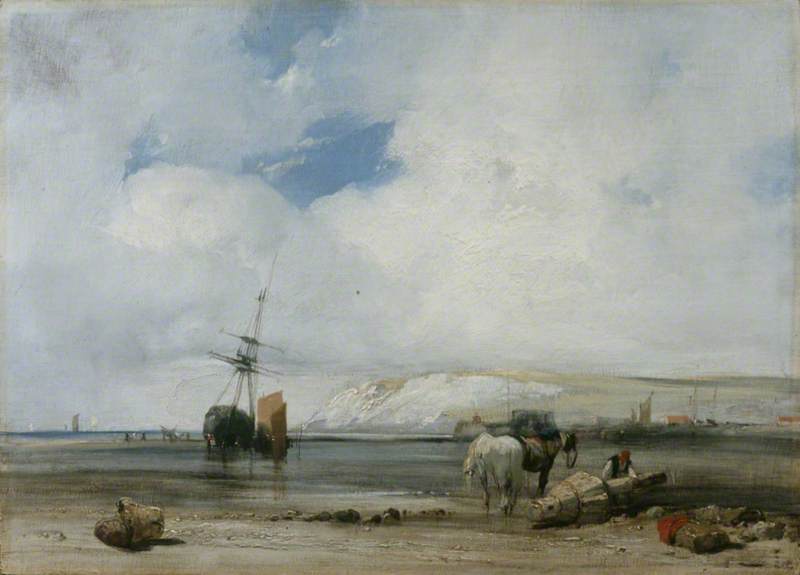
Showing posts with label Mediterranean. Show all posts

Wednesday, January 19, 2022

Mediterranean World as Viewed or Imagined by French Artists

Pierre-Henri de Valenciennes
View of Rome
ca. 1782-84
oil on canvas
Cleveland Museum of Art, Ohio

Claude Monet
Palazzo Dario, Venice
1908
oil on canvas
Art Institute of Chicago

Claude Lorrain
Landscape with an Imaginary View of Tivoli
1642
oil on copper
Courtauld Gallery, London

François de Nomé
Capriccio View of an Italian Piazza with a Royal Procession
before 1647
oil on canvas
private collection

Francisque Millet
The Flight from Troy
before 1679
oil on canvas
Hatton Gallery, Newcastle upon Tyne

Pierre Patel
Rest on the Flight into Egypt
1652
oil on canvas
National Gallery, London

Jean Lemaire
Landscape with Praying Hermit among Ruins
1637-38
oil on canvas
Museo del Prado, Madrid

Gaspard Dughet
Classical Landscape with a Lake
ca. 1658
oil on canvas
Scottish National Gallery, Edinburgh

Jean-Charles-Joseph Rémond
Wounded Philoctetes abandoned on the Isle of Lemnos
1818
oil on canvas
Musée des Augustins de Toulouse

Hubert Robert
Man falling from a Ruin
ca. 1780
oil on canvas
Musée Cognacq-Jay, Paris

Carolus-Duran
The Murdered Man, or, Remembrance of the Roman Countryside
ca. 1865
oil on canvas
Palais des Beaux-Arts de Lille

Luc-Olivier Merson
The Wolf of Gubbio
1877
oil on canvas
Palais des Beaux-Arts de Lille

"At the time when Saint Francis was living in the city of Gubbio, a large wolf appeared in the neighbourhood, so terrible and fierce, that he not only devoured other animals, but made a prey of men also; and since he often approached the town, all the people were in great alarm, and used to go about armed, as if going to battle.   . . .  Saint Francis, feeling great compassion for the people of Gubbio, resolved to go and meet the wolf, though all advised him not to do so.  . . .  And the saint thus addressed him: 'Brother wolf, thou hast done much evil in this land, destroying and killing the creatures of God without His permission; yea, not animals only hast thou destroyed, but thou hast even dared to devour men, made after the image of God; for which thing thou art worthy of being hanged like a robber and a murderer.  All men cry out against thee, the dogs pursue thee, and all the inhabitants of this city are thy enemies; but I will make peace between them and thee, O brother wolf, if so be thou no more offend them, and they shall forgive thee all thy past offences, and neither men nor dogs shall pursue thee any more."  Having listened to these words, the wolf bowed his head, and, by the movements of his body, his tail, and his eyes, made signs that he agreed to what Saint Francis said.  . . .  Then said Saint Francis, addressing him again: "Brother wolf, I command thee, in the name of Christ, to follow me immediately, without hesitation or doubting, that we may go together to ratify this peace which we have concluded in the name of God"; and the wolf, obeying him, walked by his side as meekly as a lamb, to the great astonishment of the people.   . . .   "Listen my brothers: the wolf who is here before you has promised and pledged his faith that he consents to make peace with you all, and no more offend you in aught, and you must promise to give him each day his necessary food; to which, if you consent, I promise in his name that he will most faithfully observe the compact."  Then all the people promised to feed the wolf to the end of his days."

– excerpted from The Little Flowers of St Francis, translated by Roger Huddleston from the 14th-century Italian  

Jean-Baptiste-Camille Corot
Tivoli - The Cascades
1843
oil on paper, mounted on canvas
Musée du Louvre

Jean-Baptiste-Camille Corot
Castel Sant'Angelo and the Tiber, Rome
ca. 1826-28
oil on paper, mounted on canvas
Musée du Louvre

Jean-Baptiste-Camille Corot
Cave at San Marino
1826
oil on paper
Speed Art Museum, Louisville, Kentucky

Tuesday, March 3, 2020

Painted Landscapes - Domestic and Touristic

Johannes Vorsterman
London from Greenwich Hill
ca. 1680
oil on canvas
Guildhall Art Gallery, London

Julian Perry
View over East London with Hampstead in the Distance
1995
oil on canvas
Guildhall Art Gallery, London

Oskar Kokoschka
London - Waterloo Bridge
1928
oil on canvas
National Museum Cardiff, Wales

Anonymous French Artist
View of Olevano
ca. 1820
oil on canvas
Ashmolean Museum, Oxford

Walter Sickert
Le Grand Duquesne, Dieppe
ca. 1935
oil on canvas
Manchester Art Gallery

Robert Hope
The Fountain, Princes Street Gardens, Edinburgh
ca. 1895
oil on board
McManus Gallery, Dundee

Silhouette

He preached of the sins of the world – and of evil
That ever seeks triumph in man.
He thundered of lust,
Of hell-fire and dust,
Of flesh and the devil;
And then – he was civil –
Said, "Do come to dine when you can."

His wife cooked the dinner, and served it, and kept
The children all quiet;
Though he would deny it,
And wonder just why
The baby must cry
Exactly at meal-times, or else when he slept;
While she scrubbed, mended, dusted, and swept.

Do you think he found out, when his nine lost their mother?
Of course not; he married another.

– Flora Brent Hamilton (1929)

Jean-Baptiste-Camille Corot
Avignon from the West
1836
oil on canvas
National Gallery, London

Bernardo Bellotto
Fortress of Konigstein - Courtyard with the Brunnenhaus
ca. 1756-58
oil on canvas
Manchester Art Gallery

Jan van der Heyden
View of the Westerkerk, Amsterdam
ca. 1668-72
oil on panel
Wallace Collection, London

Eugène Boudin
Entrance to Trouville Harbour
1888
oil on panel
National Gallery, London

Richard Parkes Bonington
On the Coast of Picardy
1826
oil on canvas
Wallace Collection, London

Charles Conder
On the Beach, Swanage
1901
oil on canvas
Manchester Art Gallery

Cherubino Pata after Gustave Courbet
North African Walled Town
before 1899
oil on panel
Hunterian Art Gallery, University of Glasgow

Leo von Klenze
Ideal View of the Acropolis and Areopagus, Athens
1846
oil on canvas
Alte Pinakothek, Munich

John Hubbard
Old Epidaurus
1962
oil on canvas
Bristol Museum and Art Gallery

Thursday, February 16, 2017

Classical Fragments by Jean-Pierre Houël

Jean-Pierre Houël
Antique Statue - Island of Gozo
ca. 1776-79
gouache
Hermitage, Saint Petersburg

Jean-Pierre Houël
Classical Fragments - Catania
ca. 1776-79
wash drawing
Hermitage, Saint Petersburg

"In her 1969 'Maintenance Art Manifesto' performance artist Mierle Laderman Ukeles divided human labor into two categories: development and maintenance. She writes: Development: pure individual creation; the new; change; progress; advance; excitement; flight or fleeing. Maintenance: Keep the dual off the pure individual creation; preserve the new; sustain the change; protect progress; defend and prolong the advance; renew the excitement; repeat the flight. Ukeles' manifesto insists that ideals of modernity (progress, change, individual creation) are dependent on the denigrated and boring labor of maintenance (activities that make things possible  cooking, cleaning, shopping, child rearing, and so forth). Incisively, Ukeles does not refer to maintenance as domestic labor, or housework, for it is evident that such labor is not confined solely to the spaces of domesticity. Included in this manifesto was a proposal that Ukeles live in the museum and perform her maintenance activities; while the gallery might look 'empty', she explained that her labor would indeed be the 'work'. Her offer went unaccepted." 

Jean-Pierre Houël
Classical Fragments with Bust of Ceres
ca. 1776-79
wash drawing
Hermitage, Saint Petersburg

Jean-Pierre Houël
Bas-relief Tullia Ciceronis and Clodia Metelli
ca. 1776-79
wash drawing
Hermitage, Saint Petersburg

"In 1973, however, the Wadsworth Atheneum agreed to the Maintenance Art Performances. In Hartford Wash: Washing Tracks, Maintenance Inside, Ukeles scrubbed and mopped the floor of the museum for four hours. In Hartford Wash: Washing Tracks, Maintenance Outside, she cleaned the exterior plaza and steps of the museum. She referred to these activities as 'floor paintings'. In Transfer: The Maintenance of the Art Object, she designated her cleaning of a protective display case as an art work  a 'dust painting'. Normally the vitrine was cleaned by the janitor; however, once Ukeles' cleaning of the case was designated as 'art' the responsibility of the cleaning and maintenance of this case became the job of the conservator. The fourth performance, The Keeping of the Keys, consisted of Ukeles taking the museum guards' keys and locking and unlocking galleries and offices, which when locked were subsequently deemed to be works of 'maintenance art'. In each performance Ukeles' role as 'artist' allowed her to reconfigure the value bestowed upon these otherwise unobtrusive maintenance operations, and to explore the ramifications of making maintenance labor visible in public."

 from House Work and Art Work by Helen Molesworth, excerpted in The Everyday, edited by Stephen Johnstone and published by Whitechapel Gallery (2008) in the series Documents of Contemporary Art

Jean-Pierre Houël
Classical Bas-reliefs - Catania
ca. 1776-79
wash drawing
Hermitage, Saint Petersburg

Jean-Pierre Houël
Classical Torso - Malta
ca. 1776-79
drawing
Hermitage, Saint Petersburg

Jean-Pierre Houël
Classical Fragments
ca. 1776-79
wash drawing
Hermitage, Saint Petersburg

Jean-Pierre Houël
Classical Fragments
ca. 1776-79
wash drawing
Hermitage, Saint Petersburg

Jean-Pierre Houël
Classical Fragments - Malta
ca. 1776-79
wash drawing
Hermitage, Saint Petersburg

Jean-Pierre Houël
Classical Fragments - Malta
ca. 1776-79
wash drawing
Hermitage, Saint Petersburg

Jean-Pierre Houël
Ancient Building - Cefalu
ca. 1776-79
wash drawing
Hermitage, Saint Petersburg

Jean-Pierre Houël
Ancient Building - Cefalu
ca. 1776-79
wash drawing
Hermitage, Saint Petersburg

Jean-Pierre Houël
Ancient Building - Cefalu
ca. 1776-79
gouache
Hermitage, Saint Petersburg

Jean-Pierre Houël
Greek House - Malta
ca. 1776-79
gouache
Hermitage, Saint Petersburg

Mediterranean Gouaches by Jean-Pierre Houël

Jean-Pierre Houël
Stromboli Volcano erupting
ca. 1776-79
gouache
Hermitage, Saint Petersburg

Jean-Pierre Houël
Cyclopean Isles
ca. 1776-79
gouache
Hermitage, Saint Petersburg

According to curators at the Hermitage, these gouaches came into existence during an extended tour in the 1770s by French artist Jean-Pierre Houël(1735-1813). He was gathering views for a 4-volume publication of engravings ultimately published in Paris between 1782 and 1787  A Picturesque Voyage Through the Isles of Sicily, Malta and Lipari, which deals with Antiquities Still to be Found There, the Principal Phenomena Offered by Nature, the Costumes of the Inhabitants, and some Customs. Over 500 highly finished sketches like these made the basis for the printed illustrations. Of these originals, more than half were sold to agents for the Russian court, which accounts for their presence in Saint Petersburg today.

Jean-Pierre Houël
Cyclopean Isles
ca. 1776-79
gouache
Hermitage, Saint Petersburg

Jean-Pierre Houël
Islands of Vulcano and Vulcanello
ca. 1776-79
gouache
Hermitage, Saint Petersburg

Jean-Pierre Houël
Island of Vulcano from Lipari
ca. 1776-79
gouache
Hermitage, Saint Petersburg

Jean-Pierre Houël
Cyclopean Isles from the Bay of La Trizza
 ca. 1776-79
gouache
Hermitage, Saint Petersburg

Jean-Pierre Houël
La Trizza Bay - Basalt Rock
ca. 1776-79
gouache
Hermitage, Saint Petersburg

Jean-Pierre Houël
La Trizza Bay - Basalt rocks
ca. 1776-79
gouache
Hermitage, Saint Petersburg

Jean-Pierre Houël
Ruins of Ancient Tindari - Sicily
ca. 1776-79
gouache
Hermitage, Saint Petersburg

Jean-Pierre Houël
Classical Ruins - Caccia - Island of Gozo
ca. 1776-79
gouache
Hermitage, Saint Petersburg

Jean-Pierre Houël
Classical Fragments - Island of Lipari
ca. 1776-79
gouache
Hermitage, Saint Petersburg

Jean-Pierre Houël
View of Mount Etna from Monte Rosso
ca. 1776-79
gouache
Hermitage, Saint Petersburg

Jean-Pierre Houël
View of Mount Etna from San Leonardo
ca. 1776-79
gouache
Hermitage, Saint Petersburg
 
Jean-Pierre Houël
Chestnut Tree - Slope of Mount Etna
ca. 1776-79
gouache
Hermitage, Saint Petersburg