Showing posts with label Victorian. Show all posts

Sunday, May 18, 2025

Narrative Tendencies (1845-1881)

Antoine Wiertz
Battle of Greeks and Trojans for the Body of Patroclus
ca. 1845
oil on canvas
Royal Museum of Fine Arts, Antwerp

Wilhelm Marstrand
Last Night of Carnival on the Corso in Rome
ca. 1848
oil on canvas
Ordrupgaard Art Museum, Copenhagen

François-Joseph Navez
Pilgrimage in the Roman Campagna
1848
oil on canvas
Museum of Fine Arts, Boston

William-Adolphe Bouguereau
Zenobia discovered by Shepherds
on the Banks of the Araxes

1850
oil on canvas
Musée de l'École Nationale Supérieure
des Beaux-Arts, Paris

Abbondio Sangiorgio
Mythological Scene
ca. 1850
drawing
Nasjonalmuseet, Oslo

François-Auguste Biard
Mal de mer sur une Corvette anglaise
1857
oil on canvas
Dallas Museum of Art

Joseph Lies
Disasters of War
1858
oil on panel
Royal Museum of Fine Arts, Antwerp

Ferdinand Heilbuth
Painter Luca Signorelli with the Corpse of his Son
1859
oil on canvas
Hamburger Kunsthalle

François Debon
Caesar among the Druids
1867
oil on canvas
Musée de Picardie, Amiens

Ernest Meissonier
The Information
(Peasant addressing Napoleonic General Desaix)
1867
oil on panel
Dallas Museum of Art

Arnold Böcklin
Ruggiero and Angelica
(scene from Orlando Furioso of Ariosto)
1873
tempera on panel
Alte Nationalgalerie, Staatliche Museen zu Berlin

Joseph Caraud
The Pricked Finger
ca. 1875
oil on canvas
Musée des Beaux-Arts de Reims

John Frederick Lewis
The Street and Mosque al-Ghouri in Cairo
1875
oil on canvas
Musée du Louvre

Hermann Julius Schlösser
Prometheus and Epimetheus before Pandora
1878
oil on canvas
Alte Nationalgalerie, Staatliche Museen zu Berlin

Jules-Charles Boquet 
Mourning
ca. 1880
oil on canvas
Musée des Beaux-Arts de Rouen

Vasily Surikov
The Morning of Streltsy's Execution
1881
oil on canvas
State Tretyakov Gallery, Moscow

"For one night I saw Urania in my sleepe appeare unto me, or better to say, my conscience taking the advantage of my bodyes rest, the hatefull enemie to the soules blisse, and in that quiet shewed unto mee, my deerest shepherdesse justly accusing me, and condemning mee.  I had no way to escape, if not by this meanes; I rose, I left Dalinea for Urania's fury, whose sweete substance I lost for Dalinea's love, I have now left both, both injur'd, both afflicted by me.  Why should I then continue such an affliction to the rarest of women? and a vexation to the worst, as I am unto my unblessed selfe.  Assist me, good Father, in my misery, this is truth I have told you, and more then ought to live on earth or I hope can be found againe; wherfore that as all ill is in mee, I desire, nay, covet to end, that the world may be no longer infected with that plague, but as knit in me, that knot may never be unty'd, but end, and conclude with me." 

– from The Countesse of Mountgomeries Urania, by the right honourable the Lady Mary Wroath, daughter to the right noble Robert, Earle of Leicester, and neece to the ever famous and renowned Sʳ Phillips Sidney knight, and to ye most excellant Lady Mary Countess of Pembroke, late deceased (London: John Marriott and John Grismand, 1621)

Tuesday, June 4, 2024

19th-century Imagery

Villiers Huët
Madame Catalani
(Angelica Catalani, opera singer)
1807
hand-colored stipple-engraving
Victoria & Albert Museum, London

Louise Cochelet
The Palais Royale at Piombières
1814
drawing
Morgan Library, New York

Benjamin Robert Haydon
Study for Christ's Entry into Jerusalem
ca. 1815
drawing
Yale Center for British Art

John Linnell
Ann Law, 1st Lady Ellenborough
ca. 1821
watercolor miniature on ivory
Cleveland Museum of Art, Ohio

Alexandre Dubois-Drahonet
Frances Anne Vane, Marchioness of Londonderry
1831
oil on canvas
Victoria & Albert Museum, London

Christoffer Wilhelm Eckersberg
View through a Doorway to Hastening Figures
1845
oil on canvas
Statens Museum for Kunst, Copenhagen

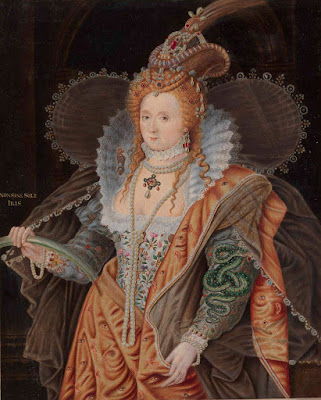
Henry Shaw after Isaac Oliver
Rainbow Portrait of Elizabeth I at Hatfield
ca. 1850
hand-colored aquatint
Royal Collection, Great Britain

Arthur Crowquill
Cover Design for Precaution
by James Fenimore Cooper

ca. 1850-60
drawing, with watercolor
Morgan Library, New York

Edgar Degas
Sheet of Studies made in Florence
1858
(misdated on sheet)
drawing
Cleveland Museum of Art, Ohio

Hablot Knight Browne (Phiz)
Women on Seashore
ca. 1860
drawing, with watercolor
British Museum

Thomas Couture
The Thorny Path
(satire on supposed French decadence after a series of political disasters)
1873
oil on canvas
Philadelphia Museum of Art

Winslow Homer
Young Woman Sewing
1876
watercolor
National Gallery of Art, Washington DC

Alphonse Legros
Study of an Italian Model
(made in London)
ca. 1880
etching
National Gallery of Art, Washington DC

Christian Krohg
Portrait of Edvard Munch
1891
oil on canvas
National Gallery of Norway, Oslo

Odilon Redon
Lumière
1893
lithograph
Cleveland Museum of Art, Ohio

Thomas Eakins
Portrait of Maud Cook
1895
oil on canvas
Yale University Art Gallery

     "During the years 1527-1530, the intellectual community was deep in a stupor. The future of Italy weighed heavily on them, like a vast anxious silence broken only by the moans of ruined scholars and the laments of poets. It was just then that Erasmus had the cruel and ingenious idea of publishing his biting pamphlet [the Dialogus Ciceronianus] against the neopaganism of Medicean Rome. The perpetual masquerade of those "Ciceronians," with their pompous language borrowed from ancient authors, struck him as absurd. To believe, or pretend to believe, that one still lives like the ancient Romans, to speak of Jupiter and consuls, is a ridiculous obsession. For "Rome no longer exists, it is nothing but ruins and debris, traces and vestiges of its ancient misfortune." The Rome of today, the Rome of the Curia, has nothing in common with the ancient world. What kind of people are these "who still dream of the Rome that was once mistress of the world with its citizenry in togas?" These poor fools are unaware that the face of the world has changed and that a Roman citizen means less in Europe than a shopkeeper from Basel. They are above all unaware that their would-be world academy is no more than a coterie of people "more lettered than pious."

                                              *                        *                       *

     "What, in the final analysis, is this nefarious paganism? Unlike many other diatribes, Erasmus's is not directed against the lack of spirituality or moral laxity of the Curia. Nor is it directed against the commercialization of sacred matters, or superstitions, which Erasmus discussed elsewhere. It is equally unconcerned with the naive affectations of the Ciceronian style. What it is concerned with is the cult of the ancient world, the nostalgia for a non-Christian order that emerges from an unconditional love of antiquity and fascination with its remains. Erasmus is now railing against the intellectual passion for history, art, and ancient philosophy that cannot be restrained by Christian conscience. Archaeology, the collection of sculpture in palaces, the resurrection of Roman models, all cease being harmless hobbies and legitimate ancillaries of knowledge if they promote feelings of inadmissible superiority, total attachment, and formalized sensibility; then they are dangerous."

     "If we do not misread it, the Ciceronianus reveals that Erasmus was now inclined to a new strictness, a more rigorous concept of culture. But most important, this is the first time in the history of the Renaissance that a fundamental critique of the "cult of antiquity" has been penned, not by a narrow-minded monk or a suspicious theologian, but by a humanist formed in the classical disciplines and the author of the Adagia [the best-selling anthology of extracts from ancient literature that had established the fame of Erasmus]. This was a major event. It can be explained by the general upheaval of those difficult years, by the pressure of reform evangelism, and by the very logic of Erasmian positions. The treatise forces us to recognize the extent of "paganization" that could be seen not only in the rhetoric, as expected, but in the whole of Roman life and culture. This raises a question of undeniable interest – and greater importance than is usually acknowledged, in interpreting the artistic development of Medicean Rome. It becomes easier to see how vastly indifferent Erasmus and his friends were to the strictly artistic aspect of the Renaissance. Perhaps the problem of Erasmus's attitude toward the arts is a false problem."

     "The Italian passion for forms escapes him and scandalizes him. Art is of the realm of externals and lacks essence.  . . .  Erasmus was so well aware that the Roman attitude toward art was not just an isolated factor but formed an entire concept, that he introduced a critical digression against painting, attacking something that may appear as morally inoffensive – the art of portraiture. Painting can capture only one aspect of man and it is precisely the most inferior one. A painter's concern for detail is ridiculous: "If he had been able to express the truly profound form of man he would not have sought refuge in those parerga [extraneous ornaments]."

– André Chastel, The Sack of Rome, 1527, translated by Beth Archer, 1983 (expanded from the A.W. Mellon Lectures in the Fine Arts, 1977, and published by Princeton University Press and the National Gallery of Art, Washington, D.C.)

Wednesday, April 24, 2024

Men Scrutinizing Female Heads - Drawings - II

Alfred George Stevens
Head of a Woman
ca. 1863
drawing
Victoria & Albert Museum, London

Pierre Puvis de Chavannes
Head of a Woman
ca. 1865
drawing
Clark Art Institute, Williamstown, Massachusetts

Dante Gabriel Rossetti
Head of a Young Woman
ca. 1870
drawing
Victoria & Albert Museum, London

Alphonse Legros
Head of a Woman
1879
drawing
National Gallery of Art, Washington DC

Frederick Sandys
Head of a Woman
ca. 1880
drawing
Victoria & Albert Museum, London

John Singer Sargent
Head of a Young Woman
ca. 1880
drawing
Yale University Art Gallery

Edward Burne-Jones
Head of a Woman
1889
drawing
Victoria & Albert Museum, London

Théophile Alexandre Steinlen
Head of a Woman
ca. 1890
drawing
Princeton University Art Museum

Jean-Jacques Henner
Head of a Woman
1901
drawing
Morgan Library, New York

Joan González
Face of a Woman
ca. 1902
drawing
Tate Gallery

Joseph Southall
Head of a Woman
1904
drawing
Victoria & Albert Museum, London

Augustus John
Head of a Woman
ca. 1905
drawing
Yale Center for British Art

Pablo Picasso
Head of a Woman (Fernande Olivier)
1906-1907
drawing
Yale University Art Gallery

Henri Gaudier-Brzeska
Head of a Woman
ca. 1910
drawing
Yale Center for British Art

Henry Lamb
Portrait of Violet Holloway
ca. 1910
drawing
Victoria & Albert Museum, London

James Havard Thomas
Head of Alma Wertheimer
ca. 1910
drawing
Tate Gallery

Edmund Joseph Sullivan
The Sibyl
ca. 1914
drawing
Morgan Library, New York

James Cowie
Head of a Woman
ca. 1930
drawing
Scottish National Gallery, Edinburgh

For Eurydice: A Song of Ascent

The songs I sang in Hell
Recalled for each his fate,
Not metaphysical freight
But the mechanical –
Beginning, middle and end
Of each eternal chore –
Till every shade deplore
Having to recontend.

So fierce those cries for change
That Hades ordered us
To leave his realm, and thus
We now approach the strange
World of the living, where
All seek stability
Through blind activity,
And comfort through despair.

– David Galler (1974)