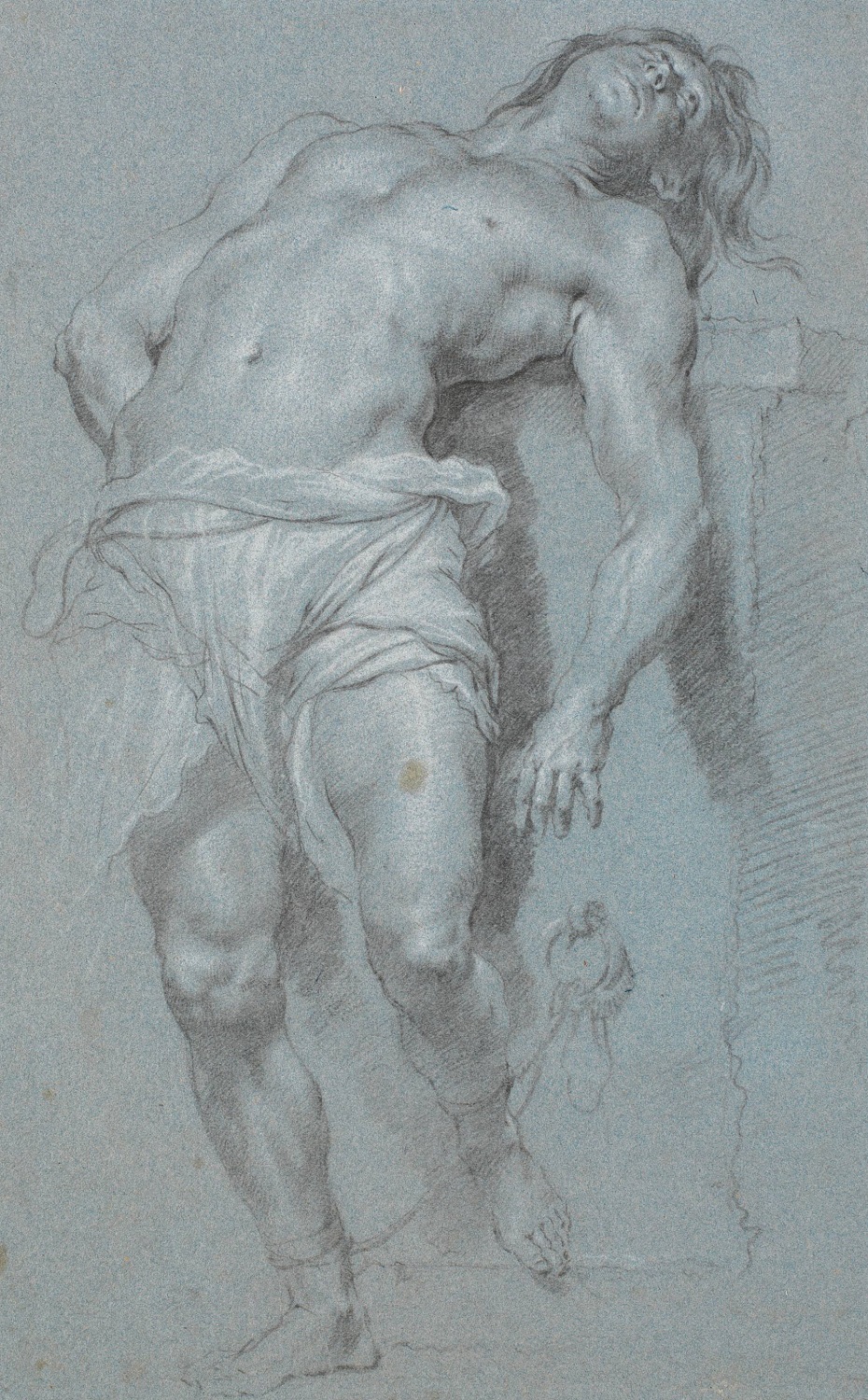
Showing posts with label atlantes. Show all posts

Friday, April 11, 2025

Traditional Study-Drawings

Ciro Ferri
Reclining Youth
ca. 1660
drawing
British Museum


Simone Pignoni
Crouching Model
ca. 1680
drawing
Rijksmuseum, Amsterdam

workshop of Benozzo Gozzoli
Study of Seated Model
ca. 1470-90
drawing
British Museum

Alessandro Gherardini
Figure with Raised Arm
1691
drawing
Statens Museum for Kunst, Copenhagen

Anonymous Flemish Artist after Anthony van Dyck
Half-Length Figure Study
ca. 1620-50
drawing
Ashmolean Museum, Oxford

Louis Boullogne the Younger
Seated Model
ca. 1680
drawing
Yale University Art Gallery

Domenico Cresti (il Passignano)
Half-Length Figure Study
ca. 1580-1600
drawing
Museum Boijmans Van Beuningen, Rotterdam

Heinrich Dittmers
Half-Length Study of Model
ca. 1650
drawing
Statens Museum for Kunst, Copenhagen

Tiburzio Passarotti
Figure Studies
ca. 1580
drawing
Graphische Sammlung Albertina, Vienna

Lucas Franchoys the Younger
Model posed as the god Mercury
before 1681
drawing
British Museum

Anonymous Florentine Artist
Figure Study
ca. 1500-1550
drawing
Kupferstichkabinett,
Staatliche Kunstsammlungen, Dresden

Agostino Carracci
Study for Pluto
ca. 1592
drawing
(design for ceiling fresco)
Kupferstichkabinett, Staatliche Kunstsammlungen, Dresden

Carracci Academy (Bologna)
Study for Atlante
ca. 1580-1610
drawing
Kupferstichkabinett,
Staatliche Kunstsammlungen, Dresden

Parmigianino (Francesco Mazzola)
Figure Study for Warrior
ca. 1535
drawing-
National Gallery of Canada, Ottawa

attributed to Francesco Padovanino
Study of Youth bending forward
ca. 1600
drawing
Art Gallery of New South Wales, Sydney

Anton Domenico Gabbiani
Figure Study
ca. 1695
drawing
Agnes Etherington Art Centre, Kingston, Ontario

Mirror

I grow old under an intensity
Of questioning looks. Nonsense,
I try to say, I cannot teach you children
How to live – If not you, who will?
Cries one of them aloud, grasping my gilded
Frame till the world sways. If not you, who will?
Between their visits the table, its arrangement
Of Bible, fern and Paisley, all past change,
Does very nicely. If ever I feel curious
As to what others endure,
Across the parlor you provide examples,
Wide open, sunny, of everything I am
Not. You embrace a whole world without once caring
To set it in order. That takes thought. Out there
Something is being picked. The red-and-white bandannas
Go to my heart. A fine young man
Rides by on horseback. Now the door shuts. Hester
Confides in me her first unhappiness.
This much, you see, would never have been fitted
Together, but for me. Why then is it
They more and more neglect me? Late one sleepless
Midsummer night I strained to keep
Five tapers from your breathing. No, the widowed
Cousin said, let them go out. I did.
The room brimmed with gray sound, all the instreaming
Muslin of your dream . . .
Years later now, two of the grown grandchildren
Sit with novels face-down on the sill,
Content to muse upon your tall transparence,
Your clouds, brown fields, persimmon far
And cypress near. One speaks. How superficial
Appearances are! Since then, as if a fish
Had broken the perfect silver of my reflectiveness,
I have lapses. I suspect
Looks from behind, where nothing is, cool gazes
Through the blind flaws of my mind. As days,
As decades lengthen, this vision
Spreads and blackens. I do not know whose it is,
But I think it watches for my last silver
To blister, flake, float leaf by life, each milling-
Downward dumb conceit, to a standstill
From which not even you strike any brilliant
Chord in me, and to a faceless will,
Echo of mine, I am amenable.

– James Merrill (1959)

Wednesday, February 12, 2025

Pairs - III

Enea Vico
Antique Statues of Draped Woman and Priestess
in the Delle Valle collection, Rome

1541
engraving
Hamburger Kunsthalle

Enea Vico
Antique Statues of Minerva and Draped Woman
in the Delle Valle collection, Rome
1541
engraving
Hamburger Kunsthalle

Maarten van Heemskerck
Decorative Panel with Pluto
ca. 1550-60
oil on panel (grisaille)
Rijksmuseum, Amsterdam

Maarten van Heemskerck
Decorative Panel with Neptune
ca. 1550-60
oil on panel (grisaille)
Rijksmuseum, Amsterdam

Annibale Carracci
Atlante
ca. 1596-98
drawing
(study for fresco, Palazzo Farnese)
Biblioteca Reale, Turin

Annibale Carracci
Atlante
ca. 1596-98
drawing
(study for fresco, Palazzo Farnese)
Biblioteca Reale, Turin

Anonymous Italian Artist after Pietro Tacca
Captive Corsair
ca. 1620
bronze statuette
Bode Museum, Berlin

Anonymous Italian Artist after Pietro Tacca
Captive Corsair
ca. 1620
bronze statuette
Bode Museum, Berlin

Heinrich Dittmers
Académie
ca. 1650
drawing
Statens Museum for Kunst, Copenhagen

Heinrich Dittmers
Académie
ca. 1650
drawing
Statens Museum for Kunst, Copenhagen

Nicolai Abildgaard
Seated Model
ca. 1780
drawing
Statens Museum for Kunst, Copenhagen

Nicolai Abildgaard
Seated Model
ca. 1790
drawing
National Gallery of Norway, Oslo

Gaetano Vascellini
Antique and Modern Statues of Gladiators,
Giardino di Boboli, Florence

1789
engraving
Hamburger Kunsthalle

Gaetano Vascellini
Antique Statues of Emperor and Philosopher
Giardino di Boboli, Florence
1789
engraving
Hamburger Kunsthalle

Conrad Martin Metz
Putti at Play
ca. 1810
drawing
Statens Museum for Kunst, Copenhagen

Conrad Martin Metz
Putti frightened by a Bull
ca. 1810
drawing
Statens Museum for Kunst, Copenhagen

The Unicorn

The true Unicorn is not the white horse of legend,
coaxed by the droplets staining a virgin's blue bodice,
but the corpse-pale Narwhal, with its counter-clockwise swirl
of jousting tooth, heraldic as any animal.
Ground, it could vanquish poison, and in goblets or spoons
rinsed the provender of crowned and syphilitic heads.
That the bulbous asymmetry of its otherwise
toothless skull should culminate in such a twisted myth!
Armies of Narwhal congregate, like Rhinoceri
at their sub-Saharan drinking holes, fencing to breathe,
and are pulled by their noses onto the ice. Tokens
of love for the sweethearts of Hull whalers, walking canes
and bedsteads, these are the Unicorn's final blazon.

– Caitríona O'Reilly, The Sea Cabinet (2006)

Monday, November 25, 2024

Fauns and Satyrs

Jacob Jordaens
Study Head of Faun
ca. 1650
oil on canvas
Musée Ingres-Bourdelle, Montauban

Ciro Ferri
Faun with Wine in a Glass Bowl
ca. 1660
oil on canvas
Musée Fesch, Ajaccio, Corsica

Clodion
Bacchante and Satyr
ca. 1775-80
terracotta
Detroit Institute of Arts

Anonymous Italian Artist
Antique Bust of Faun
(illustration to Winckelmann)
1767
etching
Hamburger Kunsthalle

Anonymous Italian Artist after Giulio Romano
Figure of Faun
ca. 1550
drawing
Graphische Sammlung Albertina, Vienna

Anonymous Italian Artist
Satyrs as Atlantes
17th century
drawing
Hamburger Kunsthalle

Anonymous Italian Artist
Half-Length Study of Faun
17th century
drawing
Victoria & Albert Museum, London

Magnus Enckell
Awakening Faun
1914
oil on canvas
Ateneum Art Museum, Helsinki

Antoine Coypel
Faun seated on Balustrade
ca. 1695
drawing
National Gallery of Canada, Ottawa

Anonymous Italian Artist
Nymph and Satyr
16th century
engraving
Hamburger Kunsthalle

Pirro Ligorio
Satyrs spying on Nymphs
ca. 1560
drawing
Statens Museum for Kunst, Copenhagen

Ludwig Habich
Faun blowing on a Flame
ca. 1900
bronze lighter
(on ceramic fluid-well)
Museum für Kunst und Kulturgeschichte, Dortmund

Filippo Napoletano
Nymph and Satyr
ca. 1610-20
engraving and etching
Hamburger Kunsthalle

William-Adolphe Bouguereau
Nymphs and Satyr
1873
oil on canvas
Clark Art Institute, Williamstown, Massachusetts

Anonymous French Artist
Nymph and Satyr
18th century
drawing
Yale University Art Gallery

Jean-Alexandre-Joseph Falguière
Two Satyrs
ca. 1875
drawing
Morgan Library, New York

He thinks of Those who have spoken Evil of his Beloved

Half close your eyelids, loosen your hair,
And dream about the great and their pride;
They have spoken against you everywhere,
But weigh this song with the great and their pride;
I made it out of a mouthful of air,
Their children's children shall say they have lied.

– W.B. Yeats (1899)

Friday, October 11, 2024

Burden Bearers

Ferdinand Erfmann
Acrobats
1964
oil on canvas
Bonnefantenmuseum, Maastricht

Wiener Kunstkeramische Werkstätte
Boy with Crocodile
ca. 1910
glazed earthenware
National Gallery of Victoria, Melbourne

Gari Melchers
Four Figures bearing a Burden
ca. 1900
drawing
(study for mural, Peace)
Carnegie Museum of Art, Pittsburgh

Adolf von Hildebrand
Fisherman carrying a Net
1886
marble
Neue Pinakothek, Munich

Antoine-Louis Barye after Giambologna
Hercules carrying the Erymanthean Boar
ca. 1850
bronze statuette (partly gilt)
Morgan Library, New York

Pieter Xavery
Satyr
1671
terracotta statuette
High Museum of Art, Atlanta

Giovanni Pietro Possenti
Two Putti carrying a Third
ca. 1650
drawing
Yale University Art Gallery

Bernardino Cesari
Faun abducting Nymph
ca. 1616
drawing
Graphische Sammlung Albertina, Vienna

Monogrammist DS
Angel with Column of the Passion
ca. 1599
drawing
Museum of Fine Arts, Budapest

Annibale Carracci
Study for Hercules Supporting the Globe
ca. 1595-97
drawing
Biblioteca Reale, Turin

Cornelis Cort
Antique Statue of Bacchus carrying the Young Dionysus
ca. 1574
engraving
Albright-Knox Art Gallery, Buffalo, New York

Anonymous Netherlandish Artist
The Paralytic healed by Christ
ca. 1560-90
oil on panel
National Gallery of Art, Washington DC

Anonymous Venetian Artist
Pan as Atlante
ca. 1550-80
drawing
Graphische Sammlung Albertina, Vienna

Paolo Farinati
Two Atlantes
ca. 1540-60
drawing
Graphische Sammlung Albertina, Vienna

Bartolomeo Montagna
Christ carrying the Cross
ca. 1515
oil on canvas
Kunsthaus, Zürich

Roman Empire
Bacchus carrying the young Dionysus,
accompanied by Satyrs

AD 200-220
marble
Musée d'Art Classique de Mougins

 from The Island of Statues

'Tis here the arrow fell: the breezes laughed
Around the feathery tip. Unto the shaft
This blossom is most near. Statue! Oh, thou
Whose beard a moonlight river is, whose brow
Is stone: old sleeper! this same afternoon
O'er much I've talked: I shall be silent soon,
If wrong my choice, as silent as thou art,
Oh! gracious Pan, take now thy servant's part.
He was our ancient god. If I speak low,
And not too clear, how will the new god know
But that I called on him?

– W.B. Yeats (1885)