Showing posts with label fences. Show all posts

Wednesday, January 31, 2024

Visual Relics (1940-1947)

PaJaMa
(Paul Cadmus, Jared French, Margaret French)
Margaret French, Hoboken NJ
ca. 1940
gelatin silver print
Phillips Collection, Washington DC

Consuelo Kanaga
Wharton Esherick, Master Woodworker
1940
bromide print
Brooklyn Museum

Drahomir Josef Ruzicka
Pennsylvania Station, New York
1941
chlorobromide print
Brooklyn Museum

Edmund Teske
Nude - Davenport, Iowa
1942
gelatin silver print
Denver Art Museum

Philippe Halsman
Ballet Production
1944
gelatin silver print
Brooklyn Museum

Philippe Halsman
Portrait of a Woman
1944
gelatin silver print
Brooklyn Museum

Weegee
Woman at the Bar, Eddie Condon's, Greenwich Village
ca. 1945
gelatin silver print
Indianapolis Museum of Art

W. Eugene Smith
Martha Graham and Eric Hawkins
ca. 1945
gelatin silver print
Indianapolis Museum of Art

Laura Gilpin
Chichen Itza
1946
gelatin silver print
Denver Art Museum

Man Ray
Frosted Objects (of my Affection)
1946
rayograph
Albright-Knox Art Gallery, Buffalo, New York

Nikolas Muray
Frida Kahlo, New York
1946
carbon pigment print
Brooklyn Museum

Athol Shmith
Fashion Shot
1946
gelatin silver print
National Gallery of Victoria, Melbourne

Sid Grossman
Coney Island
ca. 1947
gelatin silver print
Yale University Art Gallery

Sid Grossman
Coney Island
ca. 1947
gelatin silver print
Yale University Art Gallery

Godfrey Frankel
Window, 3rd Avenue El, New York
1947
gelatin silver print
Yale University Art Gallery

Walker Evans
Untitled
ca. 1947
gelatin silver print
Yale University Art Gallery

But Dido – for who can deceive a lover? –
had caught his craftiness; she quickly sensed
what was to come; however safe they seemed,
she feared all things. That same unholy Rumor
brought her these hectic tidings: that the boats
were being armed, made fit for voyaging.
Her mind is helpless; raging frantically,
inflamed, she raves through the city – just
as a Bacchante when, each second year,
she is startled by the shaking of the sacred 
emblems, the orgies urge her on, the cry
"o Bacchus" calls to her by night; Cithaeron
incites her with its clamor. And at last
Dido attacks Aeneas with these words . . .

– Aeneas fails to conceal from Dido his intended departure, from Book IV of Virgil's Aeneid, translated by Allen Mandelbaum (1971)
Wednesday, September 13, 2023

Trees (domesticated)

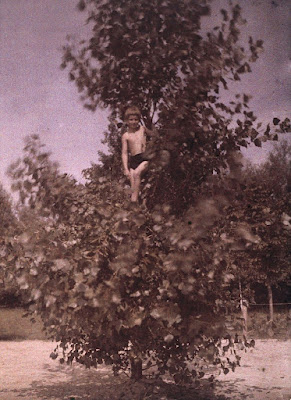
Friedrich Adolf Paneth
Heinz Paneth in a Tree
ca. 1925
autochrome
Victoria & Albert Museum, London

Anonymous Photographer
Woman in a Tree
ca. 1910
gelatin silver print
Victoria & Albert Museum, London

Léon Bonvin
Landscape with Bare Tree and Plowman
1864
drawing, with watercolor
Getty Museum, Los Angeles

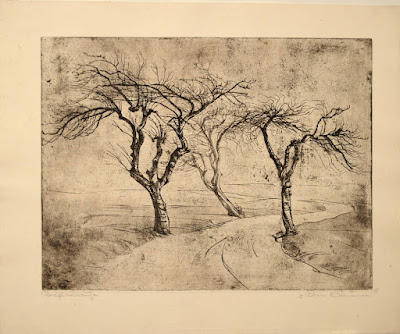
Rolf Krause
Three Trees
before 1982
etching
Gemäldegalerie, Dresden

George Henry Smillie
Avenue of Trees
1878
watercolor
Yale University Art Gallery

Paul Cézanne
Avenue of Chestnut Trees at the Jas de Bouffon
ca. 1878-90
watercolor
Städel Museum, Frankfurt

Meade Ashley Spencer
Apple Tree
1928
etching
Cleveland Museum of Art, Ohio

John Taylor Arms
The Apple Tree
1920
etching
Chrysler Museum of Art, Norfolk, Virginia

Jacques Hnizdovsky
Apple Tree
before 1985
drawing
Chrysler Museum of Art, Norfolk, Virginia

Vance Gellert
Apple Tree, Isles
1991
C-print
Minneapolis Institute of Art

Auguste Lepère
The Dead Apple Tree
1913
etching
Art Institute of Chicago

Nicolaas Bastert
Two Studies of Tree and Fence
ca. 1910
drawing
Teylers Museum, Haarlem

James Stack Lauder 
Tree Study
ca. 1880
albumen print
Museum of Fine Arts, Boston

Zoe Leonard
Detail (Tree + Fence)
1998
gelatin silver print
Tate Gallery

Charles Clifford
Walnut Tree of Emperor Charles V at Yuste
1858
albumen silver print
Metropolitan Museum of Art, New York

Eric Thake
Soldier's Memorial Tree
1957
gelatin silver print
National Gallery of Victoria, Melbourne

from Industrial Teflon Comes Into Domestic Use

After the wars were over, the ones people sang about,  
things quit sticking. My grandparents, for instance,
shook the dirt from their shoes and moved to town,
drove the paved streets of Columbia, spurned
orange juice for astronaut Tang.
And what year exactly did I start shaking off hugs?

For a wedding gift, I got Teflon pans.
Teflon, if you'd like to know, is a long-chain polymer,
a fluorocarbon plastic, like Freon.
As good as gold and platinum at resisting things.
Eggs slide right off, as on TV.
Not to mention what came after, Reagan and Bush,
facts sliding across the screen, disappearing
out of memory.
Not to mention the literary canon: Pope, Richardson,
Dryden, Spenser. Who reads them now?

– Fleda Brown (2000)

Wednesday, February 12, 2014

Landscape


California photographs.

Above, the arid south.

Below, the foggy north.


Images by Carol M. Highsmith, from the large archive of her work at the Library of Congress.

Sunday, August 25, 2013

Panorama


This twelve-page "panorama" of drawings was published in the catalog to the James Castle retrospective mounted in 2008 at the Philadelphia Museum of Art. At top the artist gazes (in fact or in memory or in imagination) down the road away from home. Then he slowly pivots and draws and pivots and draws – though successive scenes don't line up literally edge to edge. Perspectives and light effects vary, but the circle  is continuous. And completes with a face-on symmetrical picture of the farmhouse and its trees.

Tuesday, August 20, 2013

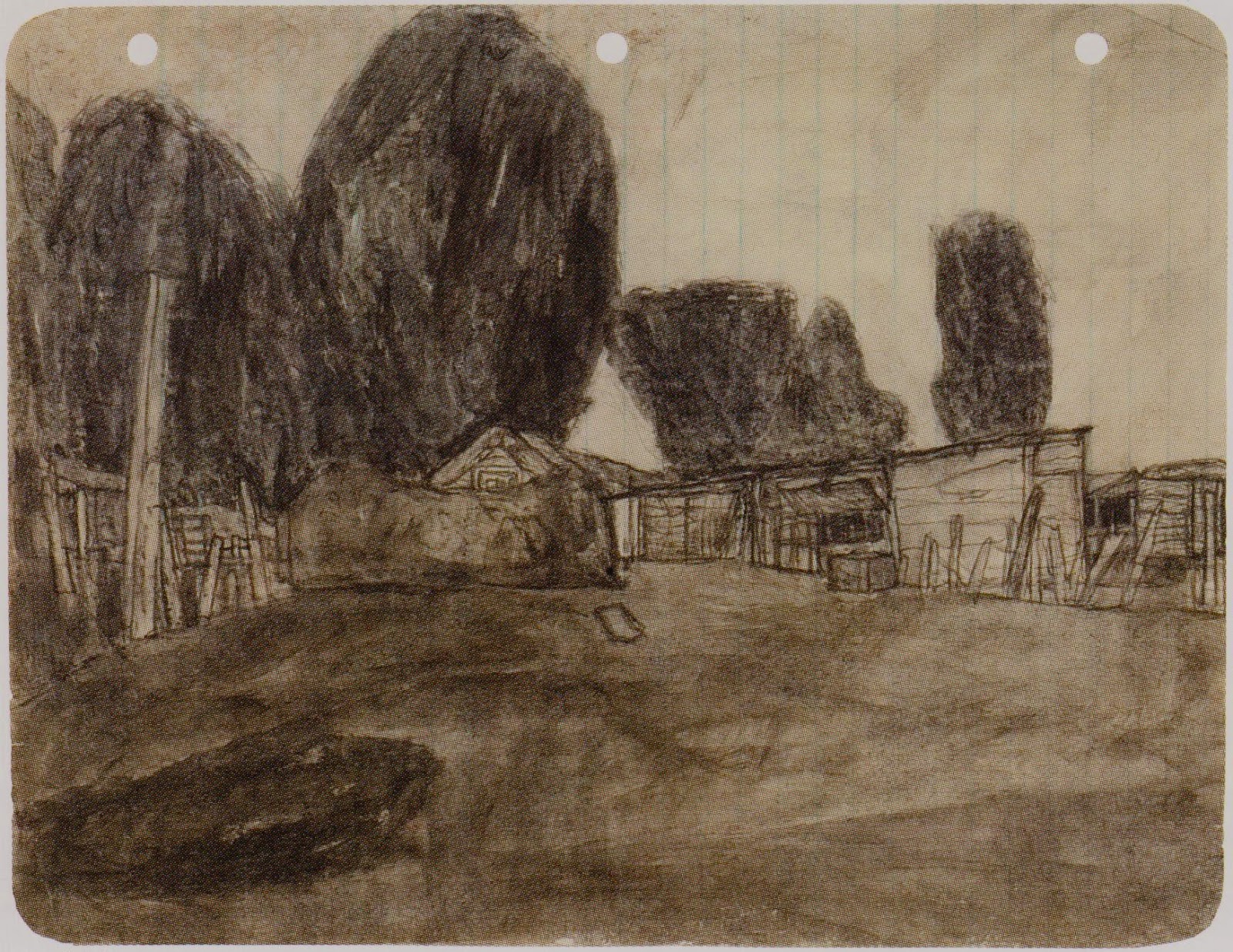
Farmyards


These farmyard landscapes were the first images I chanced to see when I became aware of artist James Castle (1899-1977). They remain with me as the essence of his art, even though the distortions and singularities that distinctively mark most of his work are not forcefully evident here.

Those above were drawn from memories of the farm in Garden Valley, Idaho where James Castle grew up. He continued to draw this landscape all his life, even though his family sold the farm in 1923. They moved to another part of the state. As their dependent, the deaf son who could not speak or read or write went along to other places with other atmospheres.


Fragments of architecture could float free if they chose. They looked equally coherent scattered around a field or assembled into vibrating emanence.


Toward the end of his life James Castle repeatedly drew small freestanding houses and made a point of showing the pictures to his relatives. They understood these drawings as a request for his own little house to live in elsewhere on the property, outside the family house. As the fifties turned into the sixties, Castle's work (promoted by a nephew) began to be shown and sold on a small scale in regional galleries. To their great credit, family members used the first money generated by art sales to buy a small prefabricated house. James Castle inhabited it and appeared to be delighted with it.