Showing posts with label parks. Show all posts

Thursday, November 16, 2023

Visual Relics (1854-1857)

Félix-Jacques Moulin
Model kissing her Reflection
ca. 1854
hand-colored daguerreotypes (stereograph)
Getty Museum, Los Angeles

Félix-Jacques Moulin
Genre Scene
ca. 1854
albumen print
Princeton University Art Museum

Alban-Adrien Tournachon and Félix Nadar
Pierrot Yawning
1854
salted paper print
Nelson-Atkins Museum of Art, Kansas City, Missouri

attributed to Bruno Braquehais
Model in Diaphanous Gown
ca. 1854
hand-colored daguerreotypes (stereograph)
Getty Museum, Los Angeles

attributed to Bruno Braquehais
Reclining Model in Harem Costume
ca. 1856
hand-colored daguerreotypes (stereograph)
Getty Museum, Los Angeles

Anonymous Photographer
Portrait of Annie Holland
ca. 1855
hand-colored daguerreotype
Chrysler Museum of Art, Norfolk, Virginia

Anonymous Photographer
Portrait of Arthur Holland (postmortem)
ca. 1855
hand-colored daguerreotype
Chrysler Museum of Art, Norfolk, Virginia

Olympe Aguado
Gros Chêne au Bois de Boulogne
ca. 1855
albumen silver print
Getty Museum, Los Angeles

Olympe Aguado
Crossroads in the Bois de Boulogne
ca. 1856
albumen print
Nelson-Atkins Museum of Art, Kansas City, Missouri

Jeremiah Gurney
Mr & Mrs Moses Sperry Beach
ca. 1855
hand-colored daguerreotype
Nelson-Atkins Museum of Art, Kansas City, Missouri

Félix Nadar
Antoine-Samuel Adam-Salomon
ca. 1855
albumen print
Nelson-Atkins Museum of Art, Kansas City, Missouri

Louis-Pierre-Théophile Dubois de Nehaut
Women Stacking Carrots
ca. 1854-56
salted paper print
Metropolitan Museum of Art, New York

Louis-Pierre-Théophile Dubois de Nehaut
La nièce de M. Tahon,
propriétaire de la maison n° 7

ca. 1854-56
salted paper print
Metropolitan Museum of Art, New York

Louis-Pierre-Théophile Dubois de Nehaut
Construction of Commemorative Fountain
1856
salted paper print
Cleveland Museum of Art, Ohio

Oscar Gustave Rejlander
Standing Model
ca. 1857
albumen print
Princeton University Art Museum

Oscar Gustave Rejlander
There He Goes
1857
albumen print
Los Angeles County Museum of Art

Angels Grieving over the Dead Christ

         The epitaphios of Thessaloniki

From those few famous silkworms smuggled
Into Constantinople in the head of a walking stick
Silk waterfalls
Poured from the ancient bolts

Into now-destitute reservoirs
Of church treasuries in Aachen,
In Liège, in Maastricht, in Sens,
In the Sancta Sanctorum of the Vatican,

Bright rivers seeping past
The age when a teaspoonful of
Silkworm eggs the size of one grain
Could endow a church,

The age when the letters in the words
Of sacred testaments were
Unreeled in the coastal cities of Asia Minor,
When a bookworm conspired

To wrest a maze of empty roads
Through the words My Lord –
That ancient, flickering text
Once permanently affixed

By blind but face-picturing, speechless
But law-breaking wooden shuttles,
Now a heap of gold wires displayed
With a crumbling silk vestment someone

Plucked from a shovelful of dust
During one of those treasure hunts conducted
In the burying grounds, in other eras,
A shovelful of dust

Now blowing into your eyes,
As if a storm wind from Paradise
Blew the rumors of this death
So hard you must cover your eyes

Before the museum case.
The late afternoon tugs
At a gold thread you can hear fraying
When you close your eyes,

A thread you feel your way along,
A thread at which the invisible globe pulls,
Leading you to the end of the world
Where there is a pile of

Clothes stolen from the grave,
Where your fear is relegated
To a masterwork of silk slaves –
That He is dead.

Here death is only a flash of worlds
Unfurled from a rifled
Church treasury, and you are invited
To walk this alluvial wave of gold,

To walk in the labyrinths 
Of the angels' howls,
To run your hands along the walls
Of the silk thread's passageways,

To feel with your fingers
The angels' barbaric, stifled,
Glittering vowels
Tightly woven with gold wires.

If you were to tug at one,
Unraveling the angels
Into a vivid labyrinth of thread
From the fourteenth century

Backwards to the scissors blade
A seraph takes to a fragile
Filament of gilt
According to a law still unrevealed,

The shroud would disappear
In the gust of a little breeze
From this door left ajar
Into the next life,

The threshold we cross with closed eyes –
Where angels hide behind their backs
The saws with which they mean
To saw the present from the past,

Oblivious to the scarlet threads
That prove to be hidden among
The filaments, those red rivers
Running through the theme of time

So shockingly – so before you set foot there,
Take heed. This is the work
Of Byzantine silk slaves confined
To the palace grounds at Constantinople,

And you must beware.
There was a way station
On the Silk Road
Where the authorities executed

Traitors in a wooden box
In innumerable, unspeakable ways.
When you touch this shroud from the east
You take that hundred feet of road.

You must walk softly past.
You must try not to look.
The torrent of words – later, later.
Here tongues are cut out,

And that is why the howling
Is mute,
Gilded, herringboned.
Because although this is death,

It is the work of slaves
Whose task was only
To expose the maximum amount of gold thread
To the ceiling price of so many nomismata

Per square inch, in a swift mischief
Of curious knots, of mazes
Flashing past, of straight paths
Made inextricable,

So look again.
The angels wring their hands
Over a statue. They are deranged,
But not by grief. They mourn

Not a body, but a work of bronze.
They do not bring a mortal to the grave.
But we onlookers who grieve and grieve –
We cannot relegate this thought

To a glory woven cryptically
In heavy silks;
We cannot consign it, sweep it off,
For we cannot weigh

In our palms the empty cocoons,
We cannot study
Within the secret workshops
Of the silkworm,

We cannot touch the boiling
Water where the spools whirl,
We cannot learn firsthand
The bleakness of the craft

With which God made the world,
We cannot recount the legend that,
When they met face-to-face, both
God and the worm laughed.

Note: The title is from a description of the Thessalonikian epitaphios in Byzantium, by Paul Hetherington and Werner Forman (London: Orbis, 1983). Hetherington proposes that the epitaphios, an Orthodox liturgical length of cloth, was worn, perhaps, over the heads of priests as they approached the altar to celebrate the Eucharist. The epitaphios of Thessaloniki was discovered in 1900.

– Gjertrud Schnackenberg (Supernatural Love: Poems 1976-1992)

Thursday, November 9, 2023

Visual Relics (1980-1982)

Joel Meyerowitz
Untitled
1980
dye transfer print
Nelson-Atkins Museum of Art, Kansas City, Missouri

Robert Mapplethorpe
Helen Whitney
1980
gelatin silver print
Los Angeles County Museum of Art

Robert Mapplethorpe
Peter Reed, New York City
(Contemporary Ballet Company)
1980
gelatin silver print
Princeton University Art Museum

Lawrence J. Merrill
New York City
1981
C-print
Minneapolis Institute of Art

Garry Winogrand
Untitled
1981
gelatin silver print
Minneapolis Institute of Art

Garry Winogrand
Untitled
1981
gelatin silver print
Minneapolis Institute of Art

Minette Lehmann
Man: A Treatise
1981
gelatin silver prints
Art Institute of Chicago

Deborah Turbeville
Versailles
1981
gelatin silver print
Victoria & Albert Museum, London

Gotfryd Bernard
Mikhail Baryshnikov, Rudolf Nureyev, Paul Taylor - in Rehearsal
1981
35mm slide
Library of Congress, Washington DC

Duane Michals
The Return of the Prodigal Son I
1982
gelatin silver print
Princeton University Art Museum

Duane Michals
The Return of the Prodigal Son II
1982
gelatin silver print
Princeton University Art Museum

Duane Michals
The Return of the Prodigal Son III
1982
gelatin silver print
Princeton University Art Museum

Duane Michals
The Return of the Prodigal Son IV
1982
gelatin silver print
Princeton University Art Museum

Duane Michals
The Return of the Prodigal Son V
1982
gelatin silver print
Princeton University Art Museum

Nan Goldin
Brian in the Cabana, Puerto Juárez, Mexico
1982
C-print
Milwaukee Art Museum

Larry Fink
Self and Molly
1982
gelatin silver print
Los Angeles County Museum of Art

He Posits Certain Mysteries

The body of the boy who took his flight
off the cliff at Kilchloher into the sea
was hauled up by curragh-men, out at first light
fishing mackerel in the estuary.
"No requiem or rosary" said the priest,
"nor consecrated ground for burial,"
as if the boy had flown outside the pale
of mercy or redemption or God's love.
"Forgive them, for they know not what they do,"
quoth Argyle to the corpse's people,
who heard in what he said a sort of riddle,
as if he meant their coreligionists
and not their sodden, sadly broken boy. 
Either way, they took some comfort in it
and readied better than accustomed fare
of food and spirits; by their own reckoning:
the greater sin, the greater so the toll. 
But Argyle refused their shilling coin
and helped them build a box and dig a grave.
"Your boy's no profligate or prodigal,"
he said, "only a wounded pilgrim like us all.
What say his leaping was a leap of faith,
into his father's beckoning embrace?"
They killed no fatted calf. They filled the hole.

– Thomas P. Lynch (2011)

Monday, November 6, 2023

Visual Relics (1969-1973)

William Eggleston
Jackson, Mississippi
ca. 1969
dye transfer print
Nelson-Atkins Museum of Art, Kansas City, Missouri

William Eggleston
Huntsville, Alabama
1971
dye transfer print
Milwaukee Art Museum

William Eggleston
Sumner, Mississippi
ca. 1972
dye transfer print
Chrysler Museum of Art, Norfolk, Virginia

Michael Peto
Ian McKellen
1969
bromide print
National Portrait Gallery, London

Joel Meyerowitz
Untitled (Central Park Scene)
1969
gelatin silver print
Nelson-Atkins Museum of Art, Kansas City, Missouri

Diane Arbus
King and Queen of Senior Citizens' Dance, N.Y.C.
1970
gelatin silver print
Yale University Art Gallery

Diane Arbus
Untitled
1970-71
gelatin silver print
Chrysler Museum of Art, Norfolk, Virginia

Richard Avedon
Jean Genet, New York City
1970
gelatin silver print
Cleveland Museum of Art

Leon Levinstein
Houston Street
1970
gelatin silver print
Minneapolis Institute of Art

Larry Clark
Untitled
1971
gelatin silver print
Minneapolis Institute of Art

Lee Friedlander
Statue, New Jersey
1971
gelatin silver print
Minneapolis Institute of Art

Bill Owens
I Really Love Him
ca. 1972
gelatin silver print
Nelson-Atkins Museum of Art, Kansas City, Missouri

Larry Fink
Parsons School of Design Costume Party
1972
gelatin silver print
Minneapolis Institute of Art

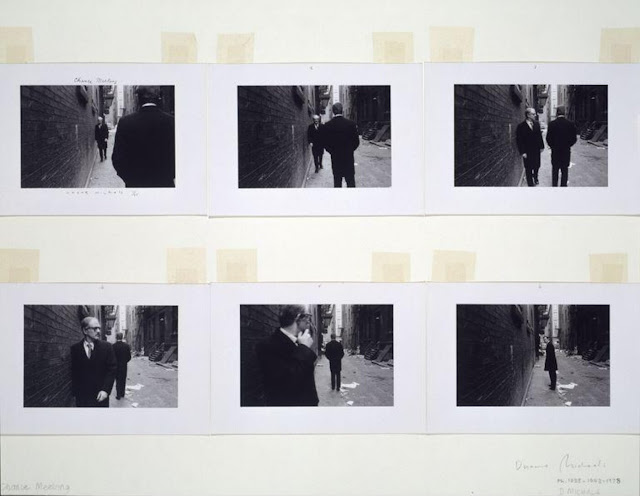
Duane Michals
Chance Meeting
1972
gelatin silver prints
Victoria & Albert Museum, London

Louis Faurer
Bowing for the Vogue Collections, Paris
1972
gelatin silver print
Milwaukee Art Museum

Louis Faurer
New York
1973
gelatin silver print
Milwaukee Art Museum

Walking to Work

It's going to be the sunny side
from now
             on. Get out, all of you.

This is my traffic over the night
and how
             should I range my pride

each oceanic morning    like a cutter
if I
    confuse the dark world is round
round who
              in my eyes at morning saves

nothing from nobody? I'm becoming
the street.
                Who are you in love with?
me?
     Straight against the light I cross.

– Frank O'Hara (1926-1966)

Saturday, February 22, 2020

Painted Views - Gardens, Fields, Parks

John Aldridge
Garden in January
1967
oil on canvas
Chelmsford Museum, Essex

George Vicat Cole
A Surrey Cornfield
1864
oil on canvas
Touchstones Rochdale, Lancashire
 
William Davis
Corner of a Cornfield
ca. 1870
oil on panel
Walker Art Gallery, Liverpool

Cherryl Fountain
View of Priest's House and Tower, Sissinghurst
1987
acrylic and oil on canvas
National Trust, Sissinghurst Castle, Kent

Jean Frélaut
Apple Blossom
before 1939
oil on canvas
Ashmolean Museum, Oxford

Harvest

What a relief to have the cherry tree gone,
to leave the ladder in the shed the whole month of June
and think of nothing redder than a glass of Beaujolais
as we celebrate not making cherry pies and jam.

Here's to the way we used to net the tree
and haul it in like plunder, unwilling
to let the birds have even a taste,
my bucketful and yours added
to all the others in the washtub.

And here's to the pitting, those long afternoons
of splatters and speckles, faces and walls measled,
our hands streaked, forearms and elbows sticky with trickles,
the telephone marked by our answering,
and every other thing we touched
blotched like evidence.

Here's to the end of evenings at the boiling stove,
to measuring and timing, and to jam, of course,
that garnet made of the best summer days,
the ones we squander now in idleness, feeling richer.

– Neal Bowers (1996)

Camille Pissarro
View from my Window, Éragny-sur-Epte
ca. 1886-88
oil on canvas
Ashmolean Museum, Oxford

Charles Jacque
Mowers
ca. 1860-70
oil on panel
Bowes Museum, Barnard Castle, County Durham

Charles Ginner
Pond Square, Highgate
1932
oil on canvas
The Hepworth, Wakefield, Yorkshire

Adrian Allinson
The AFS Dig-for-Victory in St James's Square
1942
oil on board
City of Westminster Archives Centre, London

Spencer Gore
Panshanger Park
1908
oil on canvas
Southampton City Art Gallery

Carl Laubin
A Reconstruction of Claydon House
1987
oil on canvas
National Trust, Claydon House, Buckinghamshire

Derwent Wise
Blagdon Hall, Northumberland
1990
acrylic on paper
Hatton Gallery, Newcastle-upon-Tyne

Paul Maitland
Kensington Gardens
ca. 1890
oil on canvas
Ashmolean Museum, Oxford

John Nash
Walled Pond, Little Bredy, Dorset
1923
oil on canvas
Aberdeen Art Gallery, Scotland

Stanley Spencer
Clipped Yews
ca. 1938
oil on canvas
Aberdeen Art Gallery, Scotland