Showing posts with label rococo. Show all posts

Sunday, July 12, 2026

Utility

Anonymous German Artist
Design for Candlestick
1551
engraving
Herzog August Bibliothek, Wolfenbüttel

Erasmus Horninck
Design for Candlestick with Satyrs
ca. 1570-80
drawing
(print study)
Museum für Angewandte Kunst, Vienna

Jakob Wilhelm Heckenauer
Design for Rococo Wall-Light
ca. 1728
engraving
Herzog Anton Ulrich Museum, Braunschweig

Benigno Bossi after Ennemond Alexandre Petitot
Vase with Lions
1764
etching
Kupferstichkabinett, Staatliche Kunstsammlungen, Dresden

workshop of Francesco Salviati
Design for Vessel with Lion Heads
ca. 1550
drawing
Museum für Angewandte Kunst, Vienna

Ignác Bendl
Fantastical Vases
ca. 1690
etching
Museum für Angewandte Kunst, Vienna

Giulio Romano
Design for Casket
ca. 1530
drawing
Statens Museum for Kunst, Copenhagen

Jacques Androuet du Cerceau the Elder
Design for Lidded Cup
ca. 1555
etching
Museum für Angewandte Kunst, Vienna

Augustin Hirschvogel
Grotesque Composite Jug
1543
etching
Herzog Anton Ulrich Museum,
Braunschweig

Cornelis Floris the Younger
Design for Pitcher
1548
engraving
Museum für Angewandte Kunst, Vienna

Cornelis Floris the Younger
Design for Sweetmeat Dish
1548
engraving
Museum für Angewandte Kunst, Vienna

Jean Le Pautre
Design Studies for Ewer
ca. 1660
drawing
Kupferstichkabinett,
Staatliche Kunstsammlungen, Dresden

Susanne Maria von Sandrart after Jean Le Pautre
Vase Design with Fruit Garlands
1678
etching
Herzog Anton Ulrich Museum, Braunschweig

Christoph Melchior Roth
Rococo Vase
ca. 1760
etching
Herzog Anton Ulrich Museum, Braunschweig

Johann Gottfried Thelott after Martin Engelbrecht
Rococo Vase Design with Marine Elements
ca. 1735
etching
Herzog Anton Ulrich Museum, Braunschweig

Johann Jakob Schübler
Design for a Clock
ca. 1730
engraving
Museum für Angewandte Kunst, Vienna

The people of Athens being advertised of the state of their army, how it was in distress, and that victual was transported into the island, knew not what they should do to it and feared lest winter should overtake them in their siege, fearing not only that to provide them of necessaries about Peloponnesus, and in a desert place withal, would be a thing impossible, but also that they should be unable to send forth so many things as were requisite, though it were summer; and again, that the parts thereabout being without harbour, there would be no place to lie anchor in against them, but that the watch there ceasing of itself, the men would by that means escape or in some foul weather be carried away in the same boats that brought them meat.  But that which they feared most was that the Lacedaemonians seemed to have some assurance of them already, because they sent no more to negotiate about them.  And they repented now that they had not accepted of the peace.  But Cleon, knowing himself to be the man suspected for hindering the agreement, said that they who brought the news reported not the truth.  Whereupon, they that came thence advising them, if they would not believe it, to send to view the estate of the army, he and Theogenes were chosen by the Athenians to view it.  But when he saw that he must of force either say as they said whom he before calumniated or, saying the contrary, be proved a liar, he advised the Athenians, seeing them inclined of themselves to send thither greater forces than they had before thought to do, that it was not fit to send to view the place nor to lose their opportunity to delay; but if the report seemed unto them to be true, they should make a voyage against those men; and glanced at Nicias, the son of Niceratus, then general, upon malice and with the language of reproach, saying it was easy, if the leaders were men, to go and take them there in the island; and that himself, if he had the command, would do it.

– from The Peloponnesian War as written by Thucydides (5th century BC) and translated by Thomas Hobbes (1628) and edited by David Grene (1959)

Monday, March 23, 2026

Rococo

Anonymous French Designer
Rococo Revival
ca. 1915
block-printed wallpaper
Cooper Hewitt, Smithsonian Design Museum


Cheney Brothers (Manchester, Connecticut)
Brocatelle
1925
printed silk and linen upholstery fabric
National Museum of American History, Washington DC

Anonymous French Designer
Cope Hood
ca. 1700
silk satin damask with metallic thread brocading
Cooper Hewitt, Smithsonian Design Museum

Anonymous French Designer
L'Ouïe
ca. 1935
block-printed wallpaper
Cooper Hewitt, Smithsonian Design Museum

Anonymous French Designer
Loop-knotted Ribbons
ca. 1900
block-printed wallpaper border
Cooper Hewitt, Smithsonian Design Museum

Anonymous French Designer
Rococo Revival
ca. 1910
block-printed wallpaper
Cooper Hewitt, Smithsonian Design Museum

Nicolas Jean-Baptiste de Poilly
Rococo Ornament Design
ca. 1730-40
etching and engraving
Cooper Hewitt, Smithsonian Design Museum

Nicolas Jean-Baptiste de Poilly
Rococo Cartouche Design
ca. 1730-40
etching and engraving
Cooper Hewitt, Smithsonian Design Museum

Anonymous British Designer
Rococo Revival
ca. 1880-90
embossed and hand-painted wallpaper
Cooper Hewitt, Smithsonian Design Museum

Anonymous American Designer
Rococo Revival
ca. 1875
machine-printed wallpaper
Cooper Hewitt, Smithsonian Design Museum

Anonymous French Designer
Border with Griffin
18th century
Valenciennes bobbin-lace of linen
National Museum of American History, Washington DC

Anonymous French Designer
Embroidery Sample
ca. 1770
silk embroidery with sequins on silk velvet
Cooper Hewitt, Smithsonian Design Museum

Anonymous French Designer
Embroidery Sample
ca. 1770
silk embroidery with sequins on silk velvet
Cooper Hewitt, Smithsonian Design Museum

Anonymous American Designer
Rococo Revival
ca. 1930-40
machine-printed wallpaper
Cooper Hewitt, Smithsonian Design Museum

Anonymous French Designer
Rococo Revival
ca. 1928-29
machine-printed wallpaper
Cooper Hewitt, Smithsonian Design Museum

Anonymous French Designer
Fabric Panel
ca. 1740-60
silk satin brocade with metal-wrapped threads
Cooper Hewitt, Smithsonian Design Museum

Anonymous American Designer
Paper Doll Costume
ca. 1876-80
die-cut and hand-colored lithograph
Cooper Hewitt, Smithsonian Design Museum

21 September 1946

    We went to Rochester.  Saw the gulls on the brown mud, heard the boys and men singing and droning beautifully in the cathedral.  Close up to me lump of the Norman pillar, so massive. it made me think for once of all the weight in the air above me – every moment pressing down, threatening century after century.  
    And the west front with the broken saints, thin in their Romanesque niches – black, crusted, cruelly restored in some places.  It gave me the feeling of a noble slum.  It had been there, I suppose, since the twelfth century, gathering all the defacements and scourings and mendings to it, until it seemed toughened to receive almost any outrage. 

                *

    We found the Guildhall door open so we went up the fine wide staircase, gazed up at the plaster angel's fully modelled stomach in the middle of the ceiling, admired the wide panels on the walls, then came into the fine room hung with full-length portraits nearly all in early eighteenth or late seventeenth-century clothes.  Only one man was in nineteenth-century tailcoat.  And he seemed disregarded by all the men of Anne's reign, and Anne herself.  Or perhaps it is truer to say that all the whigged people were so busy concentrating on their own consequence that his lesser sort of pomposity looked almost like the sad smiling anxiety of the snubbed.

– from The Journals of Denton Welch (who was born in 1915, gravely injured in 1935, then wrote the journals between 1942 and his early death in 1948), edited by Michael De-la-Noy (1984)

Thursday, May 15, 2025

Narrative Tendencies (1738-1780)

Cornelis Troost
Harlequin, Magician and Barber
(The Rivals Exposed)

1738
pastel and gouache on paper
Mauritshuis, The Hague

Franz Christoph Janneck
The Embarcation for Cythera
ca. 1740
oil on copper
Deutsche Barockgalerie, Augsburg

Jacopo Amigoni
The Encounter of Anthia and Habrocomes
(scene from The Ephesian Tale by Xenophon of Ephesus)
1744
oil on canvas
Staatsgalerie Stuttgart

Henri de Favanne
Parting of Telemachus and Eucharis
(scene from The Adventures of Telemachus by François Fénelon)
ca. 1746
oil on canvas
Musée des Beaux-Arts de Lyon

Gaspare Traversi
The Portrait Session
ca. 1750
oil on canvas
Musée Magnin, Dijon

Pompeo Batoni
Scene of Frenzy
ca. 1760
drawing
National Gallery, Athens

Gabriel de Saint-Aubin
The Death of Tancrède
(scene from Voltaire's verse drama, Tancrède)
ca. 1760
drawing, with added watercolor
Morgan Library, New York

Francesco Bartolozzi after Sebastiano Ricci
Furius Camillus liberating Rome from Brennus
(episode described by Plutarch)
1763
etching printed in two colors
Scottish National Gallery, Edinburgh

Jean-Baptiste Greuze
The Father's Curse on the Ungrateful Son
ca. 1765
drawing
Palais des Beaux-Arts de Lille

François Boucher
Boreas abducting Oreithyia
(scene from Ovid's Metamorphoses)
1769
oil on canvas
Kimbell Art Museum, Fort Worth, Texas

Jacques-Louis David
The Death of Seneca
(scene from the Annals of Tacitus)
1773
oil on canvas
Musée du Petit Palais, Paris

Gaetano Fryer
Lucius Albinus offering his Cart to the Vestal Virgins
(scene from Livy's History of Rome)
1774
oil on canvas
Galleria Nazionale di Parma

Marco Marcola
Scene of Assassination from Ancient History
ca. 1775
drawing
Morgan Library, New York

Jean-Pierre Norblin
The Pierides transformed into Magpies
(scene from Ovid's Metamorphoses)
ca. 1780
oil on canvas
National Museum, Warsaw

Antoine-François Callet
Sacrifice of Polyxena
(scene from Ovid's Metamorphoses)
ca. 1780-83
drawing
Kupferstichkabinett, Staatliche Museen zu Berlin

Then casting up his eyes, he saw before him a rare meadow, and in the midst of it a little Arbour, as he so farre off tooke it to bee, but drawing neerer he found a delicate Fountaine circled about with Orange, and Pomgranet trees, the ground under them all hard sand, about the Fountaine (as next adjoyning) was a hedge of Jesamins mingled with Roses and Woodbines, and within that, paved with pavements of divers colours, plac'd for shew and pleasure; on the steps he sate downe beholding the worke of the Fountaine which was most curious, being a faire Maide as it were, thinking to lade it drie, but still the water came fast, as it past over the dish she seemed to lade withall.  "And just thus," said hee, "are my labours fruitlesse, my woes increasing faster then my paines find ease."  Then having enough, as hee thought, given liberty to his speech, he put the rest of his thought into excellent verse, making such excelling ones, as none could any more imitate or match them, then equall his valour: so exquisite was he in all true vertues, and skill in Poetry, a quallitie among the best much prized and esteemed, Princes brought up in that, next to the use of Armes.

– from The Countesse of Mountgomeries Urania, by the right honourable the Lady Mary Wroath, daughter to the right noble Robert, Earle of Leicester, and neece to the ever famous and renowned Sʳ Phillips Sidney knight, and to ye most excellant Lady Mary Countess of Pembroke, late deceased (London: John Marriott and John Grismand, 1621)

Friday, January 10, 2025

Curio Cabinet

Anonymous American Makers
Candlesticks
ca. 1920
glass
Clark Art Institute, Williamstown, Massachusetts

Anonymous French Makers
Candlestick
19th century
ormolu, with porcelain figurine
Newport Mansions Preservation Society,
Rhode Island

Anonymous Persian Makers
Bottle
AD 1100-1200
glazed earthenware
Asian Art Museum, San Francisco

Anonymous German Makers
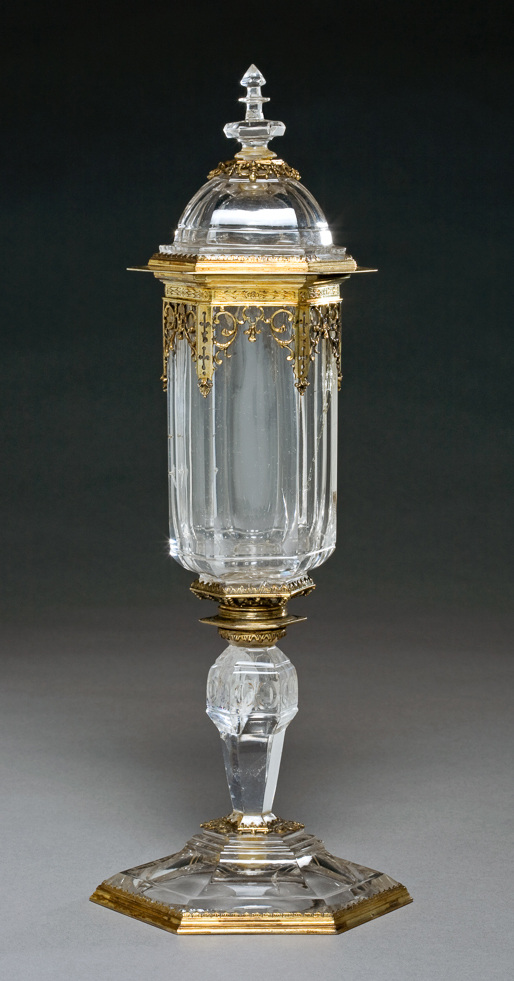
Reliquary
ca. 1550-1650
rock crystal, silver gilt, gold
Fitzwilliam Museum, Cambridge

Anonymous Greek Makers
Collection Box depicting the Legend of St Charalambos
18th or 19th century
painted wood
Royal Ontario Museum, Toronto

Anonymous Dutch Makers
Wallcovering
17th century
painted and gilded leather
Isabella Stewart Gardner Museum, Boston

Anonymous German Makers
Mirror
ca. 1750
mirrored glass with frame of carved oak,
papier-mâché and stucco (all gilded)
Bayerisches Nationalmuseum, Munich

Anonymous English Makers
Etui
ca. 1760-70
enamel on copper
Fitzwilliam Museum, Cambridge

Anonymous German Makers
Planter-Vase as Miniature Rococo Folding-Screen
19th century
porcelain
Newport Mansions Preservation Society, Rhode Island

Anonymous English Makers
Toilet Bowl
1895
glazed earthenware
Royal Ontario Museum, Toronto

Anonymous Russian Makers
Cigarette Case
19th century
enamelware
Newport Mansions Preservation Society, Rhode Island

Anonymous Russian Makers
Icon Cover
19th century
cloisonné on silver-gilt
Royal Ontario Museum, Toronto

Anonymous Persian Makers
Bowl of Water Pipe
ca. 1850-1900
brass with turquoise inlay
Asian Art Museum, San Francisco

Anonymous Persian Makers
Storage Jar
AD 500-700
glazed earthenware
Asian Art Museum, San Francisco

Anonymous French Makers
Apothecary Jar
ca. 1675-1725
glazed earthenware
Royal Ontario Museum, Toronto

Anonymous European Makers
Wine Jar
17th or 18th century
blown glass
Fitzwilliam Museum, Cambridge

Telemachus' Fantasy

Sometimes I wonder about my father's
years on those islands: why
was he so attractive
to women? He was in straits then, I suppose
desperate. I believe
women like to see a man
still whole, still standing, but
about to go to pieces: such
disintegration reminds them
of passion. I think of them as living
their whole lives
completely undressed. It must have
dazzled him, I think, women
so much younger than he was 
evidently wild for him, ready 
to do anything he wished. Is it
fortunate to encounter circumstances
so responsive to one's own will, to live
so many years
unquestioned, unthwarted? One
would have to believe oneself
entirely good or worthy. I
suppose in time either
one becomes a monster or
the beloved sees what one is. I never
wish for my father's life
nor have I any idea
what he sacrificed
to survive the moment. Less dangerous
to believe he was drawn to them
and so stayed
to see who they were. I think, though,
as an imaginative man
to some extent he
became who they were.

– Louise Glück (1996)