Showing posts with label conservation. Show all posts

Friday, January 2, 2026

Antiquarum Statuarum Urbis Romae

Lorenzo Vaccari (publisher)
Statues of Adonis and Emperor Augustus
(from Antiquarum Statuarum Urbis Romae)
1584
engraving
Herzog August Bibliothek, Wulfenbüttel

Lorenzo Vaccari (publisher)
Statues of Cleopatra and Venus
(from Antiquarum Statuarum Urbis Romae)
1584
engraving
Herzog August Bibliothek, Wulfenbüttel

Lorenzo Vaccari (publisher)
Statues of Crouching Venus and Spinario
(from Antiquarum Statuarum Urbis Romae)
1584
engraving
Herzog August Bibliothek, Wulfenbüttel

Lorenzo Vaccari (publisher)
Statues of Cupid and Apollo
(from Antiquarum Statuarum Urbis Romae)
1584
engraving
Herzog August Bibliothek, Wulfenbüttel

Lorenzo Vaccari (publisher)
Equestrian Statues of Amazon and Marcus Aurelius
(from Antiquarum Statuarum Urbis Romae)
1584
engraving
Herzog August Bibliothek, Wulfenbüttel

Lorenzo Vaccari (publisher)
Statues of Barbarian Captives
(from Antiquarum Statuarum Urbis Romae)
1584
engraving
Herzog August Bibliothek, Wulfenbüttel

Lorenzo Vaccari (publisher)
Statues of Faun and Fishing-Boy
(from Antiquarum Statuarum Urbis Romae)
1584
engraving
Herzog August Bibliothek, Wulfenbüttel

Lorenzo Vaccari (publisher)
Statues of Ganymede and Bacchus
(from Antiquarum Statuarum Urbis Romae)
1584
engraving
Herzog August Bibliothek, Wulfenbüttel

Lorenzo Vaccari (publisher)
Statues of Hercules
(from Antiquarum Statuarum Urbis Romae)
1584
engraving
Herzog August Bibliothek, Wulfenbüttel

Lorenzo Vaccari (publisher)
Statues of Hermaphrodite and Apollo
(from Antiquarum Statuarum Urbis Romae)
1584
engraving
Herzog August Bibliothek, Wulfenbüttel

Lorenzo Vaccari (publisher)
Statues of Horse-Tamers
(from Antiquarum Statuarum Urbis Romae)
1584
engraving
Herzog August Bibliothek, Wulfenbüttel

Lorenzo Vaccari (publisher)
Statues of Mercury
(from Antiquarum Statuarum Urbis Romae)
1584
engraving
Herzog August Bibliothek, Wulfenbüttel

Lorenzo Vaccari (publisher)
Statues of Muse and Flora
(from Antiquarum Statuarum Urbis Romae)
1584
engraving
Herzog August Bibliothek, Wulfenbüttel

Lorenzo Vaccari (publisher)
Statues of Pyrrhus and Julius Caesar
(from Antiquarum Statuarum Urbis Romae)
1584
engraving
Herzog August Bibliothek, Wulfenbüttel

Lorenzo Vaccari (publisher)
Statues of Roma and Minerva
(from Antiquarum Statuarum Urbis Romae)
1584
engraving
Herzog August Bibliothek, Wulfenbüttel

Lorenzo Vaccari (publisher)
Statues of Pan and Apollo
(from Antiquarum Statuarum Urbis Romae)
1584
engraving
Herzog August Bibliothek, Wulfenbüttel

Danaus:  Children, you must show good sense. This trusty old man, your father, with whom you have reached this place, has been a sensible shipmaster; now I have likewise taken thought regarding the situation on land, and I advise you to record my words on the tables of your mind and keep them safe. I can see a dust-cloud, the voiceless harbinger of an army; the sockets of wheels are not silent as the axles drive them round; and now I see a mass of men bearing shields and spears, together with horses and curve-fronted chariots.  Perhaps the ruler of this land and his followers may be coming to us to view for themselves what is happening here, after getting word from messengers. But whether he has set out on this mission with no harmful intent, or whetted with raw anger, it is best from every point of view, girls, to sit at this rock sacred to the Assembled Gods: an altar is an unbreakable shield, stronger than a city wall. But come as quickly as you can; hold reverently in your left hands your white-wreathed suppliant-branches, sacred emblems of Zeus the enforcer of respect, and answer the natives in words that display respect, sorrow and need, as it is proper for aliens to do, explaining clearly this flight of yours which is not due to bloodshed.* Let your speech, in the first place, not be accompanied by arrogance, and let it emerge from your disciplined faces and your calm eyes that you are free of wantonness. And be neither forward nor sluggish in speech: the people here are very ready to take offence. Remember to be yielding – you are a needy foreign refugee: bold speech does not suit those in a weak position. 

– Aeschylus, from Suppliants (ca. 470-460 BC), translated by Alan H. Sommerstein (2008)

*lack of bloodshed taken to mean that the suppliants are free of pollution, but also hinting at the bloodshed to come

Friday, March 31, 2023

Poussin's Sacraments - Originals versus Early Copies

Nicolas Poussin
Sacraments I - Baptism
1637-40    
oil on canvas
National Gallery of Art, Washington DC
(purchased from the Duke of Rutland)

Anonymous copyist working in Rome after Nicolas Poussin
Sacraments I - Baptism
before 1784
watercolor and gouache on paper
Musée du Louvre

Nicolas Poussin
Sacraments I - Confirmation
1637-40
oil on canvas
Fitzwilliam Museum, Cambridge
(on long-term loan from the Duke of Rutland)

Anonymous copyist working in Rome after Nicolas Poussin
Sacraments I - Confirmation
before 1784
watercolor and gouache on paper
Musée du Louvre

Nicolas Poussin
Sacraments I - Eucharist
1637-40
oil on canvas
Fitzwilliam Museum, Cambridge
(on long-term loan from the Duke of Rutland)

Anonymous copyist working in Rome after Nicolas Poussin
Sacraments I - Eucharist
before 1784
watercolor and gouache on paper
Musée du Louvre

Nicolas Poussin
Sacraments I - Extreme Unction
1637-40
oil on canvas
Fitzwilliam Museum, Cambridge
(purchased from the Duke of Rutland)

Anonymous copyist working in Rome after Nicolas Poussin
Sacraments I - Extreme Unction
before 1784
watercolor and gouache on paper
Musée du Louvre

Nicolas Poussin
Sacraments I - Marriage
1637-40
oil on canvas
Fitzwilliam Museum, Cambridge
(on long-term loan from the Duke of Rutland)

Anonymous copyist working in Rome after Nicolas Poussin
Sacraments I - Marriage
before 1784
watercolor and gouache on paper
Musée du Louvre

Nicolas Poussin
Sacraments I - Ordination
1637-40
oil on canvas
Kimbell Art Museum, Fort Worth, Texas
(purchased from the Duke of Rutland)

Anonymous copyist working in Rome after Nicolas Poussin
Sacraments I - Ordination
before 1784
watercolor and gouache on paper
Musée du Louvre

Jean Dughet after Nicolas Poussin
Sacraments I - Penance
ca. 1650
engraving
Clark Art Institute, Williamstown, Massachusetts
(Poussin's original painting destroyed in a fire in 1816
at Belvoir Castle, seat of the Dukes of Rutland)

Anonymous copyist working in Rome after Nicolas Poussin
Sacraments I - Penance
before 1784
watercolor and gouache on paper
Musée du Louvre

Nicolas Poussin
St John baptising the People
(not a component of the Sacrements series)
ca. 1630-40
oil on canvas
Getty Museum, Los Angeles
(purchased indirectly from the Duke of Rutland)

Anonymous copyist working in Rome after Nicolas Poussin
St John baptising the People
before 1784
watercolor and gouache on paper
Musée du Louvre

" . . . this Poussin is indeed a mighty eagle in his profession, or, to put it more clearly and without using metaphors, he is the most accomplished and perfect of all our modern painters.  It is not difficult to convince scholars of this, men who study and judge matters in the manner of mathematicians, that is to say with precision, on the basis of pure demonstration, through analysis of the principles involved, and without allowing opinion or favour, which are the bane of truth, to intrude.  Others, however, who have only a superficial knowledge, but yet have a very over-inflated view of their own judgment, will see this statement as a paradox, and in so doing render themselves incapable of ever being shown its truth.  That is why I leave them to argue about it, and content myself with having established in this treatise the fundamental principles and the method by which it should be dissected, without involving myself any further in this dispute.  I would only add by way of information that anyone who is curious enough to get to the stage of seeking decisive proof of Poussin's worth will find it amply demonstrated in his set of Seven Sacraments, which are to be seen in Paris at the residence of Monsieur Chantelou, a steward in ordinary to the King, and a close friend of this illustrious Poussin. [Chantelou owned, not the first set of Sacraments illustrated here, but the second set, in the same format, painted a few years later.  Unlike the first set, so disastrously mishandled by the Rutland Estate, the second set is still intact, and currently on view at the National Gallery of Scotland in Edinburgh.]  It is a series of seven uniform pictures, moderate in size, but of extraordinary diligence, in which this noble painter seems to have given us not only a perfect demonstration of the art in accordance with all the parts examined in this treatise, but also an illustration of the highest state of excellence which can be achieved, through his innovation and inventiveness, the nobility of his ideas on each subject, his scholarly and judicious observance of costume (in which he is almost unique), the force of his figures' expressions, and, in a word, all the same qualities discernible in the great geniuses of antiquity . . . "    

– Roland Fréart de Chambray, from An Idea of the Perfection of Painting (1662), translated by Fabia Claris and Bridget Maison (1990)

Friday, November 27, 2020

Dimly Legible Paintings (Darkened by Corroding Time or Dirt)

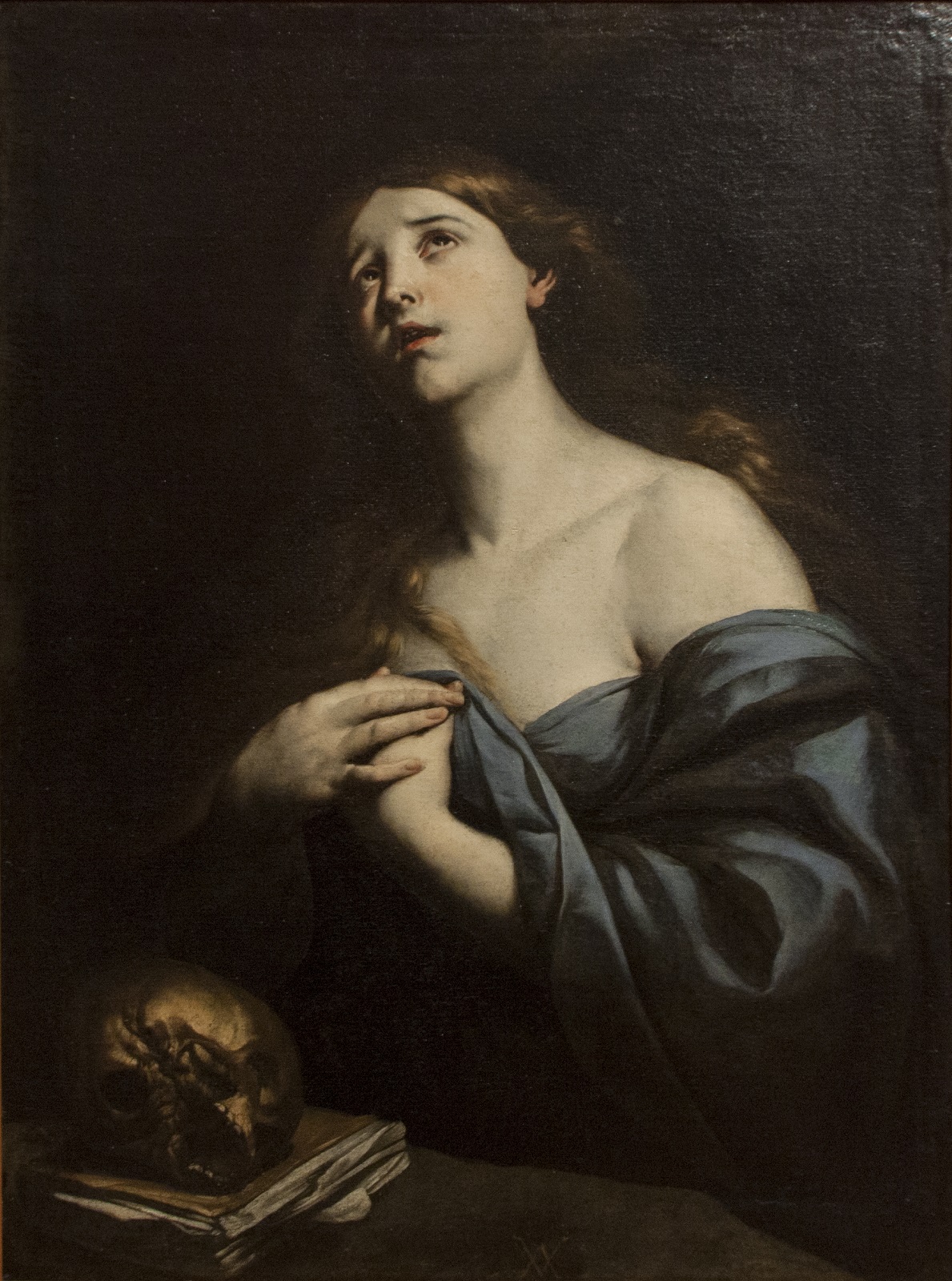
Andrea Vaccaro
Penitent Magdalen
before 1670
oil on canvas
Palazzo Abatellis, Palermo

Willem Drost
Apostle with a Book
ca. 1654-59
oil on canvas
National Museum, Warsaw

Giovanni Andrea Donducci (Mastelletta)
The Madonna distributing Alms
ca. 1610-12
oil on canvas
Pinacoteca Nazionale di Bologna

Luca Giordano
The Entombment
ca. 1659-60
oil on canvas
Detroit Institute of Arts

Francesco Maffei
Sacrifice of the Daughter of Jephthah
ca. 1650
oil on canvas
Castello del Buonconsiglio, Trento

Bacchiacca (Francesco Ubertini)
St John the Baptist in the Wilderness
before 1557
oil on panel, transferred to canvas
Detroit Institute of Arts

Gianlorenzo Bernini
Christ Mocked
ca. 1630
oil on canvas
private collection

Giovanni Battista Paggi
The Flagellation
1615
oil on canvas
Palazzo Bianco, Genoa

Agnolo Bronzino and workshop
Immaculate Conception (detail)
ca. 1570-72
oil on panel
Chiesa di Santa Maria Regina della Pace, Florence

from Blues for Alice

When you get in on a try you never learn it back
umpteen times the tenth part of a featured world
in black and in back it's roses and fostered nail
bite rhyme sling slang, a song that teaches without
travail of the tale, the one you longing live
and singing burn

                    *            *           *

Step down off our whelm lessons and shortly fired
enter the bristle strum of Corrosion Kingdom
where the last comes by first ever ring, every
race through that tunnel of sun drop and pencil
in the margins of a flare, of higher wish than dare,
the stroked calmings of a line will spin and chime
in blue quicks of a dream blues, the chores
of those whispering gone crenulations

 – Clark Coolidge, from Sound as Thought: Poems 1982-1984

Guercino (Giovanni Francesco Barbieri)
St Peter receiving the Keys from Christ
ca. 1618
oil on canvas
Pinacoteca Civica, Cento

Michiel van Musscher
Portrait of a Gentleman
ca. 1660-80
oil on canvas
Warrington Museum and Art Gallery, Cheshire

Domenico Riccio (Domenico Brusasorci)
Adoration of the Magi
1553
oil on canvas
Museo degli affreschi Giovanni Battista Cavalcaselle, Verona

Marco Pino
Raising of Lazarus
ca. 1570
oil on canvas
Yale University Art Gallery
 
Battista Franco
Baptism of Christ
ca. 1555
oil on canvas
Chiesa di San Francesco della Vigna, Venice

Giovanni Lanfranco
Samson battling the Lion
ca. 1632-33
oil on canvas
Pinacoteca Nazionale di Bologna

Monday, August 12, 2019

French Conquerors and Italian Pictures

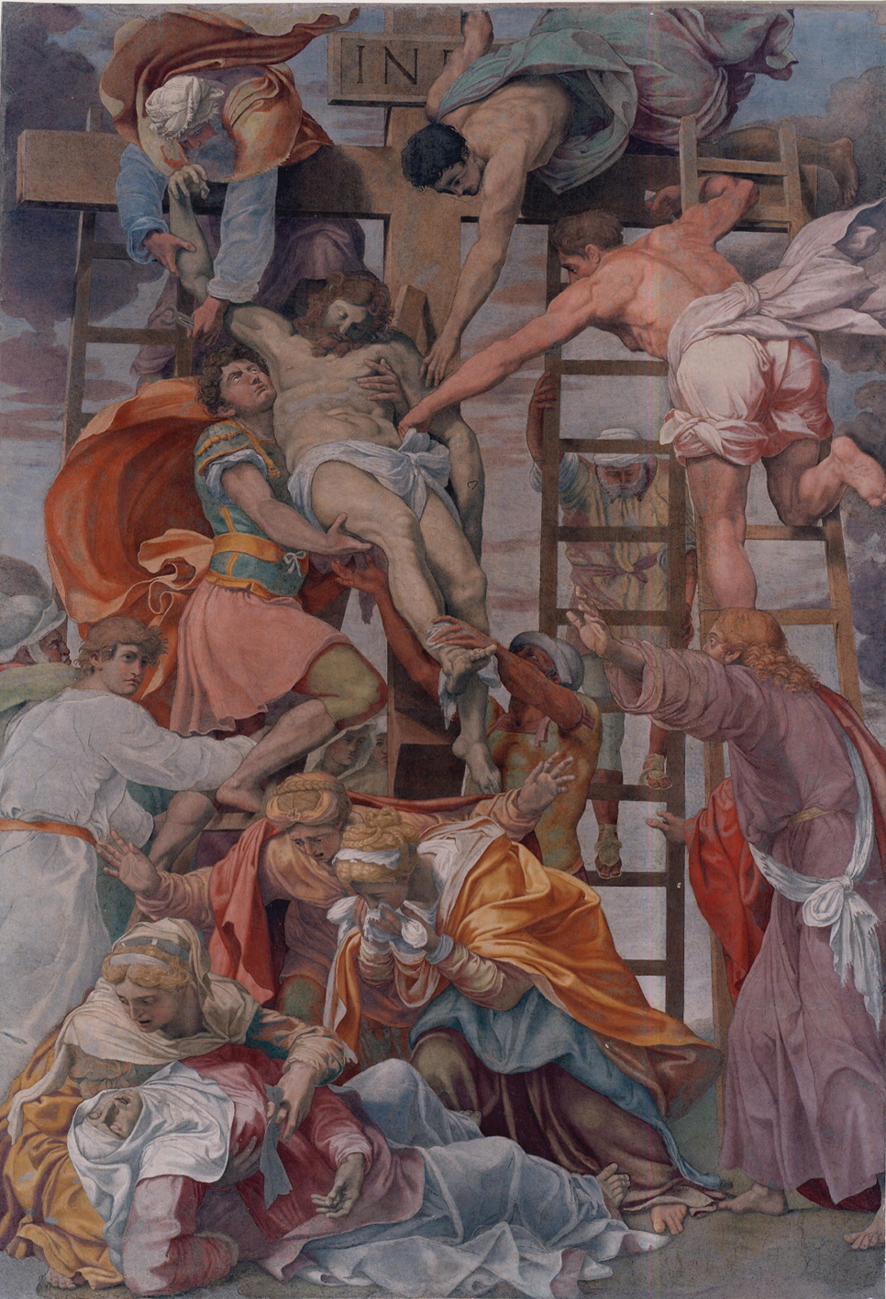
Daniele da Volterra
Descent from the Cross
1545
detached fresco mounted on canvas
Chiesa di Santissima Trinità dei Monti, Rome

"After the Revolution, the technique of removal was used to enable transport to Paris of paintings that the French government wanted to acquire.  It fabricated mobile objects to fill gaps in the museum that was opened in 1793 in the Louvre Palace.  The most significant interventions were carried out under the Empire, primarily in Italy.  One of the most famous was undertaken by Pietro Palmaroli, who was charged with detaching the Descent from the Cross painted by Daniele da Volterra in 1545.  In his Report dated June 28, 1794 (10 Messidor of Year II), Varon was already dreaming of "ripping it off the walls of Rome" and transporting it to the museum to complete the collection.  The National Museum called in vain for a single production by Daniele da Volterra, and did not know where to go to find it.  The superintendent's storehouse at Versailles has a Christ in the Tomb by this master.  How can we not rip from the walls of Rome that sublime fresco at the Trinità dei Monti, which posterity has ranked among the three masterpieces of painting?  . . .  According to this rhetoric, the French government only had to desire artworks for them to be removed from their support and transported to Paris.  The operation was, however, more complex.  For instance, a first attempt at stacco a massello was unsuccessfully undertaken on the work by Volterra. The board of the Musée Central learned in October 1798 that an attempt was being made to remove the painting without its consent.  The French administration was worried at that time about the loss of the artwork.  Ten years later, it took over the initiative on its own behalf.  In 1809, Denon "longed for the time when, separated, it could be shipped to Paris."  In December, the painting was removed and had to be retouched by the restorer.  In March 1810, the intervention that Palmaroli was performing on the surface of the artwork was still not completed.  Denon wrote: As for the Daniele da Volterra fresco, I beg you to tell Mr. Palmaroli to accelerate his work as much as possible, because his Majesty asked me if it was completed and when we would receive this masterpiece, which it would have been to my advantage to offer to the public at the forthcoming opening of the exhibition of masterpieces at the Musée Napoléon.

In 1811, the painting was in Palmaroli's workshop, where it was admired by Stendhal and Goethe.  A letter dated March 18, 1812, confirms that the work was still there four years after the start of the intervention.  In April 1812, Palmaroli was urged to transport the painting to the Vatican at Denon's orders, "so that it may be viewed by the curious and artists."  While Denon was longing to see the canvas in the Musée Napoléon, the idea of taking the work to Paris seemed to be gradually abandoned in favor of exhibiting it in Rome.  According to the director, it was no longer as important to transport the painting to the French museum as to avoid its deterioration.  As the proportions of this painting would be an obstacle to its current transportation, my Lord, I pray you order that it be placed in a room of the Vatican buildings where foreigners and artists might view it and, even if the Emperor consents to it remaining there, his Roman subjects would see with the greatest recognition that, when his Majesty has ordered that the famous fresco be removed, his intention was to save it from the ruin that threatened it in order to preserve it for his good city of Rome.  My Lord, I leave it to your Excellency's wisdom to weigh the proposal I have the honor of making to you and pray you to authorize the Intendant of the Crown in Rome to have this fresco taken from Mr. Palmaroli and have it brought to the Vatican without saying whether or not it will remain there temporarily.  

The Descent from the Cross removed by Pietro Palmaroli never left Rome.  Today it can still be seen in the church for which it was painted.  So the wishes of the French government did not always come to fruition.  Furthermore, the arguments used to justify removals changed around 1810.  In 1812, seeing that the departure of the Descent from the Cross was constantly being postponed, Denon said he preferred to preserve the painting rather than transport it to Paris."

Bartolomeo Schedoni
Entombment
1613
oil on canvas
Galleria Nazionale di Parma

"At the turn of the nineteenth century, the importance attributed to the original dimensions of a painting was explicitly stated in a document produced by the administration of the Musée Central des Arts.  After the Revolution, the issue of dimensions in fact solidified various tensions within the institution.  In 1797, there was criticism of the changes in format made to paintings in the museum.  . . .  On December 31, 1797 (11 Nivôse of year VI), a panel of experts reviewed the accusations.  For the most part, they excused the institution's practices, but they did not legitimize the format changes made to the artworks.  . . .  Only Joseph Lavallée, father of Secretary Anastase Lavallée, in a subsequent document, tried to put the importance of the intervention into perspective.  And they want to cry attack, rape, murder, because a three-inch (not a nine-inch) strip was cut from a painting by Schedoni, which had an absolutely black background, insignificant, needless for the effect, which the master had extended only to fit the space.  If they wanted an operation prescribed by taste to be considered a crime, they should not have cited the authority of Citizen Lebrun, who teaches us that we can safely cut in half a painting by Guido, which is as good as the Schedoni.  If they further wanted the accusation to retain at least a semblance of credibility, they should not exploit the administration's veracity with regard to Schedoni by assuming that ten other paintings had been cropped and designating them by name in order to give more weight to the supposition.  Lavallée waxed ironical about the "rape," "murder" and "attack" that cropping of artworks represented.  Despite his irony, the vocabulary reflected the vehemence of the accusation, which interpreted trimming as mutilation.  . . .  As for the Schedoni, this master's works are extremely rare.  This one is the only asset the nation possesses. This painting was eight feet four inches high.  It depicts Christ in the Tomb.  To enhance his composition, inspire the sadness and the contemplation in the viewer commensurate with its subject, the painter had set his figures on a dark background in a dark cave.  A nine-inch strip forming the background was cut from the top of this painting.  This pushed the figures outside the painting and destroyed the entire effect the painter sought.  The purpose of that operation was to pair it with a painting by Bononi that was not considered worth placing in the museum, and the administration had the effrontery to call the piece it cut from the Schedoni painting an extension.  So when a war hero has the misfortune to lose an arm, that arm should be called an extension.

Faced with criticism in December 1797, the administrators of the Musée Central sought to rectify the situation and attempted to return the paintings to their former dimensions.  The restorer Joseph Fouque, who had cut the strip of canvas from the Schedoni painting, was summoned to return the removed part.  But Fouque had burned the fragment.  He wrote a brief release, stating, "I, the undersigned, certify that the strip removed by me from the Schedoni painting, when I relined it, was burnt as I do all the pieces I reline for individuals, which happens very often."  So the restorer did not hesitate to destroy the strip from the painting belonging to the national collection, using industry conventions in this situation."

– Noémie Étienne, from The Restoration of Paintings in Paris, 1750-1815, published in French in 2012, translated by Sharon Grevet and published by the Getty Conservation Institute in 2017

[after the Empire collapsed in 1815, the Schedoni was returned to Italy, nine inches shorter than it had been when the French looted it]

Wednesday, May 22, 2019

Paolo Farinati (1524-1606) - Fresco Decorations

Paolo Farinati
Apollo
ca. 1590
fresco
Sala Divinità
Villa Nichesola-Conforti
Ponton di Sant'Ambrogio di Valpolicella

Paolo Farinati
Diana
ca. 1590
fresco
Sala Divinità
Villa Nichesola-Conforti
Ponton di Sant'Ambrogio di Valpolicella

Paolo Farinati
Ceres
ca. 1590
fresco
Sala Divinità
Villa Nichesola-Conforti
Ponton di Sant'Ambrogio di Valpolicella

Paolo Farinati
Ceres
ca. 1590
fresco
Sala Divinità
Villa Nichesola-Conforti
Ponton di Sant'Ambrogio di Valpolicella

Above, ornamental fresco panels by Paolo Farinati in the Sala Divinità at Villa Nichesola-Conforti in the village of Ponton di Sant'Ambrogio di Valpolicella near Verona.  Farinati decorated the villa around 1590, and what survives of his work there was restored in 2016.  Below are the artist's decorations for two adjoining chambers, the Sala Rossa and the Sala Verde. 

Paolo Farinati
Figure of Wisdom
ca. 1590
fresco
Sala Rossa
Villa Nichesola-Conforti
Ponton di Sant'Ambrogio di Valpolicella

Paolo Farinati
Figure of Abundance
ca. 1590
fresco
Sala Rossa
Villa Nichesola-Conforti
Ponton di Sant'Ambrogio di Valpolicella

Paolo Farinati
Death of Lucretia
ca. 1590
fresco
Sala Rossa
Villa Nichesola-Conforti
Ponton di Sant'Ambrogio di Valpolicella

Paolo Farinati
Death of Lucretia (over door) flanked by figures of Wisdom and Abundance
ca. 1590
fresco
Sala Rossa
Villa Nichesola-Conforti
Ponton di Sant'Ambrogio di Valpolicella

Paolo Farinati
Mercury guiding Fortune
ca. 1590
fresco
Sala Rossa
Villa Nichesola-Conforti
Ponton di Sant'Ambrogio di Valpolicella

Paolo Farinati
Janus
ca. 1590
fresco
Sala Verde
Villa Nichesola-Conforti
Ponton di Sant'Ambrogio di Valpolicella

Paolo Farinati
Aeneas with Anchises and Ascanius fleeing Troy
ca. 1590
fresco
Sala Verde
Villa Nichesola-Conforti
Ponton di Sant'Ambrogio di Valpolicella

Paolo Farinati
Minerva as Virtue defeating Vice
ca. 1590
fresco
Sala Verde
Villa Nichesola-Conforti
Ponton di Sant'Ambrogio di Valpolicella

Paolo Farinati
Janus (over door) flanked by Aeneas and Minerva
ca. 1590
fresco
Sala Verde
Villa Nichesola-Conforti
Ponton di Sant'Ambrogio di Valpolicella

Paolo Farinati
Latona with her children Apollo and Diana
ca. 1590
fresco
Sala Verde
Villa Nichesola-Conforti
Ponton di Sant'Ambrogio di Valpolicella