Showing posts with label armour. Show all posts

Thursday, August 13, 2026

Plated

Adolph Menzel
Suits of Armour
1866
watercolor and gouache on paper
Hamburger Kunsthalle

Salvator Rosa
Two Soldiers with Attendant
ca. 1657-58
etching
Hamburger Kunsthalle

Hans Thoma
Young Woman with Dejected Knight
1894
watercolor on paper
Städel Museum, Frankfurt

Leonhard Beck
Tournament Opponents Unhorsed
1517
woodcut
Graphische Sammlung Albertina, Vienna

Christian Friedrich Wilhelm Beyer
Francis I, Holy Roman Emperor
(posthumous portrait in classical garb)
ca. 1770-80
marble
Belvedere Museum, Vienna

Philibert Benoît Delarue
Soldiers gathered around a Knight of Malta
1753-54
drawing
Graphische Sammlung Albertina, Vienna

Benjamin West
Portrait of George III
1783
oil on canvas
Cleveland Museum of Art, Ohio

Francesco Solimena
Prince Joseph Wenzel I von Liechtenstein
1725
oil on canvas
Liechtenstein Museum, Vienna

François Guérin
Portrait of Prince Xavier of Saxony
ca. 1765
oil on canvas
Gemäldegalerie Alte Meister, Dresden

Anonymous Britain Artist after Anthony van Dyck
Portrait of Thomas Wentworth, 1st Earl of Strafford
ca. 1635
oil on canvas
National Portrait Gallery, London

Pierre Mignard
Portrait of young Louis XIV, King of France
ca. 1655-60
oil on canvas
Statens Museum for Kunst, Copenhagen

Hyacinthe Rigaud
Prince Joseph Wenzel I von Liechtenstein
1740
oil on canvas
Liechtenstein Museum, Vienna

Jean-François de Troy
Louis-Auguste, duc du Maine
(illegitimate son of Louis XIV)
ca. 1705
oil on canvas
Musée d'Île de France, Château de Sceaux

Anthony van Dyck
James, 3rd Marquess of Hamilton
ca. 1640
oil on canvas
Liechtenstein Museum, Vienna

Heinrich Göding
Portrait of Elector Moritz of Saxony
ca. 1606
oil on canvas
Gemäldegalerie Alte Meister, Dresden

Frank Eugene
Man in Armour
ca. 1910
photogravure
Amon Carter Museum, Fort Worth, Texas

For shadow, as Hogarth knew, is only an indication of form as long as we know where the light comes from.  If we do not know, we have to guess.  Psychologists have found that in the absence of other clues, Western observers have settled for the probability that the light falls from high up and from the left-hand side.  It is the position most convenient for drawing and writing with the right hand, and it therefore applies to most paintings.  . . .  The method of isolation and guessing is not merely a frivolous game.  It reminds us of the tremendous gulf that separates the reading of pictures from the sight of the visible world.  Simply to equate the one with the other, as Ruskin did, in common with so many nineteenth-century critics, is to bar one's way to the understanding of representation.  . . .  Without some initial system, without a first guess to which we can stick unless it is disproved, we could indeed make no "sense" of the milliards of ambiguous stimuli that reach us from our environment.  . . .  It is hardly necessary to stress how immeasurably richer is the information we have at our disposal in this process of trial and error when we move around in the real world, compared with the interpretation of representations.  The philosophers and psychologists from Berkeley's time onward were certainly right when they stressed the importance of touch for our confidence in a solid, permanent world.  But we now know that touch is only one of a whole battery of cross checks at our disposal.  . . .  But all these clues, we may be sure, are subsidiary to the test of movement.  Whenever we do not quite trust our eyes or want additional information, we shift our head slightly and watch the relative change of position.  

– E.H. Gombrich, Art and Illusion: a Study in the Psychology of Pictorial Representation (Princeton University Press, 1960)

Wednesday, August 12, 2026

Casqued

Antonio Tempesta
Augustus
(series, Roman Emperors)
1596
etching
Kupferstichkabinett,
Staatliche Kunstsammlungen, Dresden

Louis Millenet
Athena
ca. 1885
enamel plaque
Musées d'Art et d'Histoire, Genève

Adolph Menzel
Armoured Tomb Statue of Ludwig I
in Bayern Cathedral, Munich

1889
drawing
Kupferstichkabinett, Staatliche Museen zu Berlin

Nicoletto da Modena
Mars
ca. 1500-1510
engraving
Graphische Sammlung Albertina, Vienna

Marcantonio Raimondi after Raphael
Athena
ca. 1510-20
engraving
Graphische Sammlung, ETH Zürich

Salvator Rosa
Antique Soldier
ca. 1657-58
etching and drypoint
Hamburger Kunsthalle

Adamo Scultori after Giulio Romano
Mars attended by Winged Putto
before 1585
engraving
Graphische Sammlung, ETH Zürich

Giovanni Battista Scultori
after Giulio Romano
Athena
1538
engraving
Graphische Sammlung, ETH Zürich

Giovanni Francesco Penni
Archangel Raphael subduing Demon
ca. 1520
drawing
Nasjonalmuseet, Oslo

Joseph Heintz the Elder after Paolo Veronese
Galloping Warrior
ca. 1587-89
drawing
Graphische Sammlung Albertina, Vienna

Antonio Salamanca
Artemisia
(sister and consort of Mausolus)
ca. 1540-50
etching and engraving
Staatliche Graphische Sammlung, Munich

attributed to Jacques de Gheyn II
Half-Length Study of Warrior
before 1629
drawing
Städel Museum, Frankfurt

Guercino (Giovanni Francesco Barbieri)
Study of Warrior
before 1666
drawing
Graphische Sammlung Albertina, Vienna

Anonymous French Artist
Study of a Soldier
ca. 1600-1650
drawing
Graphische Sammlung Albertina, Vienna

Ferdinand Bol
Portrait of a Man in Armour
ca. 1655-57
oil on canvas
National Museum, Warsaw

Johann Wilhelm Meil
Helmet with Plumes
1779
etching
Herzog Anton Ulrich Museum, Braunschweig

The illusions of art presuppose recognition; to repeat the phrase from Philostratus, "No one can understand the painted horse or bull unless he knows what such creatures are like."  The mistake which has led so much theorizing on art into the bog is in thinking that there must be means of representing "appearances" or even "space" as such.  It is our knowledge, or more precisely our guess,  that makes us interpret the small horse or bull in many a picture as a distant horse or bull.  It is not for nothing, therefore, that perspective creates its most compelling illusion where it can rely on certain ingrained expectations and assumptions on the part of the beholder.  The Baroque decorator's illusion of painted ceilings or architecture works so well because those paintings represent what might, after all, be real.  Every care is taken to blur the transition between the solidly built and the flatly painted, and we continue to interpret the one in terms of the other.  It is for similar reasons that Renaissance painters liked to suggest depth through the rendering of tiled pavements.  Assuming as we must that the pavements are flat and the tiles identical units, we are compelled to read their progressive diminution as recession.  But here, as always, the impression of depth is entirely due to our share, our assumption, of which we are rarely aware.  In a similar way, modern poster artists often rely on our expectations of the normal letter form to give us the impression of letters or words arranged in depth or coming toward us with aggressive force.  It is an effect which would be lost on someone who did not know the conventions of lettering.  

– E.H. Gombrich, Art and Illusion: a Study in the Psychology of Pictorial Representation (Princeton University Press, 1960)

Sunday, March 15, 2026

Militant

Carlo Crivelli
St George and the Dragon
1470
tempera and gold on panel
Isabella Stewart Gardner Museum, Boston


Paris Bordone
Perseus armed by Mercury and Minerva
ca. 1545-55
oil on canvas
Birmingham Museum of Art, Alabama

Camillo Mariani
Roman General Aulus Caecina Alienus
ca. 1590
bronze medallion
National Gallery of Art, Washington DC

Juan Pantoja de la Cruz
Portrait of Prince Philip Emmanuel of Savoy
ca. 1604
oil on canvas
Museo de Bellas Artes de Bilbao

Giacomo Franco
Venetian Military Captain in Parade Armour
with view of the Battle of Lepanto

ca. 1610
engraving
British Museum

Filippo Napoletano (Filippo Angeli)
Landsknecht
(series, Capricci e Habiti Militari)
before 1629
etching
British Museum

Justus Sustermans
Alfonso IV d'Este, Duke of Modena and Reggio
1649
oil on canvas
Isabella Stewart Gardner Museum, Boston

Samuel Bottschild
Study of Roman Cuirasse and Helmet
1674
drawing
Kupferstichkabinett, Staatliche Kunstsammlungen, Dresden
 
Georg Fennitzer
Portrait of Werner von Parsberg
(copied from a painting dated 1442)
ca. 1690
mezzotint
British Museum

Girolamo Ferroni after Carlo Maratti
Joshua commanding the Sun to Halt
ca. 1710-30
etching
Graphische Sammlung, ETH Zürich

Domenico Maria Fratta
Sleeping Pandur (Hungarian Soldier)
1745
drawing
Graphische Sammlung Albertina, Vienna

Benigno Bossi after Ennemond-Alexandre Petitot
Grenadier à la Grecque
(fanciful figure with architectural elements)
1771
etching
Cooper Hewitt, Smithsonian Design Museum

James Fittler after Henry Howard
Coriolanus
1805
etching
(illustration to an edition of Shakespeare)
British Museum

Anonymous Italian Woodcarver
Puppet - Orlando Furioso
19th century
painted wood body, silk satin suit, brass armor
National Museum of American History,
Washington DC

Anonymous British Printmaker
Edmund Kean as Richard Coeur de Lion
ca. 1830
hand-colored engraving, with embellishments
Cooper Hewitt, Smithsonian Design Museum

Winslow Homer
Cavalry Soldier
1863
drawing
Cooper Hewitt, Smithsonian Design Museum

Conrad Felixmüller
Soldier in Madhouse II
1918
lithograph
Los Angeles County Museum of Art

Alexias: the Complaint of the Forsaken Wife of Sainte Alexis: 
The Seconde Elegie

Though All the joyes I had fled hence with Thee
Unkind! yet are my Teares still true to me.
I'm wedded ore again, since thou art gone,
Nor couldst thou, cruell, leave me quite alone.
Alexis' widdow now is sorrow's wife,
With him shall I weep out my weary life.
Wellcome, my sad sweet Mate! Now have I gott
At last a constant love that leaves me not. 
Firm he, as thou art false, nor need my cryes
Thus vex the earth & teare the beauteous skyes.
For him, alas, n'ere shall I need to be
Troublesom to the world, thus, as for thee.
For thee I talk to trees; with silent groves
Expostulate my woes & much-wrong'd loves.
Hills & relentlesse rockes, or if there be
Things that in hardnesse more allude to thee,
To these I talk in teares, & tell my pain,
And answer too for them in teares again.
How oft have I wept out the weary sun!
My watry hour-glasse hath old times outrunne.
O I am learned grown, poor love & I
Have study'd over all astrology.
I'm perfect in heavn's state, with every starr
My skillfull greife is grown familiar.
Rise, fairest of those fires, whate're thou be
Whose rosy beam shall point my sun to me,
Such as the sacred light that erset did bring
The Eastern princes to their infant king.
O rise, pure lamp! & land thy golden ray
That weary love at last may find his way.

– Richard Crashaw, Sacred Poems (1652)

Wednesday, June 4, 2025

Martial Costuming

attributed to Giorgione (Giorgio Barbarelli)
Portrait of a Warrior
ca. 1505-1510
oil on canvas
Kunsthistorisches Museum, Vienna


Daniel van den Queborne
Portrait of a Man
ca. 1585-90
oil on canvas
North Carolina Museum of Art, Raleigh

Filippo Napoletano (Filippo Angeli)
Soldier in Motion
(series, Capricci e Habiti Militari)
before 1629
etching
British Museum

Grégoire Huret
Portrait of a Commander
ca. 1645
engraving
Kupferstichkabinett, Kunstsammlungen der Veste Coburg

Arie de Vois
Standard-Bearer of the Leiden Militia
1664
oil on panel
Museum de Lakenhal, Leiden

Peter Boy
Miniature Portrait of Prince Karl Philipp von Pfalz-Neuburg
1696
enamel on copper
Bayerisches Nationalmuseum, Munich

Antoine Pesne
General Théodore Gigou de Briou
ca. 1711
oil on canvas
Bildgalerie von Sanssouci, Potsdam

Christian Albrecht Jensen
Cadet Cosmus Bornemann
1828
oil on canvas
Göteborgs Konstmuseum, Sweden

William Strutt
The Three Centurions
ca. 1876
oil on canvas
National Gallery of Australia, Canberra

Vincent van Gogh
The Zouave
1888
drawing
Guggenheim Museum, New York

Marie Spartali Stillman
St George
1892
watercolor on paper
Delaware Art Museum, Wilmington

Kenyon Cox
Study for Mural Figure as Allegory of Force
ca. 1899
oil on canvas
Smithsonian American Art Museum, Washington DC

Leo Williams
Sailor on the U.S.S. Paducah
ca. 1910
collodion print
Clark Art Institute, Williamstown, Massachusetts

Charles Demuth
Two Sailors
1930
drawing
Whitney Museum of American Art, New York

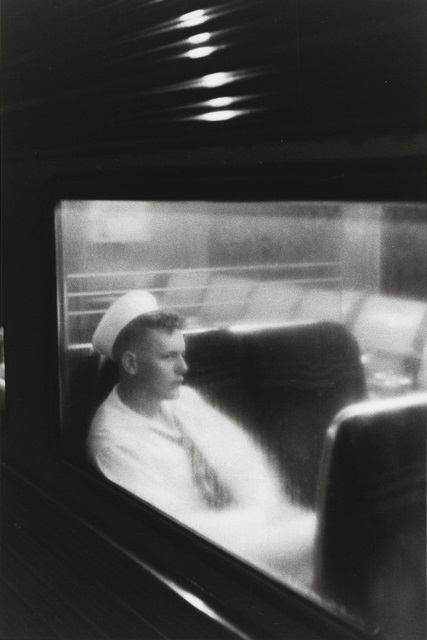
Louis Stettner
Sailor on Train, Penn Station
1958
gelatin silver print
Whitney Museum of American Art, New York

Jack Shadbolt
Armour
ca. 1970
watercolor and ink on paper
Art Gallery of Greater Victoria, British Columbia

Luc Tuymans
Soldier
1999
oil on canvas
Art Institute of Chicago

from Lost in Translation

Out of the blue, as promised, of a New York
Puzzle-rental shop the puzzle comes –
A superior one, containing a thousand hand-sawn,
Sandal-scented pieces. Many take
Shapes known already – the craftsman's repertoire
Nice in its limitation – from other puzzles:
Witch on broomstick, ostrich, hourglass,
Even (surely not just in retrospect)
An inchling, innocently branching palm.
These can be put aside, made stories of
While Mademoiselle spreads out the rest face-up,
Herself excited as a child; or questioned
Like incoherent faces in a crowd,
Each with its scrap of highly colored
Evidence the Law must piece together.
Sky-blue ostrich? Likely story. 
Mauve of the witch's cloak white, severed fingers
Pluck? Detain her. The plot thickens
As all at once two pieces interlock. 

Mademoiselle does borders – (Not so fast.
A London dusk, December last.
Chatter silenced in the library
This grown man reenters, wearing gray.
A medium. All except him have seen
Panel slid back, recess explored,
An object at once unique and common
Displayed, planted in a plain tole
Casket the subject now considers
Through shut eyes, saying in effect:
"Even as voices reach me vaguely
A dry saw-shriek drowns them out,
Some loud machinery – a lumber mill?
Far uphill in the fir forest
Trees tower, tenses with shock,
Groaning and cracking as they crash groundward.
But hidden here is a freak fragment
Of a pattern complex in appearance only.
What it seems to show is superficial
Next to that long-term lamination
Of hazard and craft, the karma that has 
made it matter in the first place.
Plywood. Piece of a puzzle." Applause
Acknowledged by an opening of lids 
Upon the thing itself. A sudden dread –
But to go back. All this lay years ahead.)

– James Merrill (1976)