Showing posts with label sailors. Show all posts

Monday, August 4, 2025

Whistler

James McNeill Whistler
Portrait of a Lady
1859
etching
Freer Gallery, Smithsonian Institution, Washington DC


James McNeill Whistler
Longshore Men
1859
etching
Freer Gallery, Smithsonian Institution, Washington DC

James McNeill Whistler
Rotherhithe
1860
etching and drypoint 
Cooper-Hewitt Smithsonian Design Museum, New York

James McNeill Whistler
Morning before the Massacre of St Bartholomew
1862
wood-engraving
(magazine illustration)
Freer Gallery, Smithsonian Institution, Washington DC

James McNeill Whistler
Symphony in Blue and Pink
ca. 1868
oil on board
Freer Gallery, Smithsonian Institution, Washington DC

James McNeill Whistler
Symphony in White and Red
ca. 1868
oil on board
Freer Gallery, Smithsonian Institution, Washington DC

James McNeill Whistler
Venus
1888
oil on board
Freer Gallery, Smithsonian Institution, Washington DC

James McNeill Whistler
The Steps, Amsterdam
1888
etching
Freer Gallery, Smithsonian Institution, Washington DC

James McNeill Whistler
The Square House, Amsterdam
1888
etching
Freer Gallery, Smithsonian Institution, Washington DC

James McNeill Whistler
The Embroidered Curtain, Amsterdam
1889
etching
Freer Gallery, Smithsonian Institution, Washington DC

James McNeill Whistler
Confidences in the Garden
(Whistler's wife Beatrix with her sister)
1894
drawing (print study)
Freer Gallery, Smithsonian Institution, Washington DC

James McNeill Whistler
La Robe Rouge
(Whistler's wife Beatrix)
1894
drawing (print study)
Freer Gallery, Smithsonian Institution, Washington DC

James McNeill Whistler
La Belle Dame Paresseuse
(Whistler's wife Beatrix)
1894
drawing (print study)
Freer Gallery, Smithsonian Institution, Washington DC

James McNeill Whistler
La Belle Dame Endormie
(Whistler's wife Beatrix)
1894
drawing (print study)
Freer Gallery, Smithsonian Institution, Washington DC

James McNeill Whistler
The Russian Schube
1896
lithograph
Freer Gallery, Smithsonian Institution, Washington DC

James McNeill Whistler
Firelight, Joseph Pennell no.2
1896
drawing (print study)
Freer Gallery, Smithsonian Institution, Washington DC

from The Art of Poetry

    Observe what Characters your persons fit,
Whether the Master speak, or Jodelet:
Whether a man, that's elderly in growth,
Or a brisk Hotspur in his boiling youth:
A roaring Bully, or a shirking Cheat,
A Court-bred Lady, or a tawdry Cit:
A prating Gossip, or a jilting Whore,
A travell'd Merchant, or an homespun Bore:
Spaniard, or French, Italian, Dutch, or Dane;
Native of Turky, India, or Japan.
    Either from History your Persons take,
Or let them nothing inconsistent speak:
If you bring great Achilles on the Stage,
Let him be fierce and brave, all heat and rage,
Inflexible, and head-strong to all Laws,
But those, which Arms and his own will impose.
Cruel Medea must no pity have,
Ixion must be treacherous, Ino grieve,
Io must wander, and Orestes rave.
But if you dare to tread in paths unknown,
And boldly start new persons of your own;
Be sure to make them in one strain agree,
And let the end like the beginning be.

– Horace (65-8 BC), translated by John Oldham (1681)

Wednesday, June 25, 2025

Pisceans - III

Oscar Björck
Launching the Boat
1888
oil on canvas
Skagens Museum, Denmark

Carl Bloch
Young Sailor
1874
oil on copper
Hirschsprung Collection, Copenhagen

Ditlev Conrad Blunck
Infancy
(Four Ages of Man)
ca. 1840-45
oil on canvas
Statens Museum for Kunst, Copenhagen

Ditlev Conrad Blunck
Youth
(Four Ages of Man)
ca. 1840-45
oil on canvas
Statens Museum for Kunst, Copenhagen

Ditlev Conrad Blunck
Manhood
(Four Ages of Man)
ca. 1840-45
oil on canvas
Statens Museum for Kunst, Copenhagen

Ditlev Conrad Blunck
Old Age
(Four Ages of Man)
ca. 1840-45
oil on canvas
Statens Museum for Kunst, Copenhagen

Arnold Clementschitsh
Over the Water
ca. 1920-30
oil on board
Graphische Sammlung Albertina, Vienna

Solomon Corrodi
Coast of the Island of Capri
1835
watercolor on paper
Hamburger Kunsthalle

Hendrik Jacobsz Dubbels
Seascape
ca. 1655-60
oil on canvas
Gemäldegalerie Alte Meister, Dresden

Albert Edelfelt
At Sea
1883
oil on canvas
Göteborgs Konstmuseum, Sweden

Carl Locher
Fishing Boats in Moonlight
1888
oil on canvas
Skagens Museum, Denmark

Sebastiano Ricci
The Miraculous Draught of Fishes
ca. 1695-97
oil on canvas
Detroit Institute of Arts

Karl Schnebel
Sport im Bild
(magazine)
ca. 1910
lithograph (poster)
Kunstbibliothek, Staatliche Museen zu Berlin

Joseph Mallord William Turner
Keelmen heaving in Coals by Moonlight
1835
oil on canvas
National Gallery of Art, Washington DC

Claude-Joseph Vernet
Fishing Port at Dawn
1774
oil on canvas
National Museum, Warsaw

Anders Zorn
In My Gondola
1894
oil on canvas
Zornmuseet, Mora, Sweden

It was to Thisbe that Thermouthis was hurrying, confident that she had escaped the perils of war.  He landed on the island and ran as fast as his legs would carry him to the huts, of which nothing now remained but ashes.  With some difficulty Thermouthis located the entrance to the cave by the stone that lay across it.  Making a torch from the few, still smoldering reeds that were left, he scrambled down into the cave as quickly as he could, calling Thisbe by name – for her name was the one word of Greek he knew.  But the sight of her dead body struck him dumb.  A long time he stood there, but eventually he became aware of the hum and murmur of voices floating upwards from the bowels of the cave, for Theagenes and Knemon were still engaged in conversation.  He concluded that these were Thisbe's murderers, but now he was in a quandary: on the one hand he had the hot blood of all brigands and the quick temper of all savages, which, aggravated by his frustrated passion, impelled him to close with the supposed culprits there and then; on the other hand he had no weapon, no sword.  Reluctantly he was constrained to control his impulses: better, he thought, to conceal his hostile intentions for the first encounter, then to wreak vengeance on his foes the moment he could lay his hands on a weapon.  Thus resolved, he presented himself to Theagenes and the others.  But the wild and cruel way he regarded them made all too plain that purpose hidden in his heart.  

– Heliodorus, from The Aethiopica, or, Theagenes and Charikleia (3rd or 4th century AD), translated from Greek by J.R. Morgan (1989) 

Monday, June 9, 2025

Rockwell Kent

Rockwell Kent
Pelagic Reverie
1919
drawing
Whitney Museum of American Art, New York


Rockwell Kent
The Trapper
1921
oil on canvas
Whitney Museum of American Art, New York

Rockwell Kent
Self Portrait, Improved
1923
wood-engraving
American Museum, Bath, Somerset

Rockwell Kent
Design for Boudoir-Themed Mural
ca. 1925
watercolor on paper
Cooper-Hewitt Smithsonian Design Museum, New York

Rockwell Kent
Workers of the World, Unite!
1927
wood-engraving
(later reprinted on the cover of New Masses)
Philadelphia Museum of Art

Rockwell Kent
Invitation from Random House
1930
linocut and letterpress
Whitney Museum of American Art, New York

Rockwell Kent
Sea and Sky
1931
wood-engraving
Whitney Museum of American Art, New York

Rockwell Kent
Fair Wind
1931
wood-engraving
Whitney Museum of American Art, New York

Rockwell Kent
Diver
1931
wood-engraving
Whitney Museum of American Art, New York

Rockwell Kent
The Bather
1931
wood-engraving
Smithsonian American Art Museum, Washington DC

Rockwell Kent
Home Port
1931
wood-engraving
Whitney Museum of American Art, New York

Rockwell Kent
Postage Stamp Design for Greenland
1932
wood-engraving
Whitney Museum of American Art, New York

Anonymous Photographer
Rockwell Kent at an Exhibition of his Work
ca. 1935
gelatin silver print
Archives of American Art, Washington DC

Rockwell Kent
Prometheus Unchained
1938
lithograph
Smithsonian American Art Museum, Washington DC

Rockwell Kent
Eternal Vigilance is the Price of Liberty
1945
lithograph
Smithsonian American Art Museum, Washington DC

Jesse Gordon
Rockwell Kent with Jinx Falkenberg
broadcasting in a Television Studio

1955
gelatin silver print
Archives of American Art, Washington DC

Rockwell Kent
Moby Dick 34-cent Single
2001
postage stamp
(after wood-engraved book illustration)
National Postal Museum, Washington DC

from Verse for Urania

A sleepless and unlettered urban glow
On everyone's horizon turns to gist
That rhetoric of starry beasts and gods
Whose figures, whose least phoneme made its fine
Point in the course of sweeping periods –
Each sentence thirty lives long, here below.

From out there notions reach us yet, but few
And far between as those first names we knew
Already without having to look up,
Children that we were, the Chair, the Cup,
But each night dimmer, children that we are,
Each night regressing, dumber by a star.
Still, fiction helps preserve them, those old truths
Our sleights have turned to fairy tales (or worse:
Look at – don't look at – your TV).
The storybooks you'll soon be reading me
About the skies abound with giants and dwarfs.
Think of the wealth of pre-Olympian
Amber washed up on the shores of Grimm –
The beanstalk's tenant-cyclops grown obese
On his own sons; the Bears and Berenice.
Or take those masterfully plotted high
Society conjunctions and epicycles
In late fable like The Wings of the Dove.
Take, for that matter, my beanstalk couplet, above,
Where such considerations as rhyme and meter
Prevail, it might be felt, at the expense
Of meaning, but as well create, survive it;
For the first myth was Measure . . . 

– James Merrill (1976)

Wednesday, June 4, 2025

Martial Costuming

attributed to Giorgione (Giorgio Barbarelli)
Portrait of a Warrior
ca. 1505-1510
oil on canvas
Kunsthistorisches Museum, Vienna


Daniel van den Queborne
Portrait of a Man
ca. 1585-90
oil on canvas
North Carolina Museum of Art, Raleigh

Filippo Napoletano (Filippo Angeli)
Soldier in Motion
(series, Capricci e Habiti Militari)
before 1629
etching
British Museum

Grégoire Huret
Portrait of a Commander
ca. 1645
engraving
Kupferstichkabinett, Kunstsammlungen der Veste Coburg

Arie de Vois
Standard-Bearer of the Leiden Militia
1664
oil on panel
Museum de Lakenhal, Leiden

Peter Boy
Miniature Portrait of Prince Karl Philipp von Pfalz-Neuburg
1696
enamel on copper
Bayerisches Nationalmuseum, Munich

Antoine Pesne
General Théodore Gigou de Briou
ca. 1711
oil on canvas
Bildgalerie von Sanssouci, Potsdam

Christian Albrecht Jensen
Cadet Cosmus Bornemann
1828
oil on canvas
Göteborgs Konstmuseum, Sweden

William Strutt
The Three Centurions
ca. 1876
oil on canvas
National Gallery of Australia, Canberra

Vincent van Gogh
The Zouave
1888
drawing
Guggenheim Museum, New York

Marie Spartali Stillman
St George
1892
watercolor on paper
Delaware Art Museum, Wilmington

Kenyon Cox
Study for Mural Figure as Allegory of Force
ca. 1899
oil on canvas
Smithsonian American Art Museum, Washington DC

Leo Williams
Sailor on the U.S.S. Paducah
ca. 1910
collodion print
Clark Art Institute, Williamstown, Massachusetts

Charles Demuth
Two Sailors
1930
drawing
Whitney Museum of American Art, New York

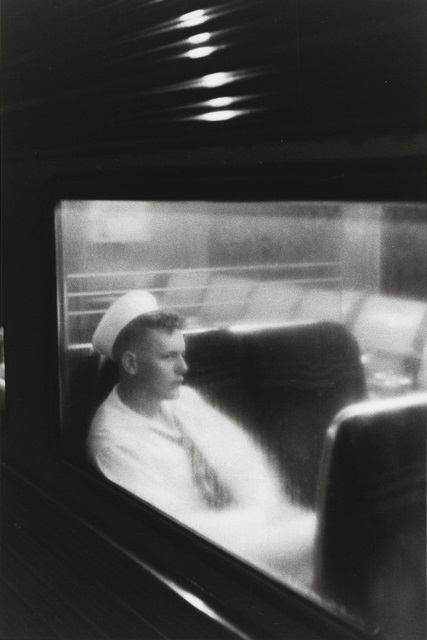
Louis Stettner
Sailor on Train, Penn Station
1958
gelatin silver print
Whitney Museum of American Art, New York

Jack Shadbolt
Armour
ca. 1970
watercolor and ink on paper
Art Gallery of Greater Victoria, British Columbia

Luc Tuymans
Soldier
1999
oil on canvas
Art Institute of Chicago

from Lost in Translation

Out of the blue, as promised, of a New York
Puzzle-rental shop the puzzle comes –
A superior one, containing a thousand hand-sawn,
Sandal-scented pieces. Many take
Shapes known already – the craftsman's repertoire
Nice in its limitation – from other puzzles:
Witch on broomstick, ostrich, hourglass,
Even (surely not just in retrospect)
An inchling, innocently branching palm.
These can be put aside, made stories of
While Mademoiselle spreads out the rest face-up,
Herself excited as a child; or questioned
Like incoherent faces in a crowd,
Each with its scrap of highly colored
Evidence the Law must piece together.
Sky-blue ostrich? Likely story. 
Mauve of the witch's cloak white, severed fingers
Pluck? Detain her. The plot thickens
As all at once two pieces interlock. 

Mademoiselle does borders – (Not so fast.
A London dusk, December last.
Chatter silenced in the library
This grown man reenters, wearing gray.
A medium. All except him have seen
Panel slid back, recess explored,
An object at once unique and common
Displayed, planted in a plain tole
Casket the subject now considers
Through shut eyes, saying in effect:
"Even as voices reach me vaguely
A dry saw-shriek drowns them out,
Some loud machinery – a lumber mill?
Far uphill in the fir forest
Trees tower, tenses with shock,
Groaning and cracking as they crash groundward.
But hidden here is a freak fragment
Of a pattern complex in appearance only.
What it seems to show is superficial
Next to that long-term lamination
Of hazard and craft, the karma that has 
made it matter in the first place.
Plywood. Piece of a puzzle." Applause
Acknowledged by an opening of lids 
Upon the thing itself. A sudden dread –
But to go back. All this lay years ahead.)

– James Merrill (1976)