Showing posts with label cinquecento. Show all posts

Wednesday, September 24, 2025

Tempera

Tommaso del Mazza
Saints Peter, John the Evangelist and Bartholomew
ca. 1385-90
tempera on panel (altarpiece fragment)
National Gallery of Canada, Ottawa


Taddeo di Bartolo
St Dominic restoring Napoleone Orsini to Life
ca. 1403
tempera on panel
McNay Art Museum, San Antonio, Texas

Master G.Z. (Italian painter)
St Nicholas presenting Donor to Virgin and Child
ca. 1420-30
tempera on panel
Metropolitan Museum of Art, New York

Michele Giambono
Man of Sorrows
ca. 1430
tempera on panel
Metropolitan Museum of Art, New York

Neri di Bicci
Altar Wing with Five Saints
ca. 1445
tempera on panel
Allen Memorial Art Museum, Oberlin College, Ohio

Dreux Budé Master
Resurrection of Christ
ca. 1450
tempera on panel (fragment of triptych)
Musée Fabre, Montpellier

Pesellino (Francesco di Stefano)
Virgin and Child
ca. 1450-55
tempera on panel
Musée des Beaux-Arts de Lyon

Carlo Crivelli
Virgin and Child
1470
tempera on panel
National Gallery of Art, Washington DC

Cosimo Rosselli
Virgin and Child
ca. 1470
tempera on panel
Rollins Museum of Art, Orlando, Florida

Francesco del Cossa
St Lucy
ca. 1473-74
tempera on panel
National Gallery of Art, Washington DC

Giovanni di Paolo
St Catherine of Siena exchanging her Heart with Christ
before 1482
tempera on panel
Metropolitan Museum of Art, New York

Filippo Mazzola
Portrait of a Man
ca. 1480-90
tempera on panel
Pinacoteca di Brera, Milan

Bartolomeo Vivarini
Virgin and Child
ca. 1490
tempera on panel
Seattle Art Museum

Benvenuto di Giovanni
Christ carrying the Cross
ca. 1491
tempera on panel
National Gallery of Art, Washington DC

Pietro Perugino
The Virgin and Saints adoring the Child
ca. 1500
tempera on panel
Morgan Library, New York

Girolamo di Benvenuto
Adoration of the Child with St Jerome
ca. 1500
tempera on panel
Philbrook Museum of Art, Tulsa, Oklahoma

Vincenzo Catena
Portrait of Giambattista Memmo
ca. 1510
tempera on panel
Lowe Art Museum, University of Miami

    Thy being depends not on matter; hence by thine understanding dost thou dive into the being of every other thing and therein art so pregnant that nothing by place, similitude, subject, time is so conjoined which thou canst not separate; as what neither is nor any way can exist, thou canst feign and give an abstract being unto.  Thou seemest a world in thyself, containing heaven, stars, seas, earth, floods, mountains, forests and all that lives: yet rest thou not satiate with what is in thyself, nor with all in the wide universe (because thou knowest their defects) until thou raise thyself to the contemplation of that first illuminating Intelligence, far above time, and even reaching eternity itself, into which thou art transformed; for by receiving, thou, beyond all other things, art made that which thou receivest.  The more thou knowest the more apt thou art to know, not being amazed with any object that excelleth in predominance, as sense by objects sensible.  Thy will is uncompellable, resisting force, daunting necessity, despising danger, triumphing over affliction, unmoved by pity, and not constrained by all the toils and disasters of life.  What the arts-master of this universe is in governing this universe, thou art in the body; and as he is wholly in every part of it, so art thou wholly in every part of the body: like unto a mirror, every small parcel of which apart doth represent and do the same what the whole did entire and together.  By thee man is that Hymen of eternal and mortal things, that chain, together binding unbodied and bodily substances, without which the goodly fabric of this world were unperfect.  

– William Drummond of Hawthornden, from A Cypress Grove (London: Hawthornden Press, 1919, reprinting the original edition of 1623)

Sunday, February 16, 2025

Mid-Century Figures

Nicolò dell'Abate
Ignudo lifting Garland
ca. 1540-50
drawing
Graphische Sammlung Albertina, Vienna

Heinrich Aldegrever
Paris, Oenone and Cupid
1550
drawing
Rijksmuseum, Amsterdam

Luca Cambiaso
Mercury
ca. 1550
drawing
Hamburger Kunsthalle

Domenico Campagnola
Penitent St Jerome
ca. 1550
drawing
Morgan Library, New York

Paolo Farinati
Abduction of Sabine Woman
ca. 1550
drawing
Graphische Sammlung Albertina, Vienna

Girolamo da Carpi
Antique Statue of Bacchus
1550
drawing
Scottish National Gallery, Edinburgh

Giulio Romano
Andromeda
ca. 1540-44
drawing
Hamburger Kunsthalle

Sebald Beham
Ceres
1549
drawing
Graphische Sammlung Albertina, Vienna

Anonymous Italian Artist after Michelangelo
St Bartholomew
(from Last Judgment fresco, Sistine Chapel)
ca. 1550
drawing
Hamburger Kunsthalle

Anonymous Italian Artist
Study of Seated Model
ca. 1550
drawing
Fondation Custodia, Paris

Pirro Ligorio
Venus and Cupid
ca. 1550
drawing
Graphische Sammlung Albertina, Vienna

Melchior Lorck
Statuette of Diana the Huntress
1553
drawing
Statens Museum for Kunst, Copenhagen

Tiziano Minio
Three Studies for Figure of Hercules
ca. 1550
drawing
Graphische Sammlung Albertina, Vienna

Bartolomeo Passarotti after Michelangelo
Charon
(from Last Judgment fresco, Sistine Chapel)
ca. 1550
drawing
National Gallery of Victoria, Melbourne

Raffaello da Montelupo
Figure Study
ca. 1550
drawing
Rijksmuseum, Amsterdam

Pellegrino Tibaldi
Polyphemus
ca. 1554
drawing
(study for fresco)
Hamburger Kunsthalle

Ovum

You'd take it for zero, or nothing, 
or the spotless oval your lips make saying it,
as if you blew both yolk and albumen
through its pin-pricked head: the meat
of the word made orotund and Latinate.
It's like putting your mouth to the smooth
breast of the ocarina, from oca, the goose,
hooting out its fledgling notes.
Unless you seal the gap it's left, they'll fall
out, those other o-words, like bubbles
streaming through a soapy blow-hole:
from oblation and obloquy to oxlip and ozone,
and that sneaky Trojan obol,
coin-shaped, it's true, but spawned
from the spiky Greek of obelus,
the death-mark, dagger or crucifix,
as phallic and obvious, now that you say it,
as that double o in spermatozoon,
which enters by its own locomotion –
the flagellum, its tiny whip and scourge.

– Caitríona O'Reilly, Geis (2015)

Saturday, February 11, 2023

Study Drawings at the Louvre by Parmigianino

Parmigianino (Francesco Mazzola)
Circumcision of Christ
before 1540
drawing
Musée du Louvre

Parmigianino (Francesco Mazzola)
Holy Family
ca. 1530
drawing
Musée du Louvre

Parmigianino (Francesco Mazzola)
Holy Family with young St John the Baptist
ca. 1522-24
drawing
Musée du Louvre

Parmigianino (Francesco Mazzola)
Philosopher Reading
ca. 1524-27
drawing
Musée du Louvre

Parmigianino (Francesco Mazzola)
Saturn devouring a Child
ca. 1535
drawing
Musée du Louvre

Parmigianino (Francesco Mazzola)
Seated Woman with Putto
ca. 1524-27
drawing
Musée du Louvre

Parmigianino (Francesco Mazzola)
Sheet of Studies
before 1540
drawing
Musée du Louvre

Parmigianino (Francesco Mazzola)
Sheet of Studies
before 1540
drawing
Musée du Louvre

Parmigianino (Francesco Mazzola)
Sheet of Studies
before 1540
drawing
Musée du Louvre

Parmigianino (Francesco Mazzola)
Sheet of Studies
before 1540
drawing
Musée du Louvre

Parmigianino (Francesco Mazzola)
St John the Baptist in the Wilderness
ca. 1527-30
drawing
Musée du Louvre

Parmigianino (Francesco Mazzola)
St John the Evangelist Preaching
before 1540
drawing
Musée du Louvre

Parmigianino (Francesco Mazzola)
St Roch
ca. 1527-30
drawing
Musée du Louvre

Parmigianino (Francesco Mazzola)
St Roch
ca. 1527-30
drawing
Musée du Louvre

Parmigianino (Francesco Mazzola)
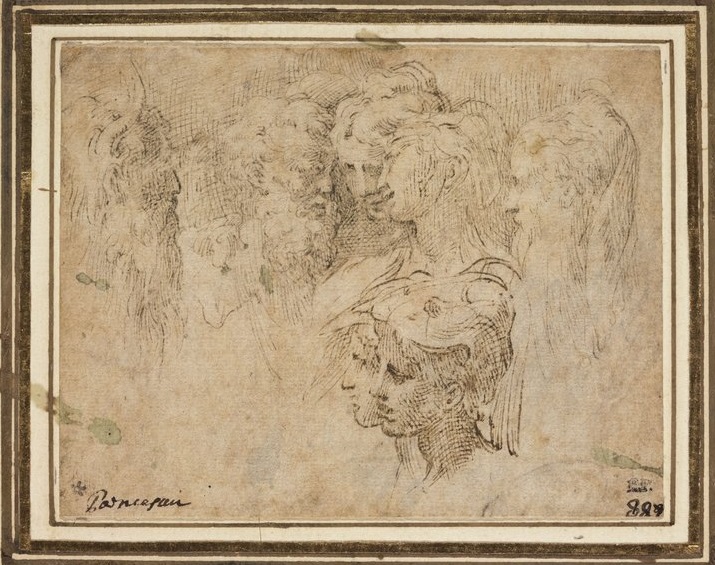
Studies of Heads
ca. 1530-40
drawing
Musée du Louvre

Parmigianino (Francesco Mazzola)
Two Putti
ca. 1522-23
drawing
(study for fresco)
Musée du Louvre

Parmigianino (Francesco Mazzola)
Two Putti
ca. 1522-23
drawing
(study for fresco)
Musée du Louvre

Parmigianino (Francesco Mazzola)
Two Studies of Women holding Infants
ca. 1524-27
drawing
Musée du Louvre

Parmigianino (Francesco Mazzola)
Elongated Virgin with Children
ca. 1534
drawing
Musée du Louvre

Parmigianino (Francesco Mazzola)
Virgin of the Annunciation
ca. 1520-24
drawing
Musée du Louvre

Girolamo Francesco Maria Mazzola, called Parmigianino (1503-1540) – Precocious painter and etcher from Parma – hence his nickname.  Assimilating the influences of Correggio, Raphael and Michelangelo, he forged an original and extremely elegant form of Mannerism which was widely influential throughout Europe, especially as it spread by means of his etchings.  Trained by his uncles, Michele and Pier Ilario Mazzola, after the death of his father in 1506, he was painting independently from the age of 18.  . . .  Vasari records that Parmigianino's last years were devoted to alchemy, although this may be a rumour caused by his interest in the chemical procedures of etching.  The artist seems certainly to have undergone a period of severe depression, [before dying of "fever" in 1540 at age 37].  

– Erika Langmuir and Norbert Lynton, Yale Dictionary of Art and Artists (2000)