Showing posts with label quattrocento. Show all posts

Wednesday, September 24, 2025

Tempera

Tommaso del Mazza
Saints Peter, John the Evangelist and Bartholomew
ca. 1385-90
tempera on panel (altarpiece fragment)
National Gallery of Canada, Ottawa


Taddeo di Bartolo
St Dominic restoring Napoleone Orsini to Life
ca. 1403
tempera on panel
McNay Art Museum, San Antonio, Texas

Master G.Z. (Italian painter)
St Nicholas presenting Donor to Virgin and Child
ca. 1420-30
tempera on panel
Metropolitan Museum of Art, New York

Michele Giambono
Man of Sorrows
ca. 1430
tempera on panel
Metropolitan Museum of Art, New York

Neri di Bicci
Altar Wing with Five Saints
ca. 1445
tempera on panel
Allen Memorial Art Museum, Oberlin College, Ohio

Dreux Budé Master
Resurrection of Christ
ca. 1450
tempera on panel (fragment of triptych)
Musée Fabre, Montpellier

Pesellino (Francesco di Stefano)
Virgin and Child
ca. 1450-55
tempera on panel
Musée des Beaux-Arts de Lyon

Carlo Crivelli
Virgin and Child
1470
tempera on panel
National Gallery of Art, Washington DC

Cosimo Rosselli
Virgin and Child
ca. 1470
tempera on panel
Rollins Museum of Art, Orlando, Florida

Francesco del Cossa
St Lucy
ca. 1473-74
tempera on panel
National Gallery of Art, Washington DC

Giovanni di Paolo
St Catherine of Siena exchanging her Heart with Christ
before 1482
tempera on panel
Metropolitan Museum of Art, New York

Filippo Mazzola
Portrait of a Man
ca. 1480-90
tempera on panel
Pinacoteca di Brera, Milan

Bartolomeo Vivarini
Virgin and Child
ca. 1490
tempera on panel
Seattle Art Museum

Benvenuto di Giovanni
Christ carrying the Cross
ca. 1491
tempera on panel
National Gallery of Art, Washington DC

Pietro Perugino
The Virgin and Saints adoring the Child
ca. 1500
tempera on panel
Morgan Library, New York

Girolamo di Benvenuto
Adoration of the Child with St Jerome
ca. 1500
tempera on panel
Philbrook Museum of Art, Tulsa, Oklahoma

Vincenzo Catena
Portrait of Giambattista Memmo
ca. 1510
tempera on panel
Lowe Art Museum, University of Miami

    Thy being depends not on matter; hence by thine understanding dost thou dive into the being of every other thing and therein art so pregnant that nothing by place, similitude, subject, time is so conjoined which thou canst not separate; as what neither is nor any way can exist, thou canst feign and give an abstract being unto.  Thou seemest a world in thyself, containing heaven, stars, seas, earth, floods, mountains, forests and all that lives: yet rest thou not satiate with what is in thyself, nor with all in the wide universe (because thou knowest their defects) until thou raise thyself to the contemplation of that first illuminating Intelligence, far above time, and even reaching eternity itself, into which thou art transformed; for by receiving, thou, beyond all other things, art made that which thou receivest.  The more thou knowest the more apt thou art to know, not being amazed with any object that excelleth in predominance, as sense by objects sensible.  Thy will is uncompellable, resisting force, daunting necessity, despising danger, triumphing over affliction, unmoved by pity, and not constrained by all the toils and disasters of life.  What the arts-master of this universe is in governing this universe, thou art in the body; and as he is wholly in every part of it, so art thou wholly in every part of the body: like unto a mirror, every small parcel of which apart doth represent and do the same what the whole did entire and together.  By thee man is that Hymen of eternal and mortal things, that chain, together binding unbodied and bodily substances, without which the goodly fabric of this world were unperfect.  

– William Drummond of Hawthornden, from A Cypress Grove (London: Hawthornden Press, 1919, reprinting the original edition of 1623)

Friday, May 31, 2024

Early Renaissance Imagery

Giotto
Virgin and Child
ca. 1310-15
tempera on panel
National Gallery of Art, Washington DC

Simone Martini
St Judas Thaddeus
ca. 1315-20
tempera on panel
National Gallery of Art, Washington DC

Simone Martini
St Simon
ca. 1315-20
tempera on panel
National Gallery of Art, Washington DC

Simone Martini
St Matthew
ca. 1315-20
tempera on panel
National Gallery of Art, Washington DC

Bernardo Daddi
St Paul and Group of Worshippers
1333
tempera on panel
National Gallery of Art, Washington DC

Giovanni Baronzio
The Birth, Naming and Circumcision
of St John the Baptist

ca. 1335
tempera on panel
National Gallery of Art, Washington DC

Giovanni Baronzio
Baptism of Christ
ca. 1335
tempera on panel
National Gallery of Art, Washington DC

Bartolomeo Bulgarini
St Catherine of Alexandria
ca. 1335-40
tempera on panel
National Gallery of Art, Washington DC

Nardo di Cione
Virgin and Child
ca. 1350
tempera on panel
Milwaukee Art Museum

Paolo di Giovanni Fei
Assumption of the Virgin
ca. 1400-1405
tempera on panel
National Gallery of Art, Washington DC

Lorenzo Monaco
Virgin and Child
1413
tempera on panel
National Gallery of Art, Washington DC

Sassetta (Stefano di Giovanni)
St Francis kneeling
before the Crucified Christ

ca. 1437-44
tempera on panel
Cleveland Museum of Art, Ohio

Francesco del Cossa
St Florian
ca. 1473-74
tempera on panel
National Gallery of Art, Washington DC

Carlo Crivelli
Virgin and Child
ca. 1480
tempera on panel
Victoria & Albert Museum, London

Master of the Starck Triptych
The Raising of the Cross
ca. 1480-90
oil on panel
National Gallery of Art, Washington DC

Giovanni Bastianini
Virgin and Child
ca. 1855
marble
(forgery of early Renaissance relief)
Victoria & Albert Museum, London

     "Far from diminishing, the reasons for friction and irreconcilability multiplied from year to year. The very forces that urged Roman humanists to glorify the providential nature of Catholicism led those who rejected it to be scandalized by the sumptuous manifestations, the commitment to ceremony, and the inclination to paganism that were on daily display. The antagonism ran so deep that it declared itself in two utterly opposing modes of graphic discourse: on the one side, the tradition of monumental Mediterranean painting at the height of its powers; and on the other, the direct, popular, and quickly produced art of Northern printmaking, which for the first time in history became a major force in cultural and religious life. Rome did not make use of the right weapons, the modern media; there could be no hope of victory."

– André Chastel, The Sack of Rome, 1527, translated by Beth Archer, 1983 (expanded from the A.W. Mellon Lectures in the Fine Arts, 1977, and published by Princeton University Press and the National Gallery of Art, Washington, D.C.)

Thursday, September 15, 2022

Louvre - Unassigned Italian Study Sheets - Heads II

Anonymous Italian Artist
Head of Bearded Man Asleep
16th century
drawing
Musée du Louvre

Anonymous Italian Artist
Head of a Woman
16th century
drawing
Musée du Louvre

Anonymous Italian Artist
Study of a Mask
16th century
drawing
Musée du Louvre

Anonymous Italian Artist
Portrait of a Girl
ca. 1650-1700
drawing (colored chalks)
Musée du Louvre

Anonymous Italian Artist
Portrait of a Man
ca. 1550-1600
drawing
Musée du Louvre

Anonymous Italian Artist
Portrait of Checca
(mistress of Cardinal Antonio Barberini)
17th century
drawing
Musée du Louvre

Anonymous Italian Artist
Head of Masked Woman
ca. 1550-1600
drawing
Musée du Louvre

Anonymous Italian Artist
Head of a Youth
ca. 1550-1600
drawing
Musée du Louvre

Anonymous Italian Artist
Head of a Youth
ca. 1550-1600
drawing
Musée du Louvre

Anonymous Italian Artist
Two Heads
17th century
drawing
Musée du Louvre

Anonymous Italian Artist
Two Heads with Laurel Wreaths
ca. 1650-1700
drawing
Musée du Louvre

Anonymous Italian Artist
Two Studies of a Head
ca. 1650-1700
drawing
Musée du Louvre

Anonymous Italian Artist
Head of a Man
15th century
drawing
Musée du Louvre

Anonymous Italian Artist
Head of a Man
16th century
drawing
Musée du Louvre

Anonymous Italian Artist
Virgin and Child
ca. 1550-1600
drawing
Musée du Louvre

A Close Shave

From Baden, or what's left of it,
pursue a long, smooth curve of road
that skirts the northern flood wall
to parallel a palisade
of channel markers sunk in earth,
the folly of a cement works.
Its blank silos overlook
a pit of argillaceous shale,
the fine and fossilized remains
of bivalves, sponges, spines of shark,
quarried and burnt with limestone charge
to alchemize a binder of brick
and the city's shallow, brittle crust.

Around the bend, the riverbed
swings wide to open a fetch of field.
Shadows skim its mucky thaw
as juncos, whisked about by the wind
on courses neither fixed nor free,
give but a quick metallic chink.
Behind you, rain has wrapped the bluffs
and scumbled limbs of sycamores.
Ahead, each bend assumes the name
of a gaudy packet run aground,
or snagged or sunk, or blown to bits:
for one, the side-wheel Amazon,
pluperfect wheelhouse painted green,
that struck a honey-locust pike
still rooted deep in river mud
and tore its hull from stem to stern.
Down in minutes! Within the month
an island silted up behind.

A flock of luggage floated south,
remarked by those on Water Street
loafing before the trading post
and the barbershop of Madame Krull.
She can eternally be found 
at work in her elaborate room
toujours prêt to clip and coif
or wield her razor with great skill
for those who favor her with their chins.
The scent of ginger tonic blends
with that of borscht, its acrid tang,
consumed behind a wooden screen
as Illinois grows dark. In this, 
her second year since coming west.

– Devin Johnston (2012)

Monday, August 15, 2022

Bartolomeo Suardi, called Bramantino (ca. 1456-ca. 1530)

Bramantino
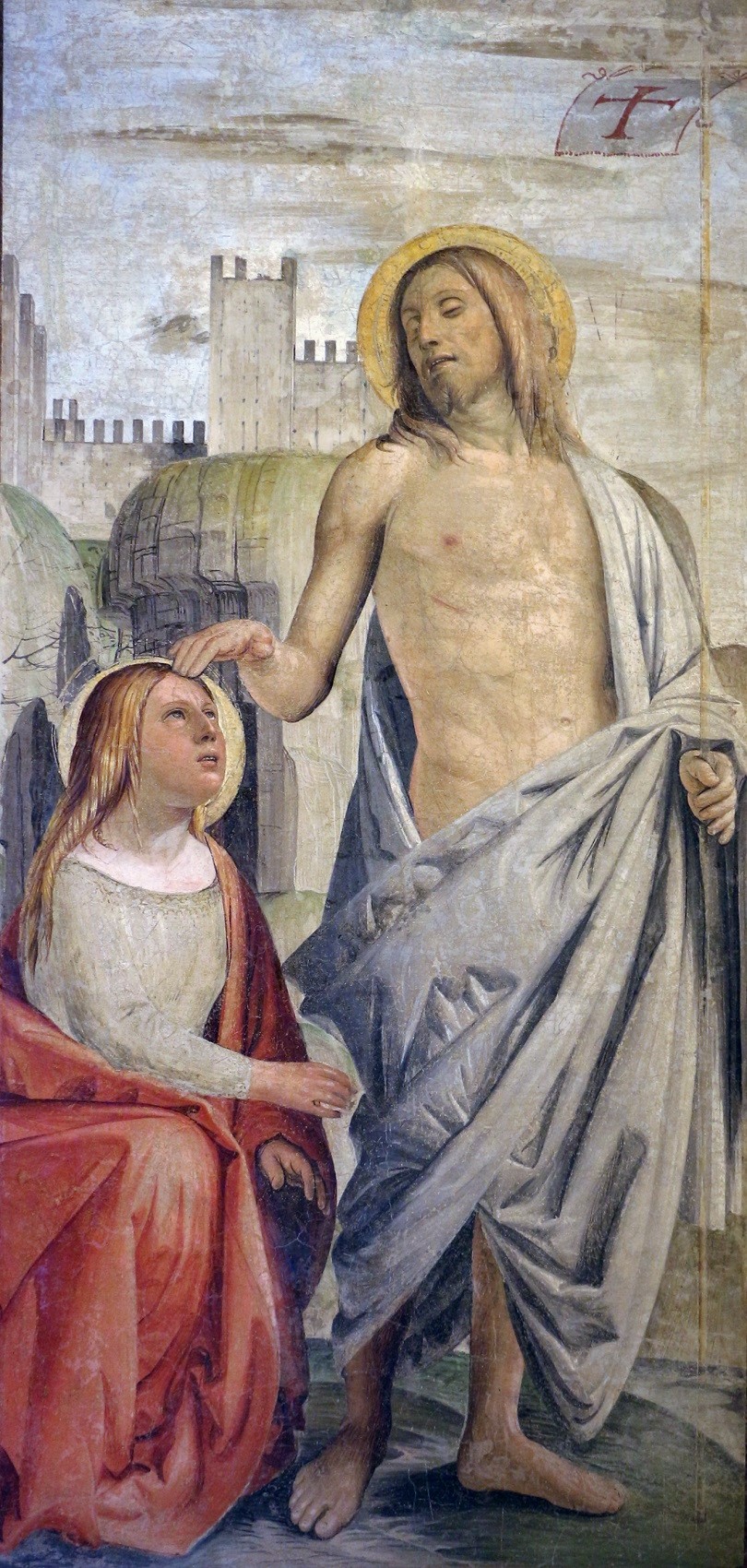
Noli me tangere
ca. 1490-95
oil on canvas
Pinacoteca del Castello Sforzesco,
Milan

Bramantino
Standing Christ with the Cross
before 1530
drawing
Graphische Sammlung Albertina, Vienna

Bramantino
The Lamentation
ca. 1512-15
oil on panel
National Museum of Art of Romania, Bucharest

Bramantino
Study for The Entombment
before 1530
drawing
Musée du Louvre

Bramantino
Adoration of the Magi (detail)
ca. 1500
oil on panel
National Gallery, London

Bramantino
Adoration of the Magi (detail)
ca. 1500
oil on panel
National Gallery, London

Bramantino
Adoration of the Magi
ca. 1500
oil on panel
National Gallery, London

Bramantino
Virgin and Child
ca. 1515-20
oil on panel
Pinacoteca di Brera, Milan

Bramantino
Kneeling Figure
ca. 1490
drawing
(drapery study)
Kupferstichkabinett, Berlin

Bramantino
The Nativity
ca. 1490-92
oil on panel
Pinacoteca Ambrosiana, Milan

Bramantino
Virgin and Child
1508
oil on panel
Metropolitan Museum of Art, New York

Bramantino
Madonna of the Towers
ca. 1520
oil on panel
Pinacoteca Ambrosiana, Milan

Bramantino
The Flight into Egypt
ca. 1515-20
oil on panel
Santuario della Madonna del Sasso,
Orselina, Switzerland

Bramantino
The Crucifixion
ca. 1520
oil on canvas
Pinacoteca di Brera, Milan

Bramantino
Story of Baucis and Philemon
ca. 1490-95
oil on panel
Wallraf-Richartz Museum, Cologne

"The artist's real name was Bartolomeo Suardi.  The name Bramantino suggests he was associated with the architect Bramante, but the nature of this relationship is not known.  Bramantino was active in Milan, and recorded in Rome in 1508.  In 1525 he was appointed painter and architect to Francesco Sforza II, ruler of Milan.  Leonardo da Vinci overwhelmingly influenced many local painters in Milan, but it appears that Bramantino was not one of them.  Stylistically his works continue to tradition of pre-Leonardesque Milanese painting of Butinone and Foppa.  Bramantino's work also shows influences from further afield, notably that of Piero della Francesca and of Mantegna."

– from curator's notes at the National Gallery, London