 |
| Liberale da Verona St Jerome removing Thorn from Lion's Paw ca. 1500 oil on panel Musée Fesch, Ajaccio, Corsica |
 |
| Hans Leinberger The Faithful offering Succour to Injured Miners ca. 1515 painted lindenwood relief Bode Museum, Berlin |
 |
| Jusepe de Ribera St Peter liberated from Prison by an Angel ca. 1613-14 oil on canvas Galleria Borghese, Rome |
 |
| Gioacchino Assereto Tobias restoring his Father's Sight ca. 1630 oil on canvas Musée des Beaux-Arts de Marseille |
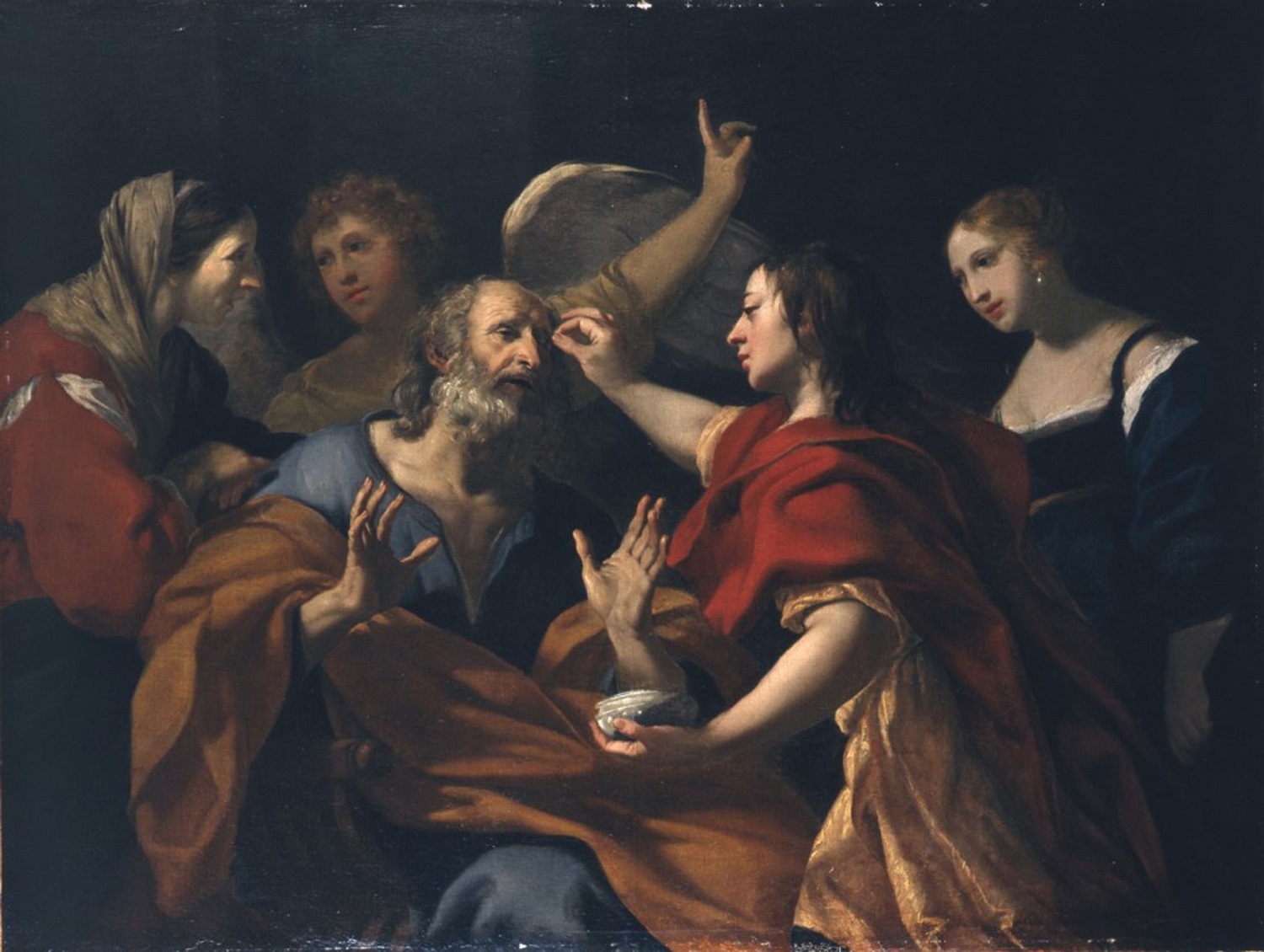 |
| Anonymous French Artist Tobias healing his Father's Blindness 17th century oil on canvas Musée des Beaux-Arts de Bordeaux |
 |
| Eustache Le Sueur St Paul healing the Afflicted and casting out Demons ca. 1645-46 oil on canvas Musée Fabre, Montpellier |
 |
| Pierre Mignard The Shepherd Faustulus bringing Romulus and Remus to his Wife 1654 oil on canvas Dallas Museum of Art |
 |
| Jacob Toorenvliet The Doctor's Visit ca. 1666-67 oil on copper Leiden Collection, New York |
 |
| Jean Jouvenet Extreme Unction ca. 1685 oil on canvas Palais des Beaux-Arts de Lille |
-1710-drawing-Rhode-Island-School-of-Design-Providence.jpg) |
| Louis Boullogne the Younger Académie (Figure Studies - Elder supporting Younger) 1710 drawing Rhode Island School of Design, Providence |
-c1725-oil-on-panel-Brukenthal-National-Museum-Sibiu-Romania.jpg) |
| Alessandro Magnasco Almsgiving outside a Monastery ca. 1725 oil on panel Brukenthal National Museum, Sibiu, Romania |
 |
| Giovanni Battista Marcola St Ferréol de Vienne pleading for Man about to be Hanged ca. 1750 drawing Hamburger Kunsthalle |
 |
| Pierre Duhallas Latona and Diana healing the wounded Aeneas 1772 oil on canvas Galleria Nazionale di Parma |
 |
| Joseph Nollekens Study for a Monument to Mrs Howard ca. 1780 drawing Harris Museum & Art Gallery, Preston, Lancashire |
-Mus%C3%A9e-Bonnat-Helleu-Bayonne.jpg) |
| Théodore Géricault Figure Studies for The Raft of the Medusa 1818-19 drawing Musée Bonnat-Helleu, Bayonne |
 |
| Henriette Browne Sisters of Mercy 1859 oil on canvas Hamburger Kunsthalle |
Et Proli toujours assis dans le fauteuil radieux pense des choses semblables, mais du point de vue de celui qui paie et ce faisant joue sa tête, avec le sourire de crocodile aussi, mais plus inquiet et comme déjà dupe; l'œil globuleux brille un peu, c'est Proli qui est le plus près de la lueur de la lanterne, on le voit presque. Le fauteuil d'évêque le porte. Bourdon est là aussi avec sans doute un sourire mauvais dans le noir, il n'aime pas les manières ci-devant de ce Corentin, il n'aime pas sa petite vieille perruque, il n'aime pas que sous la perruque Corentin lui ressemble un peu de visage, il le remettrait volontiers lui aussi au niveau de l'égalité, comme il le disait des clochers quand il voulait faire raser tous les clochers de France. Et Collot n'est pas dans Shakespeare, il est là. Il est pourtant un peu dans Shakespeare, nécessairement, parce que tout cela est nocturne, caravagesque ou shakespearien, crapuleux. L'or brille à l'oreille de Collot. Et comme toujours dans ces scènes qui font l'impasse sur les visages des hommes, les poussent au noir, les suspendent dans l'ombre, la lumière carrée tombe carrément sur les symboles, la sainte table du contrat d'où ont disparu les os et l'or, et sur la sainte table ce qui reste de pain et de vin; peut-être aussi les cartes et les dés jetés là en partant par les sans-culottes, les bons vieux comparses, dont le rôle est toujours de laisser en place quelques symboles bien flagrants avant de déguerpir. Corentin déjà a fait trois pas, il s'apprête à endosser la houppelande pour déguerpir à son tour.
C'est à ce moment que Proli du fond de son fauteuil d'apparat l'arrête sèchement et reprend la parole. Il ajoute qu'il y a au contrat deux clauses secondaires mais impératives, à quoi est tenu Corentin.
Ce tableau d'abord, il faudra le peindre dans le plus grand secret, comme on conspire, sans en aviser quiconque, et secrètement le garder jusqu'à ce qu'on le lui réclame.
La seconde clause, c'est que les robespierrots, Saint-Just, Couthon, Robespierre, doivent y être peints plus visiblement et centralement, plus magistralement que les autres personnages du Comité, qui devront y apparaître comme des comparses.
Corentin consent. Il dit qu'il en sera ainsi.
– Pierre Michon, from Les Onze (Verdier, 2009)


