Showing posts with label obelisks. Show all posts

Thursday, April 2, 2026

Habitants

Judy Chicago
Purple Atmosphere
(series, On Fire)
ca. 1969
modern inkjet print from vintage negative
Smithsonian American Art Museum, Washington DC


Judy Chicago
Multi-color Atmosphere
(series, On Fire)
1970
modern inkjet print from vintage negative
Smithsonian American Art Museum, Washington DC

Judy Chicago
Bridge Atmosphere
(series, On Fire)
1970
modern inkjet print from vintage negative
Smithsonian American Art Museum, Washington DC

Judy Chicago
Smoke Holes #2
(series, On Fire)
1970
modern inkjet print from vintage negative
Smithsonian American Art Museum, Washington DC

Judy Chicago
The Deflowering of Nye + Brown
(series, On Fire)
2012
inkjet print
Smithsonian American Art Museum, Washington DC

Francis Frith
The Broken Obelisk, Karnak
1857
albumen print
Art Institute of Chicago

Alexander Gardner
Mushroom Rock on Alum Creek, Kansas
211 miles west of the Missouri River

1867
albumen print
National Museum of the American Indian, Washington DC

Salomon Gessner
Landscape with Memorial Column
1767
drawing
Graphische Sammlung Albertina, Vienna

Pierre Gaudard
Le Lorey, Manche
1980
gelatin silver print
National Gallery of Canada, Ottawa

Trent Parke
Backyard Swing Set
2003
pigment print
Art Gallery of South Australia, Adelaide

Ana Mendieta
Anima (Alma / Soul)
1976
C-print
Smithsonian American Art Museum, Washington DC

Ana Mendieta
Silueta Works in Mexico
1973-77
modern inkjet prints from vintage negatives
Institute of Contemporary Art, Boston

Ana Mendieta
Untitled (Esculturas Rupestres)
1981
C-print
Whitney Museum of American Art, New York

Tim Gardner
Untitled (Going-Away Party)
1999
watercolor on paper
Whitney Museum of American Art, New York

Tim Gardner
Figure in a Melting Snowfield
2002
watercolor on paper
Whitney Museum of American Art, New York

Joakim Skovgaard
Sheep-shearing in Lolland
1878
oil on canvas
Fuglsang Kunstmuseum, Lolland, Denmark

Frank Wilbert Stokes
Bowdoin Bay, Greenland
1893
oil on panel
Smithsonian American Art Museum, Washington DC

    The laws of God, the laws of man,
He may keep that will and can;
Not I: let God and man decree
Laws for themselves and not for me;
And if my ways are not as theirs
Let them mind their own affairs.
Their deeds I judge and much condemn,
Yet when did I make laws for them?
Please yourselves, say I, and they
Need only look the other way.
But no, they will not; they must still
Wrest their neighbour to their will,
And make me dance as they desire
With jail and gallows and hell-fire.
And how am I to face the odds
Of man's bedevilment and God's?
I, a stranger and afraid
In a world I never made.
They will be master, right or wrong;
Though both are foolish, both are strong.
And since, my soul, we cannot fly
To Saturn or to Mercury,
Keep we must, if keep we can,
These foreign laws of God and man.

– A.E. Housman (1922)

Monday, December 15, 2025

Verticals - I

Siegfried Adam
Evening Light
1988
oil on canvas
Galerie Neue Meister (Albertinum), Dresden

Richard Gerstl
Mathilde Schönberg in the Garden
1908
oil on canvas
Leopold Museum, Vienna

August Macke
The Large Bright Shop Window
1912
oil on canvas
Sprengel Museum, Hannover

Henry Moore
Two Figures
1949
drawing, with added watercolor
Albright-Knox Art Gallery, Buffalo, New York

Charles Parrocel
Standing Figure
ca. 1720
drawing
Yale University Art Gallery

Pieter Schenck the Elder
Personification of Summer
ca. 1690
hand-colored mezzotint
Herzog August Bibliothek, Wulfenbüttel

Comme des Garçons (Japan)
Ensemble with Blouse and Skirt
1997
nylon and polyester
Groninger Museum, Netherlands

Michael Wolgemut and Wilhelm Pleydenwurff
City of Strasbourg
(opening from the Nuremberg Chronicle)
1493
woodcuts and letterpress
Kupferstichkabinett, Staatliche Kunstsammlungen, Dresden

Jeremias Paul Schweyer
after Bartholomeus Breenbergh
Ruinous Fragment of City Wall, Rome
ca. 1795
etching
Graphische Sammlung, ETH Zürich

Johann Jakob Schübler
Columns and Palms
ca. 1725
etching
Herzog August Bibliothek, Wulfenbüttel

Ian Hamilton Finlay
Urn (Garden Poem)
1986
lithograph
Kröller-Müller Museum, Otterlo, Netherlands

Stephan Bundi
Così fan Tutte
2010
screenprint
(poster for Mozart opera)
Museum Folkwang, Essen

Georg Lemberger
Pillars of Bronze
1524
hand-colored woodcut
(illustration from the "Luther" Bible)
Graphische Sammlung Albertina, Vienna

Albert Haueisen
Hans with Sunflower
1931
oil on canvas
Kunsthalle Mannheim

Wilhelm Friedrich Gmelin
Port of Brindisi seen from the end of the Appian Way
1788
drawing
Graphische Sammlung Albertina, Vienna

Moritz Bodenehr
Illuminated Obelisk
honoring the King and Queen of Sicily

ca. 1740
etching
Herzog August Bibliothek, Wulfenbüttel

Scene: The citadel of Thebes. A mound represents a shrine to the major gods of the city. One side-passage is imagined as leading to the lower town, the other to the walls and the battlefield. A crowd of armed Theban citizens is present. Eteocles (not in armour) enters, attended, from the town, to address them.

Eteocles:  Citizens of Cadmus' land, he who guards the city's fortunes, controlling the helm at its stern,* never letting his eyes rest in sleep, has to give the right advice for the situation.  For if we should be successful, the responsibility would be god's; but if on the other hand disaster were to strike (which may it not!) then Eteocles' name alone would be repeatedly harped on by the citizens throughout the town amid a noisy surge of terrified wailing – from which may Zeus the Defender, true to his title, defend the city of the Cadmeans!  This is the time when every one of you – including both those who have not yet reached the peak of young manhood, and those whom time has carried past it and who are feeding abundant bodily growth – must have a care for your city, as is right and proper, must come to its aid, to the aid of the altars of its native gods so as never to let their ties be obliterated, to the aid of your children, and to the aid of your Motherland, your most loving nurse; for when you were children crawling on her kindly soil, she generously accepted all the toil of your upbringing, and nurtured you, to become her shield-bearing inhabitants and be faithful to her in this hour of need.  And thus far, up to this day, god has inclined to the right side; we have been besieged within our walls all this time, but for the most part, thanks to the gods, the war is turning out well for us.  But now, as the prophet states – that shepherd of fowl, who with infallible skill observes birds of augury with his ears and his mind, without using fire** – this man, the master of this kind of prophecy, says that a great plan for an attack by the Achaeans upon the city is being discussed this night.  So get moving, all of you, to the battlements and gates of the walls – hurry, with your full armour!  Man the parapets, take your stand on the platforms of the walls, stand firm at the gate entrances, have good confidence, and don't be too afraid of this horde of foreigners.  God will bring success!

Exeunt citizens, making for the walls.

– Aeschylus, from Seven Against Thebes (467 BC), translated by Alan H. Sommerstein (2008)

*as often in poetry, the city is imagined as a ship

**since the prophet is said to use his "ears and mind" he evidently does not see the flight of the birds, and the audience will readily identify him as the blind Tiresias making use of divination by augury as contrasted to "fire" (divination from the manner in which sacrifices burn on an altar)

Saturday, July 1, 2023

Staring Hard at Certain Things

Themistocles von Eckenbrecher
Corner of a Meadow with Fountaingrass
ca. 1870
watercolor
National Gallery of Art, Washington DC

William Eggleston
Memphis
ca. 1969
dye-transfer print
Museum of Modern Art, New York

Pieter van Anraedt
Still Life
1658
oil on canvas
Mauritshuis, The Hague

Gianlorenzo Bernini
Chair of St Peter
1658
terracotta
(modello for monument in St Peter's Basilica)
Detroit Institute of Arts

John Yenn
Design for Garden Obelisk
ca. 1795
drawing, with watercolor
Royal Academy of Arts, London

Denton Welch
Cow at Oxenhouth House
(Oxon Hoath Manor, Kent)
ca. 1940
drawing, with watercolor
Royal Academy of Arts, London

Agnes Mary Webster
Drapery Study
ca. 1890
drawing
Royal Academy of Arts, London

Haydn Reynolds Mackey
Portrait of the artist's wife, Florence
1942
drawing
Royal Academy of Arts, London

George Elgar Hicks
Gnarled Tree Trunk
ca. 1880
oil on paper
Ulster Museum, Belfast

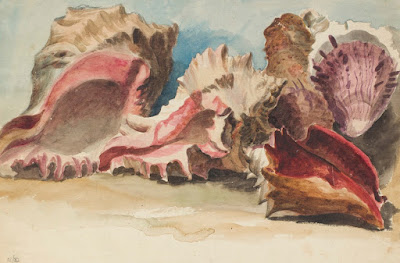
Philip Reinagle
Group of Conch Shells
ca. 1790
watercolor
Royal Academy of Arts, London

James Ensor
Shells
1896
oil on canvas
Musée Fin de Siècle, Brussels

Jacobus Schijnvoet
Ram's Skull
before 1733
drawing
(print study)
Royal Academy of Arts, London

Edmund Thomas Parris
Head of an Old Man
ca. 1844
drawing
Royal Academy of Arts, London

Walt Kuhn
Pink Roses in Blue Vase
1938
oil on canvas
private collection

Alexander Kanoldt
Table in the Studio
1924
oil on canvas
Osthaus Museum, Hagen, Germany

John Constable
Study of Sky and Trees
ca. 1821
oil on paper
Victoria & Albert Museum, London

Dawn at St. Patrick's 

There is an old
statue in the courtyard
that weeps, like Niobe, its sorrow in stone.
The griefs of the ages she has made her own.
Her eyes are rain-washed but not hard,
her body is covered in mould,
the garden overgrown.

One by one
the first lights come on,
those that haven't been on all night.
Christmas, the harshly festive, has come and gone.
No snow, but the rain pours down
in the first hour before dawn,
before daylight.

Swift's home
for 'fools and mad' has become
the administrative block. Much there
has remained unchanged for many a long year –
stairs, chairs, Georgian windows shafting light and dust,
of the satirist;

but the real
hospital is a cheerful
modern extension at the back
hung with restful reproductions of Dufy, Klee and Braque.
Television, Russian fiction, snooker with the staff,
a snifter of Lucozade, a paragraph
of Newsweek or the Daily Mail

are my daily routine
during the festive season.
They don't lock the razors here 
as in Bowditch Hall. We have remained upright –
though, to be frank, the Christmas dinner scene,
with grown men in their festive gear,
was a sobering sight.

I watch the last
planes of the year go past,
silently climbing a cloud-lit sky.
Earth-bound, soon I'll be taking a train to Cork
and trying to get back to work
at my sea-lit, fort-view desk
in the turf-smoky dusk.

Meanwhile,
next door, a visiting priest
intones to a faithful dormitory.
I sit on my Protestant bed, a make-believe existentialist,
and stare at the clouds of unknowing. We style,
as best we may, our private destiny;
or so it seems to me

as I chew my thumb
and try to figure out
what brought me to my present state –
an 'educated man,' a man of consequence, no bum
but one who has hardly grasped what life is about,
if anything. My children, far away, 
don't know where I am today,

in a Dublin asylum
with a paper whistle and a mince pie,
my bits and pieces making a home from home.
I pray to the rain-clouds that they never come
where their lost father lies; that their mother thrives; and that I
may measure up to them
before I die. 

Soon a new year
will be here demanding, as before,
modest proposals, resolute resolutions, a new leaf,
new leaves. This is the story of my life,
the story of all lives everywhere,
mad fools whatever we are,
in here or out there.

Light and sane
I shall walk down to the train,
into the world whose sanity we know,
like Swift to be a fiction and show.
The clouds part, the rain ceases, the sun
casts now upon everyone
its ancient shadow. 

– Derek Mahon (1991)

Thursday, May 5, 2022

Gian Paolo Panini (1691-1765) - Rococo Ruins

Gian Paolo Panini
Alexander visiting the Tomb of Achilles (detail)
ca. 1719
oil on canvas
Accademia di San Luca, Rome

"Gian Paolo Panini received his initial training in his native city of Piacenza as a trompe l'oeil, architectural, and theatrical set painter with Giuseppe Natali, Andrea Galluzzi and Francesco Galli-Bibiena.  In 1711 he moved to Rome to learn figure drawing with the painter Benedetto Luti.  Panini also studied with Andrea Locatelli, a landscape and decorative fresco painter.  His first documented commission was for the fresco decoration of the rooms in the Villa Patrizi in Rome (now lost), executed between 1719 and 1725.  During these years Panini acquired a precocious reputation among Roman artistic circles and in 1718 became a member of the Congregazione dei Virtuosi al Pantheon, while the following year he joined the Accademia di San Luca, presenting as his entry work Alexander visiting the Tomb of Achilles, his first documented easel painting [directly above].  Over the course of the following years Panini worked on important decorative cycles in fresco, many of which have not survived.  As an easel painter, he primarily focused on real and imaginary views of Rome with classical ruins or modern monuments and buildings."

– from curator's notes at Museo Thyssen-Bornemisza, Madrid

Gian Paolo Panini
Marriage at Cana
ca. 1725
oil on canvas
Speed Art Museum, Louisville, Kentucky

Gian Paolo Panini
Apostle preaching among Ruins
ca. 1758
oil on canvas
Speed Art Museum, Louisville, Kentucky

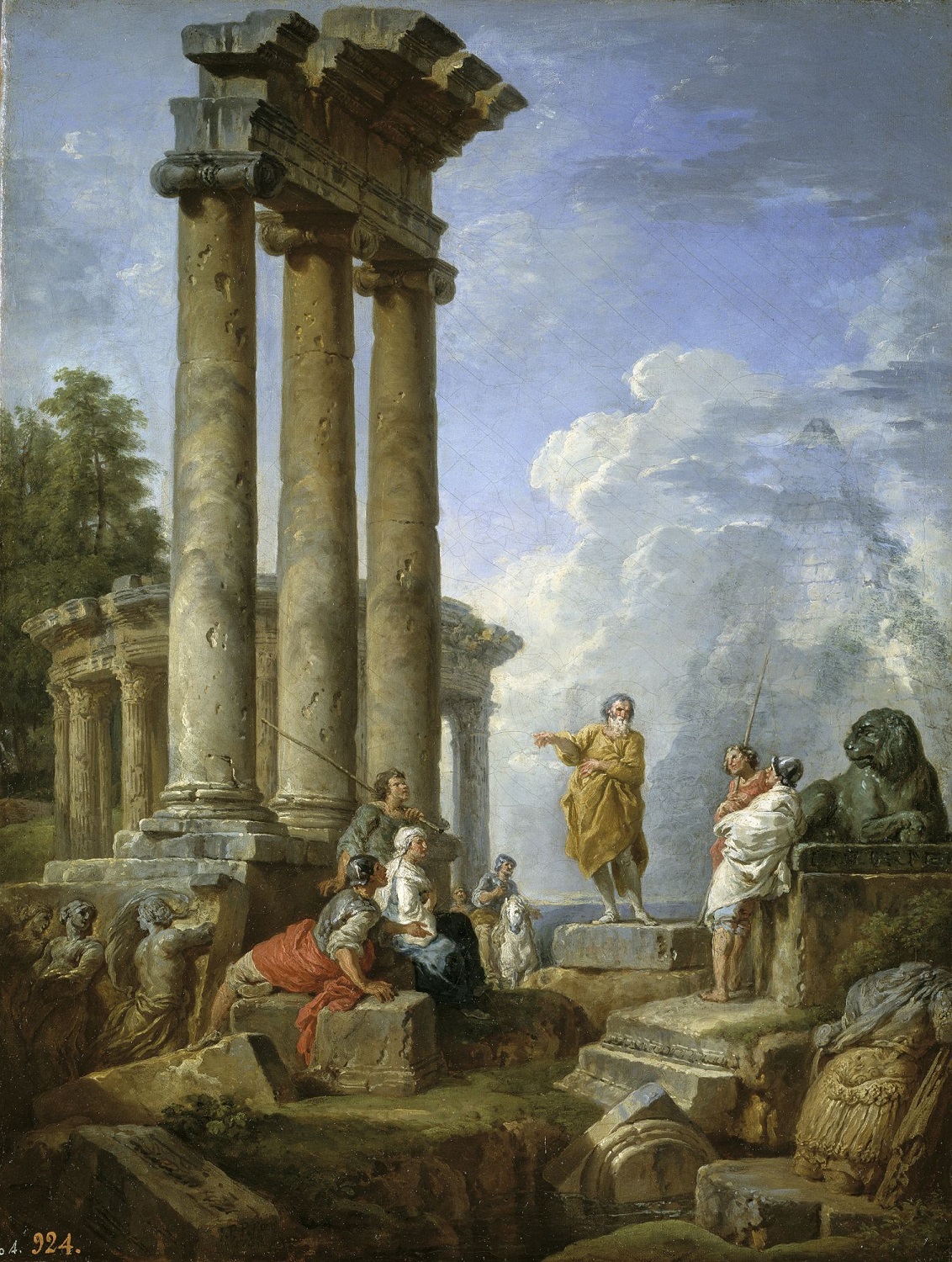
Gian Paolo Panini
St Paul preaching among Ruins
ca. 1735
oil on canvas
Museo del Prado, Madrid

Gian Paolo Panini
St Paul preaching among Ruins
1744
oil on canvas
Hermitage, Saint Petersburg

Gian Paolo Panini
St Paul preaching at Athens
1737
oil on canvas
Wellington Collection, Apsley House, London

Gian Paolo Panini
St Paul preaching among Ruins
ca. 1735-45
oil on canvas
Musées Royaux des Beaux-Arts, Brussels

Gian Paolo Panini
St Paul at Malta grasping the Viper
1735
oil on canvas
Wellington Collection, Apsley House, London

Gian Paolo Panini
Woman preaching among Ruins
ca. 1735
oil on canvas
Museo del Prado, Madrid

Gian Paolo Panini
Capriccio of Roman Ruins
ca. 1735
oil on canvas
Indianapolis Museum of Art

Gian Paolo Panini
Capriccio of Roman Ruins
1735
oil on canvas
Royal Collection, Great Britain

Gian Paolo Panini
Capriccio of Roman Ruins
1737
oil on canvas
Fitzwilliam Museum, Cambridge

Gian Paolo Panini
Capriccio of Roman Ruins
ca. 1735
oil on canvas
Indianapolis Museum of Art

Gian Paolo Panini
Capriccio of Roman Ruins
1735
oil on canvas
Royal Collection, Great Britain

Gian Paolo Panini
Capriccio of Roman Ruins
ca. 1740
oil on canvas
Royal Collection, Great Britain