Showing posts with label Urbino. Show all posts

Saturday, December 17, 2022

Drawings by Federico Barocci at the Louvre

Federico Barocci
Head of a Woman
ca. 1560-80
drawing
Musée du Louvre

Federico Barocci
Head of a Young Monk
ca. 1575
drawing
Musée du Louvre

Federico Barocci
Head of a Boy with a Ruff
ca. 1570
drawing
Musée du Louvre

Federico Barocci
Head of a Bearded Man
ca. 1590
drawing
Musée du Louvre

Federico Barocci
Head of a Bearded Man
ca. 1600
drawing
Musée du Louvre

Federico Barocci
Head of a Youth
ca. 1575
drawing
Musée du Louvre

Federico Barocci
Head of St Joachim
before 1612
drawing
Musée du Louvre

Federico Barocci
Studies of Hands
ca. 1560-80
drawing
Musée du Louvre

Federico Barocci
Study of Arm
ca. 1580
drawing
Musée du Louvre

attributed to Federico Barocci
Three Cherubs
ca. 1560-80
drawing
Musée du Louvre

Federico Barocci
Studies of a Youth with a Shovel
before 1612
drawing
Musée du Louvre

Federico Barocci
Studies of a Bending Figure 
before 1612
drawing
Musée du Louvre

Federico Barocci
Virgin and Child with St Elizabeth
and young St John the Baptist

ca. 1580
drawing
Musée du Louvre

Federico Barocci
Swooning Virgin
ca. 1567-68
drawing
Musée du Louvre

Anonymous Copyist after Federico Barocci
The Entombment
after 1582
drawing, with colored chalks and gouache
Musée du Louvre

Federico Barocci (c. 1535-1612) – Eclectic but highly individual painter of Urbino.  His refined and emotional fusion of Venetian colore with Central Italian disegno, most dependent on the earlier example of Correggio, anticipated and influenced the Carracci and led the transition from Late Mannerism to the Baroque.  Through his many altarpieces, commissioned from as far afield as Genoa, Tuscany, Umbria and Rome, he affected many artists throughout Italy.  The sincerity and lyrical pathos of his idiom perfectly expressed  Counter-Reformation sensibility.   . . .  [Especially prized are] Barocci's wonderfully colouristic chalk drawings, part of his meticulous preparation after the life for his painted works.

– Erika Langmuir and Norbert Lynton, Yale Dictionary of Art and Artists (2000)
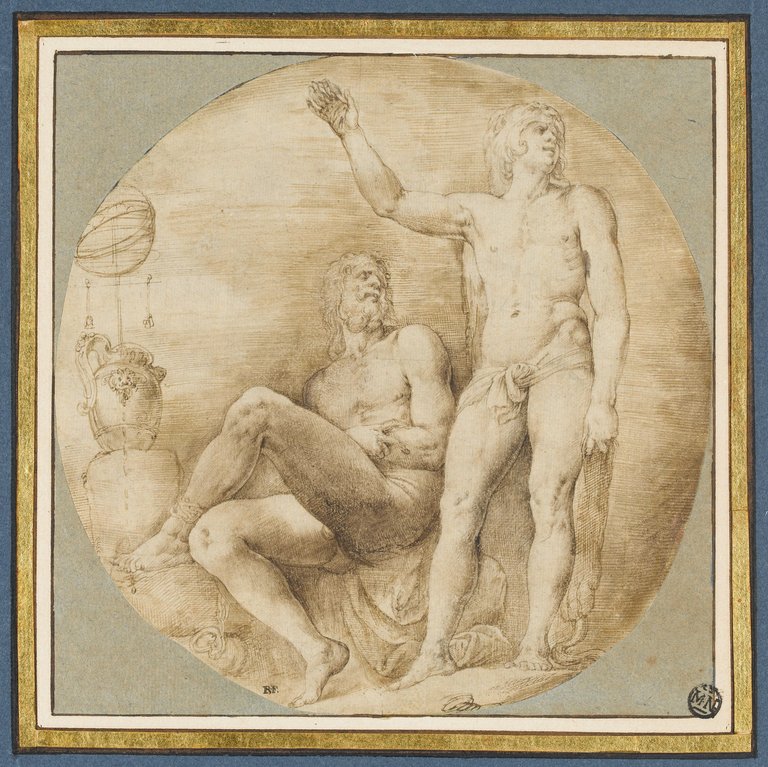
Tuesday, August 23, 2022

Battista Franco Veneziano, called il Semolei - (1510-1561)

Battista Franco
Hercules with seated Captive
before 1561
drawing
Musée du Louvre

Battista Franco
Arms of the Medici quartered with those of Austria
1536
drawing
(study for marriage festival decoration)
Musée du Louvre

Battista Franco
Study for Battle of Greeks and Trojans
ca. 1544-51
drawing
Musée du Louvre

Battista Franco
Youth leaning over a Balustrade
before 1561
drawing
Musée du Louvre

Battista Franco
Figure Study
before 1561
drawing
Musée du Louvre

Battista Franco
The Lamentation
ca. 1540
drawing
Musée du Louvre

Battista Franco
Studies for Saints in Niches above Frieze
ca. 1547-50
drawing
Musée du Louvre

Battista Franco
Study for an Allegory
before 1561
drawing
Musée du Louvre

Battista Franco
Study for Lazarus
ca. 1560
drawing
Musée du Louvre

Battista Franco
Study for Cronos
ca. 1558-59
drawing
Musée du Louvre

Battista Franco
Half-Length Figure Study
before 1561
drawing
Musée du Louvre

Battista Franco after Michelangelo
Figure of Night from Tomb of Giuliano de' Medici
ca. 1536
drawing
Musée du Louvre

Battista Franco after Michelangelo
Figure of Day from Tomb of Giuliano de' Medici
ca. 1536
drawing
Musée du Louvre

Battista Franco after Michelangelo
Figure of Day from Tomb of Giuliano de' Medici
ca. 1536
drawing
Musée du Louvre

Battista Franco after Michelangelo
Figure of Day from Tomb of Giuliano de' Medici
ca. 1536
drawing
Musée du Louvre

"Although born in Venice, Franco was in Rome by the time he was twenty.  There he made drawings after the Antique treasures that filled the city, but he also fell under the spell of Michelangelo and made numerous drawings after the master's work.  In addition to being a fine draughtsman, Franco was also an accomplished painter and printmaker.  He often produced prints of his own designs using either etching or engraving, or sometimes a combination of both.  Much of his career was spent in Rome and Urbino, but around 1552 he returned to Venice where he lived for the last decade of his life."

– from curator's notes at the National Gallery of Scotland

Wednesday, June 8, 2022

Paintings Ignored by S.J. Freedberg - Titian before 1550

Titian and workshop
Madonna and Child in a Landscape with Tobias and the Angel
ca. 1535-40
oil on panel
Royal Collection, Great Britain

Titian
Portrait of Francesco Maria della Rovere, Duke of Urbino
ca. 1536-38
oil on canvas
Galleria degli Uffizi, Florence

Titian
Portrait of a Man holding a Book
ca. 1540
oil on canvas
Museum of Fine Arts, Boston

Titian
Allocution of Alfonso d'Avalos,
Marchese del Vasto to his Troops

1540-41
oil on canvas
Museo del Prado, Madrid

Titian
Vendramin Family venerating a Relic of the True Cross 
ca. 1540-45
oil on canvas
National Gallery, London

Titian
Archangel Raphael with Tobias
ca. 1542
oil on canvas
Gallerie dell'Accademia, Venice

Titian
St John the Baptist
ca. 1542
oil on canvas
Gallerie dell'Accademia, Venice

Titian
Posthumous Portrait of Caterina Corner
as St Catherine of Alexandria

1542
oil on canvas
Galleria degli Uffizi, Florence

Titian
The Last Supper
ca. 1542-44
oil on canvas
Galleria Nazionale delle Marche, Urbino

Titian
The Resurrection
ca. 1542-44
oil on canvas
Galleria Nazionale delle Marche, Urbino

Titian
The Resurrection (detail)
ca. 1542-44
oil on canvas
Galleria Nazionale delle Marche, Urbino

Titian
The Resurrection (detail)
ca. 1542-44
oil on canvas
Galleria Nazionale delle Marche, Urbino

Titian and workshop
Portrait of Pope Paul III (Alessandro Farnese)
ca. 1545
oil on canvas
National Trust, Hatchlands, Surrey

Titian
Portrait of Doge Andrea Gritti
ca. 1545
oil on canvas
National Gallery of Art, Washington DC

 "The year 1546 having come, he went at the invitation of Cardinal Farnese to Rome, where he found Vasari, who, having returned from Naples, was executing the Hall of the Cancelleria for the above-named Cardinal; whereupon, Tiziano having been recommended by that lord to Vasari, Giorgio kept him company lovingly in taking him about to see the sights of Rome.  And then, after Tiziano had rested for some days, rooms were given to him in the Belvedere, to the end that he might set his hand to painting once more the portrait of Pope Paul.  . . .  Michelangelo and Vasari, going one day to visit Tiziano in the Belvedere, saw in a picture that he had executed at that time a nude woman representing Danaë, who had in her lap Jove transformed into a rain of gold; and they praised it much, as one does in the painter's presence."

– from Lives of the Painters, Sculptors and Architects by Giorgio Vasari (1568), translated by Gaston du C. de Vere (1912)

Friday, May 27, 2022

Battista Franco Veneziano, called il Semolei (ca. 1510-1561)

Battista Franco
Diana and Actaeon
ca. 1556
oil on canvas
Biblioteca Marciana, Venice

Battista Franco
Personification of Agriculture
with Pomona, Vertumnus, and Ceres

ca. 1556
oil on canvas
Biblioteca Marciana, Venice

Battista Franco
Baptism of Christ
ca. 1555
oil on canvas
(altarpiece)
Chiesa di San Francesco della Vigna, Venice

Battista Franco
Baptism of Christ (detail)
ca. 1555
oil on canvas
Chiesa di San Francesco della Vigna, Venice

Battista Franco
The Road to Calvary
1552
oil on canvas
Galleria degli Uffizi, Florence

Battista Franco
The Road to Calvary (detail)
1552
oil on canvas
Galleria degli Uffizi, Florence

Battista Franco
The Road to Calvary (detail)
1552
oil on canvas
Galleria degli Uffizi, Florence

Battista Franco
The Road to Calvary (detail)
1552
oil on canvas
Galleria degli Uffizi, Florence

Battista Franco
The Road to Calvary (detail)
1552
oil on canvas
Galleria degli Uffizi, Florence

Battista Franco
Fifteen Scenes from the Apocalypse
ca. 1550
vault frescoes
Cappella Grimani,
Chiesa di San Francesco della Vigna, Venice

Battista Franco
Fifteen Scenes from the Apocalypse (detail)
ca. 1550
vault fresco
Cappella Grimani,
Chiesa di San Francesco della Vigna, Venice

Battista Franco
Fifteen Scenes from the Apocalypse (detail)
ca. 1550
vault fresco
Cappella Grimani,
Chiesa di San Francesco della Vigna, Venice

Battista Franco
Fifteen Scenes from the Apocalypse (detail)
ca. 1550
vault fresco
Cappella Grimani,
Chiesa di San Francesco della Vigna, Venice

Battista Franco
Fifteen Scenes from the Apocalypse (detail)
ca. 1550
vault fresco
Cappella Grimani,
Chiesa di San Francesco della Vigna, Venice

Battista Franco
Fifteen Scenes from the Apocalypse (detail)
ca. 1550
vault fresco
Cappella Grimani,
Chiesa di San Francesco della Vigna, Venice

"Initially no less close an imitator of Michelangelo, but in a way assertively opposite – concerned with Michelangelo's demonstrations of form but disregarding what he meant to be its human content – was Battista Franco Veneziano (il Semolei).  Franco appeared in Rome at the age of twenty and dedicated himself for a span of years to the exclusive study of Michelangelo's art, but as a draughtsman only.  . . .  The reception given in Rome to this naїve extreme of the cult of Michelangelo was unsympathetic, and Franco left to practise elsewhere.  From about 1545 to 1551 he was mostly in Urbino.  . . .  By 1554 Franco had returned finally to his native Venice, but even before this he had begun to yield, in Urbino, to influences from the Venetian school.  Still, his first Venetian works made propaganda there for a mode of Romanism, though not at a level which, in the Venetian community of the time, could have carried much weight.  The process that had begun before his return, of readjustment towards a Venetian style, accelerated rapidly.  Franco was by no means the sole painter in Venice to profess a Romanist aesthetic.  Nevertheless, the authenticity of his Roman experience, compared with that of Venetian colleagues of similar inclination, made him more distinct than they within a Venetian context and lent his production a measure of authority that theirs did not always have."    

– S.J. Freedberg, Painting in Italy 1500-1600 in the Pelican History of Art series (1970)

Battista Franco after Michelangelo
Noli me tangere
ca. 1537
oil on panel
Dayton Art Institute, Ohio