Showing posts with label beauty. Show all posts

Thursday, December 22, 2022

French Heads (Study Drawings)

Simon Vouet
Head of Endymion
before 1649
drawing
(study for painting)
Musée du Louvre

Pierre Puvis de Chavannes
Head of a Woman
ca. 1880
drawing
Musée d'Orsay, Paris

Bernard Picart
Head of a Woman
before 1733
drawing
Rijksmuseum, Amsterdam

Charles-Joseph Natoire
Head of an Angel
ca. 1755
drawing
(study for painting)
Musée du Louvre

School of Fontainebleau
Head of a Woman
16th century
drawing
Musée du Louvre

School of Fontainebleau
Head of a Woman
16th century
drawing
Musée du Louvre

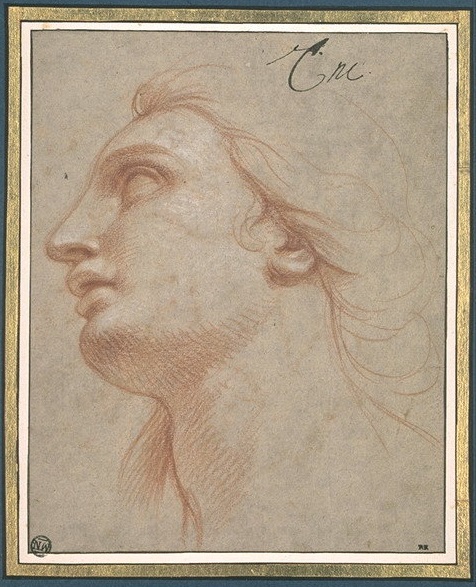
Michel Corneille the Younger
Head of the Virgin
ca. 1660-70
drawing
Musée du Louvre

Louis Boullogne the Younger
Head of a Woman
ca. 1713-15
drawing
(study for painting)
Musée du Louvre

Anonymous French Artist
Head of a Barbarian from Trajan's Column, Rome
18th century
drawing
Musée du Louvre

Anonymous French Artist
Head of a Youth
18th century
drawing
Musée du Louvre

Anonymous French Artist
Head of a Man
18th century
drawing
Musée du Louvre

Charles Le Brun
Head of a Woman
ca. 1670
drawing
Musée du Louvre

Charles Le Brun
Head of a Soldier
ca. 1685
drawing
(study for painting, The Raising of the Cross)
Musée du Louvre

Nicolas-Bernard Lépicié
Head of a Youth
before 1784
drawing
Musée du Louvre

Nicolas-Bernard Lépicié
Head of a Woman with an Earring
before 1784
drawing
Musée du Louvre

"When we ask what is beautiful, we do not mean to speak of an object which exists outside us and is separate from other objects, as when we ask what is a horse or what is a tree. A tree is a tree and a horse is a horse absolutely and in themselves, there is no need to compare them with any of the other things contained in the universe. This is not the case with beauty. This term is not absolute but expresses a relation between the objects we call beautiful and our ideas, or our feelings, or our understanding, or our heart, or, finally, other objects different from ourselves."

"Some speculative thinkers, accustomed to judging objects coolly and from ideas only, count feelings for nothing and consider all that is built upon them and all that follows from them as capricious or wayward. In contrast others, who are more numerous, do not reason at all, or hardly at all, and deliver themselves over entirely to their feelings. Since these latter are unable to trace the origins of their feelings and the causes of their differences with each other, in order to give some account of such differences and have done with it, they attribute them to chance, to some je ne sais quoi, or to pure caprice, thus confounding taste with fancy. However, we ought to avoid equally both confusion and excess."   

– Jean-Pierre de Crousaz, Treatise on Beauty (1714), translated by Katerina Deligiorgi

Tuesday, March 9, 2021

Classic & Baroque - Painting in Italy - 1620-1625

Ferraù Fenzoni
The Conversion of St Paul
ca. 1620
oil on canvas
Fondazione Cavallini Sgarbi, Ferrara

Giuseppe Vermiglio
Jael and Sisera
ca. 1620
oil on canvas
Pinacoteca Ambrosiana, Milan

from the Book of Judges, chapter 5

She put her hand to the nail, and her right hand to the workmen's hammer,
and with the hammer she smote Sisera, she smote off his head, 
when she had pierced and stricken through his temples. 
At her feet he bowed, he fell, he lay down: 
at her feet he bowed, he fell: 
where he bowed, there he fell down dead.

– King James Bible (1611)

Luca Saltarello
Christ in the Tomb
ca. 1620
oil on canvas
Accademia Ligustica di Belle Arti, Genoa

Pier Francesco Mazzucchelli (il Morazzone)
The Beheading of St John the Baptist
ca. 1620
oil on canvas
Palazzo Bianco, Genoa

Giovanni Lanfranco
St Peter freed from Prison
ca. 1620-21
oil on canvas
Birmingham Museum of Art, Alabama

Nicolas Tournier
Soldier lifting a Flask
ca. 1620-24
oil on canvas
Palazzo dei Musei, Modena

from Tamburlaine the Great

What is beauty, saith my sufferings, then?
If all the pens that poets ever held
Had fed the feeling of their masters' thoughts,
And every sweetness that inspired their hearts,
Their minds, and muses on admirèd themes,
If all the heavenly quintessence they still
From their immortal flowers of poesy,
Wherein, as in a mirror, we perceive
The highest reaches of a human wit,
If these had made one poem's period
And all combined in beauty's worthiness,
Yet should there hover in their restless heads
One thought, one grace, one wonder at the least,
Which into words no virtue can digest.

– Christopher Marlow (1590)

"The first note of that passage is a surprise: we are used to thinking of Tamburlaine as acting, not suffering; it is his victims who suffer.  But the apprehension of beauty, Tamburlaine recognizes, does indeed demand suffering of a kind."

– Alexander Leggatt, from Tamburlaine's Sufferings (Yearbook of English Studies, 1973) 

Domenico Fetti
The Flight into Egypt
ca. 1622-23
oil on panel
Kunsthistorisches Museum, Vienna

The two young children in the foreground of Fetti's Flight into Egypt are described by a commentator at the British Museum (in reference to an early print of this painting) as "sleeping putti" – but I wonder if this is what they are.  Fully illuminated, they are gazed at by the Virgin with her habitual serenity, but also by St Joseph, with furrowed brow, seemingly expressive of perturbation.  The traveling party crosses a small arched bridge, and the bodies of the so-called putti are disposed so as to mirror that shallow arch.  Have they been lulled to sleep by some sort of sympathetic magic, reflecting the sleep of the Christ Child in the Virgin's embrace?  Or are they dead?  Granted, if they are indeed putti, it could make no sort of sense for them to be dead.  But what if the two represent the much more numerous Holy Innocents, massacred by Herod's soldiers while the Flight into Egypt was going forward, and killed in place of the Christ Child himself?  In that case, their sacrifice could represent the "bridge" that permitted the Holy Family's escape to safety.  The prominence of the pair in the picture, their un-lifelike disposition, and above all what appears to be a red wound on the torso of the upper child, raise for me this question about their identity, though I haven't seen it questioned in any of the literature. 

Gérard Douffet
Ecce Homo
ca. 1623
oil on canvas
Speed Art Museum, Louisville, Kentucky

Jacopo Vignali
Tobias and the Archangel Raphael
ca. 1623
oil on canvas
Palazzo Pretorio, Prato

Giovanni Biliverti
Angelica ashamed of her nakedness before Ruggiero
ca. 1624
oil on canvas
Palazzo Pretorio, Prato

"Tenderly he addressed the maiden, after reining in his charger. 'Gentle lady, the only fetter you merit is that with which Love binds his votaries: quite undeserving must you be if this plight or of any other. Who is the miscreant so perverted as to blemish the smooth ivory of your delicate hands with unwelcome bruising?'  On hearing him speak she perforce became like white ivory sprinkled with carmine, seeing those parts of her exposed to view which, for all their beauty, modesty would conceal.  She would have covered her face with her hands were they not tied to the hard rock.  But she bathed it in tears – this at least she was free to do – and tried to keep it bowed.  After sobbing a little, she prepared to speak." 

– Ludovico Ariosto, Orlando Furioso (1516), translated by Guido Waldman (1974)

Giovanni Biliverti
Angelica ashamed of her nakedness before Ruggiero
(detail with the distant Hippogryph ridden by Ruggiero)
ca. 1624
oil on canvas
Palazzo Pretorio, Prato

"Logistilla was visibly pleased that so worthy a knight should have come to her, and she gave orders that everyone should make much of him and study to do him reverence.  . . . She took counsel with herself how best to help Ruggiero and, after him, the duke.  Her conclusion was that the winged horse would have to return the former to the shores of Aquitania; but first the beast would have to be fitted with a special bridle wherewith Ruggiero could turn him in flight and rein him in.  She showed him what to do if he wanted the steed to climb, what to do to make him descend, how to make him wheel in a circle, or go fast, or simply hover.  And whatever the knight was accustomed to performing on a good earth-bound horse he soon became adept at achieving in the air on the feathered steed."

– Ludovico Ariosto, Orlando Furioso (1516), translated by Guido Waldman (1974)

Gianlorenzo Bernini
David
ca. 1624-25
oil on canvas
Palazzo Barberini, Rome

Pietro Paolini (il Lucchese)
Concert with Five Musicians
ca. 1625
oil on canvas
private collection

Pietro Paolini (il Lucchese)
Concert with Five Musicians (detail)
ca. 1625
oil on canvas
private collection

Pietro Paolini (il Lucchese)
Concert with Five Musicians (detail)
ca. 1625
oil on canvas
private collection

from The Concert

No, I will go alone.
I will come back when it's over. 
Yes, of course I love you.
No, it will not be long.
Why may you not come with me? –
You are too much my lover.
You would put yourself
Between me and song. 

           *             *            *

You and I have nothing to do with music.
We may not make of music a filigree frame,
Within which you and I,
Tenderly glad we came,
Sit smiling, hand in hand.

Come now, be content.
I will come back to you, I swear I will;
And you will know me still.
I shall be only a little taller
Than when I went.

– Edna St. Vincent Millay (1923)

Thursday, March 12, 2020

Invoking Bronzino (Pink Dawn of an Apotheosis)

Agnolo Bronzino
Portrait of Lucrezia Panciatichi
ca. 1540
oil on panel
Galleria degli Uffizi, Florence

A prime reason, we must add, why sundry impressions were not to be fully present to the girl till later on was that they yielded at this stage, with an effect of sharp supersession, to a detached quarter of an hour – her only one – with Lord Mark.  "Have you seen the picture in the house, the beautiful one that's so like you?" – he was asking that as he stood before her; having come up at last with his smooth intimation that any wire he had pulled and yet wanted not to remind her of wasn't quite a reason for his having no joy at all.

"I've been through rooms and I've seen pictures.  But if I'm 'like' anything so beautiful as most of them seemed to me – !"  It needed in short for Milly some evidence which he only wanted to supply.  She was the image of the wonderful Bronzino, which she must have a look at on every ground.  He had thus called her off and led her away; the more easily that the house within was above all what had already drawn round her its mystic circle. 

                                      *                             *                            *

It was all the while for Milly as if Lord Mark had really had something other than this spoken pretext in view; as if there were something he wanted to say to her and were only – consciously yet not awkwardly, just delicately – hanging fire.  At the same time it was as if the thing had practically been said by the moment they came in sight of the picture; since what it appeared to amount to was "Do let a fellow who isn't a fool take care of you a little."  The thing somehow, with the aid of the Bronzino, was done; it hadn't seemed to matter to her before if he were a fool or no; but now, just where they were, she liked his not being; and it was moreover none the worse for coming back to something of the same sound as Mrs. Lowder's so recent reminder.  She too wished to take care of her – and wasn't it, à peu près, what all the people with the kind eyes were wishing? Once more things melted together – the beauty and the history and the facility and the splendid midsummer glow: it was a sort of magnificent maximum, the pink dawn of an apotheosis coming so curiously soon.  What in fact befell was that, as she afterwards made out, it was Lord Mark who said nothing in particular – it was she herself who said all.  She couldn't help that – it came; and the reason it came was that she found herself, for the first moment, looking at the mysterious portrait through tears.  Perhaps it was her tears that made it just then so strange and fair – as wonderful as he had said: the face of a young woman, all splendidly drawn, down to the hands, and splendidly dressed; a face almost livid in hue, yet handsome in sadness and crowned with a mass of hair, rolled back and high, that must, before fading with time, have had a family resemblance to her own.  The lady in question, at all events, with her slightly Michael-angelesque squareness, her eyes of other days, her full lips, her long neck, her recorded jewels, her brocaded and wasted reds, was a very great personage – only unaccompanied by a joy.  And she was dead, dead, dead.  Milly recognised her exactly in words that had nothing to do with her.  "I shall never be better than this."

He smiled for her at the portrait.  "Than she?  You'd scarce need to be better, for surely that's well enough.  But you are, one feels, as it happens, better; because, splendid as she is, one doubts if she was good."

He hadn't understood.  She was before the picture, but she had turned to him, and she didn't care if he noticed her tears.  It was probably as good a moment as she should ever have with him.  It was perhaps as good a moment as she should have with any one, or have in any connexion whatever.  "I mean that everything this afternoon has been too beautiful, and that perhaps everything together will never be so right again.  I'm very glad therefore you've been a part of it."

Though he still didn't understand her he was as nice as if he had; he didn't ask for insistence, and that was just a part of his looking after her.  He simply protected her now from herself, and there was a world of practice in it.  "Oh we must talk about these things!"

Ah they had already done that, she knew, as much as she ever would; and she was shaking her head at her pale sister the next moment with a world, on her side, of slowness.  "I wish I could see the resemblance.  Of course her complexion's green," she laughed, "but mine's several shades greener."

"It's down to the very hands," said Lord Mark.

"Her hands are large," Milly went on, "but mine are larger.  Mine are huge."

"Oh you go her, all round, 'one better' – which is just what I said.  But you're a pair.  You must surely catch it," he added as if it were important to his character as a serious man not to appear to have invented his plea.

"I don't know – one never knows one's self.  It's a funny fancy, and I don't imagine it would have occurred –"

"I see it has occurred" – he had already taken her up.  She had her back, as she faced the picture, to one of the doors of the room, which was open, and on her turning as he spoke she saw that they were in the presence of three other persons, also, as appeared, interested enquirers.  Kate Croy was one of these; Lord Mark had just become aware of her, and she, all arrested, had immediately seen, and made the best of it, that she was far from being first in the field.  She had brought a lady and a gentleman to whom she wished to show what Lord Mark was showing Milly, and he took her straightway as a re-enforcement.  Kate herself had spoken, however, before he had time to tell her so.

"You had noticed too?" – she smiled at him without looking at Milly.  "Then I'm not original – which one always hopes one has been.  But the likeness is so great."  And now she looked at Milly – for whom again it was, all round indeed, kind, kind eyes.  "Yes, there you are, my dear, if you want to know.  And you're superb."  She took now but a glance at the picture, though it was enough to make her question to her friends not too straight.  "Isn't she superb?"

"I brought Miss Theale," Lord Mark explained to the latter, "quite off my own bat."

"I wanted Lady Aldershaw," Kate continued to Milly, "to see for herself."

"Les grands esprits se rencontrent!" laughed her attendant gentleman, a high but slightly stooping, shambling and wavering person who represented urbanity by the liberal aid of certain prominent front teeth and whom Milly vaguely took for some sort of great man.

Lady Aldershaw meanwhile looked at Milly quite as if Milly had been the Bronzino and the Bronzino only Milly.  "Superb, superb.  Of course I had noticed you.  It is wonderful," she went on with her back to the picture, but with some other eagerness which Milly felt gathering, felt directing her motions now.  It was enough – they were introduced, and she was saying "I wonder if you could give us the pleasure of coming –"

– Henry James, The Wings of the Dove (New York Edition, 1909)

Thursday, July 18, 2019

Cleopatra as Ideal Beauty

Piero di Cosimo
Portrait of Simonetta Vespucci as Cleopatra
ca. 1480
oil on panel
Musée Condé, Chantilly

Antico (Pier Jacopo Alari-Bonacolsi)
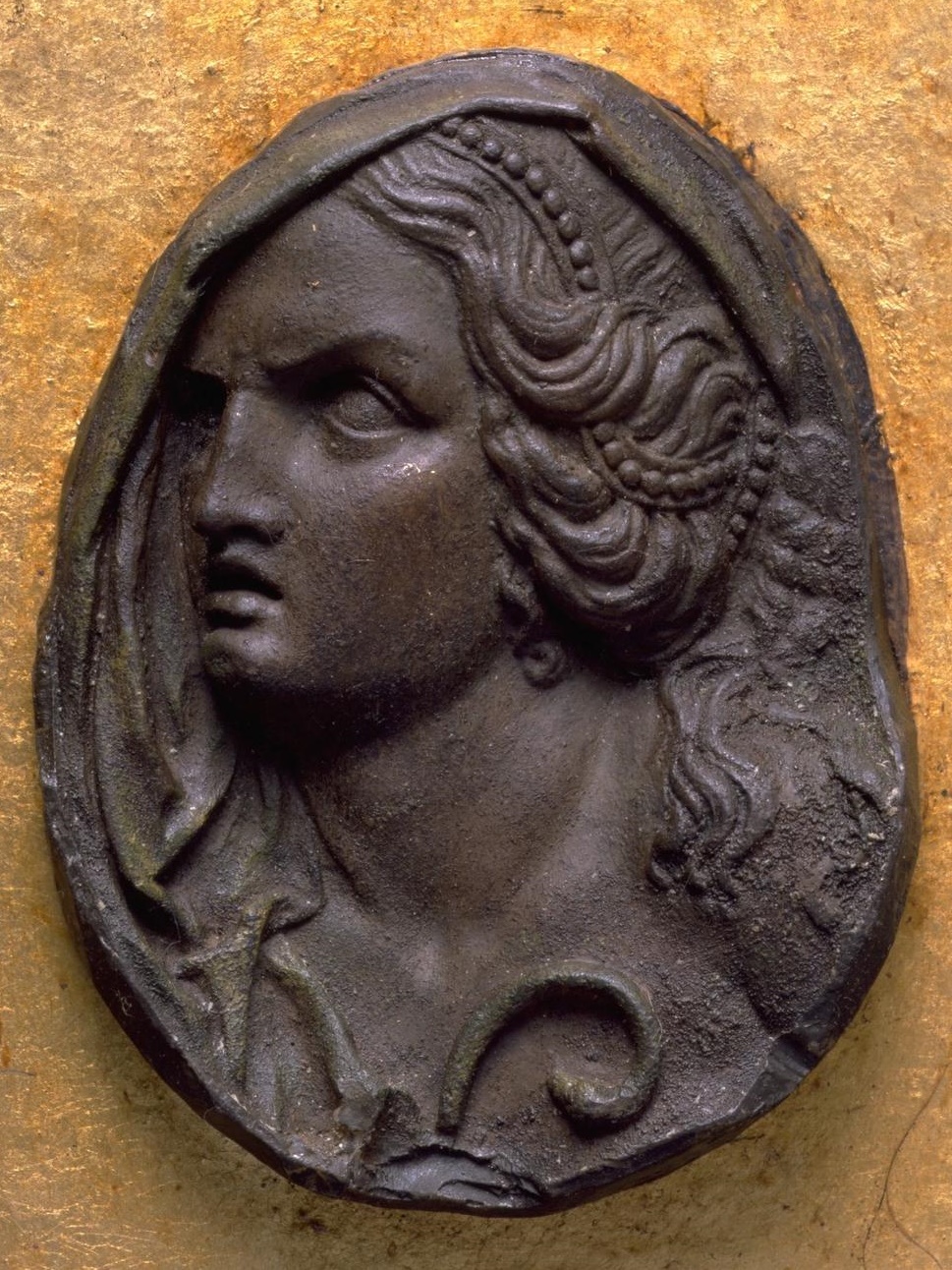
Bust of Cleopatra
ca. 1519-22
bronze
Museum of Fine Arts, Boston

Henry van der Weyde
Mrs Langtry as Cleopatra
1890
albumen cabinet card
National Portrait Gallery, London

William and Daniel Downey
Cleopatra (Mrs Langtry)
1891
photogravure
National Portrait Gallery, London

Lawrence Alma-Tadema
Cleopatra
1877
oil on panel
Auckland Art Gallery, New Zealand

Anonymous French Maker
Pendant - Cleopatra
19th-century imitation of 16th-century work
enameled gold, sapphires, rubies, pearls, emeralds
British Museum

Egypt

Cle–
1600 men to a stone.  Please mention
the Nile.  Croco– But the slow thing
happens in the air.
Tree slender as light.
Did Cae– ?  I don't remember
that he came.
I remember the sand.
The limping slaves.
The exact condition
of their death.
The terrible thing somehow happens
in the air.
Night in that Egypt.  God!  how cold
the stars must have been.

Tree slender as life,
and as tall
– green then!  Where are the leaves
of that time?  Why can't I think
these stars are the same stars?
Where do the souls of men have their spaces?
Shall I be obedient in that silver nudity?

– Kenneth Patchen (1943)

Anonymous Maker working in Milan
Cleopatra
early 17th century
sardonyx cameo
British Museum

Richard Cockle Lucas
Cleopatra
1848
wax relief
Victoria & Albert Museum

Lavinia Fontana
Cleopatra
1582
oil on canvas
Galleria Spada, Rome

Massimo Stanzione
Cleopatra
ca. 1630-50
oil on canvas
Hermitage, Saint Petersburg

Rembrandt
Cleopatra with Arrow
1661
etching
British Museum

Giambattista Tiepolo
Cleopatra
before 1770
drawing
Victoria & Albert Museum

Guercino
Cleopatra and Octavian
ca. 1640
drawing
Museum Kunstpalast, Düsseldorf

Guercino
Cleopatra and Octavian
ca. 1640
oil on canvas
Pinacoteca Capitolina, Rome

Saturday, June 22, 2019

Seicento Painting (Selections - Later)

Ottavio Vannini
St Sebastian
before 1644
oil on canvas
Museo di San Marco, Florence

Bernardo Cavallino
Adoration of the Magi
ca. 1630-56
oil on canvas
Kunsthistorisches Museum, Vienna

Guido Cagnacci
Penitent Magdalen
1658
oil on canvas
Portsmouth Museums (Hampshire)

Salvator Rosa
Madonna del Suffragio
1661-62
oil on canvas
Pinacoteca di Brera, Milan

"Earlier in the century, it was the most responsive writers who might begin their setting of the encounter with a much admired body of pictures to words by paying tribute to painting as a form of the unsayable.  As Paul Valéry wrote in 1932 (it's the first sentence of "About Corot"): "One must always apologize for talking about painting."  From the summoning of each art to what its means only could enact, it follows that nothing can be paraphrased or transposed into another medium.  Painting, like music and dance, does not signify in the verbal sense; what you see is what you get.  "A work of art, if it does not leave us mute, is of little value" (Valéry again).  Of course, we don't stay mute."

– Susan Sontag, from About Hodgkin (1995)

Matteo Ponzoni
Judith with the Head of Holofernes
before 1663
oil on canvas
Victoria & Albert Museum

Carlo Maratti
Alpheus and Arethusa
ca. 1650-90
oil on canvas
private collection

Guillaume Courtois (Il Borgognone) and Abraham Brueghel
Woman with Roses
ca. 1665-75
oil on canvas
private collection

Francesco Allegrini
Triumph of David
before 1679
oil on canvas
Palazzo Ducale, Gubbio

Francesco Allegrini
Fall of Icarus
before 1679
oil on paper, mounted on panel
Fitzwilliam Museum, Cambridge

Pietro Montanini
St Martin dividing his Cloak with a Beggar
before 1689
oil on canvas
National Museum of Art of Romania, Bucharest

Francesco Solimena
Hagar and the Angel
ca. 1690
oil on canvas
Banco Commerciale Italiana, Naples

Francesco Solimena
Joseph and Potiphar's Wife
ca. 1690
oil on canvas
private collection

Sebastiano Ricci
Martyrdom of St Erasmus
ca. 1694-97
oil on canvas
Pinacoteca di Brera, Milan

Stefano Maria Legnani
Self-portrait
1692
oil on canvas
Pinacoteca di Brera, Milan