Showing posts with label cameras. Show all posts

Saturday, June 13, 2026

Solos

Victor Landweber
Ansco Panda
1983
C-print
San Francisco Museum of Modern Art


Hiram Powers
Loulie's Hand
1851
marble
Clark Art Institute, Williamstown, Massachusetts

Robert Kulicke
Dollar Bill on Dark Background
1976
oil on board
Buffalo AKG Art Museum, New York

Henri Matisse
La Table au Café
ca. 1899
oil on canvas
San Francisco Museum of Modern Art

Roman Empire
Spoon
AD 250-300
silver
Morgan Library, New York

Eric Ravilious
Ship's Screw on Railway Truck
1940
watercolor and graphite on paper
Ashmolean Museum, Oxford

Anne Redpath
Posy
before 1965
oil on canvas
Scottish National Gallery of Modern Art, Edinburgh

Amanda Means
Lightbulb #3
1998
gelatin silver print
San Francisco Museum of Modern Art

Melissa Ann Pinney
Kiddy Pool - Onekama, Michigan
1990
C-print
San Francisco Museum of Modern Art

Ellsworth Kelly
Green Curve I
1969
oil on canvas
Buffalo AKG Art Museum, New York

Roy Lichtenstein
Mirror I
1976
painted bronze
San Francisco Museum of Modern Art

Raphaelle Peale
Venus rising from the Sea: A Deception
ca. 1822
oil on canvas
Nelson-Atkins Museum of Art, Kansas City, Missouri

Bernard Perrot
Wig Stand
ca. 1700-1715
blown glass
Musée du Louvre

Alessandro Mendini
Armchair
1978
painted wood and upholstery
Museum of Modern Art, New York

Vico Magistretti for Oluce (Italy)
Atollo Table Lamp
1977
aluminum and polyurethane
Museum of Modern Art, New York

Robert Mapplethorpe
Leaf
1989
gelatin silver print
Scottish National Gallery of Modern Art, Edinburgh

Alexander Ross
Untitled
2004
oil on canvas
Nelson-Atkins Museum of Art, Kansas City, Missouri

So, insecure, he loves and love
Is insecure, gives less than he expects.
He knows not if it be seed in time to display
Luxuriantly in a wonderful fructification
Or whether it be but a degenerate remnant
Of something immense in the past but now
Surviving only as the infectiousness of disease
Or in the malicious caricature of drunkenness;
Its end glossed over by the careless but known long
To finer perceptions of the mad and ill.

– W.H. Auden (1929)

Thursday, August 15, 2024

Made in 1990

Lisa Zwerling
Mannequin, Pre-Columbian Figure, and Drapery
1990
oil on canvas
Fralin Museum of Art, Charlottesville, Virginia

Lawrence Weiner
Chains Wrapped Around One Thing & Another
1990
vinyl text panels
(variable installation)
Art Gallery of Ontario, Toronto

Joanne Tod
When Imperative is Conditional
1990
oil on canvas
Museum London, Ontario

Alice Aycock
Miami Proposal II
(steel, concrete, water)

1990
screenprint
Madison Museum of Contemporary Art, Wisconsin

William Robinson
William Jumping the Gate
1990
etching
National Gallery of Australia, Canberra

Orest Semchishen
Two Immigrant Polish Priests, Lac Ste. Anne, Alberta
1990
gelatin silver print
National Gallery of Canada, Ottawa

Lorraine Gilbert
Josée and Carole, Invermere, British Columbia
1990
C-print
National Gallery of Canada, Ottawa

Jeff Atkinson
Piazza del Duomo, Milano
1990
gelatin silver print
National Gallery of Australia, Canberra

Jeff Atkinson
Camera on the Acropolis, Athens
1990
gelatin silver print
National Gallery of Australia, Canberra

David Spear
Neugents on the Porch
1990
gelatin silver print
North Carolina Museum of Art, Raleigh

Robert Nelson Markle
Untitled (Table Dancer)
1990
acrylic and ink on canvas
Art Gallery of Ontario, Toronto

Sandow Birk
Guard Tower,
Sing-Sing Correctional Facility, Ossining NY

1990
acrylic and oil on canvas
New Britain Museum of American Art, Connecticut

Sharon Thompson
Heaven and Earth move with Devotion
1990
oil on canvas
Agnes Etherington Art Centre, Kingston, Ontario

Milan Todd
Galahs
1990
screenprint
National Gallery of Australia, Canberra

Yvan Adam
L'Homme de Rêve
1990
screenprint
(poster for Canadian Film Board)
Musée National des Beaux-Arts du Québec

Robert Foster
Yellow Pitcher
1990
anodised aluminum
Art Gallery of South Australia, Adelaide

A.E. Housman

No one, not even Cambridge, was to blame 
(Blame if  you like the human situation):
Heart-injured in North London, he became
The Latin Scholar of his generation.

Deliberately he chose the dry-as-dust,
Kept tears like dirty postcards in a drawer;
Food was his public love, his private lust
Something to do with violence and the poor.

In savage foot-notes on unjust editions
He timidly attacked the life he led,
And put the money of his feelings on

The uncritical relations of the dead,
Where only geographical divisions
Parted the coarse hanged soldier from the don.

– W.H. Auden (1938)

Sunday, September 18, 2016

Industrial Arts by Thomas Struth

Thomas Struth
CHEMISTRY FUME CABINET
UNIVERSITY OF EDINBURGH
2010

Thomas Struth
CURVED WAVE-TANK
UNIVERSITY OF EDINBURGH
2010

"Unlike, for example, the gritty, dread-inducing paintings of Anselm Kiefer, whose thoughts never seem far from Auschwitz, Struth’s photographs evoke nothing bad. They have a lightness of spirit, you could almost say a sunniness, that is not present in the work of the other major practitioners of the new oversized color photography—Andreas Gursky, Candida Höfer, Jeff Wall, Thomas Ruff among them. Struth is the Sunday child of the lot. His huge photographs—city streets, people looking at paintings in museums, industrial landscapes, factories, laboratories, rain forests, and family groups—are as pleasing as his persona; they seem to be an extension of it. Michael Fried, in his tautly argued book Why Photography Matters as Art as Never Before (2008), pauses to remark, with apparent (uncharacteristic) irrelevance — but evident intuitive understanding of the force of Struth’s radiance — “A striking fact about Struth’s public career is the almost universally enthusiastic response that his work has received.” 

Thomas Struth
DRYDOCK
DSME SHIPYARD, GEOJE ISLAND, KOREA
2007

Thomas Struth
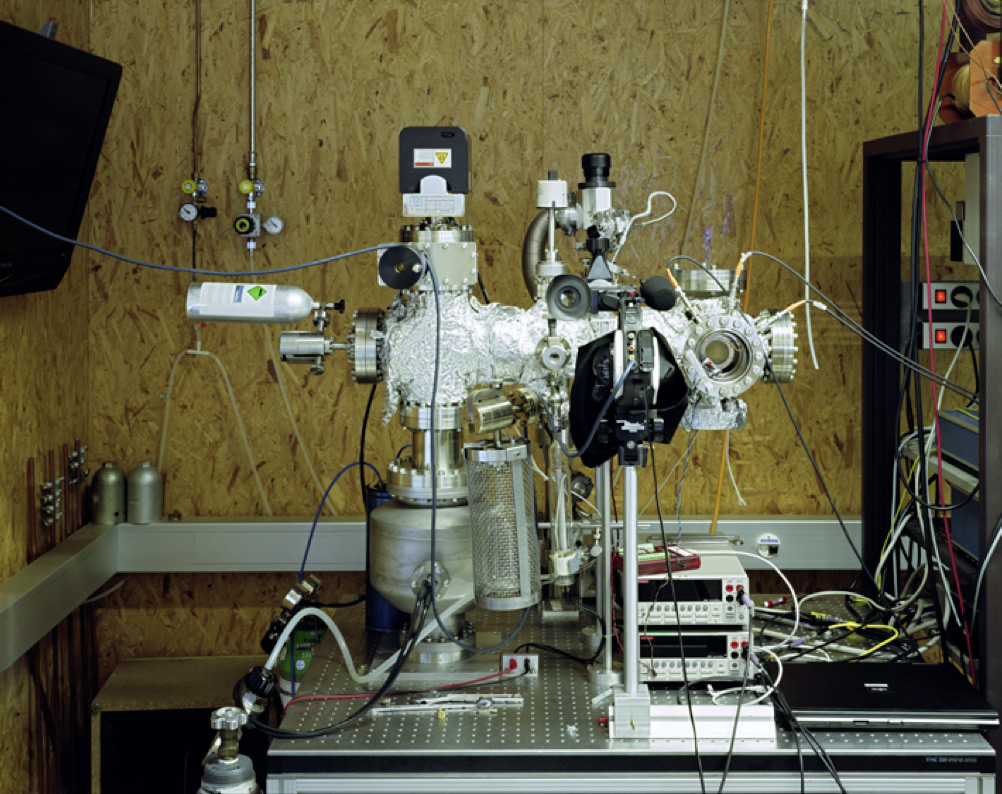
FIELD-ION MICROSCOPE
UNIVERSITAET, ZURICH
2010

Thomas Struth
PHARMACEUTICAL PACKAGING LABORATORIES
PHOENIX, BUENOS AIRES
2009

"Struth’s photographs taken in factories, laboratories, and nuclear power plants ... look like nothing one has ever seen before. These glimpses into what the critic Benjamin Buchloh calls “the technological sublime” were on view at Marian Goodman last year and constitute some of Struth’s most powerful images. ... The feeling of not understanding what one is seeing, of not knowing the functions of madly tangled wires and tubes and cables and mysterious flanges and pulleys and levers, is brilliantly conveyed by these huge pictures of places few of us have ventured into and on whose products many of us depend. Predictably, the places are not satanic mills but belong to the world of Struth’s benign photographic vision. They reassure even as they baffle. They tell us that the people who are absent from the pictures are back there somewhere and that they know what it all means and know what they are doing."

Thomas Struth
REACTOR PRESSURE VESSEL PHASE-OUT
AKW WUERGASSEN, BEVERUNGEN
2009

Thomas Struth
SEEMLESS TUBE PRODUCTION
TENARIS SIDERCA CAMPANA, BUENOS AIRES
2009

Thomas Struth
SEMI-SUBMERSIBLE RIG
DSME SHIPYARD, GEOJE ISLAND,KOREA
2007

"The picture we had been standing in front of showed a semi-submersible oil rig in a shipyard on Geoje Island, in South Korea—a huge red thing, a colossus on four legs on a platform afloat near the shore, taut cables anchoring it to the concrete pavement onshore, on which piles of miscellaneous building materials are strewn. The photograph (a hundred and ten by a hundred and thirty-eight inches) magisterially represents what can be called the new optics of the new photography, which sees the world as no human eye does. When you look at these photographs, it is as if you were looking through strange new bifocals that focus on things at a distance at the same moment that they focus on things close up. Everything is equally sharp."

Thomas Struth
SPACE SHUTTLE
KENNEDY SPACE CENTER, CAPE CANAVERAL
2008

Thomas Struth
STELLARATOR WENDELSTEIN 7-X DETAIL
MAX PLANCK IPP, GREIFSWALD
2009

Thomas Struth
TOKAMAK ASDEX UPGRADE INTERIOR I
MAX PLANCK IPP, GARCHING
2010

Thomas Struth
TOKAMAK ASDEX UPGRADE PERIPHERY
MAX PLANCK IPP, GARCHING
2009

Thomas Struth
VEHICLE ASSEMBLY BUILDING
KENNEDY SPACE CENTER, CAPE CANAVERAL
2008

Thomas Struth
Installation View
2010
Galerie Max Hetzler, Berlin

Quoted texts above are from Janet Malcolm's extended New Yorker interview with Thomas Struth published in 2011. This usually-skeptical journalist conveyed the impression that she  like the rest of the art world  felt spontaneously fond of the forthright and ingenuous Struth. Yet their concluding exchange, as reported below, also suggests that she had a few reservations. Malcolm describes herself strolling with Struth through Dresden, talking about the artist's most recent pictures shot at industrial and scientific workplaces. She asked if he felt he was making some sort of "statement" about society with these photographs.

"I think yes," he said, but he added, "Some of the pictures don't show what I was thinking. For instance, when I went to Cape Canaveral as a tourist I was struck with the sense of the space program as an instrument of power. When, as a state, you demonstrate that you are able to do that, it contributes to cultural dominance. I hadn't realized this before. But when I went there to photograph I saw that it is something you cannot put into a photograph."

"Do you feel you need to put large meanings into your work?" I asked.

"Well, it's part of my thinking. It's something that stimulates me. To have a narrative is an incentive. If it was only about composition and light and beautiful pictures, I could just photograph flowers."

"Forget the flowers," I said, "Let's stay in the factory. Because there were very beautiful forms there. Wouldn't that be enough for you? If you just found beautiful compositions there, and made beautiful photographic abstractions. You want to do more than that?"

"Yes."

"I'm trying to elicit from you what the more is."

"The more is a desire to melt, like to  how can I say it?  be an antenna for a part of our contemporary life and to give this energy, put that into part of this narrative of the visual, of sort of symbolic visual expression ..."  Struth struggled, and gave up.

I asked him if the fact that SolarWorld's activity had to do with solar energy was part of his interest in photographing there.

He said that it was, and added, "My own personal energy account is very bad, because I fly so often and I can't claim that I'm a good sustainable-energy person. But I've almost always voted for the Green Party, and since it was founded I always thought these subjects were important and are a fascinating challenge for the world."

"How will your pictures show that what is being produced at SolarWorld is good for mankind?"

'"Just by the title."

"So photographs don't speak."

"The picture itself is powerless to show."