Showing posts with label conceptual art. Show all posts

Wednesday, December 5, 2018

Modern Posters (and other poster-like graphics)

Edward McKnight Kauffer
Godstone
(for London Underground)
1915
lithograph
Cooper Hewitt, Smithsonian Design Museum

Edward McKnight Kauffer
London History at the London Museum
(for London Underground)
1922
lithograph
Cooper Hewitt, Smithsonian Design Museum

Anonymous Swiss printmaker
St. Moritz
ca. 1930
lithograph
Museum of Fine Arts, Boston

Georgi Vladimirovich Kibardin
Let's build a Fleet of Dirigibles in Lenin's Name
1931
lithograph
Museum of Fine Arts, Boston

Revolutionaries, 1929

Twelve years on, the beard that Lenin wore
Still sharpens revolutionary chins
To dagger-points held ready for the war
In which the outgunned proletarians
Will triumph thanks to these, their generals,
Whose rounded shoulders and round glasses say
That sedentary intellectuals
Raised in the bosom of the bourgeoisie
Can also learn to work – if not with hands,
Then with the liberated consciousness
That shrinks from nothing since it understands
What's coming has to come. The monuments
To which the future genuflects will bear
These faces, so intelligently stern,
Under whose revolutionary stare
Everything that is burnable must burn.

– Adam Kirsch (published in Poetry, 2013)

Robert Motherwell
Robert Motherwell (Gallerie der Spiegel, Cologne)
1962
exhibition poster
Philadelphia Museum of Art

Ian Hamilton Finlay
Poster Poem (Le Circus)
1964
screenprint
Tate Gallery

from The Circus

I remember when I wrote The Circus
I was living in Paris, or rather we were living in Paris
Janice, Frank was alive, the Whitney Museum
Was still on 8th Street, or was it still something else?
Fernand Léger lived in our building
Well it wasn't really our building it was the building we lived in
Next to a Grand Guignol troupe who made a lot of noise
So that one day I yelled through a hole in the wall
Of our apartment I don't know why there was a hole there
Shut up! And the voice came back to me saying something
I don't know what. Once I saw Léger walk out of the building
I think. Stanley Kunitz came to dinner. I wrote The Circus
In two tries, the first getting most of the first stanza;
That fall I also wrote an opera libretto called Louisa or Matilda.
Jean-Claude came to dinner. He said (about "cocktail sauce")
It should be good on something but not on these (oysters).
By that time I think I had already written The Circus . . .

– Kenneth Koch (published in The New York Review of Books, 1974)

Richard Hamilton
Photo-collage of snapshots of the Beatles (recto)
(poster included in The White Album)
1968
photo-lithograph
British Museum

Richard Hamilton
Photo-collage of snapshots of the Beatles (verso)
(poster included in The White Album)
1968
photo-lithograph
British Museum

Jenny Holzer
Inflammatory Essay
(exactly 100 words in 20 lines)
1979-82
lithograph
Tate Gallery

Jenny Holzer
Inflammatory Essays
(each has exactly 100 words in 20 lines)
1979-82
lithograph
Tate Gallery

Guerrilla Girls
It's Even Worse in Europe
1986
screenprint
Tate Gallery

from Trans-Europe-Express

Now nothing is born and dies anymore, in Europe.
The night trains run as in a
dark mushroom bed, immutable. We are awakened
by a metallic voice that announces: next stop in . . .

– Giuseppe Conte, translated by Lawrence Venuti (published in Poetry, 1989)

Richard Long
Watershed
1992
digital print
Tate Gallery

Julian Opie
Gary, popstar
1998-99
screenprint
Tate Gallery

David Shrigley
Untitled
2004
drawing
Tate Gallery

Tuesday, February 6, 2018

Cornelia Parker's Room for Margins Series (after Turner)

Cornelia Parker
Room for Margins
from A River Seen from a Hillcirca 1840, by J.M.W. Turner
1998
canvas lining with ingrained dust and ink
Tate Gallery

J.M.W. Turner
A River Seen from a Hill
circa 1840-45
oil on canvas
Tate Gallery

Cornelia Parker
Room for Margins
from Rough Seacirca 1840-45, by J.M.W. Turner
1998
canvas tacking edges with ingrained dust
Tate Gallery

J.M.W. Turner
Rough Sea
circa 1840-45
oil on canvas
Tate Gallery

"Room for Margins became part of Tate's collection under highly individual circumstances.  It was first conceived as a temporary installation for Cornelia Parker's 1998 exhibition at the Serpentine Gallery using archive material lent from Tate's conservation department.  It comprises six canvas liners and five sets of canvas tacking edges, all removed by conservators in the 1950s and 1960s, due to their deteriorating condition, from paintings by J.M.W. Turner (1775-1851) in Tate's collection.  A canvas liner is an unprimed canvas placed over a stretcher before attaching the primed canvas on which the artist has painted.  This is done to protect the back of the painted canvas and to help keep it flat.  Tacking edges are the parts of the canvas which have been folded around the back of the stretcher.  Parker first saw the liners and edges in Tate conservation in February 1998 and was intrigued by their fragile beauty.  Each liner bears water damage or tearing, and variations in tone and texture reveal the 'ghosted' image of the stretcher, occasionally with the imprint of the cross-brace visible.  In Parker's work, each piece is displayed with an adjacent label citing the Turner painting from which it had been removed.  The liners act as 'physical stand-ins' or metaphors for 'removal', their deteriorated state an eerie reminder of the vulnerability of works of art and the threat of physical loss.  Moreover, Parker's individual framing of each canvas stresses the beauty and power of the liners as visual objects in their own right."

Cornelia Parker
Room for Margins
from Venetian Scenecirca 1840-45, by J.M.W. Turner
1998
canvas lining with ingrained dust and ink
Tate Gallery

J.M.W. Turner
Venetian Scene
circa 1840-45
oil on canvas
Tate Gallery

Cornelia Parker
Room for Margins
from Rough Sea with Wreckagecirca 1830-35, by J.M.W. Turner
1998
canvas tacking edges with ingrained dust
Tate Gallery

J.M.W. Turner
Rough Sea with Wreckage
circa 1840-45
oil on canvas
Tate Gallery

"Although they have research value as historical items, the liners and tacking edges are classified as residual or support material.  Therefore, unlike the 'originals' from which they were removed, they were never accessioned into Tate's collection.  By displaying them as a work authored by herself, Parker sought to question that classification and reveal it as arbitrary.  The subsequent accessioning of the liners and edges in the form of the installation Room for Margins into Tate Collection adds to this meaning, effecting the shift in their status from temporary to permanent, from secondary to original material.  Although the eleven pieces are regarded as part of a single installation, they can also be exhibited in smaller groups of no fewer than five."

Cornelia Parker
Room for Margins
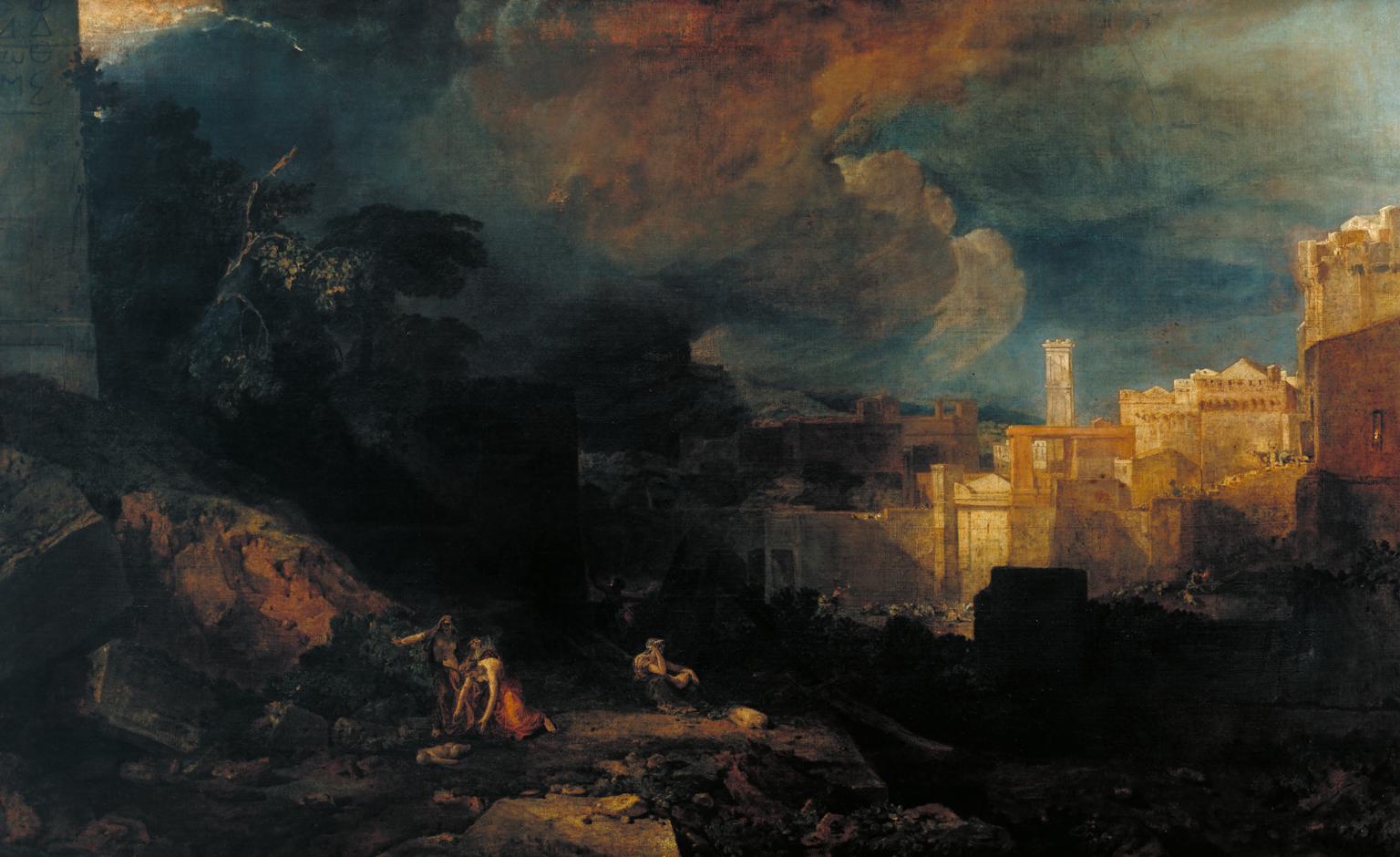
from The Tenth Plague of Egypt, exhibited 1802, by J.M.W. Turner
1998-
canvas tacking edges with ingrained dust
Tate Gallery

J.M.W. Turner
The Tenth Plague of Egypt
 exhibited 1802
oil on canvas
Tate Gallery

Cornelia Parker
Room for Margins
from Chichester Canal, circa 1828, by J.M.W. Turner
1998
canvas tacking edges with ingrained dust
Tate Gallery

J.M.W. Turner
Chichester Canal
 circa 1828
oil on canvas
Tate Gallery

"Room for Margins recalls Parker's longstanding fascination with the positive and negative values that we attribute to materials and the arbitrary basis by which we ascribe them.  Her interest in reclaiming the 'waste' or 'disposable' counterparts to products of worth similarly informs her 1996 work Negatives of Sound (Frith Street Gallery), which comprises the black lacquer excreted during the process of cutting grooves into a vinyl record.  This strategy of transforming a material's status without enacting any physical change to it provides an interesting complement to Parker's more familiar practice of transforming the value of an object or material through the use of extreme physical force."

Cornelia Parker
Room for Margins
from Scene in Venice, circa 1840-45, by J.M.W. Turner
1998-
canvas lining with ingrained dust and ink
Tate Gallery

J.M.W. Turner
Scene in Venice
circa 1840-45
oil on canvas
Tate Gallery

– quoted passages from curator's notes at the Tate Gallery, London

Sunday, September 18, 2016

Industrial Arts by Thomas Struth

Thomas Struth
CHEMISTRY FUME CABINET
UNIVERSITY OF EDINBURGH
2010

Thomas Struth
CURVED WAVE-TANK
UNIVERSITY OF EDINBURGH
2010

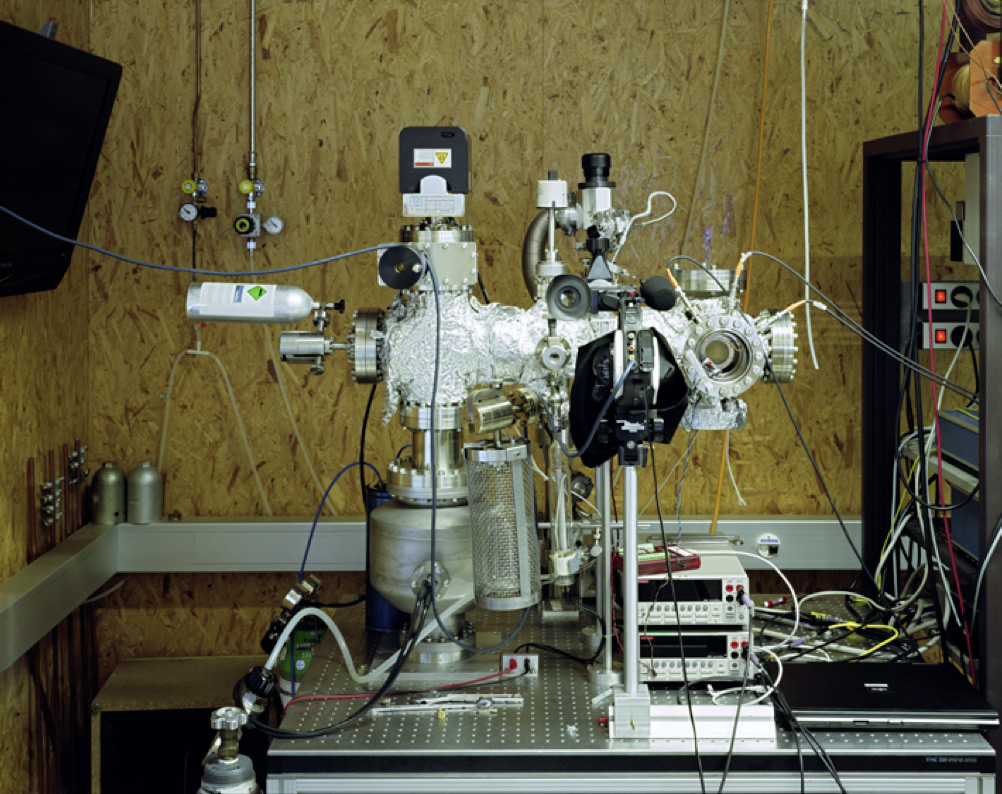
"Unlike, for example, the gritty, dread-inducing paintings of Anselm Kiefer, whose thoughts never seem far from Auschwitz, Struth’s photographs evoke nothing bad. They have a lightness of spirit, you could almost say a sunniness, that is not present in the work of the other major practitioners of the new oversized color photography—Andreas Gursky, Candida Höfer, Jeff Wall, Thomas Ruff among them. Struth is the Sunday child of the lot. His huge photographs—city streets, people looking at paintings in museums, industrial landscapes, factories, laboratories, rain forests, and family groups—are as pleasing as his persona; they seem to be an extension of it. Michael Fried, in his tautly argued book Why Photography Matters as Art as Never Before (2008), pauses to remark, with apparent (uncharacteristic) irrelevance — but evident intuitive understanding of the force of Struth’s radiance — “A striking fact about Struth’s public career is the almost universally enthusiastic response that his work has received.” 

Thomas Struth
DRYDOCK
DSME SHIPYARD, GEOJE ISLAND, KOREA
2007

Thomas Struth
FIELD-ION MICROSCOPE
UNIVERSITAET, ZURICH
2010

Thomas Struth
PHARMACEUTICAL PACKAGING LABORATORIES
PHOENIX, BUENOS AIRES
2009

"Struth’s photographs taken in factories, laboratories, and nuclear power plants ... look like nothing one has ever seen before. These glimpses into what the critic Benjamin Buchloh calls “the technological sublime” were on view at Marian Goodman last year and constitute some of Struth’s most powerful images. ... The feeling of not understanding what one is seeing, of not knowing the functions of madly tangled wires and tubes and cables and mysterious flanges and pulleys and levers, is brilliantly conveyed by these huge pictures of places few of us have ventured into and on whose products many of us depend. Predictably, the places are not satanic mills but belong to the world of Struth’s benign photographic vision. They reassure even as they baffle. They tell us that the people who are absent from the pictures are back there somewhere and that they know what it all means and know what they are doing."

Thomas Struth
REACTOR PRESSURE VESSEL PHASE-OUT
AKW WUERGASSEN, BEVERUNGEN
2009

Thomas Struth
SEEMLESS TUBE PRODUCTION
TENARIS SIDERCA CAMPANA, BUENOS AIRES
2009

Thomas Struth
SEMI-SUBMERSIBLE RIG
DSME SHIPYARD, GEOJE ISLAND,KOREA
2007

"The picture we had been standing in front of showed a semi-submersible oil rig in a shipyard on Geoje Island, in South Korea—a huge red thing, a colossus on four legs on a platform afloat near the shore, taut cables anchoring it to the concrete pavement onshore, on which piles of miscellaneous building materials are strewn. The photograph (a hundred and ten by a hundred and thirty-eight inches) magisterially represents what can be called the new optics of the new photography, which sees the world as no human eye does. When you look at these photographs, it is as if you were looking through strange new bifocals that focus on things at a distance at the same moment that they focus on things close up. Everything is equally sharp."

Thomas Struth
SPACE SHUTTLE
KENNEDY SPACE CENTER, CAPE CANAVERAL
2008

Thomas Struth
STELLARATOR WENDELSTEIN 7-X DETAIL
MAX PLANCK IPP, GREIFSWALD
2009

Thomas Struth
TOKAMAK ASDEX UPGRADE INTERIOR I
MAX PLANCK IPP, GARCHING
2010

Thomas Struth
TOKAMAK ASDEX UPGRADE PERIPHERY
MAX PLANCK IPP, GARCHING
2009

Thomas Struth
VEHICLE ASSEMBLY BUILDING
KENNEDY SPACE CENTER, CAPE CANAVERAL
2008

Thomas Struth
Installation View
2010
Galerie Max Hetzler, Berlin

Quoted texts above are from Janet Malcolm's extended New Yorker interview with Thomas Struth published in 2011. This usually-skeptical journalist conveyed the impression that she  like the rest of the art world  felt spontaneously fond of the forthright and ingenuous Struth. Yet their concluding exchange, as reported below, also suggests that she had a few reservations. Malcolm describes herself strolling with Struth through Dresden, talking about the artist's most recent pictures shot at industrial and scientific workplaces. She asked if he felt he was making some sort of "statement" about society with these photographs.

"I think yes," he said, but he added, "Some of the pictures don't show what I was thinking. For instance, when I went to Cape Canaveral as a tourist I was struck with the sense of the space program as an instrument of power. When, as a state, you demonstrate that you are able to do that, it contributes to cultural dominance. I hadn't realized this before. But when I went there to photograph I saw that it is something you cannot put into a photograph."

"Do you feel you need to put large meanings into your work?" I asked.

"Well, it's part of my thinking. It's something that stimulates me. To have a narrative is an incentive. If it was only about composition and light and beautiful pictures, I could just photograph flowers."

"Forget the flowers," I said, "Let's stay in the factory. Because there were very beautiful forms there. Wouldn't that be enough for you? If you just found beautiful compositions there, and made beautiful photographic abstractions. You want to do more than that?"

"Yes."

"I'm trying to elicit from you what the more is."

"The more is a desire to melt, like to  how can I say it?  be an antenna for a part of our contemporary life and to give this energy, put that into part of this narrative of the visual, of sort of symbolic visual expression ..."  Struth struggled, and gave up.

I asked him if the fact that SolarWorld's activity had to do with solar energy was part of his interest in photographing there.

He said that it was, and added, "My own personal energy account is very bad, because I fly so often and I can't claim that I'm a good sustainable-energy person. But I've almost always voted for the Green Party, and since it was founded I always thought these subjects were important and are a fascinating challenge for the world."

"How will your pictures show that what is being produced at SolarWorld is good for mankind?"

'"Just by the title."

"So photographs don't speak."

"The picture itself is powerless to show."

Friday, August 1, 2014

Charlesworth


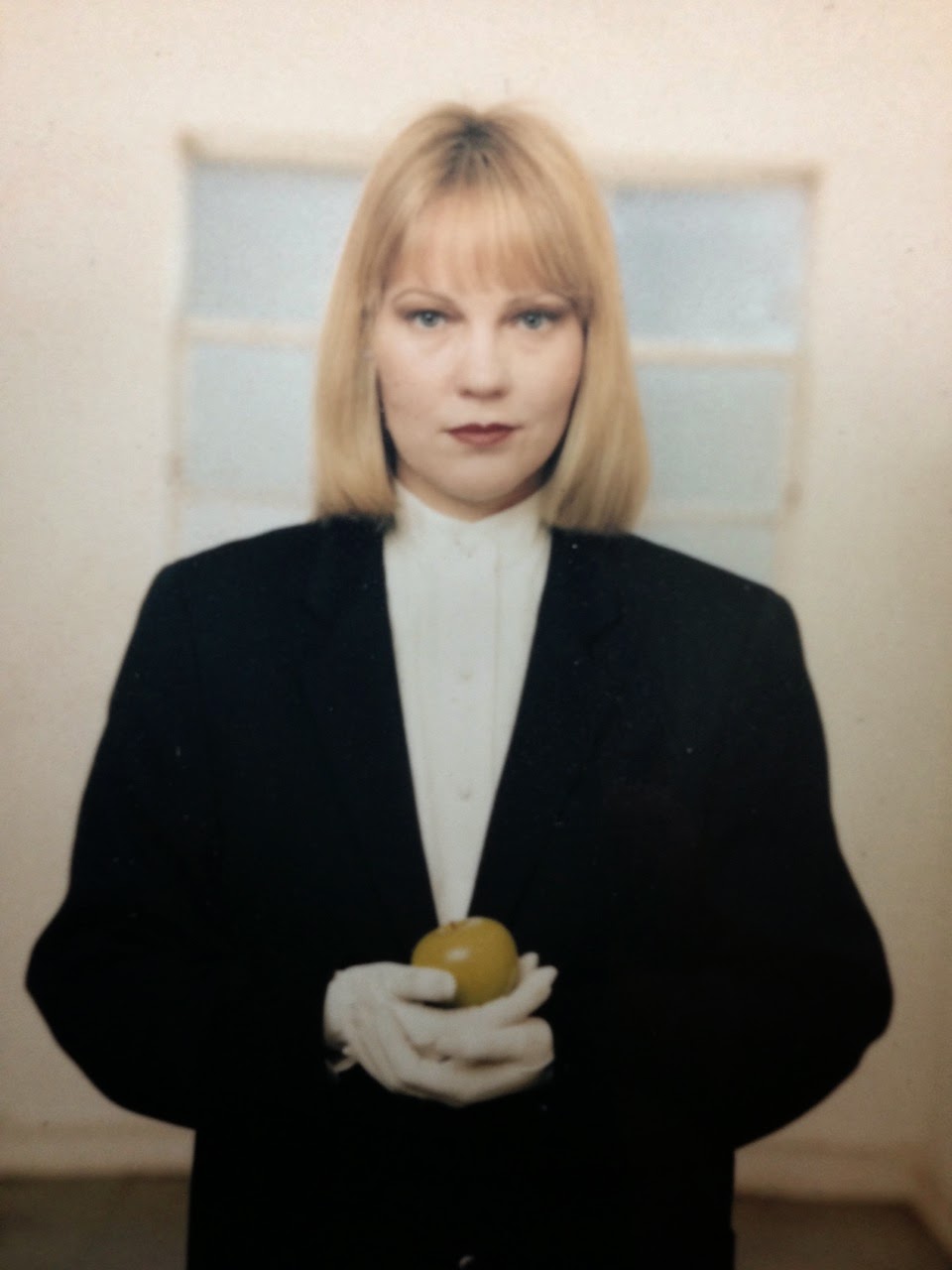
In November of last year Cindy Sherman published an obituary in Artforum for her friend and fellow Picture Generation photographer Sarah Charlesworth who had died in June at age 66. The obituary was illustrated with this 1989 photograph of Sarah Charlesworth in Rome, as recorded on film by Cindy Sherman.

This year there are many attempts to further memorialize Sarah Charlesworth, including her posthumous presence in the summer's Whitney Biennial, major gallery shows, and a solo exhibition at the Art Institute of Chicago.


Sarah Charlesworth first became widely known in the late 70s with the series Modern History. These were actual-size photographs of newspaper front pages with all text blocked out (as white space) and only the masthead and photographs revealed.

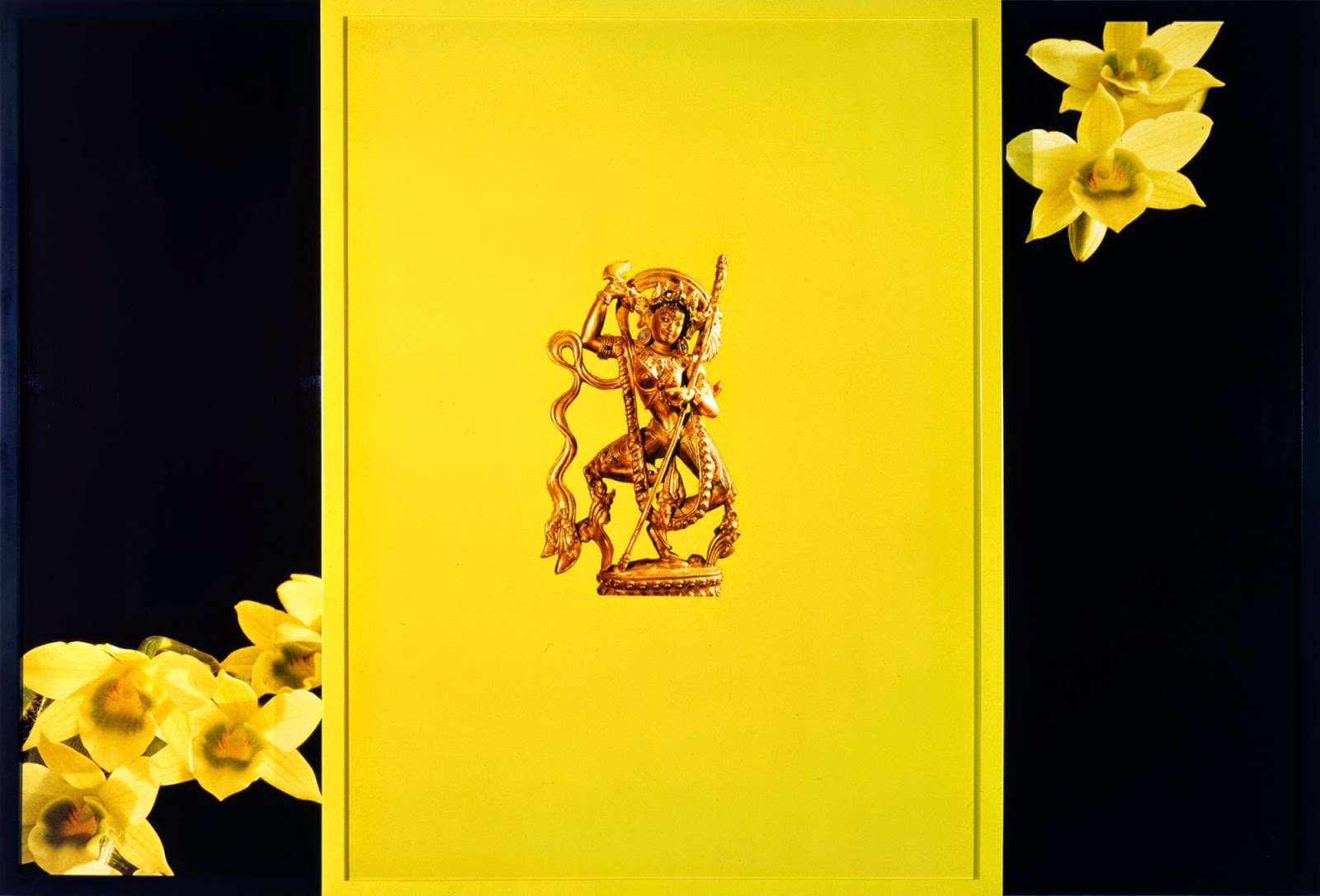
Next came Objects of Desire in the early 80s. This is the work  photographic collages isolated in pairs against bright solid colors  most often reproduced in recent tributes.