Showing posts with label future. Show all posts

Thursday, June 7, 2018

Futurists at the Tate Gallery

Gerardo Dottori
Explosion of Red on Green
1910
oil on canvas
Tate Gallery

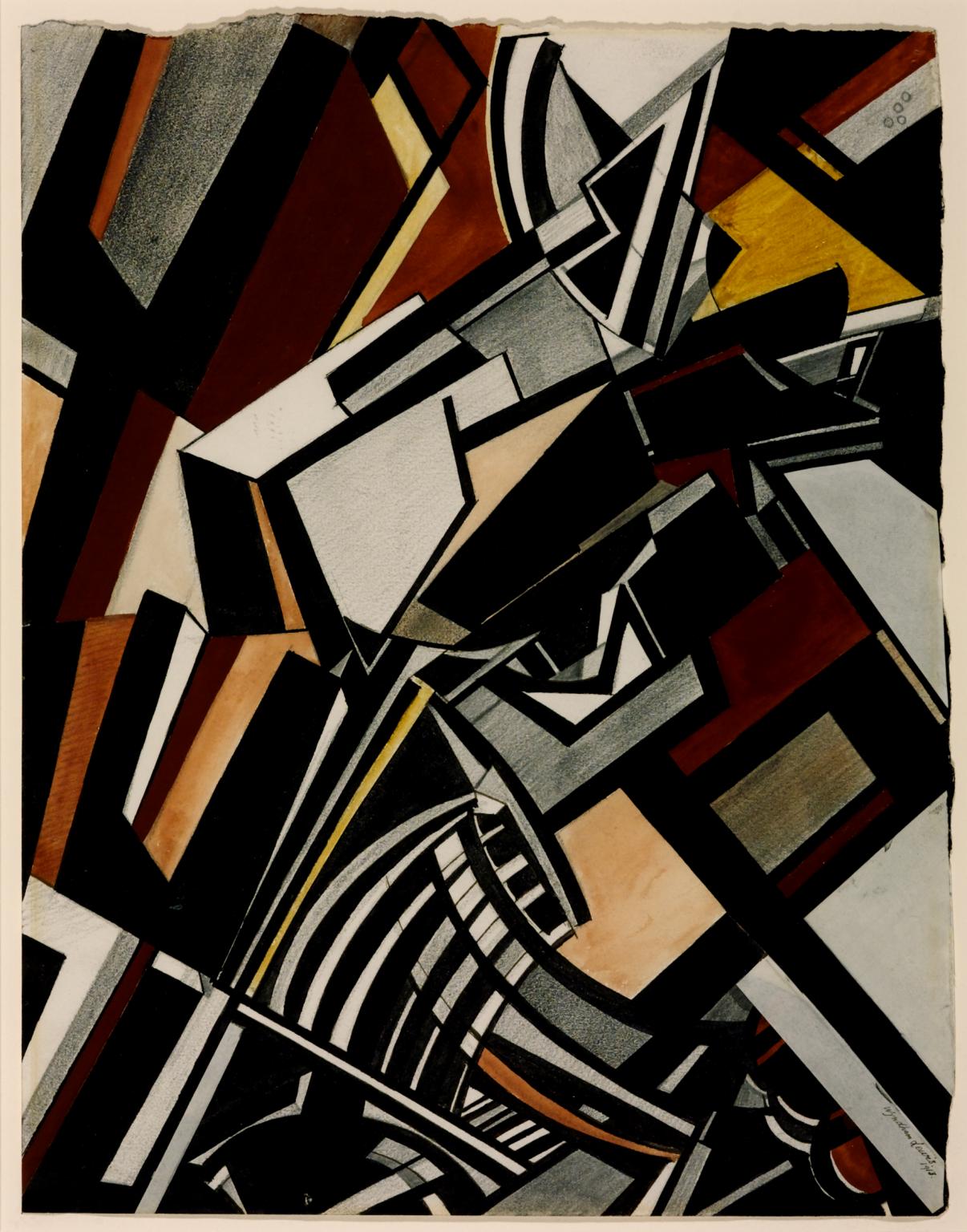
Wyndham Lewis
Composition
1913
watercolor
Tate Gallery

Giacomo Balla
Abstract Speed - The Car Has Passed
1913
oil on canvas
Tate Gallery

Gino Severini
Suburban Train Arriving in Paris
1915
oil on canvas
Tate Gallery

from a journal article by Walter Benjamin published in 1937 –

"A program was due, but failed to materialize.  That failure sealed a process characteristic of the past century:  the bungled reception of technology.  The process has consisted of a series of energetic, constantly renewed efforts, all attempting to overcome the fact that technology serves this society only by producing commodities.  At the beginning, there were the Saint-Simonians with their industrial poetry.  Then came the realism of  Du Camp, who saw the locomotive as the saint of the future.  Finally there was Ludwig Pfau: "It is quite unnecessary to become an angel," he wrote, "since a locomotive is worth more than the nicest pair of wings."  This view of technology is straight out of the Gartenlaube [a mass-market family magazine of the time].  It may cause one to ask whether the complacency of the nineteenth-century bourgeoisie did not stem from the hollow comfort of never having to experience how the productive forces had to develop under their hands.  This experience was really reserved for the following century, which has discovered that the speed of traffic and the ability of machines to duplicate words and writing outstrip human needs.  The energies that technology develops beyond this threshold are destructive.  First of all they advance the technology of war and its propagandistic preparation.  One might say that this development (which was thoroughly class-conditioned) occurred behind the back of the last century, which was not yet aware of the destructive energies of technology.  This was especially true of the Social Democrats at the turn of the century.  Though they occasionally took a stand against the illusions of positivism, they remained largely in thrall to them.  They saw the past as having been gathered up and stored forever in the granaries of the present.  Although the future held the prospect of work, it also held the certainty of a rich harvest."    

– quoted from Edward Fuchs, Collector and Historian, originally published in Zeitschrift für Sozialforschung, translated by Howard Eiland and Michael W. Jennings (2008)

Michel Larionov
Nocturne
ca. 1913-14
oil on canvas
Tate Gallery

David Bomberg
Ju-Jitsu
ca. 1913
oil on panel
Tate Gallery

Christopher Nevinson
Bursting Shell
1915
oil on canvas
Tate Gallery

Lawrence Atkinson
The Lake
ca. 1915-20
watercolor
Tate Gallery

Jessica Dismorr
Abstract Composition
ca. 1915
oil on panel
Tate Gallery

Cedric Morris
Experiment in Textures
1923
oil on canvas
Tate Gallery

Edward Wadsworth
Abstract Composition
1915
gouache on paper
Tate Gallery

El Lissitzky
Troublemaker
1923
lithograph
Tate Gallery

Naum Gabo
Model for 'Rotating Fountain'
1925
metal and plastic
Tate Gallery

Cathy De Monchaux
Wandering about in the future, looking forward to the past
1994
glass, velvet ribbon, metal
Tate Gallery

Thursday, November 14, 2013

Yamamoto


Yohji Yamamoto showed Spring Summer 2014 collections for women and for men. There was as always a great deal of black but I have favored several looks with alternative Yamamoto colors and prints here.

Friday, November 19, 2010

Not Only London

NEW SIMPLIFIED MAP OF LONDON

Unfortunately, this looks to me like a pretty fair picture of the likely 21st century future everywhere.

Image source is here

Wednesday, March 3, 2010

Runway


Models rehearsing the Versace Fall/Winter 2010/11 fashion show in Milan. To me these look like costume designs for a movie version of one of Margaret Atwood's dystopian novels where young women are trapped inside a vast, futuristic, corporatized brothel. Image source here.

Friday, February 26, 2010

Stripped Car


Stripped Car


There’s something in me that likes
to imagine the things I’m afraid of,

for example, the future.
I don’t mean the celestial fireworks

from melting reactors, or New York
under six feet of sea water,
but the future in its most intimate,

most probable forms—vignettes
subversive enough to slip through the radar.

That’s how I come to be crouched
behind a stripped car wondering

would it be too dangerous
to piss in the street?
It would, I’m a woman.

So I go on holding it,
distracting myself by trying to remember
every fruit I’ve ever eaten,

their exact textures and flavors.
So far the most exotic is the custard apple.

I use up a whole hour of daylight
and then another—apricot, blueberry, plum—

calves cramping from having to stay low,
waiting behind a car pitted

with the acne of automatic fire.

There are still too many guns
walking around out there,
and no one I know,

so I’m waiting for twilight at least.
Is everyone alone now?

The wind says so. It says
a winter is coming without oil.

It bites to get my attention
and scatters a few leaflets,
pictures of a blackened car,

a city that seems to catch on fire
every sunset, though there’s
little enough to burn. Stone only chars.

This isn’t a likeness of the future, is it?
Every person in the street a stranger?

Will a word like ‘neighbor’ survive this?

I fired a gun once. It smelled rancid, sour,
like bad food. It hurt my shoulder

and left a wound of oil on my shirt.

My mind is thinking of sleep again.
Sleep lets things escape—my pocket-knife

vanished through a knife-sized hole.

There’s nothing to cut,
no guava, nectarine, winter pear,

and nothing left of the car at all,
not even the rear-view mirror
I was counting on,

hoping my face could tell me
it was safe to go home, and where is that?

A place with a bed
and a desk where I sit and plot
next year’s garden on graph paper.

The skin of a tangelo is faintly pebbly,
easy to peel, but the sweetest citrus

is the satsuma, then the clementine.
If I had to choose between natural
disaster and a firing squad,

I’d take the river of lava any day.

Hurricane, tidal wave, tornado, drought.
I want the earth, which is waiting
under the sidewalk, to be the one.

Not any of these human shadows
sporting their silhouetted guns.
There were gun shadows before,

but the two worlds overlapped,
guns and the amber waves of grain.

It’s hard to say whether bramble fruits
actually have skins. Does a raspberry?
Does each tiny globe have its own?

How will I live without the earth?

In a stripped car, unable to piss
when I want to, all the time cold?

Maybe weapons interbred with humans,
and a strain of hybrids was born,
half metal, half flesh.

I know there’s an enemy—
look at all the damage it’s doing.
Maybe it’s still a baby,

its weak neck wobbling as its carriage
lurches over the broken pavement.

But probably by now
it’s a sulking adolescent
starting to look like serious trouble,

with a silky little shadow-moustache
and a gun. Who’ll kill it? Will I?

What if it doesn’t look like the enemy?
What if it comes disguised as a savior,
or resembles nothing so much as hunger,

so that everyone has his own
private piece to kill? Will we do it?

– Chase Twichell

Monday, February 15, 2010

Vernal


Holiday Monday afternoon in the East Bay garden where the roses my daughter pruned last month now needed to be fed. Their growth spurt arrived this week, and that seems to be one of the more reliable signs of spring in this peculiar micro-climate we live in here. The rose above is a mongrel climber that blooms profusely in May – hundreds of small flat-faced scarlet roses – and then festers in mold for the rest of the year. My daughter is never tired of stressing the virtues of this rose, and takes more time to prune it than any of the others. Clearly, it reciprocates her affection.


Our transplanted lilies are still bruised-looking, but lustily blooming anyway, and clearly intending to thrive.


New iris spears, from the roots we broke up and spread out last August.


Grape hyacinth, a tiny brief flower, but well worth the bother of rearing it. I will now officially stop using the tag "winter" for any & all subsequent posts covering the short-term future, no matter how winter-like the weather that may still arrive. We will, by virtue of this grape hyacinth growing out of the ground, now say that in San Francisco it is spring.

Tuesday, August 18, 2009

Freise Brothers


A benign post-industrial future where all the cars have quietly surrendered.

I stumbled upon these appealing, semi-utopian images on the Freise Brothers site.