Showing posts with label kitchens. Show all posts

Wednesday, July 15, 2026

Proles

Anonymous French Artist
Men sawing Timber
17th century
drawing
Städel Museum, Frankfurt

Laurits Andersen Ring
Building Watercourse at Søndersø
1885
oil on canvas
Fuglsang Kunstmuseum, Lolland, Denmark

Elias Porcelius
The Carpenter
ca. 1710
woodcut
Museum für Angewandte Kunst, Vienna

Wilhelm Trübner
Young Carpenter planing a Coffin
1870
drawing
Städel Museum, Frankfurt

Anthon van Rappard
Cotton Worker
ca. 1890
oil on canvas
Kröller-Müller Museum, Otterlo

Anonymous German Artist
Lathe Worker
ca. 1518
woodcut
Herzog August Bibliothek, Wulfenbüttel

Stefano della Bella
Studies of Workers
ca. 1640
drawing
Yale University Art Gallery

Joseph Wagner after Jacopo Amigoni
Lamp-Lighter
1739
etching and engraving
Herzog Anton Ulrich Museum, Braunschweig

Albert Renger-Patzsch
Crab Fisherman
1925
gelatin silver print
Von der Heydt Museum, Wuppertal

Fritz Boehle
Group of Fishermen
ca. 1898
drawing
Städel Museum, Frankfurt

Ramiro Arrúe Valle
Basque Fishermen
1930
oil on panel
Musée des Beaux-Arts de Pau

Carl Ludvig Locher
Women gathering Nets on the Beach at Hornbæk
1884
oil on canvas
Kunsten Museum, Aalborg, Denmark

Alexander Archipenko
Gondolier
1914
gouache on paper
Kröller-Müller Museum, Otterlo

Lorenzo Bianchi and Domenico Cuciniello
Maltese Fish-Seller
ca. 1825
lithograph
Graphische Sammlung, ETH Zürich

Jean-Baptiste-Simeon Chardin
Kitchen Maid
ca. 1738
oil on canvas
Alte Pinakothek, Munich

Claude-Joseph Bail
Far Niente
ca. 1890
oil on canvas
Musée des Beaux-Arts de Mulhouse

For the Athenians vexing Peloponnesus, and their particular territory Laconia most of all, they thought the best way to divert them was to send an army to the confederates of the Athenians, so to vex them again.  And the rather because Perdiccas and the Chalcideans were content to maintain the army, having called it thither to help the Chalcideans in their revolt.  And because also they desired a pretence to send away part of their Helotes, for fear they should take the opportunity of the present state of affairs, the enemies lying now in Pylus, to innovate.  For they did also this further, fearing the youth and multitude of their Helotes, for the Lacedaemonians had ever many ordinances concerning how to look to themselves against the Helotes.* They caused proclamation to be made that as many of them as claimed the estimation to have done the Lacedaemonians best service in their wars should be made free; feeling them in this manner and conceiving that, as they should every one out of pride deem himself worthy to be first made free, so they would soonest also rebel against them.  And when they had thus preferred about two thousand, which also with crowns on their heads went in procession about the temples as to receive their liberty, they not long after made them away, and no man knew how they perished. 

– from The Peloponnesian War as written by Thucydides (5th century BC) and translated by Thomas Hobbes (1628) and edited by David Grene (1959)

*Helot is the general name applied to the people who cultivated the ground for the Spartans.  As the latter lived entirely in barracks till the age of thirty and even after that were closely attached to the army, the farming of their estates had to be done by others.  These farm workers were serfs, but not slaves.  They were bound to the land but could not be sold, and they were paid a proportion of produce from the land they worked.  They were of various races, being composed of the people who had owned the land when the Spartans conquered it.

Thursday, August 8, 2024

Paladino - Evans - Olley - Porter

Mimmo Paladino
Aleco
1990
screenprint, woodcut, etching and drypoint
Art Gallery of New South Wales, Sydney

Mimmo Paladino
Dedalus
1984
color linocut
Art Gallery of New South Wales, Sydney

Mimmo Paladino
Occhio Sinistro
1986
linocut
National Gallery of Australia, Canberra

Mimmo Paladino
Ospite Conosciuto
1986
linocut
National Gallery of Australia, Canberra

Walker Evans
Boarding House, Birmingham, Alabama
1936
gelatin silver print
Loeb Art Center, Vassar College, Poughkeepsie, New York

Walker Evans
Doorway, 204 West 13th Street, New York City
ca. 1931
gelatin silver print
National Gallery of Australia, Canberra

Walker Evans
Maine
1969
gelatin silver print
National Gallery of Australia, Canberra

Walker Evans
New York State Farm Interior
1931
gelatin silver print
National Gallery of Australia, Canberra

Margaret Olley
Chinese Screen and Yellow Room
1996
oil on panel
Art Gallery of New South Wales, Sydney

Margaret Olley
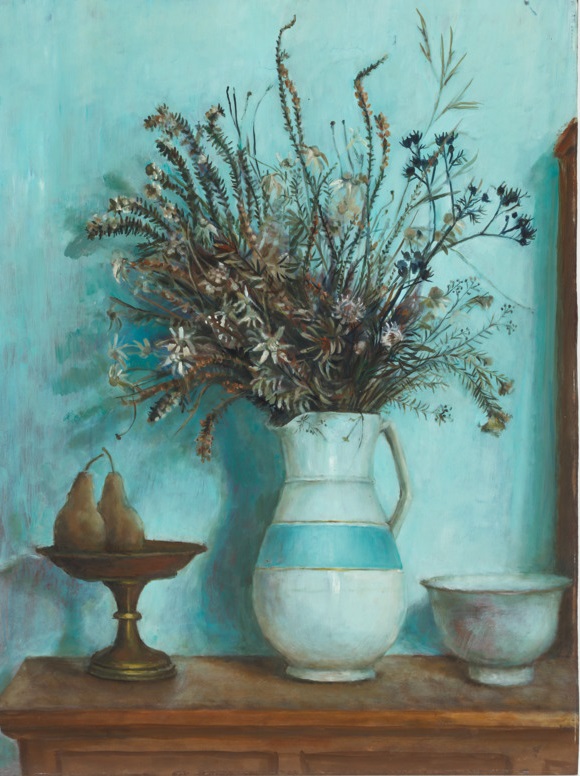
Hawkesbury Wildflowers and Pears
ca. 1973
oil on panel
National Gallery of Australia, Canberra

Margaret Olley
Katie's Quinces
1976
oil on panel
National Gallery of Australia, Canberra

Margaret Olley
Ranunculus and Pears
2004
oil on panel
Art Gallery of New South Wales, Sydney

Fairfield Porter
The Table
1970
lithograph
Art Institute of Chicago

Fairfield Porter
Still Life with Giotto's Magdalene
1966
oil on panel
Portland Museum of Art, Maine

Fairfield Porter
Elaine de Kooning
1957
oil on canvas
Metropolitan Museum of Art, New York

Fairfield Porter
Laurence at the Piano
1953
oil on panel
New Britain Museum of American Art, Connecticut

Sonnets from China

                                 XV

As evening fell the day's oppression lifted;
Tall peaks came into focus; it had rained:
Across wide lawns and cultured flowers drifted
The conversation of the highly trained. 

Thin gardeners watched them pass and priced their shoes;
A chauffeur waited, reading in the drive,
For them to finish their exchange of views:
It looked a picture of the way to live.

Far off, no matter what good they intended,
Two armies waited for a verbal error
With well-made implements for causing pain,

And on the issue of their charm depended
A land laid waste with all its young men slain,
Its women weeping, and its towns in terror.

– W.H. Auden (1938)

Wednesday, May 1, 2024

Ribot - Sloan - Knight - Modigliani

Théodule Ribot
Lamb Chops and Kidneys
ca. 1880
oil on canvas
Musée de l'Oise

Théodule Ribot
Still Life with Pumpkin, Plums, Cherries, Figs and Jug
ca. 1860
oil on canvas
Museo de Bellas Artes de Bilbao

Théodule Ribot
The Burnt Dish
1863
etching
National Gallery of Canada, Ottawa

Théodule Ribot
The Peelers
1863
etching
National Gallery of Canada, Ottawa

John Sloan
Silhouette of James Preston
ca. 1896
drawing
Delaware Art Museum, Wilmington

John Sloan
Self Portrait
1946
drawing
Delaware Art Museum, Wilmington

John Sloan
Hudson Sky
1908
oil on canvas
Wichita Art Museum, Kansas

John Sloan
Road to Santa Fe
1924
oil on canvas
Phoenix Art Museum, Arizona

Laura Knight
Backstage at the Birmingham Rep
ca. 1930
pastel on paper
Art Gallery of Greater Victoria, British Columbia

Laura Knight
Trio Gymnastique
1932
aquatint
Art Gallery of New South Wales, Sydney

Laura Knight
Carmo's Circus
1935
drawing
Art Gallery of New South Wales, Sydney

Laura Knight
Circus Dressing Room
ca. 1935
aquatint
Art Gallery of Greater Victoria, British Columbia

Amedeo Modigliani
Head
1911-12
limestone
Barnes Foundation, Philadelphia

Amedeo Modigliani
Portrait of a Man
1913
oil on canvas
Denver Art Museum

Amedeo Modigliani
Jeanne Hébuterne
1918
oil on canvas
Norton Simon Museum, Pasadena

Amedeo Modigliani
Girl with Polka-Dot Blouse
1919
oil on canvas
Barnes Foundation, Philadelphia

from The Sea and the Mirror

Antonio:

As all the pigs have turned back into men
And the sky is auspicious and the sea
Calm as a clock, we can all go home again.

Yes, it undoubtedly looks as if we
Could take life as easily now as tales
Write ever-after: not only are the

Two heads silhouetted against the sails
– And kissing, of course – well-built, but the lean
Fool is quite a person, the fingernails

Of the dear old butler for once quite clean,
And the royal passengers quite as good
As rustics, perhaps better, for they mean

What they say, without, as a rustic would,
Casting reflections on the courtly crew.
Yes, Brother Prospero, your grouping could

Not be more effective: given a few
Incomplete objects and a nice warm day,
What a lot a little music can do. 

Dotted about the deck, they doze or play,
Your loyal subjects all, grateful enough
To know their place and believe what you say.

Antonio, sweet brother, has to laugh.
How easy you have made it to refuse
Peace to your greatness! Break your wand in half,

The fragments will join, burn your books or lose
Them in the sea, they will soon reappear,
Not even damaged: as long as I choose 

To wear my fashion, whatever you wear
Is a magic robe; while I stand outside
Your circle, the will to charm is still there.

As I exist so you shall be denied,
Forced to remain our melancholy mentor,
The grown-up man, the adult in his pride,

Never have time to curl up at the centre
Time turns on when completely reconciled.
Never become and therefore never enter
The green occluded pasture as a child.

     Your all is partial, Prospero;
          My will is all my own:
     Your need to love shall never know
     Me: I am I, Antonio,
          By choice myself alone.

– W.H. Auden (1942-44)

Thursday, February 24, 2022

Bartolomé Estebán Murillo - The Angels' Kitchen

Bartolomé Estebán Murillo
The Angels' Kitchen
1646
oil on canvas
Musée du Louvre

Intersection of Styles

Realistic in his portraits of beggars, ethereal in his canvases of the Immaculate Conception, Murillo draws on his entire range of manners in this singular work.  Realism is expressed by abundant still-life elements underlining the fact that we are in a kitchen, though it is also the site of mystical ecstasy – a Franciscan brother levitates in mid-air.  According to legend, this monk while at work preparing a meal was uplifted by such emotion as he meditated that angels descended from Heaven to work in his place so that everything would be ready on time.  Three men then enter the kitchen, stumbling upon this extraordinary scene, but are unable to perceive the angels.  

Angelic Workers

These angels have wings, their normal attribute, yet also have their feet on the ground.  Incarnate angels, they take on lowly jobs: fetching water, setting the table, grinding something in a mortar.  Two cherubs, also clearly of flesh and blood, fat-bottomed as those by Rubens – robust little fellows – handle spices.  

The devotee suspended above the floor, despite his ecstatic demeanor, remains entirely human and carnal; it clearly requires a genuine miracle to maintain him aloft.  The food and cooking utensils give every evidence of providing for hearty appetites: a magnificent cauldron, a big haunch of meat, a substantial pitcher for the wine.  

The Last Shall Be First   

The angels descend and the brother rises.  Associated with him are the generous but rustic objects we see, this peasant crockery which an angelic light reveals as beautiful.  He is the lowest of the monks, but the first to be raised high in holiness.  And he will be the one above who welcomes the powerful, if they prove able to clothe themselves in a humility equal to his.

– translated and adapted from Le Musée imaginaire de Michel Butor: 105 œuvres décisives de la peinture occidentale (Paris: Flammarion, 2019)

Friday, November 17, 2017

18th-century Design Drawings

Filippo Juvarra
Stage Design - Garden Loggia
ca. 1700-1714
drawing
Cooper Hewitt, Smithsonian Design Museum

Mirabell:  I would beg a little private audience too.  You had the tyranny to deny me last night, though you knew I came to impart a secret to you that concerned my love.

Millamant:  You saw I was engaged.

Mirabell:  Unkind. You had the leisure to entertain a herd of fools, things who visit you from their excessive idleness, bestowing on your easiness that time which is the encumbrance of their lives. How can you find delight in such society? It is impossible they should admire you, they are not capable. Or if they were, it should be to you as a mortification, for sure, to please a fool is some degree of folly.

Millamant:  I please myself. Besides, sometimes to converse with fools is for my health.

Mirabell:  Your health! Is there a worse disease than the conversation of fools?

Gaetano Lazzara
Design for Illusionistic Wall Decoration with King and Soldiers
1703
drawing
Cooper Hewitt, Smithsonian Design Museum

Anonymous artist
Stage Design - Kitchen
ca. 1700-1750
drawing
Cooper Hewitt, Smithsonian Design Museum

after Andrea Pozzo
Perspective Design for Painted Dome and Cupola
ca. 1725
drawing
Cooper Hewitt, Smithsonian Design Museum

Anonymous artist
Design for Proscenium and Plan for a Stage
ca. 1725-50
drawing
Cooper Hewitt, Smithsonian Design Museum

Millamant:  Come, don't look grave then. Well, what do you say to me?

Mirabell:  I say that a man may as soon make a friend by his wit, or a fortune by his honesty, as win a woman with plain dealing and sincerity.

Millamant:  Sententious Mirabell!  Prithee don't look with that violent and inflexible wise face, like Solomon at the dividing of the child in an old tapestry-hanging.

Mirabell:  You are merry, Madam, but I would persuade you for one moment to be serious.

Millamant:  What, with that face?  No, if you keep your countenance, 'tis impossible I should hold mine.

Anonymous artist
Interior of a Temple
ca. 1775-1800
drawing
Cooper Hewitt, Smithsonian Design Museum

Anonymous Italian artist
Stage Design - Prison Cellar
ca. 1700-1800
drawing
Cooper Hewitt, Smithsonian Design Museum

Anonymous Italian artist
Stage Design - Prison Hall
ca. 1700-1800
Cooper Hewitt, Smithsonian Design Museum

Louis-Jean Desprez
Sepulchre in Egyptian style with Death carrying a Smoking Lamp
ca. 1779-84
wash drawing
Cooper Hewitt, Smithsonian Design Museum

Louis-Jean Desprez
Sepulchre in Egyptian style with Caryatids and Lion
ca. 1779-84
wash drawing
Cooper Hewitt, Smithsonian Design Museum

Louis-Jean Desprez
Sepulchre in Egyptian style with Sphinxes and Owl
ca. 1779-84
wash drawing
Cooper Hewitt, Smithsonian Design Museum

Louis-Jean Desprez
Sepulchre in Egyptian style with Death seated and crowned
ca. 1779-84
wash drawing
Cooper Hewitt, Smithsonian Design Museum

Anonymous artist
Stage Design - Palace Hall
ca. 1775-1800
watercolor
Cooper Hewitt, Smithsonian Design Museum

Millamant:  Vanity! No  I'll fly and be followed to the last moment. Though I am upon the very verge of matrimony, I expect you should solicit me as much as if I were wavering at the grate of a monastery, with one foot over the threshold. I'll be solicited to the very last, nay and afterwards.

Mirabell:  What, after the last?

Millamant:  Oh, I should think I was  poor and had nothing to bestow, if I were reduced to an inglorious ease and freed from the agreeable fatigues of solicitation. 

Mirabell:  But do not you know that when favors are conferred upon instant and tedious solicitation, that they diminish in their value, and that both the giver loses the grace and the receiver lessens his pleasure?

Millamant:  It may be, in things of common application, but never sure in love. Oh, I hate a lover that can dare to think he draws a moment's air independent on the bounty of his mistress. There is not so impudent a thing in nature as the saucy look of an assured man, confident of success. The pedantic arrogance of a very husband has not so pragmatical an air. Ah! I'll never marry unless I am first made sure of my will and pleasure.

Mirabell:  Would you have 'em both before marriage? Or will you be contented with the first now, and stay for the other till after grace?

Millamant:  Ah, don't be impertinent.   My dear liberty, shall I leave thee? My faithful solitude, my darling contemplation, must I bid you then adieu? Aye, adieu  my morning thoughts, agreeable wakings, indolent slumbers, all ye douceurs, ye sommeils du matin, adieu  I can't do't, 'tis more than impossible  positively, Mirabell, I'll lie abed in a morning as long as I please. 

Mirabell:  Then I'll get up in a morning as early as I please. 

Millamant:  Ah! Idle creature, get up when you will  and d'ye hear, I won't be called names after I'm married, positively I won't be called names.

Mirabell:  Names!

Millamant:  Aye, as Wife, Spouse, My dear, Joy, Jewel, Love, Sweetheart, and the rest of that nauseous cant in which men and their wives are so fulsomely familiar  I shall never bear that . . .

 William Congreve, from The Way of the World (1700)

Anonymous French artist
Design for semi-circular Council Chamber dedicated to Nature
ca. 1795-97
drawing
Cooper Hewitt, Smithsonian Design Museum