Showing posts sorted by relevance for query good samaritan. Sort by date Show all posts

Thursday, March 20, 2025

Succour - II

attributed to Trophime Bigot
St Sebastian tended by St Irene
ca. 1620-30
oil on canvas
Musée des Beaux-Arts de Bordeaux

Dirck van Baburen
St Irene tending St Sebastian
ca. 1622
oil on canvas
Hamburger Kunsthalle

Theodoor Rombouts
St Irene succouring St Sebastian
ca. 1635
oil on canvas
Staatliche Kunsthalle, Karlsruhe

Lodovico Lana
St Sebastian tended by St Irene
1643
etching
Hamburger Kunsthalle

Marcantonio Franceschini
St Sebastian tended by St Irene
ca. 1705-1706
oil on canvas
Musée des Beaux-Arts de Reims

Balthasar van Cortbemde
The Good Samaritan
1647
oil on canvas
Royal Museum of Fine Arts, Antwerp

Johann Carl Loth
The Good Samaritan
ca. 1678-80
oil on canvas
Herzog Anton Ulrich Museum, Braunschweig

Nicolas Bertin
The Good Samaritan
ca. 1720
oil on canvas
Neue Pinakothek, Munich

Louis Fabritius Dubourg
The Good Samaritan
ca. 1750
drawing
Rijksmuseum, Amsterdam

Julius Schnorr von Carolsfeld
and Ferdinand and Friedrich Olivier
The Good Samaritan
1833
oil on canvas
Städel Museum, Frankfurt

Domenico Fiasella
Christ healing the Blind Man
ca. 1615
oil on canvas
John and Mable Ringling Museum of Art,
Sarasota, Florida

Peter van Lint
Christ healing the Sick at the Pool of Bethesda
1643
oil on canvas
Kunsthistorisches Museum, Vienna

Paolo Pagani
Christ healing the Blind Man
ca. 1680
oil on canvas
Galleria Sabauda, Turin

Bernardino Licinio
Return of the Prodigal Son
ca. 1530
oil on canvas
Romanian National Museum of Art, Bucharest

Bartolomé Estebán Murillo
Return of the Prodigal Son
ca. 1667-70
oil on canvas
National Gallery of Art, Washington DC

Pompeo Batoni
Return of the Prodigal Son
ca. 1765-70
oil on canvas
Galleria Sabauda, Turin

Je veux enfin vous redire ici, Monsieur, la cause de la commande, sa petite raison nécessaire et suffisante, le dessein des commanditaires. Qui ils sont. Et je sais bien que vous l'avez lu, dans la petite antichambre, que vous êtes censé l'avoir lu – mais je vous connais, Monsieur, vous et vos semblables: vous allez tout de suite dans vos lectures à ce qui brille et dont on est avide, les jupes de maman-putain, le plumet, les louis d'or: ou à ce qui est parfaitement mat et noir, la guillotine, Shakespeare: mais les arguties politiques vous fatiguent, vous sautez tout cela. La grisaille théorique et historique, la lutte des classes et le panier de crabes, vous vous dites que tout cela vous le lirez demain. Et je sais bien que vous n'avez pas besoin de l'entendre, mais j'ai besoin, moi, de vous le dire.

– Pierre Michon, from Les Onze (Verdier, 2009) 

Thursday, August 27, 2020

Baroque Piety (Narratives and Figures)

Peter Paul Rubens
St Francis
ca. 1615
oil on panel
Art Institute of Chicago

Peter Paul Rubens
Capture of Samson
ca. 1609-1610
oil on panel (sketch)
Art Institute of Chicago

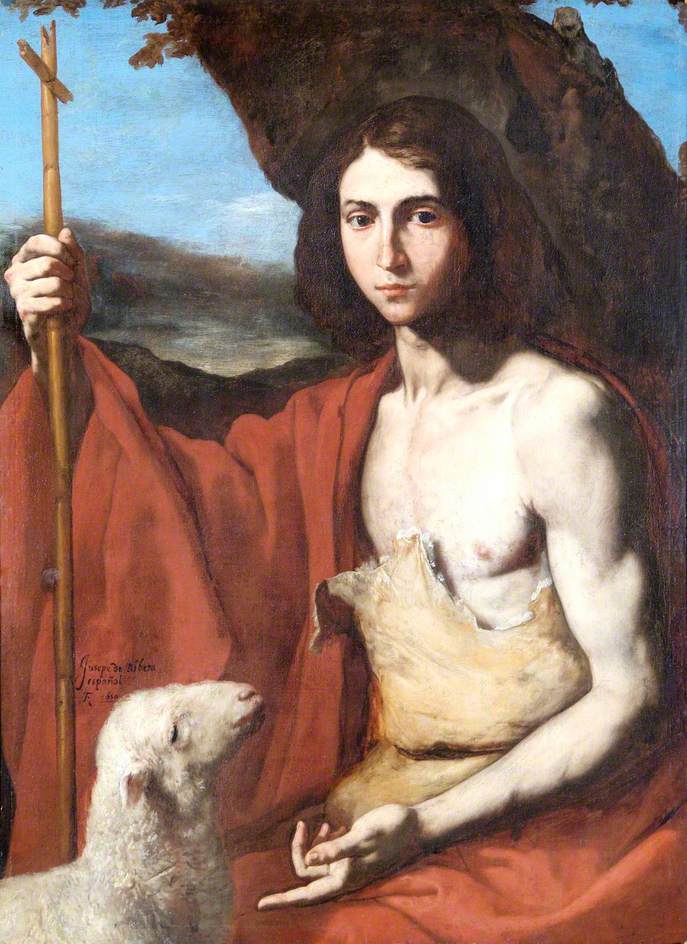
Jusepe de Ribera
St John the Baptist
1650
oil on canvas
Wellington Collection, Apsley House, London

Anonymous Artist
The Annunciation
17th century
oil on panel
Guildhall Art Gallery, London

Over the course of the past millennium (and more) the traditional Annunciation scene – angel-messenger rushing with his news toward the seated and unsuspecting Virgin – was painted uncountable times throughout Europe.  Yet the anonymous example above is a bit singular.  There exist relatively few examples like this, with the angel approaching from the viewer's right (Mary's left).  Since earliest Christian days, the iconographic norm placed the winged figure on the left. 

Alessandro Turchi
Virgin and Child
before 1649
oil on canvas
Kunsthistorisches Museum, Vienna

Jacob van Oost
Holy Family with St Elizabeth and St John the Baptist
1643
oil on panel
Ulster Museum, Belfast

Jan van Bijlert
St Matthew and the Angel
ca. 1625-30
oil on canvas
Ulster Museum, Belfast

Francisco de Zurbarán
The Crucifixion
1627
oil on canvas
Art Institute of Chicago

Cornelis van Poelenburgh
The Crucifixion with the Fall of the Rebel Angels
ca. 1627-67
oil on panel
Wellington Collection, Apsley House, London

Another iconographic oddity is van Poelenburgh's Crucifixion, combined in one image with the Fall of the Rebel Angels.  Both representations were conventional, but blending them together was not.

Eustache Le Sueur
Christ on the Cross
with the Magdalen, the Virgin, and St John the Evangelist
ca. 1643
oil on canvas
National Gallery, London

Rembrandt
The Good Samaritan
1630
oil on canvas
Wallace Collection, London

The Good Samaritan story was usually represented at the moment when the Samaritan discovered the robbed and beaten traveler helpless upon the ground, or slightly later when the Samaritan lifted the victim onto his own horse.  Rembrandt most unusually shows seven figures (plus the horse) participating in the pair's arrival at the inn, where the Samaritan opens his purse to pay the innkeeper for the injured man's care.  This act of bourgeois kindness takes place in the dim doorway at rear, while the light (and the viewer's scrutiny) falls upon the small patient horse and two servants of the inn (unmentioned in the Biblical narrative) performing the literal work of charity which the Samaritan's money is paying for.

attributed to Alessandro Salucci
St Paul and St Barnabas at Lystra
ca. 1640
oil on canvas
National Trust, Kingston Lacy, Dorset

Giovanni Battista Langetti
Ecce Homo
ca. 1650-60
oil on canvas
Bolton Museum and Art Gallery, Manchester

Johann Carl Loth after Pietro da Cortona
Adam and Eve
ca. 1656
oil on canvas
National Trust, Kedleston Hall, Derbyshire

Daniel Seghers
Cartouche of the Virgin and Child with St Anne
embellished with a Garland of Flowers
ca. 1655-60
oil on canvas
Dulwich Picture Gallery, London

Tuesday, June 2, 2020

Victorian Bible Stories in Paint

Solomon Alexander Hart
Philip Melanchthon expounding a Text from Luther's Bible to the Monks
1863
oil on canvas
Calderdale Council, Yorkshire

George Frederic Watts
Eve Created
ca. 1865
oil on canvas
Walker Art Gallery, Liverpool

Edward Burne-Jones
The Annunciation
1879
oil on canvas
Lady Lever Art Gallery, Liverpool

George Hayter
Angels Ministering to Christ
1847-49
oil on canvas
Victoria & Albert Museum, London

workshop of Ary Scheffer
Temptation of Christ
1854
oil on canvas
Walker Art Gallery, Liverpool

Arthur Hacker
Christ and the Magdalen
1890
oil on canvas
Walker Art Gallery, Liverpool

I do not Speak

I do not ask for mercy for understanding for peace
And in these heavy days I do not ask for release
I do not ask that suffering shall cease.

I do not pray to God to let me die
To give an ear attentive to my cry
To pause in his marching and not hurry by.

I do not ask for anything I do not speak
I do not question and I do not seek
I used to in the day when I was weak.

Now I am strong and lapped in sorrow
As in a coat of magic mail and borrow
From Time today and care not for tomorrow.

– Stevie Smith (ca. 1937)

Briton Rivière
Daniel in the Lions' Den
1872
oil on canvas
Walker Art Gallery, Liverpool

Ford Madox Brown
The Coat of Many Colours
1866
oil on canvas
Walker Art Gallery, Liverpool

William Dyce
Meeting of Jacob and Rachel
1850
oil on canvas
New Walk Museum and Art Gallery, Leicester

John Adam Houston
The Good Samaritan
ca. 1845
oil on canvas
Royal Scottish Academy of Art and Architecture, Edinburgh

Philip Richard Morris
The Good Samaritan
1857
oil on canvas
Blackburn Museum and Art Gallery, Lancashire

William Etty
The Good Samaritan
1838
oil on canvas
National Trust, Anglesey Abbey, Cambridge

Byam Shaw
Jezebel
1896
oil on canvas
Russell-Cotes Art Gallery and Museum, Bournemouth

Frederic Leighton
Jezebel and Ahab
ca. 1863
oil on canvas
Scarborough Art Gallery, Yorkshire

Thomas Matthews Rooke
Jezebel Thrown to the Dogs
1879
oil on canvas
Russell-Cotes Art Gallery and Museum, Bournemouth

Friday, March 24, 2023

Recumbent Figures

Théophile Steinlen
Model on Bed
ca. 1895
oil on canvas
Musée d'Orsay, Paris

Félix Vallotton
Cadaver
1894
oil on canvas
Musée de Grenoble

Edgar Degas
After the Bath
ca. 1886
pastel
Musée d'Orsay, Paris

Ford Madox Brown
Haydee discovering the Body of Don Juan
(scene from the mock-epic poem by Byron)
ca. 1869-78
oil on canvas
Musée d'Orsay, Paris

Henry Fuseli
Eriphyle and the Erinyes
1810
wash drawing
Musée du Louvre

William Blake
Pity
("pity like a naked, newborn babe" – Macbeth)
ca. 1795
colour print with hand-coloring
Tate Britain

Nicola Malinconico
The Good Samaritan
ca. 1703-1706
oil on canvas
Palazzo Pretorio, Prato

Antonio Molinari
The Good Samaritan
before 1704
drawing
Musée du Louvre

Hans von Aachen
The Good Samaritan
ca. 1570-80
drawing
Musée du Louvre

Simon Vouet
Académie
before 1649
drawing
Musée du Louvre

Luca Saltarello
Dead Christ
before 1645
oil on canvas
private collection

Cornelis Bloemaert
Ixion
ca. 1655-90
engraving
Rijksmuseum, Amsterdam

Giovanni Mannozzi (Giovanni da San Giovanni)
Study of Sleeping Woman
ca. 1620
drawing
Musée du Louvre

Cavaliere d'Arpino (Giuseppe Cesari)
Figure of a Dead Man
ca. 1595-96
drawing
(study for fresco, Palazzo dei Conservatori, Rome)
Musée du Louvre

Cristóvão de Figueiredo
Martyrdom of St Hippolytus
ca. 1520-30
oil on panel
Museu Nacional de Arte Antiga, Lisbon

Ancient Rome
Funerary Monument of Flavius Agricola
2nd century AD
marble
(discovered in 1623 when erecting Bernini's Vatican Baldacchino)
Indianapolis Museum of Art

"Many years ago, whilst dissecting a lion, in my early youth, I was amazingly impressed with its similarity as well as its difference in muscular and bone construction to the human figure.  It was evident the lion was but a modification of the human being, varied in organic construction and muscular arrangement, only where it was necessary he should be, that his bodily powers might suit his instincts, his propensities, his appetites, and his lower degree of reasoning power.  On comparing the two, I found the human being stood erectly on two feet, the lion horizontally on four.  On placing the lion on his two hind feet, resting on the heel and toes like the human being, I found he could not remain so; I found he had no power of grasping with his fore-paws (answering to the human hand, and but a modification); I found he could not move his fore-paw arms right from the shoulder, nor his hind-feet limbs right from the hip; I found his feet flat, his body long, his brain diminished, his eyes above the centre of his head, his jaw immense, and vast muscle occupying that portion of the skull, to assist the action of the jaw, which is filled by brain in a human creature; I found his spine long, his pan-bone narrow, his inner ancle lower than the outer, his chest contracted, and his fore-arm as long as his upper-arm.  I put down these distinctions as points characteristic in head and figure of a brutal and unintellectual being."

"I then examined the man: I found his power of grasping with his hand, by the action of his thumb, perfect; I found the motion of his arm free from the shoulder-joint, and his thigh free from the hip; I found his feet arched, his inner ancle the highest, his pan-bone large, which, by resistance to the action of the great extensor of the legs, increases their power, his eyes at the centre of his skull, his upper-arm longer than the fore-arm, his spine short, and his brain enormous. I put down these distinctions as characteristic in face and figure of a superior and intellectual being."

"These differences were facts – they were intentional, or accidental! – they were formed by the Creator, or they were not! – if they were as they were, there was reason in the differences, and that reason issued from the Creator's mind.  Surely, then, it was justifiable to lay down a principle of form from ascertaining these distinctions."    

– Benjamin Robert Haydon, from Anatomy as the Basis of Drawing (1835)