Showing posts with label 1850s. Show all posts

Friday, November 17, 2023

Visual Relics (1857-1860)

Bruno Braquehais
Model before a Mirror
ca. 1857
albumen silver print
Metropolitan Museum of Art, New York

"Académies, or nudes intended for use as preparatory studies for other artworks, were one of the most prolific forms of photography after the medium's invention in 1839. Trained as a lithographer, Braquehais registered his first photographs for sale in 1854. Through the use of elaborate props, soft lighting, and poses based on classical statues, he elevated erotic imagery to the realm of the artistic, as defined by watchful state censors. Despite the provocative nature of this photograph, it would have been deemed acceptable due to its overt reference to the established visual tradition of women at their toilettes."

– curator's notes from the Metropolitan Museum

Francis Frith
Turkish Summer Costume
1857
albumen print
Princeton University Art Museum

Francis Frith
Pyramids at Sakkara
1858
albumen print
Nelson-Atkins Museum of Art, Kansas City, Missouri

Francis Frith
The Great Pyramid and the Great Sphinx at Giza
1858
albumen print
Nelson-Atkins Museum of Art, Kansas City, Missouri

André-Adolphe-Eugène Disdéri
Palais de Versailles
1857
albumen print
Princeton University Art Museum

André-Adolphe-Eugène Disdéri
Self Portrait
ca. 1860
albumen silver print
Los Angeles County Museum of Art

André-Adolphe-Eugène Disdéri
Portrait of dancer Caroline Rosati
ca. 1860
salted paper print
Metropolitan Museum of Art, New York

Jacob Byerly
Portrait of a Man
ca. 1858
hand-colored daguerreotype
Getty Museum, Los Angeles

Anonymous Photographer
Portrait of Mary Lynne Wells
ca. 1858
hand-colored daguerreotype
Chrysler Museum of Art, Norfolk, Virginia

Jeremiah Gurney
Sally Hinkley
ca. 1858
albumen print (carte de visite)
Minneapolis Institute of Art

Charles Marville
Grotto, Bois de Boulogne
1858
albumen print
Cleveland Museum of Art

attributed to Benjamin Mulock
Mrs Craik holding a Cat
ca. 1858
salted paper print
Art Institute of Chicago

"Dinah Mulock Craik, a prolific English novelist and poet, was the subject of a series of over 25 photographs now in the Art Institute's collection. These portraits range from typical studio sittings to more casual photographs of Mrs. Craik in her garden; it is possible that at least some of them were produced by her younger brother, Benjamin Mulock, who learned photography (and later died in an asylum in 1863). In Victorian England, amateur photography required knowledge of chemistry and optics, funds to purchase equipment and chemicals, and ample leisure time to experiment. Happy accidents often resulted from these early photographs, such as the appearance here of a two-headed cat, the result of the cat moving its head during the lengthy exposure demanded by early photographic technology."

– curator's notes from the Art Institute of Chicago

Camille Silvy
L'Ordre du Jour
1859
albumen print
Art Institute of Chicago

"In this highly staged composition, which he nevertheless presented as a news photograph, Camille Silvy adapted a traditional genre painting for the depiction of a topical event. In May 1859, Emperor Napoleon III led the French Army into Italy to aid the controversial Italian unification movement (and secure the region of Nice for France). To rally French citizens behind his undertaking, the emperor sent his address to the frontline troops – the "Day's Orders" – instantly by electric telegraph back to Paris, where it was printed overnight and posted in the streets. Silvy staged an image of the populace gathering before the poster; two of the men, who turn to face the camera, represent the intellectual and revolutionary factions opposed to the virtual police state that characterized Paris under the emperor's reign. The following week, the newspaper L'Illustration printed a lithographic reproduction of the photograph, making this picture one of the earliest examples of photojournalism."

– curator's notes from the Art Institute of Chicago

William Lyndon Smith
Overgrown Ruins
ca. 1857-60
albumen print
Victoria & Albert Museum, London

William Lyndon Smith
Wooded Slope
ca. 1857-60
albumen print
Victoria & Albert Museum, London

"William Lyndon Smith was a promising and well-known artist-photographer of the 1850s. He was one of the early users of the wet collodion process on glass negatives, invented in 1851, from which he made fine albumen prints. As a gentleman amateur, Lyndon Smith made very few prints, primarily only for exhibition. As a result, these prints are very rare, probably unique, and have remained in good condition in the possession of the Lyndon Smith family until now. They are excellent examples of the artistic aspirations of photographers of the 1850s before the commercialisation of the 1860s. Lyndon Smith may have become better known if he had continued to work into the 1860s, but his talent was cut short by an early death due to a skating accident in which he attempted to save a man and woman who had fallen through ice on a pond near his home."

– curator's notes from the Victoria & Albert Museum

Olympe Aguado
Quelques familiers de Louis Robert
ca. 1860
albumen silver print
Metropolitan Museum of Art, New York

Thursday, November 16, 2023

Visual Relics (1854-1857)

Félix-Jacques Moulin
Model kissing her Reflection
ca. 1854
hand-colored daguerreotypes (stereograph)
Getty Museum, Los Angeles

Félix-Jacques Moulin
Genre Scene
ca. 1854
albumen print
Princeton University Art Museum

Alban-Adrien Tournachon and Félix Nadar
Pierrot Yawning
1854
salted paper print
Nelson-Atkins Museum of Art, Kansas City, Missouri

attributed to Bruno Braquehais
Model in Diaphanous Gown
ca. 1854
hand-colored daguerreotypes (stereograph)
Getty Museum, Los Angeles

attributed to Bruno Braquehais
Reclining Model in Harem Costume
ca. 1856
hand-colored daguerreotypes (stereograph)
Getty Museum, Los Angeles

Anonymous Photographer
Portrait of Annie Holland
ca. 1855
hand-colored daguerreotype
Chrysler Museum of Art, Norfolk, Virginia

Anonymous Photographer
Portrait of Arthur Holland (postmortem)
ca. 1855
hand-colored daguerreotype
Chrysler Museum of Art, Norfolk, Virginia

Olympe Aguado
Gros Chêne au Bois de Boulogne
ca. 1855
albumen silver print
Getty Museum, Los Angeles

Olympe Aguado
Crossroads in the Bois de Boulogne
ca. 1856
albumen print
Nelson-Atkins Museum of Art, Kansas City, Missouri

Jeremiah Gurney
Mr & Mrs Moses Sperry Beach
ca. 1855
hand-colored daguerreotype
Nelson-Atkins Museum of Art, Kansas City, Missouri

Félix Nadar
Antoine-Samuel Adam-Salomon
ca. 1855
albumen print
Nelson-Atkins Museum of Art, Kansas City, Missouri

Louis-Pierre-Théophile Dubois de Nehaut
Women Stacking Carrots
ca. 1854-56
salted paper print
Metropolitan Museum of Art, New York

Louis-Pierre-Théophile Dubois de Nehaut
La nièce de M. Tahon,
propriétaire de la maison n° 7

ca. 1854-56
salted paper print
Metropolitan Museum of Art, New York

Louis-Pierre-Théophile Dubois de Nehaut
Construction of Commemorative Fountain
1856
salted paper print
Cleveland Museum of Art, Ohio

Oscar Gustave Rejlander
Standing Model
ca. 1857
albumen print
Princeton University Art Museum

Oscar Gustave Rejlander
There He Goes
1857
albumen print
Los Angeles County Museum of Art

Angels Grieving over the Dead Christ

         The epitaphios of Thessaloniki

From those few famous silkworms smuggled
Into Constantinople in the head of a walking stick
Silk waterfalls
Poured from the ancient bolts

Into now-destitute reservoirs
Of church treasuries in Aachen,
In Liège, in Maastricht, in Sens,
In the Sancta Sanctorum of the Vatican,

Bright rivers seeping past
The age when a teaspoonful of
Silkworm eggs the size of one grain
Could endow a church,

The age when the letters in the words
Of sacred testaments were
Unreeled in the coastal cities of Asia Minor,
When a bookworm conspired

To wrest a maze of empty roads
Through the words My Lord –
That ancient, flickering text
Once permanently affixed

By blind but face-picturing, speechless
But law-breaking wooden shuttles,
Now a heap of gold wires displayed
With a crumbling silk vestment someone

Plucked from a shovelful of dust
During one of those treasure hunts conducted
In the burying grounds, in other eras,
A shovelful of dust

Now blowing into your eyes,
As if a storm wind from Paradise
Blew the rumors of this death
So hard you must cover your eyes

Before the museum case.
The late afternoon tugs
At a gold thread you can hear fraying
When you close your eyes,

A thread you feel your way along,
A thread at which the invisible globe pulls,
Leading you to the end of the world
Where there is a pile of

Clothes stolen from the grave,
Where your fear is relegated
To a masterwork of silk slaves –
That He is dead.

Here death is only a flash of worlds
Unfurled from a rifled
Church treasury, and you are invited
To walk this alluvial wave of gold,

To walk in the labyrinths 
Of the angels' howls,
To run your hands along the walls
Of the silk thread's passageways,

To feel with your fingers
The angels' barbaric, stifled,
Glittering vowels
Tightly woven with gold wires.

If you were to tug at one,
Unraveling the angels
Into a vivid labyrinth of thread
From the fourteenth century

Backwards to the scissors blade
A seraph takes to a fragile
Filament of gilt
According to a law still unrevealed,

The shroud would disappear
In the gust of a little breeze
From this door left ajar
Into the next life,

The threshold we cross with closed eyes –
Where angels hide behind their backs
The saws with which they mean
To saw the present from the past,

Oblivious to the scarlet threads
That prove to be hidden among
The filaments, those red rivers
Running through the theme of time

So shockingly – so before you set foot there,
Take heed. This is the work
Of Byzantine silk slaves confined
To the palace grounds at Constantinople,

And you must beware.
There was a way station
On the Silk Road
Where the authorities executed

Traitors in a wooden box
In innumerable, unspeakable ways.
When you touch this shroud from the east
You take that hundred feet of road.

You must walk softly past.
You must try not to look.
The torrent of words – later, later.
Here tongues are cut out,

And that is why the howling
Is mute,
Gilded, herringboned.
Because although this is death,

It is the work of slaves
Whose task was only
To expose the maximum amount of gold thread
To the ceiling price of so many nomismata

Per square inch, in a swift mischief
Of curious knots, of mazes
Flashing past, of straight paths
Made inextricable,

So look again.
The angels wring their hands
Over a statue. They are deranged,
But not by grief. They mourn

Not a body, but a work of bronze.
They do not bring a mortal to the grave.
But we onlookers who grieve and grieve –
We cannot relegate this thought

To a glory woven cryptically
In heavy silks;
We cannot consign it, sweep it off,
For we cannot weigh

In our palms the empty cocoons,
We cannot study
Within the secret workshops
Of the silkworm,

We cannot touch the boiling
Water where the spools whirl,
We cannot learn firsthand
The bleakness of the craft

With which God made the world,
We cannot recount the legend that,
When they met face-to-face, both
God and the worm laughed.

Note: The title is from a description of the Thessalonikian epitaphios in Byzantium, by Paul Hetherington and Werner Forman (London: Orbis, 1983). Hetherington proposes that the epitaphios, an Orthodox liturgical length of cloth, was worn, perhaps, over the heads of priests as they approached the altar to celebrate the Eucharist. The epitaphios of Thessaloniki was discovered in 1900.

– Gjertrud Schnackenberg (Supernatural Love: Poems 1976-1992)

Wednesday, November 15, 2023

Visual Relics (Édouard Baldus – 1850s)

Édouard Baldus
Palais des Tuileries, Paris
1856
(destroyed in 1871 under the Commune)
albumen silver print
Los Angeles County Museum of Art

Édouard Baldus
Cour Intérieure, Louvre, Paris
ca. 1856
photogravure
Los Angeles County Museum of Art

Édouard Baldus
Cour Visconti, Louvre, Paris (detail)
ca. 1856-57
albumen print
Nelson-Atkins Museum of Art, Kansas City, Missouri

Édouard Baldus
Bibliothèque Impériale, Louvre, Paris
ca. 1856-57
albumen print
Princeton University Art Museum

Édouard Baldus
Pavillon Colbert, Louvre, Paris
ca. 1855
salted paper print
Nelson-Atkins Museum of Art, Kansas City, Missouri


Édouard Baldus
Pavillon Denon, Louvre, Paris
ca. 1857
albumen print
Minneapolis Institute of Art

Édouard Baldus
Pavillon Mollien, Louvre, Paris
ca. 1856
albumen silver print
Los Angeles County Museum of Art

Édouard Baldus
Pavillon Sully, Louvre, Paris
ca. 1852-55
albumen print
Victoria & Albert Museum, London

Édouard Baldus
Pavillon Turgot, Louvre, Paris
ca. 1856-57
albumen print
Victoria & Albert Museum, London

Édouard Baldus
Pavillon Richelieu, Louvre, Paris
ca. 1856-57
salted paper print
Victoria & Albert Museum, London

"Édouard-Denis Baldus was among a group of photographers selected in 1851 by the French government's Historic Monuments Commission to document the nation's historic and contemporary architectural achievements.  He used 'mammoth plates' – large glass negatives the same size as the prints (about 80 x 60 cm, or 32 x 24 inches) to photograph the recently completed buildings which were additions to the Louvre Museum.  The results show superb clarity of detail while conveying the imposing scale and grandeur of the buildings."

– curator's notes from the Vitoria & Albert Museum

Édouard Baldus
Arc de Triomphe du Carrousel, Paris
ca. 1857-58
albumen print
Clark Art Institute, Williamstown, Massachusetts

Édouard Baldus
Cathedral, Amiens
1855
albumen print
Cleveland Museum of Art

Édouard Baldus
Medieval Ramparts, Aigues-Mortes
ca. 1853-60
salted-paper-print-
Milwaukee Art Museum

Édouard Baldus
Amphithéâtre, Arles
before 1860
albumen silver print
Metropolitan Museum of Art, New York

Édouard Baldus
Amphithéâtre, Arles
before 1860
albumen silver print
Metropolitan Museum of Art, New York

Édouard Baldus
Untitled
1854
waxed paper negative
Art Institute of Chicago

Tuesday, November 14, 2023

Visual Relics (1850-1853)

Félix-Jacques Moulin
Standing Model
ca. 1850
salted paper print
Metropolitan Museum of Art, New York

Edward Jacobs
A Young Carpenter
ca. 1850
hand-colored daguerreotype
Chrysler Museum of Art, Norfolk, Virginia

Harrison & Hill
Portrait of a Woman
ca. 1850
hand-colored daguerreotype
Nelson-Atkins Museum of Art, Kansas City, Missouri

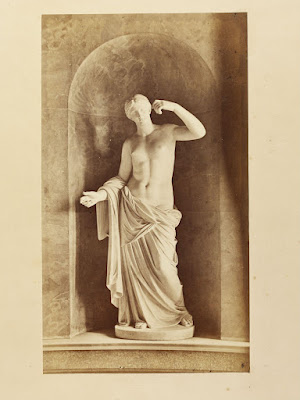
Edmund Wormwald
Niche with Victorian Imitation of Roman Sculpture
in Leeds at the house of William Lyndon Smith

ca. 1851-52
albumen print
Victoria & Albert Museum, London

John Adams Whipple
The Moon
1851
salted paper print
Princeton University Art Museum

John Adams Whipple
Self Portrait
ca. 1850
daguerreotype
Nelson-Atkins Museum of Art, Kansas City, Missouri

Jeremiah Gurney
Portrait of a Woman
ca. 1850
hand-colored daguerreotype
Nelson-Atkins Museum of Art, Kansas City, Missouri

Jeremiah Gurney
Portrait of a Family
ca. 1852
hand-colored daguerreotype
Nelson-Atkins Museum of Art, Kansas City, Missouri

Jeremiah Gurney
Portrait of a Girl
ca. 1852
daguerreotype
Nelson-Atkins Museum of Art, Kansas City, Missouri

Édouard Baldus
Temple of Augustus and Livia, Vienne
1851
salted paper print
Cleveland Museum of Art, Ohio

Édouard Baldus
Maison Carrée, Nîmes
1853
albumen silver print
Metropolitan Museum of Art, New York

Benjamin Brecknell Turner
Willowsway, Elfords, Hawkhurst, Kent
ca. 1852
albumen print
Victoria & Albert Museum, London

Benjamin Brecknell Turner
Pepperharrow Park, Surrey
ca. 1853
albumen print
Nelson-Atkins Museum of Art, Kansas City, Missouri

Maxime Du Camp
Palais de Karnak
1852
salted paper print
Chrysler Museum of Art, Norfolk, Virginia

Olympe Aguado
Six-Oxen Team and Driver
ca. 1853
salted paper print
Cleveland Museum of Art, Ohio
 
attributed to Bruno Braquehais
Model before a Mirror
ca. 1850-52
hand-colored daguerreotype
Getty Museum, Los Angeles

from Two Tales of Clumsy

Now Clumsy tries to think of what to write.
He cranes his neck around stage-left and -right,
He gazes toward the rafters thinking hard
And sometimes shakes his head as to discard
Ideas he finds less than adequate,
Then caroling a joyous, "I know what!"

He pulls a giant lightbulb from a sack
And holds it overhead and puts it back,
And in his vast excitement both his hands
Pull up his earlobe-anchored rubber bands
To lift from scalp his tiny frizzy wig:
"I'd like to start with 'God is very big.' "

– Gjertrud Schnackenberg (Supernatural Love: Poems 1976-1992)