Showing posts with label Seurat. Show all posts

Saturday, May 23, 2015

Hand of Poussin

Hand of Poussin
1875-77

Drawings and oil studies by Georges Seurat (1859-1891). Created in Paris, these artifacts made numerous separate migrations during the course of the all-too-unstable 20th century. Their common present fate unites them in the city of New York – some at the Metropolitan Museum, others at the Morgan Library.

Approach to a Bridge
1886

Peasants
1881-84

Landscape with Houses
1881-82

Fishing
1884

Monkey
1884

Circus Sideshow at Night
1887-88

Gray Weather, La Grande Jatte
1886-88

Forest at Pontaubert
1881

Saturday, May 2, 2015

Four Sketches


Four little things made in the open air of the 19th century by Georges Seurat, who died of a fever in Paris at age 31.

Wednesday, July 31, 2013

Reconstructing Seurat

After making dozens of drawings and sketches to prepare himself, Georges Seurat painted Une Baignade, Asnières in 1884. This large summer landscape with figures was rejected by the Paris Salon as incomprehensibly Impressionistic. The artist was 24. Today the picture is a universal object of worship in London at the National Gallery.

In 2004 Michael Craig-Martin made Reconstructing Seurat (Orange) and Reconstructing Seurat (Purple). For this project, Craig-Martin  imported the splendid and jarring color-vocabulary of poster-maker Peter Max, a young artist (like Seurat, but eighty years later) who gained fame and fortune instantaneously (instead of scorn) but who is now only remembered as a footnote to the Sixties.

The postmodern rag bag often involves a trick like this, selecting recognizable elements from two distinct art-historic moments and then tossing them together to produce a more-or-less fresh-looking quilt.


Monday, October 11, 2010

Sunlight

Edgar Degas (French, 1834-1917)
Interior at Menil-Hubert, 1892

The sunlight falling into this room as rendered by Degas more than a century ago seems to possess exactly the same clear golden quality as the October sunlight falling on San Francisco today. The Degas painting was part of large show earlier this year at the Albertina in Vienna. A few of the other light-filled pictures from that exhibition appear below.


Alfred Sisley (British, 1839-1899)
Bridge at Hampton Court, 1874


Édouard Manet (French, 1832-1883)
Bunch of Asparagus, 1880


Gustave Caillebotte (French, 1848–1894)
Laundry Drying on the Bank of the Seine, ca. 1892


Edgar Degas (French, 1834-1917)
After the Bath, ca. 1893


Albert Besnard (French, 1849-1934)
A Meadow in the Park in Calais, 1890


Georges Seurat (French, 1859-1891)
Figure in a Landscape at Barbizon, ca. 1882


Édouard Manet (French, 1832-1883)
Portrait of Jeanne Duval, 1862


Paul Signac (French, 1863-1935)
Capo di Noli, 1898


Claude Monet (French, 1840-1926)
View of Vétheuil, 1881


Paul Cézanne (French, 1839-1906)
Portrait of a Farmer, 1905-06


Pierre-Auguste Renoir (French, 1841-1919)
Woman with a Parasol in a Garden, 1875-76


Vincent van Gogh (Dutch, 1853-1890)
Street Scene in Montmarte - Le Moulin de Poivre, 1887


Edgar Degas (French, 1834-1917)
Two Dancers, ca. 1905

Image source is here.

Monday, April 26, 2010

Thursday, March 5, 2009

Swope


I came across this Martha Swope photograph from 1963. George Balanchine is working with one of his relatively early muses, Diana Adams, while Jacques d'Amboise gravely observes the mirror-image of what he will be expected to do.

This, by the way, was the standard ballerina figure up through the 1960s. But from the Seventies onwards (and in no small part through Balanchine's influence) the standard ballerina became at least 20 pounds thinner. I have noticed in the recent wave of fresh adulation over Balanchine that nobody has mentioned his once-famous words to all his women dancers: "Don't eat."


Balanchine in Venice at age 22 when he was dancing with the Ballet Russes under Diaghilev, who also commissioned Balanchine's first choreography.

According to Vera Zorina (married to Balanchine from 1938 to 1946): "He admired physical beauty in an abstract form the way one might admire a painting by Seurat in terms of pointillism. He would discuss the particular tilt of the neck, those slender, fragile-looking stems actually having the strength of steel, as the "Maryinsky look" – after the famous school of ballet in St. Petersburg. This look, together with the upturned wrist like a fly-away bird, marked the dancer as an unmistakable Balanchine ballerina."

Wednesday, March 4, 2009

Seurat


Portrait of Georges Seurat (ca. 1882-83) by his fellow artist Edmond Aman-Jean (1860-1936).


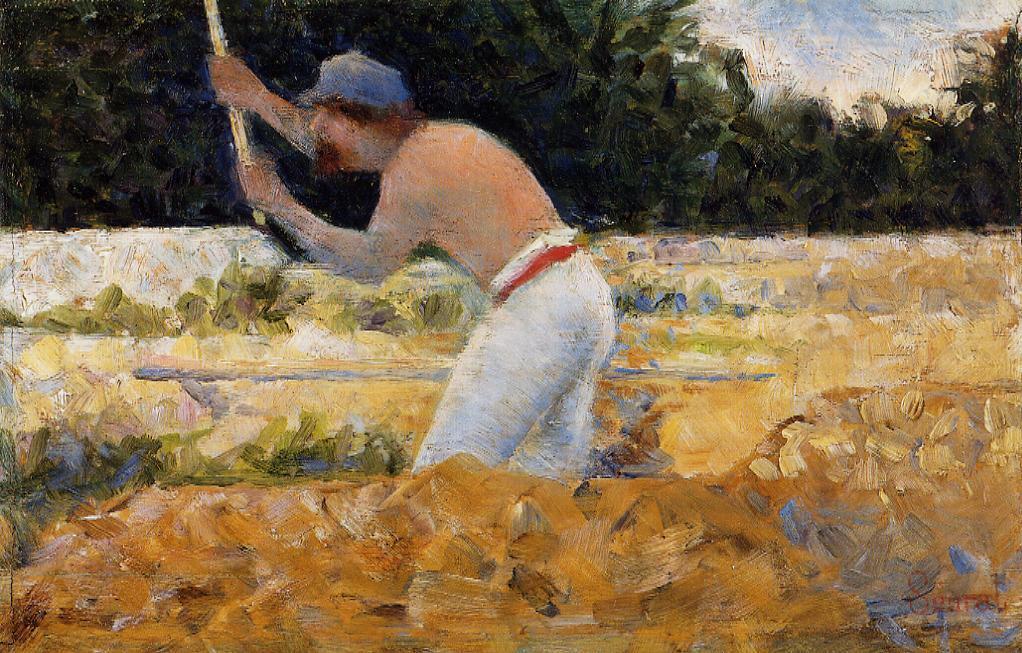
This version of Stone Breakers is maybe my single favorite painting by Georges Seurat, if I were forced at gunpoint to name just one.


I like to think this last image is another portrait of Seurat, drawn by himself, surrounded by light reflecting upward from an implied but unseen river.