Showing posts with label 18th century. Show all posts

Tuesday, August 11, 2026

Forebears

James Gillray
Ministerial Eloquence
(William Pitt the Younger)
1795
hand-colored etching
British Museum


Jean-Honoré Fragonard
Girl Reading
ca. 1769
oil on canvas
National Gallery of Art, Washington DC

James Gillray
Bar Eloquence
(Thomas Erskine, 1st Baron Erskine)
1795
hand-colored etching
British Museum

Jean-Honoré Fragonard
Portrait of Anne François d'Harcourt, duc de Beuvron
ca. 1770
oil on canvas
Musée du Louvre

James Gillray
Military Eloquence
(Frederick Augustus, Duke of York)
1795
hand-colored etching
British Museum

Jean-Honoré Fragonard
Portrait of artist Charles Paul Jérôme Bréa
ca. 1769
oil on canvas
Musée du Louvre

James Gillray
Opposition Eloquence
(Charles James Fox)
1795
hand-colored etching
British Museum

Jean-Honoré Fragonard
Portrait of Marie Anne Éléonore, comtesse de Grave
1769
oil on canvas
Musée du Louvre

James Gillray
Naval Eloquence
(William Henry, Duke of Clarence)
1795
hand-colored etching
British Museum

Jean-Honoré Fragonard
Portrait présumé de Louis François Prault
ca. 1769
oil on canvas
Musée du Louvre

James Gillray
Pulpit Eloquence
(John Moore, Archbishop of Canterbury)
1795
hand-colored etching
British Museum

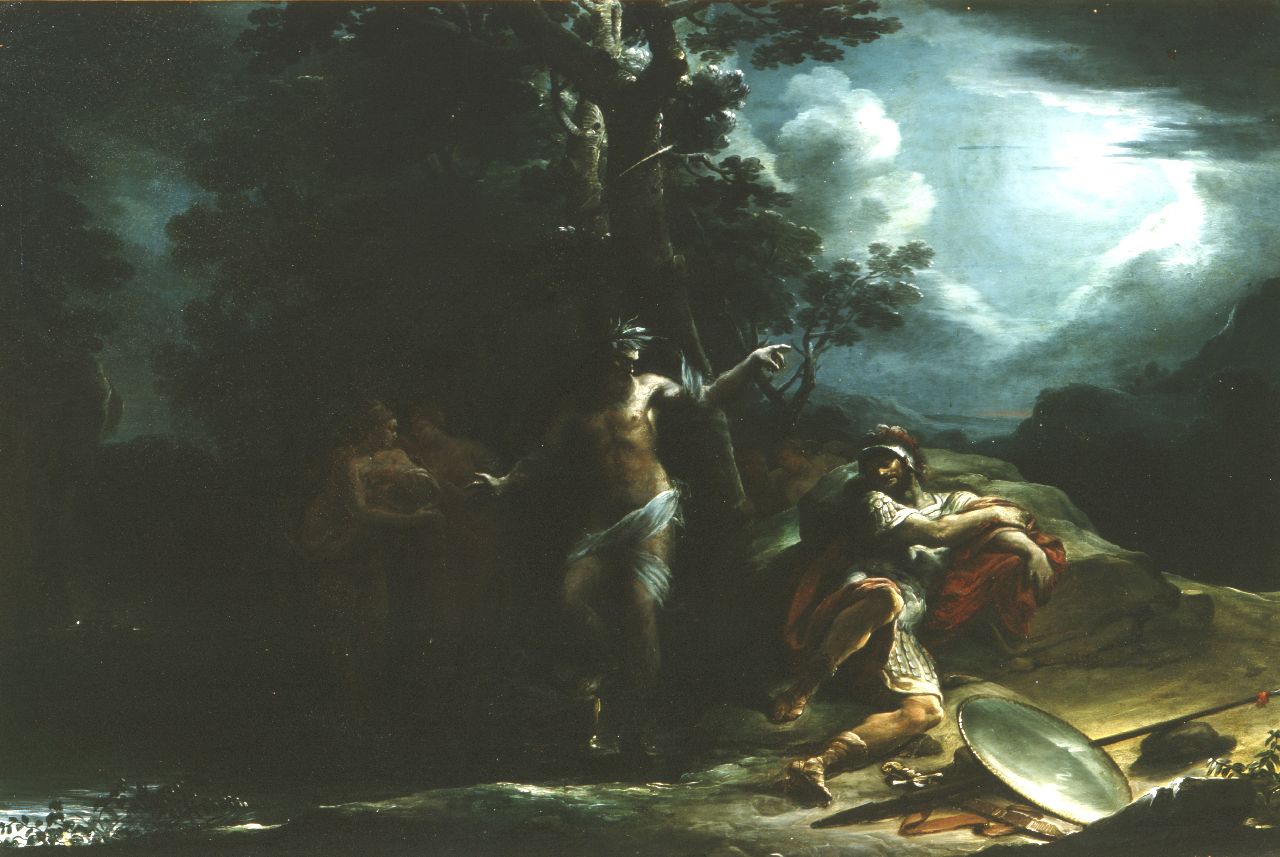
Jean-Honoré Fragonard
Rinaldo in the Garden of Armida
(scene from Tasso's Gerusalemme Liberata)
ca. 1760-70
oil on canvas
Musée du Louvre

James Gillray
Fool's Eloquence
(James Maitland, 8th Earl of Lauderdale)
1795
hand-colored etching
British Museum

Jean-Honoré Fragonard
The Shepherdess
ca. 1750-52
oil on canvas
Milwaukee Art Museum, Wisconsin

    It is delightful to repose on the wisdom of the ancients; to have some great name at hand, besides one's own initials always staring one in the face; to travel out of one's self into the Chaldee, Hebrew, and Egyptian characters; to have the palm-trees waving mystically in the margin of the page, and the camels moving slowly on in the distance of three thousand years.  In that dry desert of learning, we gather strength and patience, and a strange and insatiable thirst of knowledge.  The ruined monuments of antiquity are also there, and the fragments of buried cities (under which the adder lurks) and cool springs, and green sunny spots, and the whirlwind and the lion's roar, and the shadow of angelic wings.

– William Hazlitt (1778-1830)

Sunday, January 19, 2025

Happy Few (Ancien Régime)

Jean-Étienne Liotard
Madame François Tronchin née Anne-Marie Fromaget
1758
pastel on vellum
Musée d'Art et d'Histoire de Genève

Jean-Marc Nattier
Portrait of Anna Elisabeth Leerse
1749
oil on canvas
Städel Museum, Frankfurt

Joseph de Saint-Michel
Portrait of a Gentleman
1771
pastel and gouache on canvas
Musée des Beaux-Arts de Bordeaux

Alexis-Simon Belle
Portrait of Antoine Crozat
ca. 1715
oil on canvas
Musée Fabre, Montpellier

Élisabeth Vigée Le Brun
Portrait of the Baronne de Crussol
1785
oil on panel
Musée des Augustins de Toulouse

Jean-François Colson
François Véron de Forbonnais
1760
oil on canvas
Musée des Beaux-Arts de Dijon

Louis Tocqué
Denis-Jean de la Villguevray
ca. 1750-55
oil on canvas
Fine Arts Museums of San Francisco

Antoine Coysevox
Portrait of Madame du Vaucel
1712
marble
Saint Louis Art Museum

Jean-Antoine Houdon
Élisabeth Suzanne de Jaucourt, comtesse du Cayla
1777
marble
Frick Collection, New York

Jean-Baptiste Lemoyne the Younger
Jules-David Cromot, Baron du Bourg
ca. 1757
marble
National Gallery of Art, Washington DC

Maurice-Quentin de La Tour
Mademoiselle Ferrand meditating on Newton
ca. 1752
pastel on paper
Alte Pinakothek, Munich

Nicolas de Largillière
Anne-Louis Goislard de Montsabert,
comte de Richbourg-le-Toureil

1734
oil on canvas
Cleveland Museum of Art, Ohio

Jacques-Louis David
Portrait of Madame François Buron
1767
oil on canvas
Art Institute of Chicago

Jean-Honoré Fragonard
Portrait of a Young Woman
ca. 1772
oil on canvas
Alte Pinakothek, Munich

Adélaïde Labille-Guiard
Portrait of Madame Élisabeth de France
1788
oil on canvas
Château de Versailles

Francesco Bartolozzi
Portrait of Pierre-Noël Violet
1776
drawing
Morgan Library, New York

The earth went off hir hinges; And the Alpes
Shooke the old snow from off their trembling laps. 
The Ocean swell'd, as high as Spanish Calpe,
Or Atlas head; their saints and houshold gods
Sweate teares to shew the travailes of their citty. 
Crownes fell from holy statues, ominous birds
Defil'd the day, and wilde beastes were seene,
Leaving the woods, lodge in the streetes of Rome.
Cattell were seene that muttered humane speech:
Prodigious birthes with more and ugly jointes
Then nature gives, whose sight appauls the mother,
And dismall Prophesies were spread abroad:
And they whom fierce Bellonaes fury moves
To wound their armes, sing vengeance, Sibils priests,
Curling their bloudy lockes, howle dreadfull things,
Soules quiet and appeas'd sigh'd from their graves,
Clashing of armes was heard, in untrod woods
Shrill voices schright, and ghoasts incounter men.

– from the First Book of Lucan, translated by Christopher Marlowe (published 1600)

Tuesday, November 5, 2024

That Necklace

Nicolas-Antoine Taunay (publisher)
Représentation exacte du grand collier en brilliants
(Affaire du collier Marie-Antoinette)

ca. 1785
hand-colored engraving
British Museum

Nicolas-Antoine Taunay (publisher)
Représentation exacte du grand collier en brilliants
(Affaire du collier Marie-Antoinette)

ca. 1785
engraving
Metropolitan Museum of Art, New York

"This print shows a to-scale representation of the diamond necklace central in the so-called 'Affair of the Necklace' which brought scandal upon the French royal family and upon Queen Marie-Antoinette in particular in the years leading up to the French Revolution.  The necklace had initially been commissioned by Louis XV from Parisian jewelers Böhmer et Bassenge for his mistress, Madame du Barry (Jeanne Bécu de Cantigny).  The design for the necklace contained a total of 540 diamonds.  In the event, King Louis XV died before the jewelers could complete the commission.  Left deeply in debt and without a buyer for the extravagant piece, Böhmer et Bassenge offered their creation to the new Queen, Marie-Antoinette, but she declined.  The necklace then became the protagonist in a scheme involving the Cardinal de Rohan (Louis-René-Édouard, prince de Rohan) and his mistress the Comtesse de La Motte (Jeanne de Valois Saint-Rémy).  The Cardinal reopened negotiations with the jewelers, informing them of the Queen's renewed interest, and convinced them that she would pay them for it in installments.  The jewelers accepted this arrangement and handed the necklace over to Rohan, who gave it to his mistress, who then spirited it away.  When the jewelers wrote to Marie-Antoinette to inquire when they would receive payment, the scheme was discovered.  Both Rohan and Comtesse de La Motte were apprehended and put on trial.  They were not the only ones to pay a price, however.  Public opinion turned against the Queen, who was accused of plotting the whole scheme to rid herself of Cardinal de Rohan.  Böhmer et Bassenge were left bankrupt, never receiving payment for the necklace, which itself had disappeared and was believed to have been disassembled.  Nicholas de La Motte, husband of the Comtesse, was shortly caught fencing some of the diamonds in London."  

– from curator's notes at the Metropolitan Museum of Art, New York

Albert Guerrin
Collier de la Reine (Marie-Antoinette)
ca. 1960-63
white sapphires, pearls, gold
(replica of original in diamonds, lost since 1785)
Château de Versailles

Friday, July 12, 2024

Neoclassical Narratives

Vincenzo Valdrè
Sleeping Silenus garlanded by Bacchantes
1765
oil on canvas
Galleria Nazionale di Parma

Giovanni Battista Baguti
Dejanira pouring the Potion onto the Cloak for Hercules
1768
oil on canvas
Galleria Nazionale di Parma

Paolo Dardani
River Tiber sending Aeneas a Dream of Rome's Future Greatness
(scene from the Aeneid)
1775
oil on canvas
Galleria Nazionale di Parma

Vincenzo Guarana
Death of Pallas at the hands of Turnus
(scene from the Aeneid)
1778
oil on canvas
Galleria Nazionale di Parma

Paolo Gallinoni
Ascanius wounds Sylvia's Doe
(scene from the Aeneid)
1779
oil on canvas
Galleria Nazionale di Parma

Biagio Manfredi
Farewell of Anchises to his son Aeneas and the Delphic Sibyl
at the Gates to the Underworld

(scene from the Aeneid)
ca. 1780
oil on canvas
Galleria Nazionale di Parma

Gaspare Landi
Ulysses and Diomedes stealing the Palladium
(scene from the Iliad)
1783
oil on canvas
Galleria Nazionale di Parma

Pierre Rogat
Alexander the Great presenting his mistress Campaspe
to the painter Apelles

1787
oil on canvas
Galleria Nazionale di Parma

Antonio Corsi
Daedalus and Icarus
1790
oil on canvas
Galleria Nazionale di Parma

Giuseppe Paoletti
Death of Socrates
1791
oil on canvas
Galleria Nazionale di Parma

Vincenzo Ferreri
Sacrifice of Polyxena
1793
oil on canvas
Galleria Nazionale di Parma

Giuseppe Fornaroli
Ulysses recognizing Achilles
among the Daughters of Lycomedes

1795
oil on canvas
Galleria Nazionale di Parma

Maria Callani
Hebe serving Jupiter in the shape of an Eagle
1803
oil on canvas
Galleria Nazionale di Parma

Luigi Tagliana
Departure of Ovid, exiled by Augustus
1821
oil on canvas
Galleria Nazionale di Parma

Enrico Bandini
The Slaying of Pompey the Great
1836
oil on canvas
Galleria Nazionale di Parma

Cesare Beseghi
Apollo supporting the dying Hyacinth
1838
oil on canvas
Galleria Nazionale di Parma

These paintings (along with many others like them) were produced by members of the Accademia di Belle Arti di Parma, founded in 1752 under ducal patronage.  Competitions were held regularly, with painters required to illustrate a set subject from classical mythology, literature or history.  The first and second prize works were rewarded by state purchase and retained for the local museum, which has evolved into the present Galleria Nazionale di Parma.   

Monday, June 3, 2024

Rendering 18th-century Textiles / Garments

Anonymous Italian Artist
St Jerome in the Desert
ca. 1700
oil on canvas
Minneapolis Institute of Art

Nicolas de Largillière
Catherine Coustard, Marquise de Castelnau
with her son Léonor

ca. 1700
oil on canvas
Minneapolis Institute of Art

Nicolas de Largillière
Portrait of a Nobleman
ca. 1710
oil on canvas
Gemäldegalerie, Dresden

Bernard Lens after Peter Paul Rubens
Victorious Hero concluding Peace
(Personification of Peace with Ceres, Minerva and Mars)
1720
watercolor and gouache miniature on vellum
Yale Center for British Art

Giuseppe Ghislandi
Portrait of a Young Man
ca. 1730
oil on canvas
National Gallery of Art, Washington DC

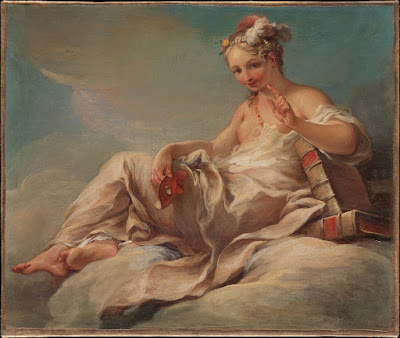
Pierre-Charles Trémolières
Personification of Comedy
ca. 1736
oil on canvas (sketch)
Metropolitan Museum of Art, New York

Jean-Étienne Liotard
Moritz, Count of Saxony, Marshal of France
ca. 1746-49
pastel on vellum
Gemäldegalerie, Dresden

Anton Raphael Mengs
Elector Friedrich August III of Saxony as an Infant
1751
pastel
Gemäldegalerie, Dresden

Joseph-Marie Vien
Sweet Melancholy
1756
oil on canvas
Cleveland Museum of Art, Ohio

Giuseppe Baldrighi
Family of Filippo I, Duke of Parma and Piacenza
ca. 1757
oil on canvas
Galleria Nazionale di Parma

Nathaniel Dance-Holland
Conversation Piece
(British Grand Tourists in Rome)
ca. 1760
oil on canvas
Yale Center for British Art

Anton Raphael Mengs
Adoration of the Shepherds
ca. 1764-65
oil on canvas
National Gallery of Art, Washington DC

Anonymous French Artist
Portrait of a Young Man
ca. 1770
oil on canvas
National Gallery of Art, Washington DC

Gilbert Stuart
Portrait of Sir Joshua Reynolds
1784
oil on canvas
National Gallery of Art, Washington DC

Thomas Lawrence
The Children of Lord George Cavendish
1790
oil on canvas
Städel Museum, Frankfurt

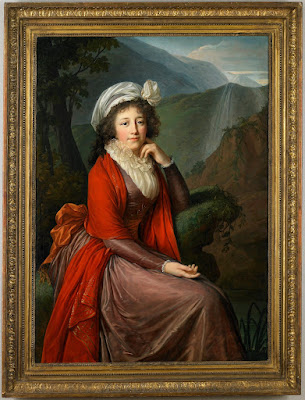
Elisabeth Vigée Le Brun
Portrait of Countess Maria Theresia Bucquoi
1793
oil on canvas
Minneapolis Institute of Art

     "Given the multitude of written texts and vehement declarations, it is impossible to separate what was rational from what such unprecedented events had kindled in the imagination. What stands out is the woefulness that could hardly be assuaged by the certainty of living in a momentous time. Two contradictory attitudes are discernible, characteristically oscillating from one to the other: on one side fate is invoked, usually accompanied by feelings of gross injustice; on the other, providence, urging repentance after punishment. The first is generally present in the lamenti and imprecations that can be termed popular; the second appears among clerics with a noteworthy difference determined by whether they continued to believe or lost faith in Rome's fundamental vocation.  . . .  [The Vatican diplomat and historian Francesco] Guicciardini died of shame. He would have liked to transcend his burning anguish through a moral or religious exaltation that might have distanced him from his despair. But he could not, nor did he even try, observing that it would be necessary to shed human weakness, which is not possible. "Just as I wish you to be in such a state of perfection, so I confess to being alien to it." 

– André Chastel, The Sack of Rome, 1527, translated by Beth Archer, 1983 (expanded from the A.W. Mellon Lectures in the Fine Arts, 1977, and published by Princeton University Press and the National Gallery of Art, Washington, D.C.)