Showing posts with label Cremona. Show all posts

Sunday, August 14, 2022

Giuseppe Bottani (1717-1784) - Academic Traditionalist

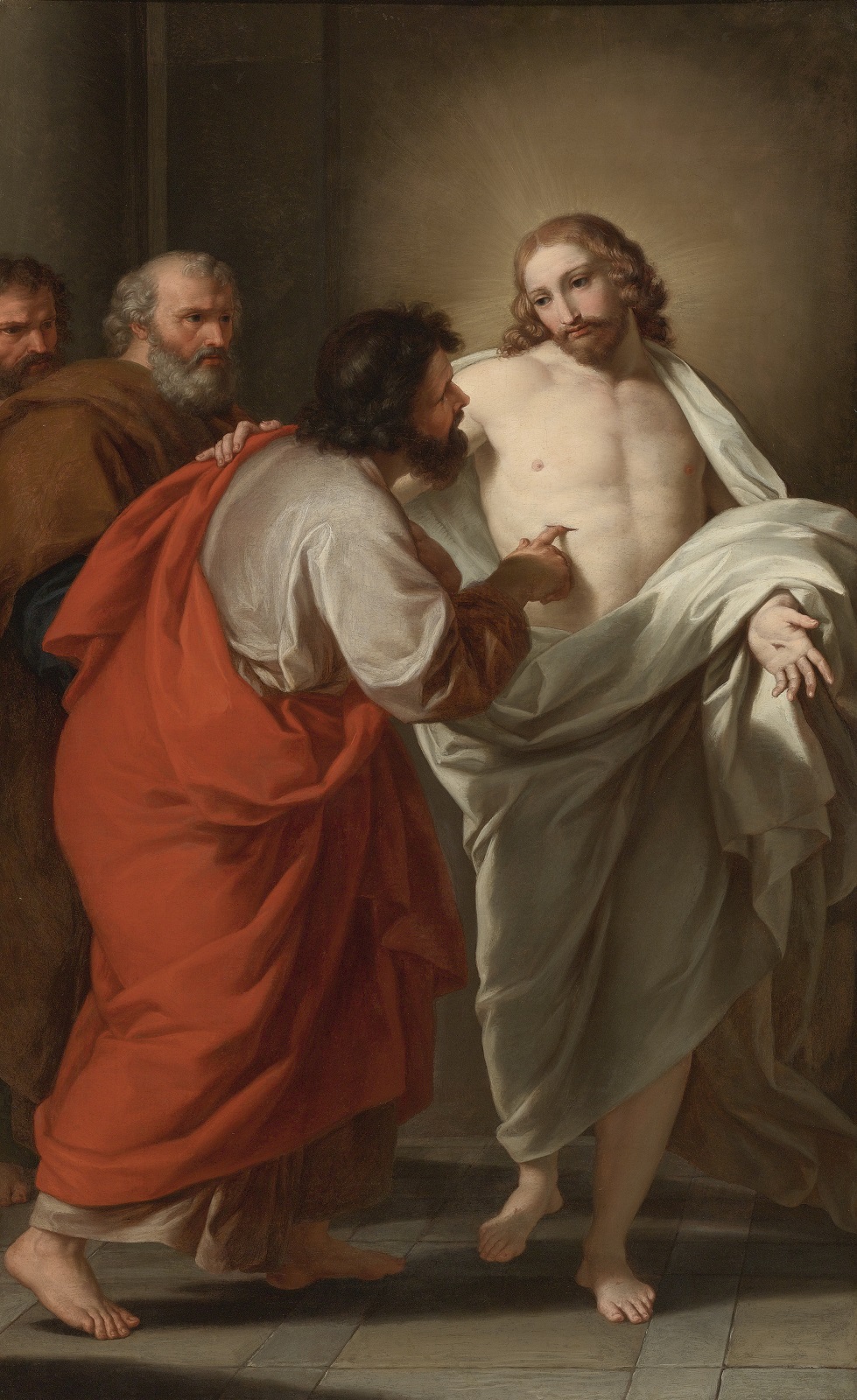
Giuseppe Bottani
Incredulity of St Thomas
before 1784
oil on canvas
private collection

Giuseppe Bottani
Portait of Caterina Valadier with her Children
1766
oil on canvas
Museo di Roma a Palazzo Braschi

Giuseppe Bottani
Hagar and the Angel
ca. 1776
oil on canvas
Musée du Louvre

Giuseppe Bottani
Departure of St Paula and St Eustochium
for the Holy Land

1740
drawing
Metropolitan Museum of Art, New York

Giuseppe Bottani
Departure of St Paula and St Eustochium
for the Holy Land

1740
oil on canvas
Metropolitan Museum of Art, New York

Giuseppe Bottani
Athena revealing Ithaca to Ulysses
ca. 1775
oil on canvas
Pinacoteca Malaspina, Pavia

Giuseppe Bottani
Athena transforming Ulysses into a Beggar
ca. 1775
oil on canvas
Pinacoteca Malaspina, Pavia

Giuseppe Bottani
Preaching of St Vincent Ferrer
ca. 1780
oil on canvas
Palazzo Ducale, Mantua

Giuseppe Bottani
Preaching of St Vincent Ferrer (detail)
ca. 1780
oil on canvas
Palazzo Ducale, Mantua

Giuseppe Bottani
Study for Portrait of a Cardinal
ca. 1753-63
drawing
Philadelphia Museum of Art

Giuseppe Bottani
Studies of Heads
for St Aloysius Gonzaga and St Stanislaus Kostka
adoring the Madonna and Child

ca. 1750-65
drawing
Philadelphia Museum of Art

Giuseppe Bottani
Sheet of Studies
ca. 1760
drawing
Rijksmuseum, Amsterdam

Giuseppe Bottani
Académie
ca. 1757
drawing
Philadelphia Museum of Art

Giuseppe Bottani
Académie
ca. 1760-70
drawing
Philadelphia Museum of Art

Giuseppe Bottani
Académie
ca. 1760
drawing
Rijksmuseum, Amsterdam

"Giuseppe Bottani was born at Cremona in 1717, and studied first at Florence under Meucci and Puglieschi, and in 1740, at Rome, under Agostino Masucci.  He returned in 1745, and established a school of painting at Cremona, and also gained considerable reputation for painting landscapes, in the style of Gaspard Poussin [Gaspard Dughet], into which he introduced figures in the pleasing manner of Carlo Maratti.  In 1769 he was made director of the Academy at Mantua." 

– Michael Bryan, Dictionary of Painters and Engravers, Biographical and Critical (London: George Bell and Sons, 1886)

Thursday, July 7, 2022

Sofonisba Anguissola (ca. 1532-1625) - Portrait Specialist

Sofonisba Anguissola
Self Portrait
1554
oil on panel
Kunsthistorisches Museum, Vienna

Sofonisba Anguissola
Self Portrait, painting a Devotional Panel
1556
oil on canvas
Łańcut Castle, Poland

Sofonisba Anguissola
Portrait of a Canon of the Lateran
1556
oil on canvas
Pinacoteca Tosio Martinengo, Brescia

Sofonisba Anguissola
Portrait of Massimiliano Stampa
1557
oil on canvas
Walters Art Museum, Baltimore

Sofonisba Anguissola
Portrait of Alessandro Farnese,
later Duke of Parma and Piacenza

ca. 1560
oil on canvas
(painted in Spain, where Farnese was a hostage)
National Gallery of Ireland, Dublin

Sofonisba Anguissola
Portrait of Joanna of Austria, Princess of Portugal
ca. 1560-70
oil on canvas
private collection

Sofonisba Anguissola
Portrait of Joanna of Austria
with a Little Girl

1561
oil on canvas
Isabella Stewart Gardner Museum, Boston

Sofonisba Anguissola
Portrait of a Boy at the Spanish Court
ca. 1565-70
oil on canvas
San Diego Museum of Art

Sofonisba Anguissola
Portrait of Infantas Isabella Clara Eugenia and Catalina Micaela
1570
oil on canvas
Royal Collection, Great Britain

Sofonisba Anguissola
Portrait of Philip II of Spain
1573
oil on canvas
Museo del Prado, Madrid

Sofonisba Anguissola
Portrait of a Young Lady
ca. 1580
oil on canvas
Museo Lázaro Galdiano, Madrid

Sofonisba Anguissola
Portrait of a Boy and Girl of the Attavanti Family
ca. 1580-85
oil on panel
Allen Memorial Art Museum, Oberlin College, Ohio

Sofonisba Anguissola
Portrait of a Man with his Daughter
ca. 1580-90
oil on canvas
National Museum, Warsaw

Sofonisba Anguissola
Portrait of Infanta Isabella Clara Eugenia
ca. 1597-98
oil on canvas
Museo del Prado, Madrid

Sofonisba Anguissola
Marriage Portrait of Margaret of Savoy,
Duchess of Mantua

1604
oil on canvas
Galleria Sabauda, Turin

"Born to a noble family from Cremona, Sofonisba Anguissola learned painting alongside her five sisters.  Her first studies, from around 1545, were with Bernardino Campi.  Then, beginning in 1549, she continued with Bernardino Gatti.  After visiting her family, Vasari remarked on Anguissola's preparation in both painting and drawing.  . . .  It has been observed that her early works were influenced by her teach Campi, who was also an outstanding portrait painter.  And through him, Anguissola appears to have been influenced by Correggio, whose work held sway in Cremona over the course of that century.  . . .  In 1559 she was invited to Philip II's court in Madrid, thanks to the duke of Alba and to the duke of Sessa, who was then governor of Milan.  After moving to Madrid, she continued to paint portraits while engaged as one of the ladies in waiting to Queen Elizabeth of Valois.  Around 1571 Anguissola married  Fabrizio de Moncada, whose brother was Viceroy of Sicily, and moved to that island.  Following her first husband's death, she married the Genoese nobleman Orazio Lomellino, dividing her time between Genoa and Palermo, where Anthony van Dyck visited her in 1624.  While there, he captured her likeness in his travel notebook, adding that her age – she was by then past ninety – in no way weakened her insightful mind and her capacity to discuss painting."  

– from curator's notes at Museo del Prado, Madrid

Saturday, October 12, 2019

Boccaccio and Camillo Boccaccino - Cremona

Boccaccio Boccaccino
Adoration of the Shepherds
ca. 1500-1507
oil on panel
Museo di Capodimonte, Naples

Boccaccio Boccaccino
Adoration of the Shepherds
ca. 1501
oil on panel
Galleria Estense, Modena

Boccaccio Boccaccino
Madonna and Child
ca. 1504-1505
oil and tempera on panel
Museum of Fine Arts, Boston

Boccaccio Boccaccino
Madonna and Child
ca. 1506
oil on panel
Metropolitan  Museum of Art, New York

Boccaccio Boccaccino
Gypsy Girl
ca. 1504-1505
oil on panel
Galleria degli Uffizi, Florence

"The caposcuola who dominated the first decade of Cinquecento painting in Cremona was himself an excellent example of the making of a style by intersection of influences, but upon a personality of much consistency and strength.  Boccaccio Boccaccino (1467-1525) was the son of a Cremonese resident in Ferrara.  His early schooling was entirely Ferrarese, and his activity almost wholly so until about 1505.  Ercole Roberti's style as well as Lorenzo Costa's had been most important to him; then, shortly after the beginning of the new century, experience of Venice caused a major infusion of Bellinism in his art."

– S.J. Freedberg from Painting in Italy - 1500 to 1600 in the Pelican History of Art series (London, 1971)

Boccaccio Boccaccino
Madonna and Child enthroned
with St John the Baptist and St Catherine of Alexandria
ca. 1504-1505
oil on panel
Gemäldegalerie, Berlin

Boccaccio Boccaccino
Madonna and Child enthroned
with Saints and Donor
ca. 1505-1515
oil on panel
Birmingham Museum & Art Gallery (West Midlands)

Boccaccio Boccaccino
Madonna and Child
before 1524
oil on panel
Manchester Art Gallery

attributed to Boccaccio Boccaccino
Portrait of a Young Man
before 1524
oil on canvas
private collection

"Camillo Boccaccino (1504-1546), Boccaccio's son, had a differently active role in his relation with the newer style.  Of a different creative stature altogether from his local contemporaries, Camillo was intelligently responsive to the most advance currents of invention that he encountered – not at Cremona, but in Emilia.  He found the examples of Correggio, Pordenone, and Parmigianino, and in time that of Giulio Romano, and creatively transformed them.  Almost from the beginning, there was an inclination in his style towards a temper which resembled that of Mannerism, and no more than a decade from the time of his first independent work he made an identifiably personal, indeed idiosyncratic, contribution to the repertory of that style.  Though first trained by his father, Camillo is reported by old sources, with almost certain truth, to have been in Parma between 1522 and 1524 and connected with Correggio.  . . .  In 1535 he was commissioned to undertake the decoration of the Cremonese abbey church of S. Sigismondo, which in consequence of his efforts and those of his successors in the task was to become one of the prime ensembles of Mannerist style in Northern Italy.  Camillo's work there consisted of the painting of the semi-dome and laterals in the apse.  In the semi-dome, the Eternal in Glory with the Evangelists [directly below] . . .  indicates that Camillo had turned away from Pordenone to renew his old allegiance to Parma – to both Correggio and Parmigianino.  Both Correggio's Parmesan domes and his apsidal scheme at S. Giovanni Evangelista supply the basis of Camillo's design, a cloud-borne illusion at once propelled towards the spectator and ascending into far celestial space, brilliant with silhouetted contrasts of sharp lights and darks.  But the precise vocabulary of form is not Correggio's but deduced from Parmigianino, describing shapes in impelled, arbitrary rhythms that make unexpected transformations of appearances and a temper of excitant grace."

– S.J. Freedberg from Painting in Italy - 1500 to 1600 in the Pelican History of Art series (London, 1971)

Camillo Boccaccino
Eternal in Glory with the Evangelists
1537
fresco
Chiesa di San Sigismondo, Cremona

Camillo Boccaccino
Madonna and Child in Glory
with St Bartholomew, St John the Baptist and St Jerome
1532
oil on canvas
Pinacoteca di Brera, Milan

Camillo Boccaccino
God the Father
ca. 1520-40
oil on panel
Museo Civico ala Ponzone, Cremona

Camillo Boccaccino
Holy Family in a Landscape
ca. 1535-40
oil on panel
Glasgow Museums

Camillo Boccaccino
Madonna and Child enthroned
with the Archangel Michael and Blessed Ambrogio Sansedoni
ca. 1537-40
oil on canvas
Museo Civico ala Ponzone, Cremona

Sunday, September 1, 2019

Bernardino Gatti, called Il Sojaro (ca. 1495-1576)

Bernardino Gatti
Ascension of Christ
1553
vault fresco
Chiesa di San Sigismondo, Cremona

Bernardino Gatti
Apostle witnessing the Ascension of Christ
(study for fresco in San Sigismondo, Cremona)
ca. 1553
drawing
Getty Museum, Los Angeles

Bernardino Gatti
Flying Angel
(study for fresco in San Sigismondo, Cremona)
ca. 1553
drawing
British Museum

Bernardino Gatti
Ascension of Christ
1553
vault fresco
Chiesa di San Sigismondo, Cremona

"A painter who was still more durable than Giulio Campi, Bernardino Gatti (Il Sojaro) more specifically illustrates the role of the Emilian style in Cremona.  Sojaro was only uncertainly of Cremonese birth, but it is known that he began his career as an independent artist there.  In the course of the 1520s, however, he must have been in Parma, intensively studying the production of Correggio.  . . .  His interpretation of Correggio's style was unfortunately graceless and pedestrian, and it was subject to the ponderousness and literalness that the Lombard disposition shows when it is least inspired.  Sojaro's most accomplished work, the large fresco of Multiplication of the Loaves and Fishes (Cremona, S. Pietro, 1552) recalls Correggesque style only in its outward guise, which is a mask for its essential Lombard stuff of realist detail and illustration.  There is as yet no accent in Sojaro of Maniera, but his next work shows the compromise that he felt forced to make with the primacy that had been established all around him of Mannerist style: his fresco in the centre field of the nave vault of S. Sigismondo, the Ascension of Christ (1553), reworks Correggio's forms into a grossly heavy Romanism based in part on Pordenone but more on Mantua.  A pretentious rhetoric dictates the posturing of figures but does not move them.  From 1560 to 1572 Sojaro was mainly employed in Parma and there demonstrated, in his dome of the church of the Steccata (1560-66) how his acquired Romanist emphases could make even direct plagiarism from Correggio quite dull."

– S.J. Freedberg from Painting in Italy - 1500 to 1600 in the Pelican History of Art series (London, 1971)

Bernardino Gatti
Assumption of the Virgin
1560-66
fresco
Basilica di Santa Maria della Steccata, Parma

Bernardino Gatti
Assumption of the Virgin
(pendentive detail with St John the Evangelist)
1560-66
fresco
Basilica di Santa Maria della Steccata, Parma

Bernardino Gatti
Assumption of the Virgin
(pendentive detail with Angel of the Annunciation)
1560-66
fresco
Basilica di Santa Maria della Steccata, Parma

Bernardino Gatti
Assumption of the Virgin
(pendentive detail with Virgin Annunciate)
1560-66
fresco
Basilica di Santa Maria della Steccata, Parma

Bernardino Gatti
Assumption of the Virgin
(pendentive detail with King David and St Matthew)
1560-66
fresco
Basilica di Santa Maria della Steccata, Parma

Bernardino Gatti
Assumption of the Virgin
(dome detail)
1560-66
fresco
Basilica di Santa Maria della Steccata, Parma

Bernardino Gatti
Apostle witnessing the Assumption of the Virgin
(study for fresco in Santa Maria della Steccata, Parma)
ca. 1560-66
drawing
British Museum

Bernardino Gatti
Madonna and Child with St John the Baptist
ca. 1552
drawing
Morgan Library, New York

Bernardino Gatti
Standing Youth in Armour
(study for painting in Cremona)
ca. 1543-47
drawing
British Museum

Bernardino Gatti
Christ carrying the Cross
before 1570
drawing
Teylers Museum, Haarlem

Bernardino Gatti
Crucifixion with St Agatha, Mary Magdalen, St Bernardo degli Uberti
1566-68
oil on canvas
Cattedrale di Parma