Showing posts with label Mantua. Show all posts

Sunday, August 14, 2022

Giuseppe Bottani (1717-1784) - Academic Traditionalist

Giuseppe Bottani
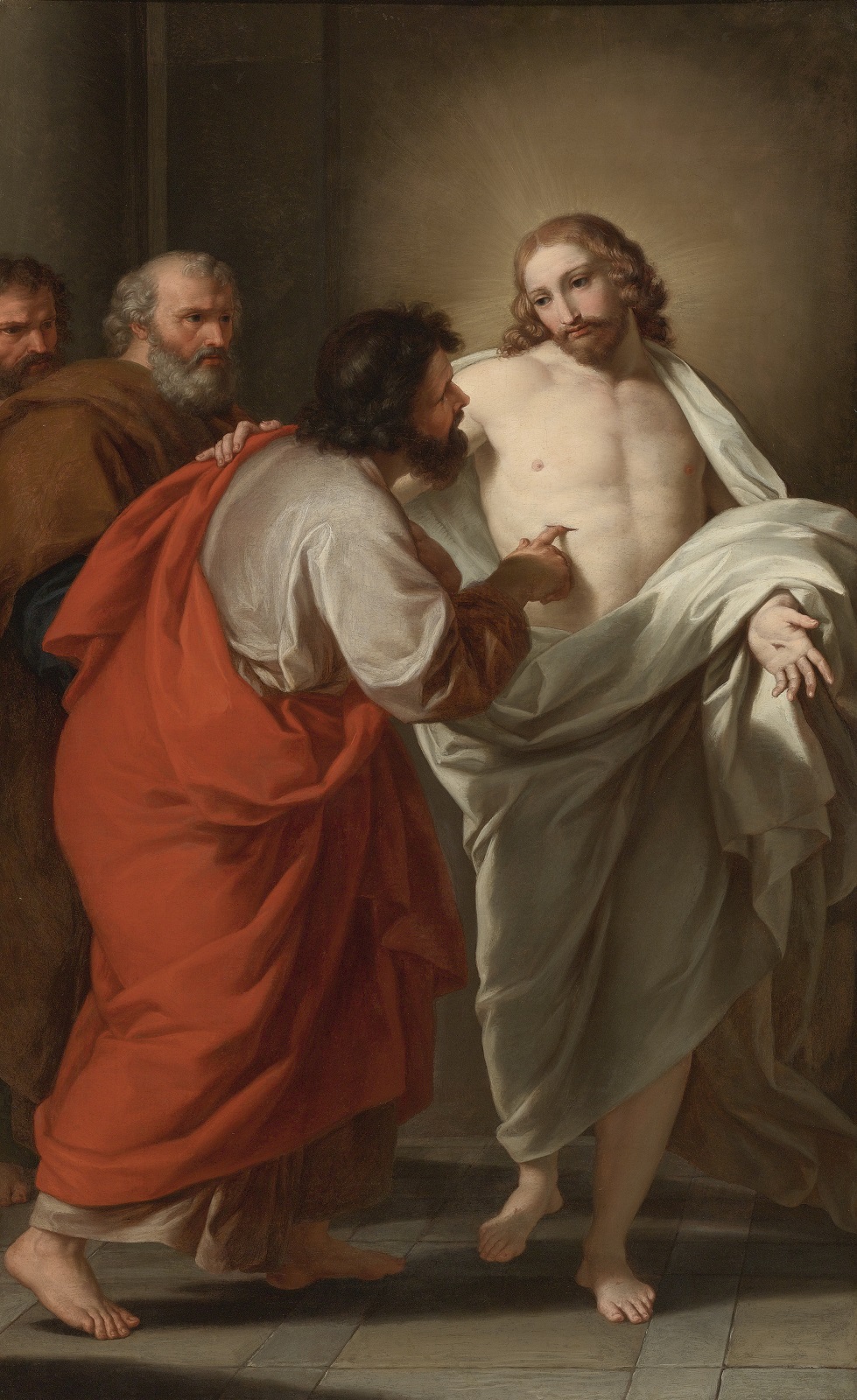
Incredulity of St Thomas
before 1784
oil on canvas
private collection

Giuseppe Bottani
Portait of Caterina Valadier with her Children
1766
oil on canvas
Museo di Roma a Palazzo Braschi

Giuseppe Bottani
Hagar and the Angel
ca. 1776
oil on canvas
Musée du Louvre

Giuseppe Bottani
Departure of St Paula and St Eustochium
for the Holy Land

1740
drawing
Metropolitan Museum of Art, New York

Giuseppe Bottani
Departure of St Paula and St Eustochium
for the Holy Land

1740
oil on canvas
Metropolitan Museum of Art, New York

Giuseppe Bottani
Athena revealing Ithaca to Ulysses
ca. 1775
oil on canvas
Pinacoteca Malaspina, Pavia

Giuseppe Bottani
Athena transforming Ulysses into a Beggar
ca. 1775
oil on canvas
Pinacoteca Malaspina, Pavia

Giuseppe Bottani
Preaching of St Vincent Ferrer
ca. 1780
oil on canvas
Palazzo Ducale, Mantua

Giuseppe Bottani
Preaching of St Vincent Ferrer (detail)
ca. 1780
oil on canvas
Palazzo Ducale, Mantua

Giuseppe Bottani
Study for Portrait of a Cardinal
ca. 1753-63
drawing
Philadelphia Museum of Art

Giuseppe Bottani
Studies of Heads
for St Aloysius Gonzaga and St Stanislaus Kostka
adoring the Madonna and Child

ca. 1750-65
drawing
Philadelphia Museum of Art

Giuseppe Bottani
Sheet of Studies
ca. 1760
drawing
Rijksmuseum, Amsterdam

Giuseppe Bottani
Académie
ca. 1757
drawing
Philadelphia Museum of Art

Giuseppe Bottani
Académie
ca. 1760-70
drawing
Philadelphia Museum of Art

Giuseppe Bottani
Académie
ca. 1760
drawing
Rijksmuseum, Amsterdam

"Giuseppe Bottani was born at Cremona in 1717, and studied first at Florence under Meucci and Puglieschi, and in 1740, at Rome, under Agostino Masucci.  He returned in 1745, and established a school of painting at Cremona, and also gained considerable reputation for painting landscapes, in the style of Gaspard Poussin [Gaspard Dughet], into which he introduced figures in the pleasing manner of Carlo Maratti.  In 1769 he was made director of the Academy at Mantua." 

– Michael Bryan, Dictionary of Painters and Engravers, Biographical and Critical (London: George Bell and Sons, 1886)

Thursday, June 30, 2022

Andrea Mantegna (ca. 1431-1506) - Padua to Mantua

Andrea Mantegna
Minerva expelling the Vices from the Garden of Virtue (detail)
1502
tempera and oil on canvas
Musée du Louvre

Andrea Mantegna
Minerva expelling the Vices from the Garden of Virtue (detail)
1502
tempera and oil on canvas
Musée du Louvre

Andrea Mantegna
Minerva expelling the Vices from the Garden of Virtue (detail)
1502
tempera and oil on canvas
Musée du Louvre

Andrea Mantegna
Samson and Delilah
ca. 1495-1506
distemper on canvas
National Gallery, London

Andrea Mantegna
Introduction of the Cult of Cybele at Rome
ca. 1505-1506
distemper on canvas
National Gallery, London

Andrea Mantegna
Introduction of the Cult of Cybele (detail)
ca. 1505-1506
distemper on canvas
National Gallery, London

Andrea Mantegna
Introduction of the Cult of Cybele (detail)
ca. 1505-1506
distemper on canvas
National Gallery, London

Andrea Mantegna
Introduction of the Cult of Cybele (detail)
ca. 1505-1506
distemper on canvas
National Gallery, London

Andrea Mantegna
Holy Family with St John the Baptist
ca. 1500
distemper on canvas
National Gallery, London

Andrea Mantegna
Holy Family with Mary Magdalen
(Castelvecchio Madonna)
1495
tempera on canvas
Museo di Castelvecchio, Verona

Andrea Mantegna
Holy Family
with St Elizabeth and St John the Baptist

ca. 1485-88
distemper and oil on canvas
Kimbell Art Museum, Fort Worth, Texas

Andrea Mantegna
Virgin and Child
with St John the Baptist and Mary Magdalen

1498
tempera on canvas
National Gallery, London

Andrea Mantegna
St Sebastian
ca. 1480
tempera on canvas
Musée du Louvre

Andrea Mantegna
St Sebastian
ca. 1457-59
tempera on panel
Kunsthistorisches Museum, Vienna

Andrea Mantegna
St Mark the Evangelist
ca. 1450
tempera and oil on canvas
Städelsches Kunstinstitut, Frankfurt

"Mantegna was born near Padua and apprenticed under a local painter called Squarcione.  Believing his talents were being exploited, the ambitious young artist broke their agreement and in 1453 married into the rival Venetian firm of the Bellinis.  He worked in Padua, Verona and Venice before moving to Mantua in 1460, where he spent the rest of his life, developing a painting technique that allowed him to imitate the look of classical sculpture.  Mantegna's scholarly interest in the antique drew him into friendship with humanist scholars like Felice Feliciano.  In 1464 they dressed up as Romans for a boating excursion on Lake Garda.  In 1484 Mantegna was knighted by his Gonzaga patrons, a rare honour for an artist in this period."    

– from curator's notes at the National Gallery, London

Sunday, June 12, 2022

Gianfrancesco Caroto (ca. 1480-1555) - Verona

Gianfrancesco Caroto
Portrait of a Lady
before 1555
oil on panel
private collection

Gianfrancesco Caroto
Portrait of a Lady
ca. 1505-1510
oil on panel
Musée du Louvre

Gianfrancesco Caroto
Portrait of a young Benedictine Monk
before 1555
oil on canvas
Museo di Castelvecchio, Verona

attributed to Gianfrancesco Caroto
Portrait of a Lady as the Magdalen
ca. 1550
oil on panel
private collection

Gianfrancesco Caroto
The Crucifixion (detail)
ca. 1545
oil on canvas
Museo degli affreschi Giovanni Battista Cavalcaselle, Verona

Gianfrancesco Caroto
Virgin and Child
ca. 1508-1510
oil on panel
Museum der bildenden Künste, Leipzig

Gianfrancesco Caroto
Tiburtine Sibyl
ca. 1540
oil on panel
Palazzo Ducale, Mantua

Gianfrancesco Caroto
Sophonisba with Goblet of Poison
before 1555
oil on panel
Museo di Castelvecchio, Verona

Gianfrancesco Caroto
Three Archangels
ca. 1520
oil on panel
Museo degli affreschi
Giovanni Battista Cavalcaselle, Verona

Gianfrancesco Caroto
St Sebastian
before 1555
oil on panel
Chiesa di Santo Stefano, Venice

Gianfrancesco Caroto
The Annunciation (detail)
before 1555
oil on canvas
private collection

Gianfrancesco Caroto
The Annunciation
before 1555
oil on canvas
private collection

Gianfrancesco Caroto
Christ washing the Feet of the Disciples
ca. 1530
oil on canvas
Museo degli affreschi
Giovanni Battista Cavalcaselle, Verona

Gianfrancesco Caroto
Pietà della Lacrima
before 1555
oil on canvas
Museo di Castelvecchio, Verona

Gianfrancesco Caroto
Rest on the Flight into Egypt
ca. 1520
oil on panel
Musée du Louvre

"Though Verona was an old tributary of the Serenissima, the main axis of its artistic interest in the sixteenth century was not towards Venice.  Until 1529, the old Liberale da Verona continued to work in the city, persisting in an essentially archaic style that had long since been generated out of Mantuan more than Venetian sources and which in his latest years was faintly touched by an Emilian Raphaelism.  His pupil Niccolò Giolfino held to this latter manner with hardly any meaningful alteration, and at a very inferior level, until 1555.  Liberale's influence and its conservative effect were also felt by the most important native painter of the first half of the century in Verona, Giovanni Francesco Caroto (1480-1555/8).  He first formed a style that was dependent not only on Liberale but on explicitly Mantuan and Mantegnesque models.  Then, in the second decade, he was resident for some years in the Milanese.  His earlier works were deeply attracted to the traditions of later Quattrocento style, and his old-fashioned inclination towards hard, still form and precise description – reinforced by his sojourn in Lombardy – was too strong for any subsequent influence to eradicate.  When in the middle twenties Caroto began to take some cognizance of the Raphaelesque mode that by then was visible in near-by Emilia, it could exact no more than limited concessions from him.  His measure of modernity consisted of an admixture of motifs from Raphaelesque prints, remembered Leonardisms, and a touch of the Mantuan Giulio Romano's smoky chiaroscuro.  Under constant pressure of Emilian example in particular, the classicistic accent of his style increased, but at no sacrifice to his literalness of touch and way of seeing.  In this, his sympathy was with the realist strain that persists also in the Lombard school, to which he looked, more willingly than towards Emilia, in his later work."   

– S.J. Freedberg, Painting in Italy 1500-1600 in the Pelican History of Art series (1970)

Tuesday, June 7, 2022

Paintings Ignored by S.J. Freedberg - Titian before 1540

Titian
Adoration of the Child
ca. 1508
oil on canvas
Hermitage, Saint Petersburg

attributed to Titian
The Lovers
ca. 1510
oil on canvas
Royal Collection, Great Britain

Titian
Man with a Quilted Sleeve
(possibly Gerolamo Barbarigo)
ca. 1510
oil on canvas
National Gallery, London

Titian
Portrait of a Man
ca. 1515
oil on canvas
Detroit Institute of Arts

attributed to Titian
Portrait of a Man
(possibly the scholar Girolamo Fracastoro)
ca. 1528
oil on canvas
National Gallery, London

Titian
Allegory of Marriage
ca. 1530
oil on canvas
Musée du Louvre

Titian
Portrait of a Man in Armour
ca. 1530
oil on canvas
Armand Hammer Museum of Art, Los Angeles

Titian
Mars, Venus and Cupid
ca. 1530
oil on canvas
Kunsthistorisches Museum, Vienna

Titian
Assumption of the Virgin
ca. 1530-35
oil on canvas
Duomo di Verona

Titian
Portrait of Giacomo Doria
ca. 1530-35
oil on canvas
Ashmolean Museum, Oxford

Titian
St Jerome in Penitence
ca. 1531
oil on canvas
Musée du Louvre

Titian
The Annunciation
ca. 1535
oil on canvas
Scuola Grande di San Rocco, Venice

Titian and workshop
Rest on the Flight into Egypt
ca. 1535
oil on canvas
Museo del Prado, Madrid

Titian
Supper at Emmaus
ca. 1535
oil on canvas
Musée du Louvre

Titian
Portrait of Giulio Romano
(holding one of his own architectural drawings)
ca. 1536
oil on canvas
Provincia di Mantova

"Tiziano was born at Cadore, a little township situated on the Piave and five miles distant from the pass of the Alps, in the year 1480, from the family of the Vecelli, one of the most noble in that place.  At the age of ten, having a fine spirit and a lively intelligence, he was sent to Venice to the house of an uncle, an honoured citizen, who, perceiving the boy to be much inclined to painting, placed him with Gian Bellini, an excellent painter very famous at that time, as has been related.  Under his discipline, attending to design, he soon showed that he was endowed by nature with all the gifts of intellect and judgment that are necessary for the art of painting; and since at that time Gian Bellini and the other painters of that country, from not being able to study ancient works, were much – nay, altogether – given to copying from the life whatever work they did, and that with a dry, crude, and laboured manner, Tiziano also for a time learned that method.  But having come to about the year 1507, Giorgione da Castelfranco, not altogether liking that mode of working, began to give to his pictures more softness and greater relief, with a beautiful manner.   . . .  Tiziano, then, having seen the method and manner of Giorgione, abandoned the manner of Gian Bellini, although he had been accustomed to it for a long time, and attached himself to that of Giorgione, coming in a short time to imitate his works so well that his pictures at times were mistaken for works by Giorgione." 

– from Lives of the Painters, Sculptors and Architects by Giorgio Vasari (1568), translated by Gaston du C. de Vere (1912)