|
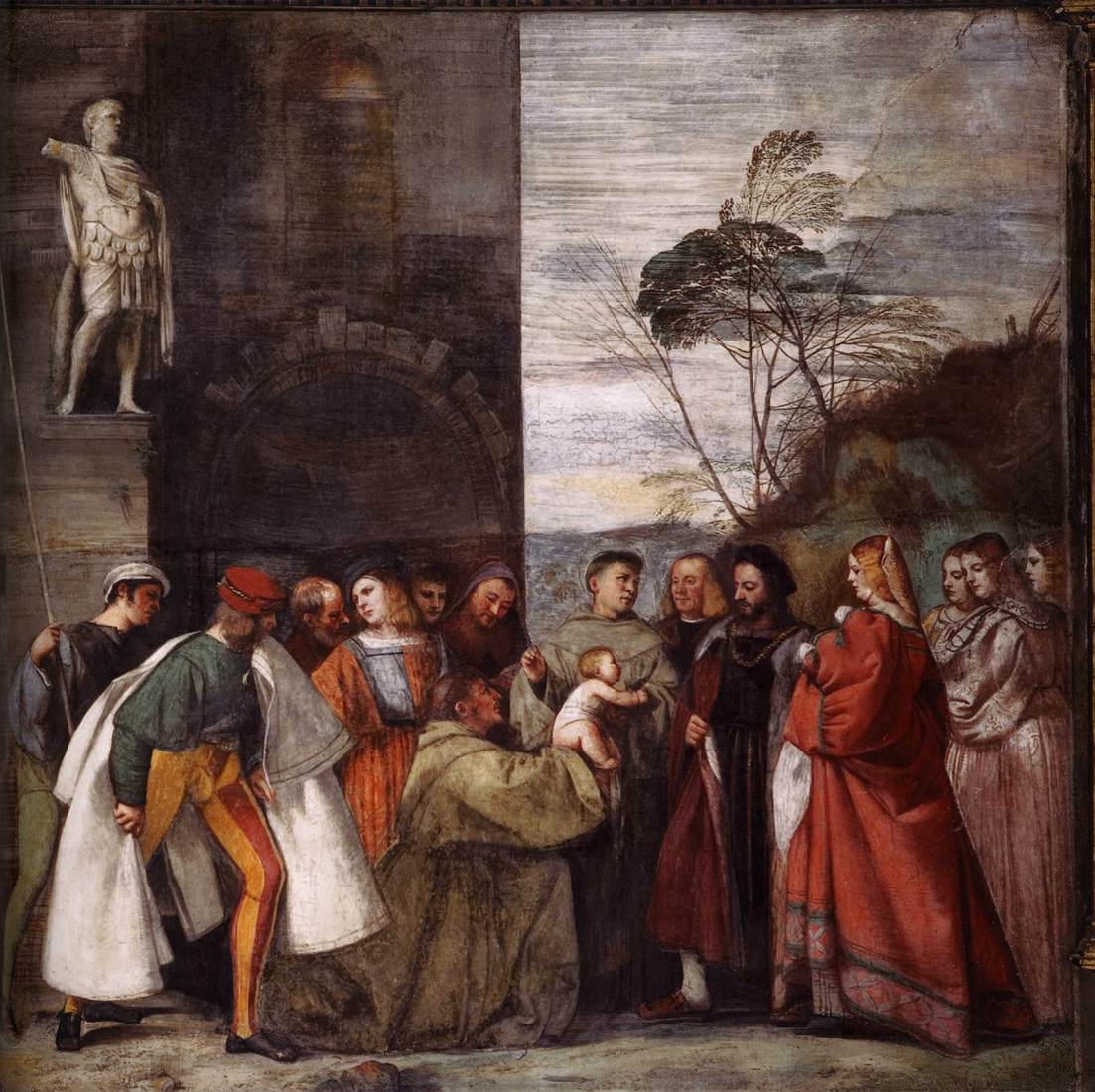
Titian
Miracle of the Newborn Child
1511
fresco
Scuola del Santo, Padua |
 |
Titian
Miracle of the Healed Foot
1511
fresco
Scuola del Santo, Padua |
 |
Titian
Miracle of the Jealous Husband
1511
fresco
Scuola del Santo, Padua |
"The breadth of form and of conception that are in the
Pastorale, and which indicate emergence to maturity, are also in the three frescoes Titian contributed to the decoration of the Scuola del Santo in Padua (1511), and their handling is still more confident – this, too, an indication of maturity. But in an important sense the Padua frescoes regress from the accomplishment of the
Pastorale. These barely face the problem of a complex pictorial order that, in the
Pastorale, Titian had so brilliantly solved. There is some comprehensive geometric structure, but the necessity to make narrative seems to recall Titian to the only tradition for it that he knew, the
teleri of the late Quattrocento. The composition of two of the Scuola frescoes shows an accent like theirs, somewhat additive, or even merely accumulative. The discipline they do have recollects, still more than Sebastiano's barely earlier Crisostomo altar, the older mode of order of Bellini. The third fresco, the
Jealous Husband, refers backward in a very different way, to Titian's own early departure from Bellini, and to his research towards an energy of action that verges in impulsiveness and force on a baroque. In all three frescoes Titian looks beyond the recent episode of close dependence on Giorgione and links their style and ambition rather to the
Adulteress. In particular, the prescription he had come to there for effects of colour that are at once illusionistic and poetic is repeated here – with astonishing brilliance for the fresco medium; and it is as if this colourism, and the
tours de force of description that accompany it, were sufficient to Titian's purposes, without more complicated demonstrations of his machinery of art."
 |
Titian
St Mark enthroned with Saints
ca. 1511
oil on canvas
(altarpiece)
Basilica di Santa Maria della Salute, Venice |
 |
Titian
Gypsy Madonna
ca. 1511
oil on panel
Kunsthistorisches Museum, Vienna |
"The
St. Mark altar (Venice, S. Maria della Salute,
c. 1511) is closely related in style to the main fresco at the Santo, the
Miracle of the Newborn Child, but even more than there its order recalls the perspective-deduced aesthetic of the Quattrocento. Yet it has visibly been brought up to date: simple but efficient devices relate forms towards unity in pattern and make connexions in their disposition in space, and the very density of form suggests its unity. Decisively unlike the Quattrocento precedents (and more than in a partial model, Giorgione's Castelfranco altar) the conception of the picture begins with the substances it represents, not with the projection of their space. There is another bridge between two tastes – in effect Bellini's and Giorgione's – in the descriptive mode. Titian's force and degree of literalness in his description of the figures is like that in the Santo frescoes, and, as there, there is a visible concession to Giorgione's precedent of regularizing form. But there is no wish thereby to reshape appearance into ideality, as there had been in the moment of the
Pastorale. Appearance is reformed, just adequately, towards classical proportion, but mainly to increase its sensuous attractiveness, which is further magnified by effects of texture and by the sheer magnetism Titian makes with coloured light. His devices are at a measurably different level of development, disciplined and subject to exact control, but Titian's basic intentions for his art are not different from those of his first years. In the
Gypsy Madonna (Vienna, Kunsthistorisches Museum), which must be virtually identical in date with the
St Mark altar, the effect of sensuous existence Titian makes by his command of optical devices is of an extreme virtuosity. No picture before this attains a comparable sense of presences existing palpably within an atmosphere, reflecting coloured light but also absorbing it to saturation point, so that each pore of flesh or drapery makes texture. The proposition is not new in Titian, but its sophisticated, utterly authoritative execution is: to a new degree the optical illusion of existence is so powerfully intense that it transcends the existence it describes, and assumes the status of idea – of sheerly pictorial, aesthetic fact, more than it is the counterfeit of a fact of nature. This vibrant presence is affirmed, in the
Gypsy Madonna, of figures which, more evidently than in the
St Mark altar, depend in physical canon on the example of the late Giorgione, of harmonious fullness and slow gravity of form. A corresponding effect of charged, grave harmony is in the mood of persons and setting that the picture illustrates. With the difference that results from Titian's greater sensuousness, this mood – like that of the
Pastorale – deliberately perpetuates the temper of Giorgione."
 |
Titian
Noli me Tangere
1511-12
oil on canvas
National Gallery, London |
 |
Titian
Madonna and Child with St Anthony of Padua and St Roch
(Freedberg identifies St Anthony as St Francis)
ca. 1511
oil on canvas
Museo del Prado, Madrid |
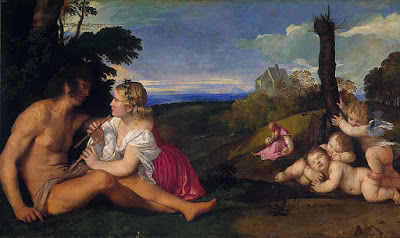 |
Titian
Three Ages of Man
ca. 1512-13
oil on canvas
Scottish National Gallery, Edinburgh |
"It is less likely that Titian is, now, referring back directly to Giorgione than that he is recalling his own translation of Giorgione in the
Pastorale. This appears to be the case in the
Noli me Tangere (London, National Gallery, 1511-12), where the motif of posture in the Christ and the principle of composition are deduced from the earlier picture. Despite the difference of subject the tenor of communication continues the poetic Giorgionismo of the
Pastorale, but the poetic temper is a little sharper, less immersed in the atmosphere of dream. This is occasioned by more than the requirements of subject: in general, in the
Noli me Tangere there is the evidence of the working of a more precise sensibility, articulated by a finer, still more virtuoso touch. The elements of awkwardness or of aggressive stress that had been frequent in Titian's juvenilia (and of which there is a trace even in the
Pastorale) are gone. Forms assume a more fluent grace, and the cursive action of the brush is so swift and exact as to suggest a sleight-of-hand. This is a further revision away from Giorgionesque example, but the affiliation is still eminently visible. It may be less so in the small
Madonna with St Roch and St Francis (Madrid, Prado,
c. 1511) [Freedberg identifies St Anthony of Padua as St Francis], for despite the variant in it of a Giorgionesque mood, the main meaning of the picture is its painterly experience of vision, as it was accessible only to Titian and demonstrable only by him at this time. As the forms of the
Noli me Tangere are the projections of a more refined sensibility, so are the behaviour of light and colour here and the subtlety and brilliance of their transcription. It is this latter aspect of the picture, not its Giorgionism, that is significant for the next few years to come in Titian's career. The subject matter of the
Three Ages of Man (Edinburgh, National Gallery, Ellesmere Loan,
c. 1512-13) still commands affiliation with Giorgione, or rather with Titian's personal precedent of a Giorgionism in the
Pastorale; but it is true in substance that the few pictures we discussed previously, and would date 1511 and early 1512, represent a brief and only partial renewal of dependence on Giorgione. What succeeds these is a series of works that reasserts Titian's distinction in vision and temperament from the older master. He seems almost to turn back across the intervening episodes of Giorgionismo to link up with his own accomplishment as it had been towards 1508 or 1509, about the time of the
Adulteress."
 |
Titian
Madonna with St John the Baptist and a Donor
ca. 1512
oil on panel, transferred to canvas
Scottish National Gallery, Edinburgh |
 |
Titian
Holy Family with a Shepherd
ca. 1512-13
oil on canvas
National Gallery, London |
 |
Titian
Madonna with St John the Baptist and a Donor
ca. 1513-14
oil on canvas
Alte Pinakothek, Munich |
 |
Titian
Madonna with Two Saints and a Donor
(Balbi Madonna with St Catherine and St Dominic)
ca. 1514-15
oil on canvas
Fondazione Magnani Rocca, near Parma |
 |
Titian
Madonna with St George and St Dorothy
(Freedberg identifies as St Ulfus and St Bridget)
ca. 1515
oil on panel
Museo del Prado, Madrid |
 |
Titian
Sacra Conversazione
ca. 1515-16
oil on panel
Gemäldegalerie Alte Meister, Dresden |
"Refinement of form and fluency of composition distinguish the
Madonna with St John the Baptist and a Donor (Edinburgh, National Gallery, Ellesmere Loan,
c. 1512) from similar themes by Titian of a few years earlier, but there is no doubt of the continuity of idea and essential concerns between them; and this is true also of the
Holy Family with a Shepherd (London, National Gallery,
c. 1512-13). Conspicuous among the continuities is a concern to exploit the brilliance of colours and reflected lights on draperies. In these pictures Titian reasserts a former tendency to descriptive literalism in the rendering of drapery and carries it much farther than before, apparently to give himself the opportunity to make virtuoso illusion, but even more to make a maximum of complex brilliance of reflected light. The look of literalness and the broken patterning of drapery intrude a note of archaism into conceptions that are otherwise advanced, and reinforce the link – almost always somewhere evident in young Titian – with the style of Bellini. In this respect these works seem somewhat regressive, and they are aberrant in Titian's evolution of these years, but only in the degree to which Titian has permitted himself for a brief while to confuse the aim of expression made by optical devices with the objective facts of optical experience."
"The tendency persists in the Madonna with Two Saints and a Donor (Genoa, Balbi Collection, c. 1514-15) [now Fondazione Magnani Rocca near Parma], where the Madonna serves almost as a lay figure on which to arrange a cascade of elaborately complicated drapery. The brilliance of her display is still more heightened by relief against a contrasting dark hanging behind the Madonna, recalling an earlier device of Titian's, as in the Gypsy Madonna. The archaistic accent of the drapery pattern is less than in the Ellesmere or the London pictures, but the emphasis on literal illusion remains very strong. This element of literalness is not quite reconciled with the grand artificiality of the Madonna's pose, or with the generous impulse of movement Titian instils into the composition, or the large clarity of balance among its forms. The Madonna with St Ulfus and St Bridget [Madonna with St George and St Dorothy] (Madrid, Prado, c. 1515) displays the same compulsion to make demonstration of illusionism with the draperies, but with an important change, which stems from the intention which had re-emerged in the Balbi Madonna and which is concerned with the inventive rather than the imitative means of art. Realizing that fine complexities of description cannot be reconciled with large effects of human presence and pictorial idea, Titian diminishes the former in the drapery style of the Ulfus Madonna, reducing the angular facetings that had given an accent of archaism. His patterning of drapery becomes again, much as it had been at an earlier time, more cursive, and this impulse of cursive patterning pervades the composition. The grand dimension of the Madonna of the Balbi picture is given now to all the figures, and they are drawn together to make a dense pictorial substance, interwoven by large movements of continuous rhythm. The sense of breadth and unity of form are new in Titian's career in the degree in which he achieves them here. By the time of the Sacra Conversazione in Dresden (Gallery, c. 1515-16) it is evident that he is close to a new stage of maturity in the evolution of a classical style in his Venetian terms. Effects of sheer illusion are still more diminished to become, in a deepened chiaroscuro, more evidently the poetic effects of the painter's art; and these are in a context of pictorial order that is concentrated and monumental, scanned by large rhythms, and of fluent ease."
– S.J. Freedberg, Painting in Italy 1500-1600 in the Pelican History of Art series (1970)