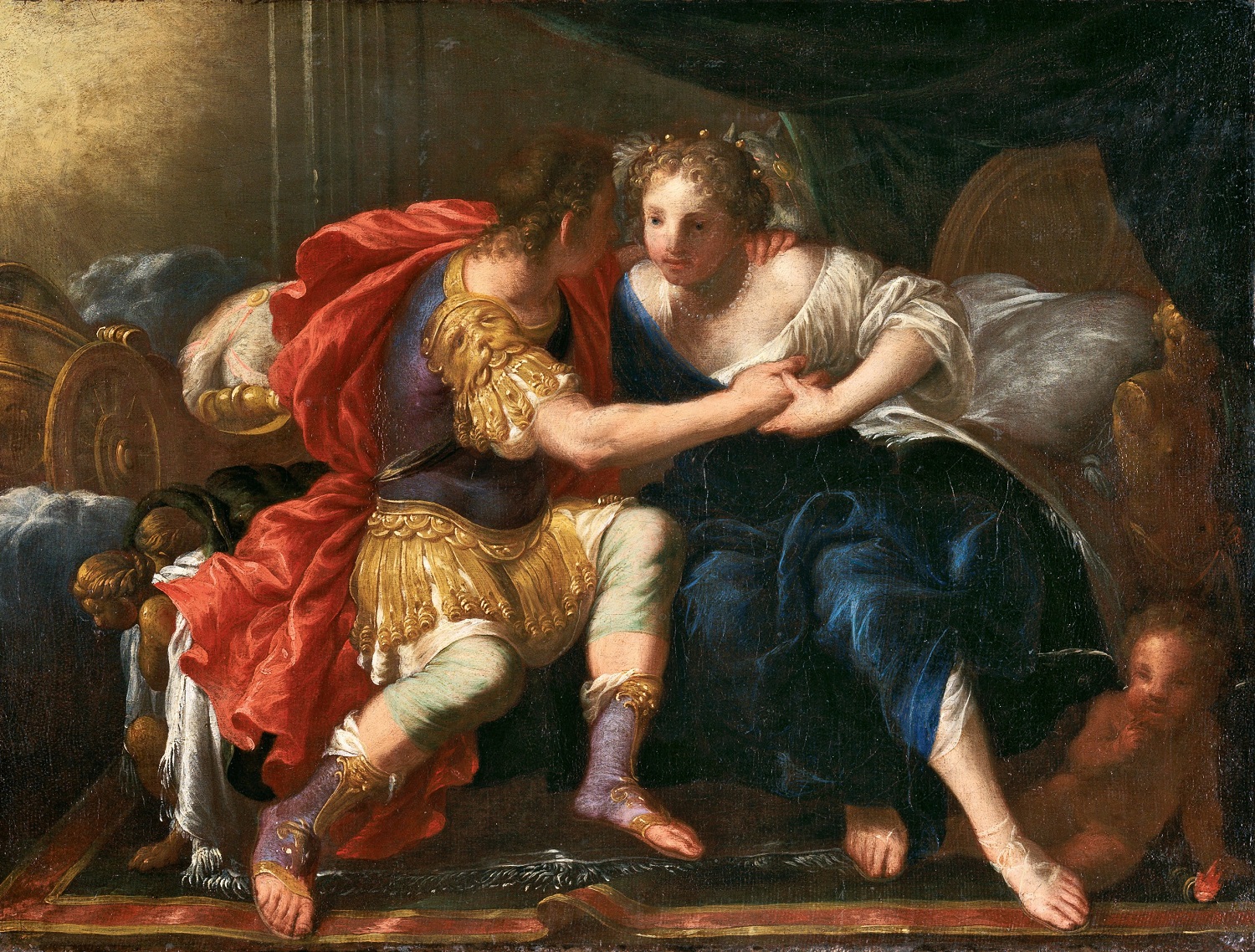
Showing posts with label fate. Show all posts

Saturday, September 14, 2024

Fate of Couples

Francesco Albani
Galatea
ca. 1632
oil on canvas
Gemäldegalerie Alte Meister, Dresden

Sebastian Stoskopff
Trompe l'oeil Print with Triumph of Galatea
1651
oil on canvas
Kunsthistorisches Museum, Vienna

Anonymous Italian Artist
Acis and Galatea fleeing Polyphemus
17th century
drawing
Graphische Sammlung Albertina, Vienna

Antoine-Jean Gros
Acis and Galatea
1833
oil on canvas
Chrysler Museum of Art, Norfolk, Virginia

Bartholomeus Spranger
Venus and Mars, with Mercury spying
ca. 1586-87
oil on canvas
Kunsthistorisches Museum, Vienna

Paolo Veronese
Mars and Venus
ca. 1575-80
oil on canvas
Galleria Sabauda, Turin

Hans Rottenhammer
Mars and Venus
1604
oil on copper
Rijksmuseum, Amsterdam

Hans Rottenhammer
Mars and Venus
1605
oil on copper
Deutsche Barockgalerie, Augsburg

Johann Heiss
Mars and Venus
ca. 1675-80
oil on canvas
Deutsche Barockgalerie, Augsburg

Nicolò dell' Abate
Cupid and Psyche
ca. 1550-70
oil on canvas
Detroit Institute of Arts

Jacopo Bertoia
Cupid and Psyche
ca. 1566-68
oil on plaster, transferred to canvas
Galleria Nazionale di Parma

Joseph Heintz the Elder
Cupid and Psyche
ca. 1605-1606
oil on copper
Deutsche Barockgalerie, Augsburg

Jacopo Zucchi
Cupid and Psyche
1589
oil on canvas
Galleria Borghese, Rome

Matthäus Gundelach
Cupid and Psyche
1613
oil on copper
Deutsche Barockgalerie, Augsburg

Ernest-Eugène Hiolle
Narcissus
1868
plaster
Palais des Beaux-Arts de Lille

Guy Head
Echo flying from Narcissus
ca. 1795-98
oil on canvas
Detroit Institute of Arts

Cuchulain Comforted

A man that had six mortal wounds, a man
Violent and famous, strode among the dead;
Eyes stared out of the branches and were gone.

Then certain Shrouds that muttered head to head
Came and were gone. He leant upon a tree
As though to meditate on wounds and blood.

A Shroud that seemed to have authority
Among those bird-like things came, and let fall
A bundle of linen. Shrouds by two and three

Came creeping up because the man was still.
And thereupon that linen-carrier said
'Your life can grow much sweeter if you will

'Obey our ancient rule and make a shroud;
Mainly because of what we only know
The rattle of those arms makes us afraid.

'We thread the needles' eyes and all we do
All must together do.' That done, the man
Took up the nearest and began to sew.

'Now we shall sing and sing the best we can
But first you must be told our character:
Convicted cowards all by kindred slain

'Or driven from home and left to die in fear.'
They sang, but had nor human notes nor words,
Though all was done in common as before,

They had changed their throats and had the throats of birds.

– W.B. Yeats (1939)

Friday, September 13, 2024

Fate of Adonis

David Teniers the Elder
Birth of Adonis
ca. 1600-1605
oil on copper
Städel Museum, Frankfurt

Carlo Cignani
Adonis
ca. 1658-65
oil on canvas
Galleria Sabauda, Turin

Josse de Pape
Venus and Adonis
1629
oil on canvas
Rijksmuseum, Amsterdam

Johann Heiss
Venus and Adonis
ca. 1675-80
oil on canvas
Deutsche Barockgalerie, Augsburg

Caspar Freisinger
Venus and Adonis
1589
drawing
Museum of Fine Arts, Budapest

Giulio Romano
Venus and Adonis
1516
drawing
(study for fresco)
Graphische Sammlung Albertina, Vienna

Hendrik Goltzius
Venus and Adonis
1614
oil on canvas
Alte Pinakothek, Munich

Luca Cambiaso
Venus and Adonis
ca. 1565-68
oil on canvas
Galleria Borghese, Rome

Hendrick de Clerck
Venus and Adonis
ca. 1600
oil on canvas
Chrysler Museum of Art, Norfolk, Virginia

Jan van Kessel the Elder
Venus and Adonis in Garland
1653
oil on panel
Staatsgalerie Flämische Barockmalerei
im Schloss Neuburg

Aegidius Sadeler
Venus and Adonis
ca. 1606-1610
oil on copper
Národní Galerie, Prague

Mattheus Terwesten
Venus and Adonis
ca. 1718
oil on canvas
Detroit Institute of Arts

Paolo Veronese after Titian
Venus and Adonis
ca. 1563-65
oil on canvas
Deutsche Barockgalerie, Augsburg

Benjamin West
Death of Adonis
1768
oil on canvas
Carnegie Museum of Art, Pittsburgh

Giulio Carpioni
Venus and Nymphs weeping for dead Adonis
ca. 1656-63
oil on canvas
Národní Galerie, Prague

Giulio Carpioni
Funeral of Adonis
ca. 1656-63
oil on canvas
Národní Galerie, Prague

St. Malachy

In November, in the days to remember the dead
When air smells cold as earth,
St. Malachy, who is very old, gets up,
Parts the thin curtain of trees and dawns upon our land.

His coat is filled with drops of rain, and he is bearded
With all the seas of Poseidon.
(Is it a crozier, or a trident in his hand?)
He weeps against the gothic window, and the empty cloister
Mourns like an ocean shell.

Two bells in the steeple
Talk faintly to the old stranger
And the tower considers his waters.
"I have been sent to see my festival," (his cavern speaks!)
"For I am the saint of the day.
Shall I shake the drops from my locks and stand in your transept,
Or, leaving you, rest in the silence of history?"

So the bells rang and we opened the antiphoners 
And the wrens and larks flew up out of the pages.
Our thoughts became lambs. Our hearts swam like seas.
One monk believed that we should sing to him
Some stone-age hymn
Or something in the giant language.
So we played to him in the plainsong of the giant Gregory
And oceans of Scripture sang upon bony Eire.

Then the last salvage of flowers
(Fostered under glass after the gardens foundered)
Held up their little lanterns on Malachy's altar
To peer into his wooden eyes before the Mass began.

Rain sighed down the sides of the stone church.
Storms sailed by all day in battle fleets.
At five o'clock, when we tried to see the sun, the speechless visitor
Sighed and arose and shook the humus from his feet
And with his trident stirred our trees
And left down-wood, shaking some drops upon the ground.

Thus copper flames fall, tongues of fire fall
The leaves in hundred fall upon his passing
While night sends down her dreadnought darkness
Upon this spurious Pentecost.

And the Melchisedec of our year's end
Who came without a parent, leaves without a trace,
And rain comes rattling down upon our forest
Like the doors of a country jail.

– Thomas Merton (1949)

Thursday, September 12, 2024

Fate of Troy

Girolamo Troppa
Homer
ca. 1665-68
oil on canvas
Statens Museum for Kunst, Copenhagen

Jean-Baptiste Frédéric Desmarais
Paris with the Golden Apple of Discord
1788
oil on canvas
National Gallery of Canada, Ottawa

Jacopo Bertoia
Abduction of Helen
ca. 1566-68
oil on plaster, transferred to canvas
Galleria Nazionale di Parma

Luca Giordano
Abduction of Helen
ca. 1680-83
oil on canvas
Musée des Beaux-Arts de Caen

Toussaint Gelton
Paris and Helen surprised by Menelaus
ca. 1670
oil on panel
Statens Museum for Kunst, Copenhagen

Bartolomeo Pinelli
Achilles swearing an Oath to avenge the dead Patroclus
1808
drawing
Yale University Art Gallery

Jacques Berger
Priam receiving the Greek Sinon
(announcing the gift of the Trojan Horse)
1782
oil on canvas
Galleria Nazionale di Parma

Pieter Matthias Goddyn
Priam receiving the Greek Sinon
(announcing the gift of the Trojan Horse)
1782
oil on canvas
Galleria Nazionale di Parma

Daniele da Volterra (Daniele Ricciarelli)
Aeneas with Ascanius fleeing Troy
ca. 1555-56
drawing
Graphische Sammlung Albertina, Vienna

Meissen Manufactory (Dresden)
Aeneas carrying Anchises out of Troy
ca. 1755-60
porcelain
Ashmolean Museum, Oxford

Bartolomeo Passarotti
Aeneas carrying Anchises out of Troy
ca. 1570
drawing
Princeton University Art Museum

Charles Errard
Aeneas carrying Anchises out of Troy
ca. 1645
oil on canvas
Musée des Beaux-Arts de Dijon

Johann Heinrich Schönfeld
Aeneas carrying Anchises out of Troy
ca. 1680
oil on canvas
Museum of Fine Arts, Budapest

Ugo da Carpi after Raphael
Aeneas carrying Anchises out of Troy
1518
chiaroscuro woodcut
Gabinetto dei Disegni e delle Stampe,
Gallerie degli Uffizi, Florence

Lorenzo Bartolini
 Death of Astyanax 
ca. 1841
drawing
(study for sculpture)
Morgan Library, New York

Jan Brueghel the Elder
The Burning of Troy
ca. 1597
oil on copper
Alte Pinakothek, Munich

from The Burning of Ilium

Look! on the high places of Ilium
I see burning firebrands
swung in men's hands.
Some new evil
is about to descend on Troy.

        Here this, you captains whose orders are to burn
        this town of Priam. In your hands
        hold back the fire no longer.
        Throw in the the torches. And having razed this city
        joyfully we'll go back home from Troy.

I go forth from my country, my city struck with flames.
Get up, old foot, and carry me along
that I may hail once more my stricken city.
Great Troy, whose very sound was once the breath of Asia,
your glorious name will soon be torn away.
You burn; already they are leading us as slaves
out of our land. O gods! But why do I call on the gods?
When I called on them before, they did not hear.

Ilium shines.
The fire burns in the chambers of Pergamus
and in the city and on the topmost parts of the walls.

And as smoke that fades on heaven's wing,
gashed by the spear, our country perishes.
Our roofbeams glow, wasted by blazing fire
and the devouring points of lances.
You, you that I bore, hear your mother's voice.
        Old woman, wail. It is the dead you call.

I set my old limbs on the ground
and loudly knock on the earth with both my hands.
I cry to the dead below,
unlucky husband.
Like a beast I am driven, like a chattel carried away
a slave under a strange roof out of my own land.
O husband, husband, lost, unburied, without a friend,
unconscious of my doom,
dark there in the dark,
for death has covered the eyes
of the holy that the unholy have slain.

– Ann Stanford, freely translated (1972) from The Trojan Women of Euripides (415 BC)