Showing posts with label orange. Show all posts

Friday, July 18, 2025

Orange Elements

Hilde Honerud
Gym #16
2021
inkjet print
KORO (Public Art Norway), Oslo

Edgar Degas
Le Bain
ca. 1895
oil on canvas
Carnegie Museum of Art, Pittsburgh

Hyacinthe Rigaud
Portrait of Suzanne de Boubers de Bernâtre,
wife of Balthasar Keller

1686
oil on canvas
Kunsthaus Zürich

Robert Skala
Still Life with Oranges
ca. 1920
oil on canvas
Belvedere Museum, Vienna

Robert Rauschenberg
Tree Frog
1964
screenprint and oil on canvas
Museum Ludwig, Cologne

Britt Juul
Untitled
1999
acrylic and oil on canvas
KORO (Public Art Norway), Oslo

Giorgio Glass
Vesuvius in Eruption
1805
gouache on black paper
Belvedere Museum, Vienna

Albrecht Dürer
The Virgin in Prayer
1518
oil on panel
Gemäldegalerie, Staatliche Museen zu Berlin

David Hopper
Artist's Model
1991
glass
National Gallery of Victoria, Melbourne

Barbara Hanrahan
Anatomical Study I
1966
color etching
Art Gallery of South Australia, Adelaide

Tor Hörlin
The Music Room
1942
oil on canvas
Göteborgs Konstmuseum, Sweden

Andy Warhol
Electric Chair
1967
screenprint and acrylic paint on canvas
Moderna Museet, Stockholm

Kerstin Abram-Nilsson
Scene from We (and They)
ca. 1965
color etching
Moderna Museet, Stockholm

Anthonie Schotel
Still Life with Oranges in a Bowl
ca. 1920
oil on canvas
Dordrechts Museum

Louis Rhead
Read The Sun
1894
lithograph (poster)
Kunstbibliothek, Staatliche Museen zu Berlin

Julius Klinger
Die Woche 
(film based on novel by Georg Engel)
1913
lithograph (poster)
Kunstbibliothek, Staatliche Museen zu Berlin

Kalasiris repeated to Charikleia all that the old woman had said, and together they moved away.  After stepping over the corpses for a short distance, they found a little hillock, and there Kalasiris stretched himself out, pillowing his head on the quiver, while Charikleia sat, using her pouch as a seat.  The moon had just risen and was bathing the whole scene in bright light, for it was the second night after the full moon.  Kalasiris, naturally enough for an old man, especially one fatigued by his travels, lay fast asleep, but the anxieties that beset Charikleia kept her awake; and thus she found herself witnessing a performance which, abominable as it may be, is common practice among the women of Egypt.

Supposing herself now secure against any intrusion or observation, the old woman began by digging a pit, to one side of which she lit a fire.  After positioning her son's body between the two, she took an earthenware bowl from a tripod that stood beside her and poured a libation of honey into the pit, likewise of milk from a second bowl, and lastly of wine from a third.*  Then she took a cake made out of fine wheat flour and shaped into the effigy of a man, crowned it with bay and fennel, and flung it into the pit.  Finally, she picked up a sword and, in an access of feverish ecstasy, invoked the moon by a series of grotesque and outlandish names, then drew the blade across her arm.  She wiped the blood onto a sprig of bay and flicked it into the fire.  There followed a number of other bizarre actions, after which she knelt over the dead body of her son and whispered certain incantations into his ear, until she woke the dead man, and compelled him by her magic arts to stand upright. 

*this scene is intended to recall the episode in the Odyssey (11:24) when Odysseus summons the spirits of the dead:
I, drawing from beside my thigh my sharp sword,
dug a pit, of about a cubit in each direction,
and poured it full of drink offering for all the dead, first
honey mixed with milk, and the second pouring was sweet wine,
and the third, water, and over it all I sprinkled white barley.

– Heliodorus, from The Aethiopica, or, Theagenes and Charikleia (3rd or 4th century AD), translated from Greek by J.R. Morgan (1989)

Saturday, March 28, 2020

Painted Surfaces (Yellow, Pink, Orange)

William Turnbull
No. 1, 1959
1958-59
oil on canvas
Tate Modern, London

Joe Tilson
Summer, 1959
1959
oil on board
Geffrye Museum, London

William Scott
Yellow Matrix
1962
oil on canvas
Fermanagh County Museum, Enniskillen Castle (Northern Ireland)

John Hoyland
18.06.69
1969
acrylic on cotton duck
Hunterian Art Gallery, University of Glasgow

Basil Beattie
Orange No. 1
1969
acrylic on canvas
Southbank Centre, London

I pray – in Satin Cash –
You did not state – your price –
A Petal, for a Paragraph
Is near as I can guess –

– Emily Dickinson (1863)

Jeremy Moon
Untitled 2/72
1972
acrylic on canvas
Tate Modern, London

John Hoyland
28.4.73
1973
acrylic on canvas
Government Art Collection, London

John Golding
D (C.S.) VI
1975
acrylic on canvas
Southbank Centre, London

Peter Joseph
Bright Orange with Green
1988
acrylic on canvas
Southbank Centre, London

David Leapman
Slowburn Escort
1992
acrylic on canvas
Southbank Centre, London

Graham Little
Untitled
ca. 1995
acrylic on canvas
University of Dundee (Scotland)

Maria Lalić
History Painting 35 - C18/19th - Cadmium Yellow
1995
oil on canvas
Tate Modern, London

Maria Lalić
History Painting 42 - C20th - Winsor Yellow
1995
oil on canvas
Tate Modern, London

Callum Innes
Exposed Painting, Cadmium Orange
1996
oil on canvas
Towner Art Gallery, Eastbourne, Sussex

Callum Innes
Exposed Painting, Cadmium Red Pale, Orange
2000
oil on canvas
Government Art Collection, London

Wednesday, March 4, 2020

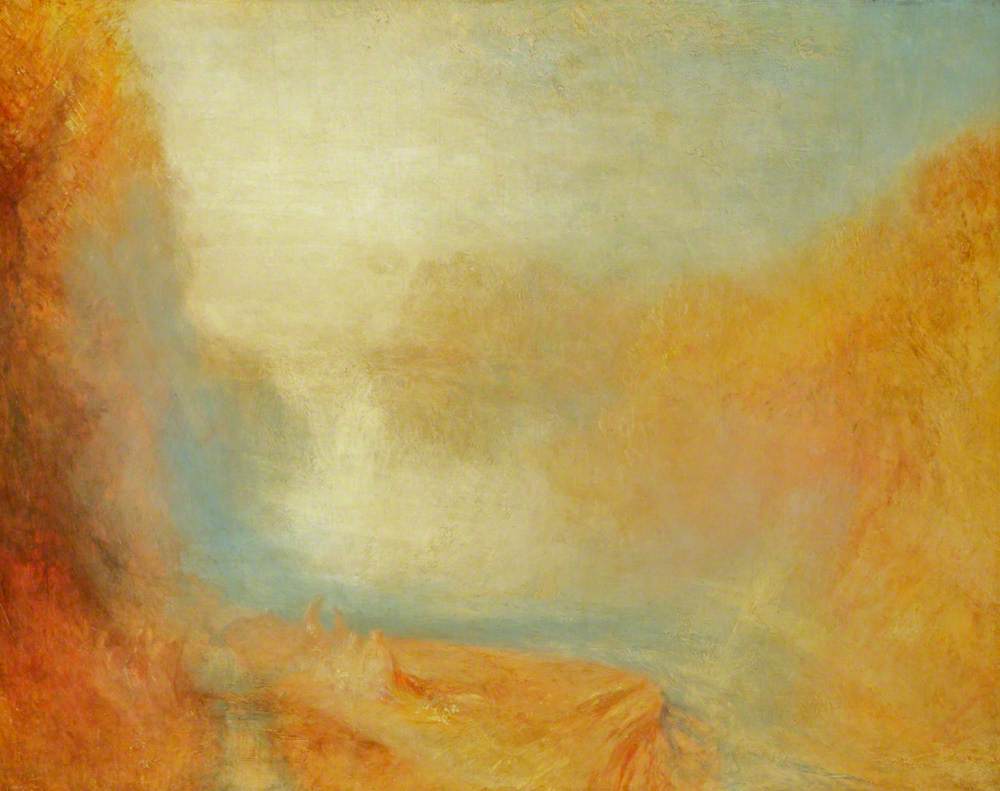
Painted Atmospherics - Predominantly Red and Orange

Joseph Mallord William Turner
The Falls of the Clyde
ca. 1845
oil on canvas
Lady Lever Art Gallery, Liverpool

William Etty
Académie
before 1849
oil on panel
Manchester Art Gallery

Howard Hodgkin
Silence
2004
oil on panel
Victoria Art Gallery, Bath

Henry Liverseege
The Conversation
(sketch for The Story of My Life)
before 1832
oil on panel
Manchester Art Gallery

William Gear
Red Feature
1966
gouache and oil pastel on paper
McManus Gallery, Dundee

Helen Frankenthaler
Saturn
1963
acrylic on canvas
Scottish National Gallery of Modern Art, Edinburgh

Light-years

It's a beautiful world, you said,
with these trees, marshes, deserts,
grasses, rivers and seas

and so on. And the moon is really something
in its circuits
of relative radiance. Include

the wingèd M, voluptuous
Venus, hotheaded Mars, that lucky devil
J and cranky Saturn, of course, plus

U and N and the wanderer P, in short
the whole solar family, complete with its
Milky Way, and count up all the other

systems with dots and spots and in
that endless emptiness what you've got
is a communion of you-know-what. It's a beautiful

universe, you said, just take a good look
through the desert's dark glasses
for instance or on your back

in seas of grass, take a good look
at the deluge of that Rorschach – we're standing out there
somewhere, together.

–  Hester Knibbe, translated by Jacquelyn Pope (2010)

Derek Jarman
Queer
1992
oil on canvas
Manchester Art Gallery

Graham Sutherland
Hanging Form over Water
1959
oil on canvas
Southampton City Art Gallery

follower of Joachim Patinir
Landscape with the Destruction of Sodom and Gomorrah
ca. 1510-30
oil on panel
Ashmolean Museum, Oxford

Patrick Procktor
Beneath the Surface
1964
oil on canvas
Museums Sheffield, Yorkshire

Robin Philipson
Fighting Horses
(study for altarpiece, Defenders of the Realm)
1965
oil and vinyl toluene on paper, mounted on board
Hunterian Art Gallery, University of Glasgow

Philip Scoular
Académie
1975
oil on board
Robert Gordon University, Aberdeen
 
Francis Bacon
Study of a Dog
1952
oil on canvas
Tate Modern, London

Edward Wadsworth
Composition on a Red Ground
1931
oil on panel
Leeds Art Gallery, Yorkshire

Ugolino di Nerio
Crucifixion with Donors
ca. 1317-27
tempera and gold leaf on panel
Courtauld Gallery, London

Saturday, August 19, 2017

Baxandall / O'Keeffe

Georgia O'Keeffe
From the Plains II
1954
oil on canvas
Museo Thyssen-Bornemisza, Madrid

"Any language, not only humanist Latin, is a conspiracy against experience in the sense of being a collective attempt to simplify and arrange experience into manageable parcels.  The language has a limited number of categories, grouping phenomena in its own way, and a very limited number of conventions for setting these categories in relation to each other.  So as to communicate with other people we keep more or less to the rules; we contract to call this section of the spectrum orange and that other section yellow, and to use these categories only in certain acceptable relationships, such as nominal and adjectival, to others.  In our normal speech we struggle to compromise between the complexity and variety of experience on the one hand, and the relatively limited, regular, and simple system of our language on the other.  Because a degree of regularity and simplicity is necessary if we are to be understood, and because also the language itself has been deeply involved in our acquiring ways of discriminating at all, the system of the language is always pressing us to conform with it.  Yet, from the other side, we continually resist the formal pressure of this system by testing it against experience.  So that our speech may keep a usefully close relation to experience we insist on irregularities and awkwardness, resist the system's pull toward simplicity, force modifications and qualifications on its categories, rebuff its invitations to tidiness and pattern."

 Michael Baxandall, from Giotto and the Orators: Humanist observers of painting in Italy and the discovery of pictorial composition, 1350-1450 (Oxford: Clarendon Press, 1971)

Georgia O'Keeffe
Abstraction Blind I
1921
oil on canvas
Museo Thyssen-Bornemisza, Madrid

Georgia O'Keeffe
Shell and Old Shingle V
1926
oil on canvas
Museo Thyssen-Bornemisza, Madrid

Georgia O'Keeffe
New York Street with Moon
1925
oil on canvas
Museo Thyssen-Bornemisza, Madrid

Georgia O'Keeffe
White Iris no. 7
1957
oil on canvas
Museo Thyssen-Bornemisza, Madrid

More from Michael Baxandall on the conflict between language and experience 

"Art criticism, making remarks about paintings, is usually epideictic rhetoric: that is, it discusses art in terms of value, praise or dispraise, and demonstrates the speaker's skill.  Its language is florid, not grand or plain.  One man disposes pigments on a ground, and another man seeing this tries to match words with the interest of the thing.  To do this much beyond the point of saying 'good' or 'bad' is difficult and eccentric, and does not often happen except in a culture which, like neo-classical cultures, sets this activity up as an institution and rewards it, as the phrase is, with approval.  It therefore very quickly develops a style and a domestic history within which the critic is expected to exercise his skill.  But terms used of the interest of painting tend not to be sharply delimited or readily checked against experience: 'beauty' is a less verifiable category than 'wealth'.  Further, there are in any case not many terms specific or proper to the interest of paintings, and above the level of 'big', 'smooth', 'yellow', 'square' our discourse must quickly become oblique.  In the case of representational arts like Renaissance painting, one can cheat by talking about the represented things as if they were real; one can also talk about how real or not they seem, though this only has a limited usefulness."

"Other approaches have to be found: we may characterize the quality of the painting by comparing it with something else, either by straight comparison or more commonly by metaphor, transferring to painting a word that has been defined by use in some other area; or we may characterize quality by imputing to it causes or effects: we may refer to the process or intention we suppose went to produce it, or to the response we claim it stimulated in us.  These are only the simplest of the linguistic tricks a critic must use.  At any time very little is said about paintings in direct descriptive terms.  It is a sort of linguistic activity specially exposed to pressure from the forms of the language in which the remarks are made."

"The ascendancy of language over experience inevitable in any critical discourse was compounded by the humanists' attitude to language in general.  We have seen that humanists shared a preoccupation with imitating the structures of classical Latin prose, itself a very elaborately patterned language; they were sufficiently linguistic determinists themselves to believe they must yield to the forms of the classical language before they could enter into the true classical consciousness and culture.  So, for more respectable reasons than one might think, the humanists were passive and compliant in their relationship to the forms of literary Latin; they let verba influence res to an extraordinary degree, and the forms of the Ciceronian period had an authority for them of a kind they could not have had for Cicero, however much better he did it.  The humanists decently disposed matter  matter naturally not in conflict with general experience  within the grand and delicately balanced forms of classical language; often, like Leonardo Bruni, they let themselves fill out the forms by generating inoffensive matter along classical lines from rather small kernels of sense.  Relatively little of their energy need be spent on brutalizing the beautiful patterns of language to make a workable fit with experience, relatively more could be spent on playing on these patterns correctly and stylishly, accurate et eleganter."