 |
Mervyn Herbert Nevil Story-Maskelyne
Charlton House, Malmesbury, Wiltshire
1856
salted paper print
Rijksmuseum, Amsterdam |
 |
Anonymous Photographer
Portrait of seated Man with Skull
1855
stereograph
Rijksmuseum, Amsterdam |
 |
William Edward Kilburn
Portrait of a Man
ca. 1852-55
daguerreotype
Rijksmuseum, Amsterdam |
 |
Claude-Marie Ferrier & Friedrich von Martens
Glass Fountain by Follett Osler in the Crystal Palace
at the Great Exhibition of 1851, London
1851
salted paper print
Rijksmuseum, Amsterdam |
 |
Claude-Marie Ferrier & Friedrich von Martens
Doors decorated with malachite
at the Great Exhibition of 1851, London
1851
salted paper print
Rijksmuseum, Amsterdam |
 |
Claude-Marie Ferrier & Friedrich von Martens
Pedestal carved by Friedrich Drake for King Frederick William III of Prussia
at the Great Exhibition of 1851, London
1851
salted paper print
Rijksmuseum, Amsterdam |
 |
Claude-Marie Ferrier & Friedrich von Martens
Repoussé Vase in Silver by Antoine Vechte for Hunt & Roskill
at the Great Exhibition of 1851, London
1851
salted paper print
Rijksmuseum, Amsterdam |
 |
Claude-Marie Ferrier & Friedrich von Martens
Sculpture of Hunter with Dog by John Gibson
at the Great Exhibition of 1851, London
1851
salted paper print
Rijksmuseum, Amsterdam |
 |
Claude-Marie Ferrier & Friedrich von Martens
Sculptures of Nymph and Hunter by Edward Hodges Baily
at the Great Exhibition of 1851, London
1851
salted paper print
Rijksmuseum, Amsterdam |
 |
Claude-Marie Ferrier & Friedrich von Martens
Sculpture of Youth on Riverbank by Henry Foley
at the Great Exhibition of 1851, London
1851
salted paper print
Rijksmuseum, Amsterdam |
 |
attributed to Hugh Owen
Sèvres Porcelain
at the Great Exhibition of 1851, London
1851
salted paper print
Rijksmuseum, Amsterdam |
1851: A Message to Denmark Hill
The writer is John Ruskin, on his wedding journey in Venice
My dearest father, it is the year's First Day
Yet so like the Last, in Venice, no one
Could tell this birth from the lees.
I know it is some while
Since you received a word of mine: there has been
The shabbiest sort of interruption
To our exchanges (to mine
At least) in the shape
Of a fever – nights of those imaginings,
Strange but shameful too, of the Infinite
By way of bedcovers and
Boa constrictors,
With cold wedges of ice, as I thought, laid down
At the corners of the bed, making me
Slip to its coiling center
Where I could not breathe.
You knew from my last, I think, I had again
Gone to the Zoological Gardens
And seen the great boa take
Rabbits, which gave me
An idea or two, and a headache. Then
I had too much wine that same night, & dreamed
Of a walk with Nurse, to whom
I showed a lovely
Snake I promised her was an innocent one:
It had a slender neck with a green ring
Round it, and I made her feel
The scales. When she bade
Me feel them too, it turned into a fat thing, like
A leech, and adhered to my hand, so that
I could scarcely pull it off –
And I awakened
(So much, father, for my serpentine fancies)
To a vermillion dawn, fever fallen,
And the sea horizon dark,
Sharp and blue, and far
Beyond it, faint with the trebled distance, came on
The red vertical cliffs in a tremor
Of light I could not see without
Recalling Turner
Who had taught me to see it, yet the whole
Subdued to one soft gray. And that morning
I had your letter, father,
Telling of the death
Of my earthly master. How much more I feel
This now (perhaps it is worth noting here
The appearance of my first
Gray hair, this morning)
– More than I thought I should: everything
In the sun, in the sky speaks of him,
So mourns their Great Witness lost.
Today, the weather
Is wretched, cold and rainy, dark like England
At this season. I do begin to lose
All faith in these provinces.
Even the people
Look to me ugly, except children from eight
To fourteen, who here as in Italy
Anywhere are glorious:
So playful and bright
In expression, so beautiful in feature,
So dark in eye and soft in hair – creatures
Quite unrivalled. At fifteen
They degenerate
Into malignant vagabonds, or sensual
Lumps of lounging fat. And this latter-day
Venice, father! where by night
The black gondolas
Are just traceable beside one, as if Cadmus
Had sown the wrong teeth and grown dragons, not
Men. The Grand Canal, this month,
Is all hung, from end
To end, with carpets and tapestries like a street
Of old-clothes warehouses. And now there is
Even talk of taking down,
Soon, Tintoretto's
Paradise to "restore" it. Father, without
The Turner Gallery, I do believe
I should go today and live
In a cave on some
Cliffside – among crows. Oh what fools they are, this
Restoring pack, yet smoothing all manner
Of rottenness up with words.
My Turner would not
Phrase like these, and only once in all the years
I knew him said, "Thank you, Mr. Ruskin."
My own power, if it be that,
Would be lost by mere
Fine Writing. You know I promised no Romance –
I promised them Stones. Not even bread.
Father, I do not feel any
Romance in Venice!
Here is no "abiding city," here is but
A heap of ruins trodden underfoot
By such men as Ezekiel
Angrily describes,
Here are lonely and stagnant canals, bordered
For the most part by blank walls of gardens
(Now waste ground) or by patches
Of mud, with decayed
Black gondolas lying keel-upmost, sinking
Gradually into the putrid soil.
To give Turner's joy of this
Place would not take ten
Days of study, father, or of residence:
It is more than joy that must be the great
Fact I would teach. I am not sure,
Even, that joy is
A fact. I am certain only of the strong
Instinct in me (I cannot reason this)
To draw, delimit the things
I love – oh not for
Reputation or the good of others or
My own advantage, but a sort of need,
Like that for water and food.
I should like to draw
All Saint Mark's, stone by stone, and all this city,
Oppressive and choked with slime as it is
(Effie of course declares, each
Day, that we must leave:
A woman cannot help having no heart, but
That is hardly a reason she should have
No manners), yes, to eat it
All into my mind –
Touch by touch. I have been reading
Paradise
Regained lately, father. It seems to me
A parallel to Turner's
Last pictures – the mind
Failing altogether, yet with intervals
And such returns of power! "Thereupon
Satan, bowing low his gray
Dissimulation,
Disappeared." Now he is gone,
my dark angel,
And I never had such a conception
Of the way I must mourn – not
What I lose, now, but
What I
have lost, until now. Yet there is more
Pain knowing that I must forget it all,
That in a year I shall have
No more
awareness
Of his loss than of that fair landscape I saw,
Waking, the morning your letter arrived,
No more left about me than
A fading pigment.
All the present glory, like the present pain,
Is no use to me; it hurts me rather
From my fear of leaving it,
Of losing it, yet
I know that were I to stay here, it would soon
Cease being glory to me – that it
has
Ceased, already to produce
The impression and
The delight. I can bear only the first days
At a place, when all the dread of losing
Is lost in the delirium
Of its possession.
I daresay love is very well when it does not
Mean
leaving behind, as it does always,
Somehow, with me. I have not
The heart for more now,
Father, though I thank you and Mother for all
The comfort of your words. They bring me,
With
his loss, to what I said
Once, the lines on this
Place you will know: "The shore lies naked under
The night, pathless, comfortless and infirm
In dark languor, still except
Where salt runlets plash
Into tideless pools, or seabirds flit from their
Margins with a questioning cry." The light
Is gone from the waters with
My fallen angel,
Gone now as all must go.
Your loving son,
JOHN
– by Richard Howard, originally published (1969) in
Untitled Subjects, a book that went on to win the Pulitzer Prize for Poetry in 1970
 |
Francis Frith
Pyramids at Giza
ca. 1856-60
albumen print
Rijksmuseum, Amsterdam |
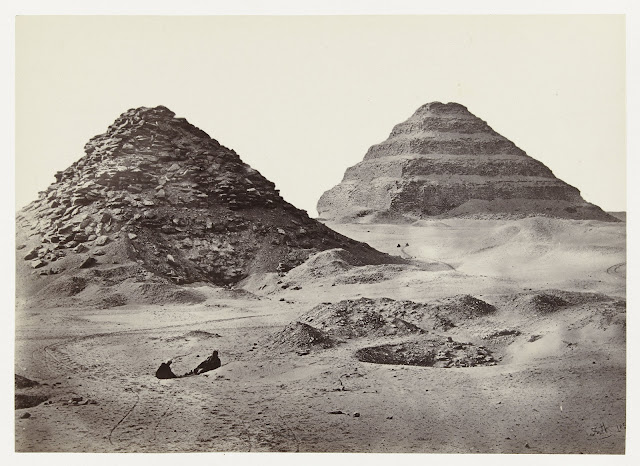 |
Francis Frith
Pyramids at Sakkara
ca. 1856-60
albumen print
Rijksmuseum, Amsterdam |
 |
Francis Frith
Pyramid of Amenemhat at Dashur
ca. 1856-57
albumen print
Rijksmuseum, Amsterdam |


