Showing posts with label palaces. Show all posts

Thursday, May 26, 2022

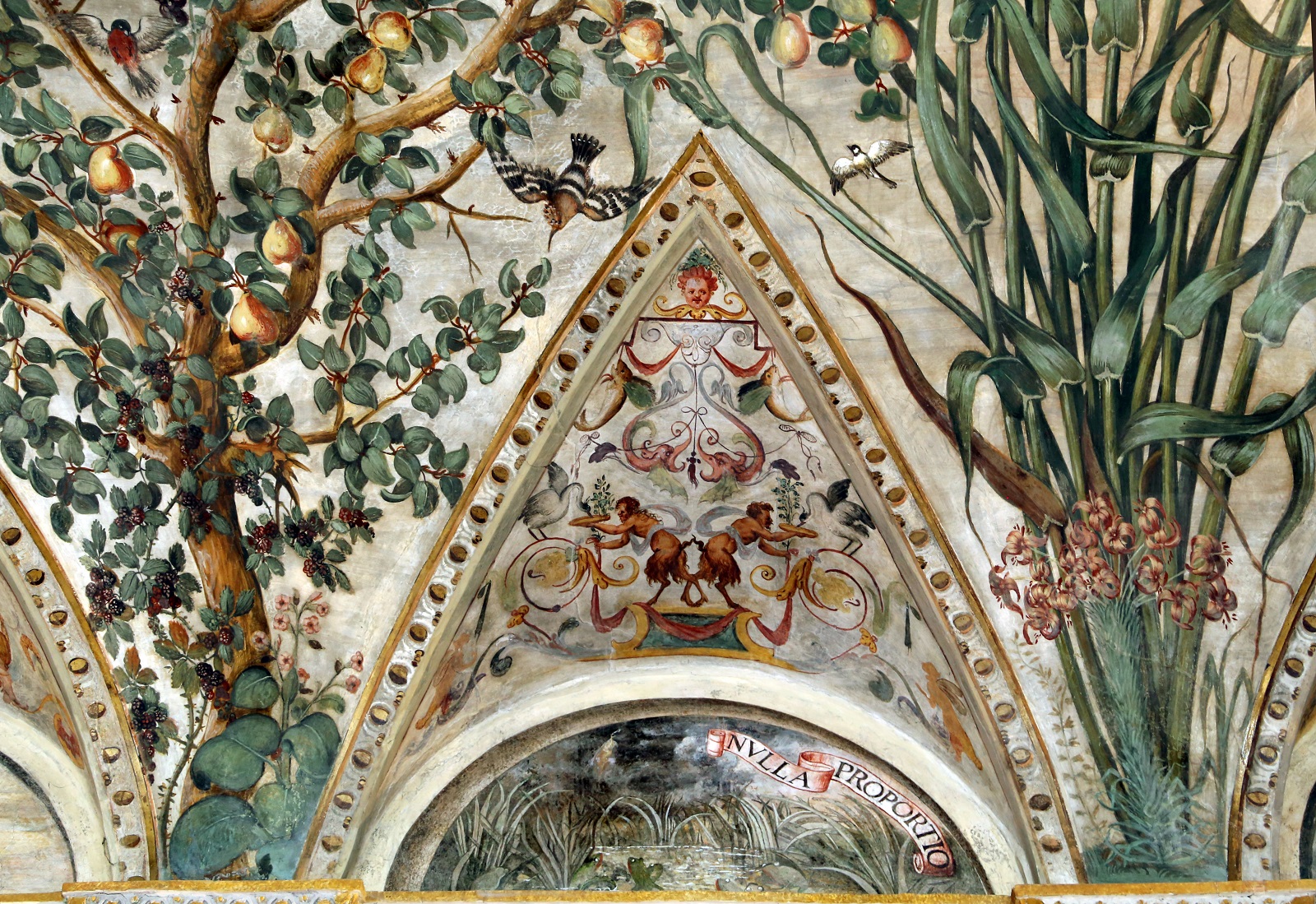
Camillo di Capelli, called Camillo Mantovano (died 1568)

Camillo di Capelli (Camillo Mantovano)
Decorative Foliage and Birds
ca. 1560-65
ceiling fresco
Sala a Fogliami, Palazzo Grimani, Venice

Camillo di Capelli (Camillo Mantovano)
Decorative Foliage and Birds
ca. 1560-65
ceiling fresco
Sala a Fogliami, Palazzo Grimani, Venice

Camillo di Capelli (Camillo Mantovano)
Decorative Foliage and Birds
ca. 1560-65
ceiling fresco
Sala a Fogliami, Palazzo Grimani, Venice

Camillo di Capelli (Camillo Mantovano)
Decorative Foliage and Birds
ca. 1560-65
ceiling fresco
Sala a Fogliami, Palazzo Grimani, Venice

Camillo di Capelli (Camillo Mantovano)
Decorative Foliage and Birds
ca. 1560-65
ceiling fresco
Sala a Fogliami, Palazzo Grimani, Venice

Camillo di Capelli (Camillo Mantovano)
Decorative Foliage and Birds
ca. 1560-65
ceiling fresco
Sala a Fogliami, Palazzo Grimani, Venice

Camillo di Capelli (Camillo Mantovano)
Decorative Foliage and Birds
ca. 1560-65
ceiling fresco
Sala a Fogliami, Palazzo Grimani, Venice

Camillo di Capelli (Camillo Mantovano)
Decorative Foliage and Birds
ca. 1560-65
ceiling fresco
Sala a Fogliami, Palazzo Grimani, Venice

Camillo di Capelli (Camillo Mantovano)
Decorative Foliage and Birds
ca. 1560-65
ceiling fresco
Sala a Fogliami, Palazzo Grimani, Venice

Camillo di Capelli (Camillo Mantovano)
Decorative Foliage and Birds
ca. 1560-65
ceiling fresco
Sala a Fogliami, Palazzo Grimani, Venice

Camillo di Capelli (Camillo Mantovano)
Decorative Foliage and Birds
ca. 1560-65
ceiling fresco
Sala a Fogliami, Palazzo Grimani, Venice

Camillo di Capelli (Camillo Mantovano)
Decorative Foliage and Birds
ca. 1560-65
ceiling fresco
Sala a Fogliami, Palazzo Grimani, Venice

Camillo di Capelli (Camillo Mantovano)
Decorative Foliage and Birds
ca. 1560-65
ceiling fresco
Sala a Fogliami, Palazzo Grimani, Venice

Camillo di Capelli (Camillo Mantovano)
Decorative Foliage and Birds
ca. 1560-65
ceiling fresco
Sala a Fogliami, Palazzo Grimani, Venice

Camillo di Capelli (Camillo Mantovano)
Decorative Foliage and Birds
ca. 1560-65
ceiling fresco
Sala a Fogliami, Palazzo Grimani, Venice

"The Duke [Francesco Maria, Duke of Urbino] having then returned to his state, Girolamo [Genga] also returned, and was retained by him and employed as architect in restoring an old palace on the Monte dell'Imperiale, above Pesaro, and adding to it another tower.  That palace was adorned with scenes in painting from the actions of the Duke, after the directions and designs of Girolamo, by Francesco da Forlì and Raffaello dal Borgo, painters of good repute, and by Camillo Mantovano, a very rare master in painting landscapes and verdure."  

– from Lives of the Painters, Sculptors and Architects by Giorgio Vasari (1568), translated by Gaston du C. de Vere (1912)

Thursday, December 21, 2017

Watercolor Interiors by James Stephanoff (1784-1874)

James Stephanoff
Buckingham House - The Staircase
1818
watercolor
Royal Collection, Windsor

James Stephanoff
Buckingham House - The Saloon
1818
watercolor
Royal Collection, Windsor

"The Saloon was the largest room in Buckingham House and occupied the first and second floor in the centre of the entrance front of the house, immediately above the Entrance Hall.  George III's works in the late 1760s may have involved a complete reconstruction of this room: as shown in this view, it is the work of a combination of King's Architects – Robert Adam, William Chambers, John Yenn and probably also James K. 'Athenian' Stuart.  The room was evidently in a fit state to receive the seven vast Raphael Cartoons from Hampton Court in 1763.  They were described in the Saloon by Horace Walpole in 1783, hanging edge to edge on all except the window wall, with 'light green Damask' below.  Cipriani's finely detailed ceiling, possibly designed by James Stuart, was presumably in place by 1763; it replaced one painted by Laguerre.  The chimneypiece on the north wall was designed by Robert Adam; it was included in his Works in Architecture with the date 1761.  Adam's design for a massive doorway, flanked by Ionic columns, may have been intended for the opening on the left leading to the Crimson Drawing Room.  After the Raphael Cartoons were removed in 1787 (to be taken first to Windsor, then back to Hampton Court), the walls of the Saloon were decorated in the manner shown here.  Elevations for the new decorative scheme were supplied by John Yenn.  Stephanoff's view also records the furnishings supplied in 1799 by the carver and gilder William Adair: six large sofas and three small ones (for the window bays).  These were originally covered with white cotton velvet, painted with flowers by Princess Elizabeth.  Further changes were made after the fire at St. James's Palace in 1809, the declaration of the Regency in 1811 and Parliament's decision in 1812 to grant Queen Charlotte her own establishment, including income for the upkeep of Buckingham House.  A number of formal receptions previously held at St. James's were now transferred to Buckingham House, hence the presence of the fine canopied throne in the Saloon.  New upholstery (in red) was introduced at the same time.  The site of George III's Saloon is now occupied by Nash's Green Drawing Room." 

James Stephanoff
Buckingham House - Crimson Drawing-room, with paintings by van Dyck, Rubens, and Domenichino
1817
watercolor
Royal Collection, Windsor

James Stephanoff
Buckingham House - Second Drawing-room, with paintings by van Dyck, del Sarto, Maratta, and Cagnacci
1818
watercolor
Royal Collection, Windsor

James Stephanoff
Buckingham House - Queen's Breakfast-room, with black-and-gold painted paneling
1817
watercolor
Royal Collection, Windsor

James Stephanoff
Buckingham House - The Octagon Library
1818
watercolor
Royal Collection, Windsor

"This view of one of the King's four library rooms shows the fine octagonal room added to the southern end of the original building soon after the arrival of Consul Smith's books in London in 1763.  After the Great (or West) Library of 1762-64 came the South and the Octagon Libraries in 1766-67, and finally the East Library in 1772-73.  . . .  The principal access to the library rooms at the ground-floor level was via a door from the King's bedroom, which led immediately into the Great Library.  A staircase in the heart of this wing allowed access by staff and visitors from the basement floor, which contained the offices and rooms for the bookbinders.  George III was keen to ensure that his library was as comprehensive as possible and scholars were encouraged to use it.  An early visitor was Mrs. Philip Lybbe Powys who in March 1767 described the three library rooms then extant.  Samuel Johnson's famous interview with George III took place in these room in the same year.  In the Octagon Library, which was 42 feet wide, books filled all the available shelf space.  The arrangement of the books is largely undocumented.  In this view the shelves between the door and the chimneypiece appear to have the added protection of cupboard doors, which may have been glazed; the remaining books were apparently on open shelves.  The octagonal desk in the centre of the room was supplied for this position, probably by Bradburn, and survives – in altered form – in the Royal Library at Windsor Castle."

– descriptions of the Octagon Library and the Saloon from an exhibition catalogue issued by the Royal Collection in 2004: George III & Queen Charlotte : Patronage, Collecting and Court Taste

James Stephanoff
Buckingham House - The East Library
1817
watercolor
Royal Collection, Windsor

James Stephanoff
Kensington Palace - Queen Mary's Drawing-room, with portraits of Admirals after Godfrey Kneller
1817
watercolor
Royal Collection, Windsor

James Stephanoff
Kensington Palace - Queen's Gallery, with royal portraits
1819
watercolor
Royal Collection, Windsor

James Stephanoff
Hampton Court Palace - Gallery for Raphael's cartoons
1818
watercolor
Royal Collection, Windsor

James Stephanoff
Fanciful arrangement of British Museum antiquities, including many of the Elgin Marbles
1819
watercolor
British Museum

James Stephanoff
The Virtuoso - idealized gallery setting for selected antiquities from the British Museum
1833
watercolor
British Museum

"When this drawing was exhibited at the Old Water-colour Society in 1833 it was titled, The Virtuoso, with the description: 'the surrounding antiquities are a selection from the Elgin Marbles, the Hamilton Vase, and the Mosaic pavements in the British Museum; on the walls are the metopes, representing the battle of the Centaurs and Lipithae; underneath is the celebrated frieze; on the left of the picture is the mutilated group of the Fates; opposite to which are the remains of the statues of Ceres and Proserpine; and on the table stands the marble bust of Pericles, under whose direction the Parthenon was erected.'  The room is very loosely based on the temporary Elgin gallery in the British Museum."

James Stephanoff
Imaginary arrangement of the Xanthos Marbles, acquired by the British Museum in 1842
1843
watercolor
British Museum

James Stephanoff
The Connoisseur - an idealized, imaginary, domestic setting for antiquities from the British Museum
ca. 1817
wash drawing
British Museum

James Stephanoff
Imaginary assemblage of antiquities, mainly from collections at the British Museum
1845
watercolor
British Museum

"The following caption accompanied this watercolour when it was exhibited at the Old Water-colour Society in 1845: 'At the base of the picture are specimens of Hindu and Javanese sculpture, and on either side are the colossal figures and bas-reliefs from Copan and Palenque; those above them are from Persepolis and Babylon, followed by the Egyptian, Etruscan, and early Greek remains, and surmounted by the pediment from Aegina; bas-reliefs and fragments from Xanthus and Phygalia; the Theseus, Ceres and Latona, the Fates, and other figures from the Parthenon; and terminating in a portion of the equestrian bas-reliefs of the Panathenaic procession in the Temple of Minerva.'  The watercolor received the following mention in the contemporary press: 'It is well executed, and arranged with great ability, but we confess that we value it more for its curiosity as a work of comparison and reference than we do artistically.' 

– from curator's notes at the British Museum

Wednesday, December 13, 2017

Palace Interiors at Fontainebleau

Frederick Marschall
Tapestry Room - wall detail
Palace of Fontainebleau
ca. 1885
watercolor
Cooper Hewitt, Smithsonian Design Museum

Frederick Marschall
Tapestry Room - wall detail with Flemish tapestry
Palace of Fontainebleau
ca. 1885
watercolor
Cooper Hewitt, Smithsonian Design Museum

Frederick Marschall
Music Room - wall detail
Palace of Fontainebleau
ca. 1885
watercolor
Cooper Hewitt, Smithsonian Design Museum

"If the Romans (someone will say) did not devote themselves to this labor of translation, then by what means were they able so to enrich their language, indeed to make it almost the equal of Greek?  By imitating the best Greek authors, transforming themselves into them, devouring them, and, after having thoroughly digested them, converting them into blood, and nourishment, selecting, each according to his own nature and the topic he wished to choose, the best author, all of whose rarest and most exquisite strengths they diligently observed and, like shoots, grafted them, as I said earlier, and adapted them to their own language.  In doing this (I say) the Romans constructed all those fine writings we so ardently praise and admire, judging some to be the equal of the Greeks, preferring some as superior to them."

.   .   .

"Thus let him who would enrich his language devote himself to the imitation of the best Greek and Latin authors and aim, as at a sure target, the point of his stylus at all their greatest strengths.  For there is no doubt that the largest part of artfulness is encompassed in imitation, and just as it was most praiseworthy in the ancients to invent well, so is it most useful to imitate well, especially for those whose language is not yet very copious and rich.  But let him who would imitate understand that it is not an easy thing faithfully to follow the strengths of a good author and, as it were, transform oneself into him, seeing that Nature herself, even with things that appear most similar, has not managed to prevent their being distinguished by some mark and difference.  I say this because there are many in all languages who, without delving into the most hidden and inward parts of the author they have chose, adapt themselves only to what they see at first and, diverting themselves with the beauty of words, miss the force of things."

"And certainly, since it is no vice, but greatly praiseworthy, to borrow from a foreign language ideas and words and to claim them as one's own, so is it greatly to be blamed and is indeed odious to any reader of liberal character to see such imitation within the same language, like that of even some learned men who judge themselves to be among the best when they most resemble a HĂ©roĂ«t or a Marot.  I thus admonish you (O you who desire the growth of your language and wish to excel in it) not to imitate lightly, as someone recently said, its most famous authors, as the greater number of our French poets commonly do, a thing surely as reprehensible as it is worthless to our vulgar tongue, since it amounts to no more (O great generosity!) than to give it what it already has.  I wish our language were so rich in homegrown models that we had no need to have recourse to foreign ones.  But if Virgil and Cicero had been content to imitate those of their own language, what would the Latins have beyond Ennius or Lucretius, beyond Crassus or Anthony?"

– Joachim du Bellay (1522-1560), from The Defense and Enrichment of the French Language (1549), translated by Richard Helgerson (Philadelphia: University of Pennsylvania Press, 2006)

Frederick Marschall
Gallery of François I - wall detail
Palace of Fontainebleau
ca. 1885
watercolor
Cooper Hewitt, Smithsonian Design Museum

Frederick Marschall
Salon of Louis XIII - wall detail
Palace of Fontainebleau
ca. 1885
watercolor
Cooper Hewitt, Smithsonian Design Museum

 Frederick Marschall
Salon of Louis XIII - panel detail
Palace of Fontainebleau
ca. 1885
watercolor
Cooper Hewitt, Smithsonian Design Museum

Frederick Marschall
Salon of Louis XIV - wall detail
Palace of Fontainebleau
ca. 1885
watercolor
Cooper Hewitt, Smithsonian Design Museum

Frederick Marschall
Guard Room - wall detail
Palace of Fontainebleau
ca. 1885
watercolor
Cooper Hewitt, Smithsonian Design Museum

Frederick Marschall
Escalier de la Cour - wall detail
Palace of Fontainebleau
ca. 1885
watercolor
Cooper Hewitt, Smithsonian Design Museum

Frederick Marschall
Council Chamber of Louis XV - wall detail
Palace of Fontainebleau
ca. 1885
watercolor
Cooper Hewitt, Smithsonian Design Museum

Frederick Marschall
Painted Panel - Escutcheon surrounded by Cherubs
Palace of Fontainebleau
ca. 1885
watercolor
Cooper Hewitt, Smithsonian Design Museum

Frederick Marschall
Two Painted-Panels 
Palace of Fontainebleau
ca. 1885
watercolor
Cooper Hewitt, Smithsonian Design Museum

Frederick Marschall
Series of Painted Panels 
Palace of Fontainebleau
ca. 1885
watercolor
Cooper Hewitt, Smithsonian Design Museum

Frederick Marschall
Bed Alcove - wall detail
Palace of Fontainebleau
ca. 1885
watercolor
Cooper Hewitt, Smithsonian Design Museum

Frederick Marschall
Queen's Bedroom - wall detail
Palace of Fontainebleau
ca. 1885
watercolor
Cooper Hewitt, Smithsonian Design Museum

Frederick Marschall
Small Antechamber - wall detail
Palace of Fontainebleau
ca. 1885
watercolor
Cooper Hewitt, Smithsonian Design Museum

Frederick Marschall
Bedroom of Marie Antoinette - wall detail
Palace of Fontainebleau
ca. 1885
watercolor
Cooper Hewitt, Smithsonian Design Museum

Frederick Marschall
Bedroom of Marie Antoinette - painted door panel 
Palace of Fontainebleau
ca. 1885
watercolor
Cooper Hewitt, Smithsonian Design Museum

Frederick Marschall
Chinese Room - wall detail
Palace of Fontainebleau
ca. 1885
watercolor
Cooper Hewitt, Smithsonian Design Museum