Showing posts with label Counter-Reformation. Show all posts

Friday, May 31, 2019

Luca Cambiaso (1527-1585) - Easel Paintings

Luca Cambiaso
Virgin and Child with Donor and Angels in Lunette
(upper section of altarpiece with St Erasmus, St Roch and St Sebastian)
1550
oil on canvas
Chiesa di Santa Maria della Castagna, Genoa

Luca Cambiaso
St Erasmus, St Roch and St Sebastian
1550
oil on canvas
Chiesa di Santa Maria della Castagna, Genoa

Luca Cambiaso
Virgin and Child with St John the Baptist
ca. 1550
oil on panel
Blanton Museum of Art, Austin, Texas

Luca Cambiaso
Venus and Cupid on Seashells
ca. 1560-65
oil on canvas
Galleria Borghese, Rome

Luca Cambiaso
Rest on the Flight into Egypt
ca. 1564-65
oil on canvas
Accademia Ligustica di Belle Arti, Genoa

"More rapidly than in his decorations, in his easel pictures Luca veered away from the obvious apparatus of Maniera.  The change is now observable to us mainly in religious works, but it is by no means confined to them alone.  By 1570 most of his religious pictures had assumed an explicit Counter-Reformation content, simply illustrating an obvious and sober popular piety, and the form and the descriptive mode devised to suit this content is a paradigm of Counter-Maniera.  The potential to make such a style may have been part of Luca's aesthetic disposition since his beginnings; he had moved towards it even in the 1550s, apparently more in consequence of aesthetic than religious attitudes; but in the course of the seventh decade the latter came to be the determining factor.  Until his departure for Spain in 1583 (where he preceded Federico Zuccaro and Tibaldi as chief painter in the Escorial) a large part of Luca's production consisted in the manufacture of simplistic works of arte sacra, almost perfectly exemplifying the conjunction only this genre could call for of naturalism adequate to inspire belief, abstractness and extreme legibility.  The degree of banality to which Luca aspires – so wholly antithetic to his earlier Maniera search for ingenuity of conceit – is, at least throughout most of the seventies, apparently in the painter's wholly self-aware control.  Some of the altarpieces, destined for the use of public piety, attain the dubious but still noteworthy character of anti-art.  But smaller devotional paintings, using a moderated version of the same vocabulary, still make witticisms and astonishments with play of the abstracting forms and evoke fine, oblique emotions, of a Maniera cast, from the persons and situations they illustrate.  With another slightest shift in handling, antique subjects, some of them quasi-erotica, recover still more of the aspect and effects of the Maniera.  Yet the basic formal matter Luca employs is, in all these cases, close to interchangeable, demonstrating perhaps more efficiently than in any of Luca's contemporaries what the relationship between Maniera and its counterpart style is."

Luca Cambiaso
Venus and Cupid
1570
oil on canvas
Art Institute of Chicago

Luca Cambiaso
Birth of the Virgin
ca. 1570
oil on canvas
Mauritshuis, The Hague

Luca Cambiaso
Esther before Ahasuerus
ca. 1565-70
oil on canvas
Blanton Museum of Art, Austin, Texas

Luca Cambiaso
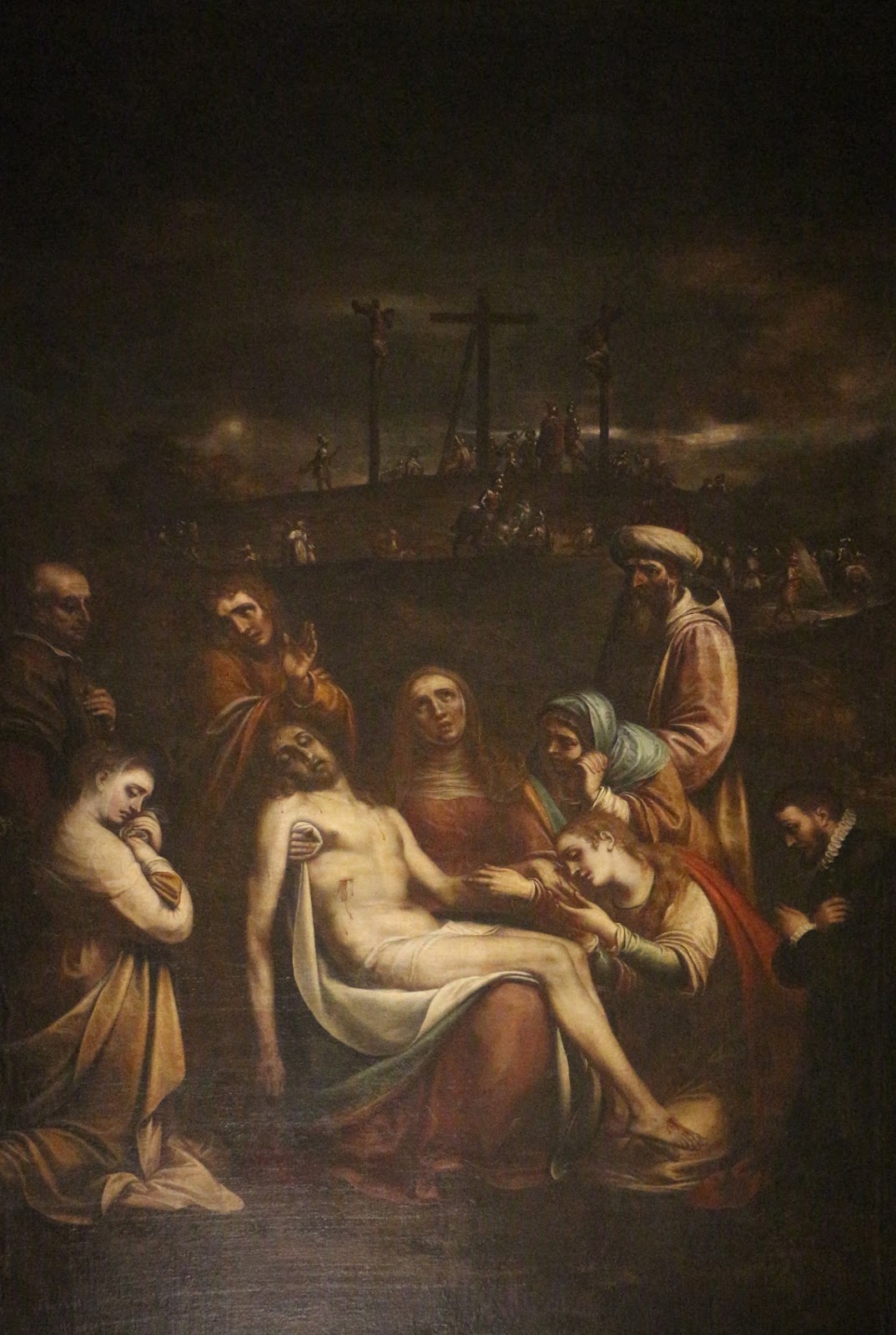
Pietà
ca. 1571
oil on canvas
Basilica di Santa Maria Assunta, Genoa

Luca Cambiaso
St Jerome
ca. 1560-80
oil on canvas
Museu Nacional de Belas Artes, Rio de Janeiro
 
Luca Cambiaso
Penitent Magdalen
ca. 1570-80
oil on canvas
Kunsthistorisches Museum, Vienna

Luca Cambiaso
Madonna of the Candle
ca. 1570-75
oil on canvas
Musei di Strada Nuova, Genoa

Luca Cambiaso
Holy Family with St John the Baptist
ca. 1578
oil on canvas
Art Gallery of New South Wales, Sydney

"Differently but not much less than the Maniera, the Counter-Maniera is an artificial style and almost as arbitrary.  Nevertheless, it is one of the elements in Counter-Maniera's difference from Maniera that, just as it pretends to classicizing rationale (but achieves no more than classicist formulae for it), so also it pretends to naturalism.  But to a still essentially Mannerist mentality, as Luca's Counter-Maniera mind still is, naturalism means either an un-fancy  kind of narrative or psychological datum that can be illustrated (not necessarily, therefore, an effect of visual mimesis) or an aspect of visual experience that can be turned to use as a concetto.  The first of these 'naturalisms' inclines Luca towards frequent and genuinely captivating incidents of genre-like intimacy, usually in smaller works; the second leads him to combine these with the theme of the nocturne.  In both respects, and more especially the latter, his tendencies coincide with those of the Cremonese Campi, Antonio in particular.  Antonio and Luca are so close in the time of their first essays in notturni that we cannot surely assign precedence to either, nor assess the possible direction of an influence between them.  Luca's notturni may well have been an an independent and coincidental growth, with one of its sources in a singular facet of the Genoese art of Perino.  In any case, it is Luca who is by far the more frequent worker in the nocturnal genre, more subtle and capricious in his exploitation of its possibilities, and far more poetic in the effects he achieves in it of visual as well as psychological sensation.  Antonio Campi's nocturnes had some role in the formation of the seeing of Caravaggio, who turned them to account in his new search for reality.  It may be significant for the qualities of Mannerism that persist more evidently in Luca's nocturnes that, by a route still unexplained, he seems to have been a source for Georges de La Tour, whose nocturnes so poetically transcend reality."

– quoted passages by S.J. Freedberg from Painting in Italy - 1500 to 1600 in the Pelican History of Art series (London, 1971)

Luca Cambiaso
Holy Family with St John the Baptist
before 1585
oil on canvas
Museo del Prado, Madrid

attributed to Luca Cambiaso
Death of Lucretia
before 1585
oil on canvas
Museo del Prado, Madrid

Tuesday, March 19, 2019

Bartolomeo Cesi (1556-1629) - Bologna

Bartolomeo Cesi
Seated Youth wearing a Monk's Habit
1590
drawing
Art Institute of Chicago

"This work was modeled on a young studio assistant who appears frequently in Cesi's drawings, but it was preparatory for a painting of a much older Saint Benedict in the church of San Procolo, Bologna."

– from curator's notes at the Art Institute of Chicago

Bartolomeo Cesi
Youth gazing upward in Adoration
(studio assistant posed as an ecstatic saint)
ca. 1594
drawing
National Gallery of Art, Washington DC

Bartolomeo Cesi
Draped Youth playing a Lute
(studio assistant posed as an angel)
ca. 1594-95
drawing
British Museum

Bartolomeo Cesi
Draped Youth with arms uplifted
(studio assistant posed as an ecstatic saint)
ca. 1607-1615
drawing
Rijksmuseum, Amsterdam

Bartolomeo Cesi
Draped Youth seen from below 
(studio assistant posed as God the Father)
ca. 1593-94
drawing
British Museum

attributed to Bartolomeo Cesi
Half-length study of Youth looking up 
before 1629
drawing
Royal Collection, Great Britain

"Despite his humanist education, the Counter-Reformation had a deeper influence on Bartolomeo Cesi's painting.  Emphasizing clarity and impact, Cesi's paintings reflect the Counter-Reformation interest in instruction.  Born into affluence, the young Cesi studied under Nosadella.  In the 1570s, while decorating the apse and crypt of the Bologna Cathedral, Cesi absorbed strict Counter-Reformation beliefs from the cardinal who coordinated the project.  Promoting art solely as a vehicle for renewing faith and promoting Roman Catholic teachings, this cardinal later wrote that painted nudes were unsuitable for private houses and churches.  . . .  Cesi's figures derive from life drawings that the indefatigable draftsman made for his paintings.  Along with his contemporary Ludovico Carracci, Cesi successfully campaigned for a separate painter's guild in Bologna in 1599."

– from curator's notes at the Getty Museum

"Cesi was an artist devoted to the Counter-Reformation belief, expressed most forcibly in the 1582 treatise of the Bolognese Cardinal Gabriele Paleotti, that the proper function of painting was the clear communication of a religious message.  Like the Carracci brothers, Cesi reacted against the complexity and artificiality of much sixteenth-century painting and returned to the study of nature, beginning each work with careful drawings from the model and abstracting from these to create an ideal form.  In his later works, however, Cesi strove for an increasingly severe geometry and reductive purity that were far removed from the dramatic action and externalization of emotion characteristic of the Carracci." 

– from curator's notes at the Metropolitan Museum

Bartolomeo Cesi
Centaur
before 1629
drawing
National Galleries of Scotland

attributed to Bartolomeo Cesi
Study of Two Youths Asleep
(studio assistants posed on the floor and radically foreshortened)
before 1629
drawing
Royal Collection, Great Britain

Bartolomeo Cesi
Male Figure carrying a load of wood 
(posed by studio assistant)
before 1629
drawing
Morgan Library, New York

Bartolomeo Cesi
Mourning Virgin - study for The Deposition
(posed by draped studio assistant)
before 1629
drawing
Royal Collection, Great Britain

Bartolomeo Cesi
St Lawrence - study for altarpiece
1619
drawing
Metropolitan Museum of Art, New York

Bartolomeo Cesi
St Anne - study for The Immaculate Conception
before 1629
drawing
British Museum

Bartolomeo Cesi
Draped Male Figure
before 1629
drawing
Museo del Prado, Madrid

Bartolomeo Cesi
Five Putti bearing the Column of the Passion
before 1629
drawing
Museo del Prado, Madrid

Saturday, March 16, 2019

Francesco Vanni (1563-1610) - Siena, Bologna, Rome

Francesco Vanni
Christ at the Column
1596
oil on canvas
Kunsthistorisches Museum, Vienna

Francesco Vanni
Holy Family with St John the Baptist
ca. 1580-86
oil on copper
Walters Art Museum, Baltimore

Francesco Vanni
Study for St Hyacinth raising a Drowned Child
ca. 1595-1600
oil on paper
Musée du Louvre

"By traveling regularly, Francesco Vanni brought an art combining many influences to his native Siena.  In its evolution away from Mannerism and its allegiance to the styles of Raphael, Federico Barocci, and the Carracci, Vanni's art had a lasting impact on Sienese painting.  After training with his stepfather, Vanni went to Bologna, where he may have worked under Bartolomeo Passarotti.  He absorbed the Carracci classicism, founded on studying nature, then spent two years in a Roman studio, when Federico Zuccaro's increasingly naturalistic Mannerist style was pervading the city.  From 1585, Barocci's style also heavily influence Vanni's painting, resulting in sharp, acid colors and delicate facial types.  Back in Siena in the 1590s, Vanni was the leading artistic figure there.  His clients from Siena's churches and confraternities desired a more realistic style, following Counter-Reformation guidelines requiring painting to communicate clear stories to the populace.  Vanni's artistic response attracted the interest of representatives from Rome, where he stayed from about 1600 to 1604.  His many commissions there included a prestigious altarpiece in Saint Peter's Basilica.  Upon his return to Siena, Vanni devoted himself to commissions from local patrons."

– from biographical notes at the Getty Museum

Francesco Vanni
Virgin and Child with St Cecilia and St Inez
1600
oil on canvas
Museo del Prado, Madrid

Francesco Vanni
Virgin Protectress of the city of Siena
1588
drawing
Metropolitan Museum of Art, New York

Francesco Vanni
Nativity
ca. 1600
drawing
Getty Museum, Los Angeles

attributed to Francesco Vanni
Putto playing Stringed Instrument
before 1610
drawing
Royal Collection, Great Britain

attributed to Francesco Vanni
Cardinal Paolo Sfondrato kneeling before St Cecilia, accompanied by other Saints
before 1610
drawing
Metropolitan Museum of Art, New York

attributed to Francesco Vanni
Seated Female Figure in Prayer
before 1610
drawing
Royal Collection, Great Britain

attributed to Francesco Vanni
Sleeping Youth
ca. 1600
drawing
Royal Collection, Great Britain

Francesco Vanni
Standing Woman looking to Left Background
ca.  1596-98
drawing
Metropolitan Museum of Art, New York

Francesco Vanni
Man chopping a Tree
before 1610
drawing
Morgan Library, New York

attributed to Francesco Vanni
Three Sleeping Apostles
(study for painting, Agony in the Garden)
before 1610
drawing
Royal Collection, Great Britain

Francesco Vanni
Coronation of the Virgin
1605
drawing
Metropolitan Museum of Art, New York

Francesco Vanni
Self-portrait
before 1610
oil on copper
Pinacoteca Nazionale di Siena

Wednesday, October 18, 2017

Anthony Blunt on the Inquisition and Veronese

Paolo Veronese
Feast in the House of Levi
1573
oil on canvas
Gallerie dell'Accademia, Venice

"In religious painting the Church did not limit its attention to the exclusion of classical or pagan elements.  It disapproved of the introduction of the secular in any form.  We are lucky enough to have the full details of one incident in which it took action against an artist in this matter, and the account is worth quoting at some length, since it throws light on the official view and on the state of mind of a certain group of artists.  In July 1573 Paul Veronese was summoned before the Tribunal of Inquisition to defend his painting of the 'Feast in the House of Levi' executed for the refectory of SS. Giovanni e Paolo, and now in the Academy in Venice.  The main objections made by the Inquisitors to the painting were that Veronese had introduced into it dogs, dwarfs, a fool with a parrot, men armed in the German manner, and a servant whose nose is bleeding  all details which are not mentioned in the Biblical story and are not suitable to a religious painting.  Veronese at first argues ingeniously that Levi was a rich man and no doubt had servants, soldiers and dwarfs about him, but he is rapidly forced to his real explanation.  When he was asked whom he supposed to have been actually present at this feast, he answered: 'I believe that Christ and the apostles were there.  But, if in a painting there is space left over, I fill it with figures from my imagination.'   And again: 'My commission was to make this picture beautiful according to my judgement, and it seemed to me that it was big and capable of holding many figures.'  His explanations were not accepted and he was ordered to make certain alterations in detail, which he duly carried out.  It is typical of the methods of the Counter-Reformation that the Inquisition in this case was satisfied with certain changes of detail which left the painting exactly as worldly in feeling as it was before.  But the replies of Veronese are even more instructive.  His ideas are entirely those of the Renaissance.  He thinks in terms of beauty not of spiritual truth, and his object was to produce a magnificent pageant painting, not to illustrate a religious story.  The explanation is that, compared with most other parts of Italy, Venice was little affected by the Tridentine phase of the Counter-Reformation.  The Jesuits were never firmly established there and the Inquisition was subject to State control.  Certain painters, like Tintoretto, absorbed the new ideas and their paintings are filled with the turbulent spirituality of the Counter-Reformers, but they were in a minority, and it was still possible in the later sixteenth century for artists like Veronese or Palladio to work on principles which are fundamentally those of the Renaissance."  

from the chapter on The Council of Trent and Religious Art in Anthony Blunt's Artistic Theory in Italy, 1450-1600 (Oxford: Clarendon Press, 1940)

Paolo Veronese
Feast in the House of Levi (detail)
1573
oil on canvas
Gallerie dell'Accademia, Venice

Paolo Veronese
Feast in the House of Levi (detail)
1573
oil on canvas
Gallerie dell'Accademia, Venice

Paolo Veronese
Feast in the House of Levi (detail)
1573
oil on canvas
Gallerie dell'Accademia, Venice

Paolo Veronese
Feast in the House of Levi (detail)
1573
oil on canvas
Gallerie dell'Accademia, Venice

Tuesday, October 17, 2017

Anthony Blunt on the Counter-Reformation and Michelangelo

Michelangelo
The Last Judgement 
ca. 1790-1800
hand-colored engraving by James Cole, after the fresco in the Sistine Chapel
British Museum

"But from the more general point of view the essential characteristic of the earlier stage of the Counter-Reformation is that it is an attempt to return to the ecclesiastical domination which the Church had held during the Middle Ages.  In the intellectual field this meant that the movement was opposed to all the achievements of Renaissance Humanism.  The individual rationalism of Humanism had played a considerable part in the development of the Reformation, and Humanism was therefore anathema to the Counter-Reformers.  It was their aim to undo all that the Renaissance had achieved, and to get back to a feudal and medieval state of affairs.  The movement was just as much a Counter-Renaissance as a Counter-Reformation, and it set itself to destroy the human scale of values in which the Humanists believed and to replace it once again with a theological scale such as had been maintained during the Middle Ages.  . . . "

"The extraordinary attention which critics and theologians paid to details in religious paintings can best be seen in the censures of Gilio da Fabriano on Michelangelo's Last Judgement or in Borghini's  comments on Florentine Mannerist paintings, particularly on Pontormo's frescoes in S. Lorenzo.  Gilio's criticisms go farther toward the ludicrous than Borghini's, for he was a priest and a professional theologian and took purely doctrinal errors intensely to heart, but Borghini comes very close to him and proves that laymen and not only priests were profoundly influenced by the Tridentine reforms.  A few of Gilio's objections to the Last Judgement are perhaps worth quoting in detail to give the tone of his dialogue.  Michelangelo, he says, has represented the angels without wings.  Certain of the figures have draperies blown about by the wind, in spite of the fact that at the Day of Judgement wind and storm will have ceased.  The trumpeting angels are shown all standing together, whereas it is written that they shall be sent unto the four corners of the earth.  Among the dead rising from the earth some are still bare skeletons, while others are already clothed with flesh, though according to the Biblical version the general Resurrection will take place instantaneously."

Michelangelo-
The Last Judgement - Trumpeting Angels
1545
engraving by Niccolò della Casa, after the fresco in the Sistine Chapel
British Museum

Michelangelo
 The Last Judgement - Resurrecting figures rising from the Earth
ca. 1540-50
anonymous engraving, after the fresco in the Sistine Chapel
British Museum

" . . .  Gilio also protests against the fact that Christ is shown standing, instead of seated upon His throne of glory.  One of the speakers justifies this on the grounds that it is symbolical, but his defence is disallowed by the leader of the argument in a sentence which sums up the whole feeling of the dialogue: 'Your opinion may be right, that he intended to interpret the words of the Gospel mystically and allegorically; but first of all the literal meaning must be taken, whenever this can properly be done, and then the others, keeping to the letter as often as possible.'  This represents not only the attitude of Gilio to Michelangelo but that of his whole generation to the great figures of thirty years before."  


Michelangelo
The Last Judgement - Christ in Judgement
1803
stipple-engraving by Conrad Martin Metz
after the fresco in the Sistine Chapel
British Museum

Michelangelo
The Last Judgement - Christ in Judgement
ca. 1543-48
engraving by Niccolò della Casa, after the fresco in the Sistine Chapel
British Museum

"The reasons why the Counter-Reformers had to fear the worship of classical antiquity have already been explained, and it is not therefore surprising to find Gilio da Fabriano objecting to Michelangelo's introduction of Charon into the Last Judgement.  It is agreed in the dialogue that Michelangelo was here acting on the authority of Dante, but this defence is not allowed to stand, and it is typical of the change in spirit in the Church that what would not have been challenged in the time of Dante could not be risked in 1560." 


Michelangelo
The Last Judgement - Damned carried to Hell in Charon's boat
1803
stipple-engraving by Conrad Martin Metz, after the fresco in the Sistine Chapel
British Museum

"As in the disputes over heresy, so in those over decency, Michelangelo's Last Judgement came in for the most violent attacks.  Its position in the Sistine Chapel gave it an importance which made it a good test case, and in the question of nudity it provided ample material for discussion.  It was not only exposed to written attacks, but on several occasions was in danger of complete destruction and only escaped with serious mutilation.  Even before it was finished, the master of the ceremonies to Paul III, Biagio da Cesena, protested against it; but the Pope stood by the artist, who took an easy revenge by painting his opponent as Minos in Hell [the figure in the stipple-engraving directly above at bottom right corner, entwined by a serpent which bites his genitals].  Paul IV threatened to destroy the whole fresco and finally ordered Daniele da Volterra to paint draperies over some of the figures.  The violence which Michelangelo's work aroused is shown by a Florentine criticism, quoted by Symonds, in which the artist is described as 'that inventor of filthiness.'  Pius IV was still dissatisfied and had the draperies increased in number, while Clement VIII was only prevented from completely destroying the painting by the appeals of the Academy of St. Luke.  Paul V also had some figures repainted; and it was on this occasion that El Greco offered to replace the whole fresco with one 'modest and decent, and no less well painted than the other.'  Clement XIII had yet more draperies added in 1762, and rumours were current in 1936 that Pius XI intended to continue the work."  


Michelangelo
The Last Judgement - Demons crouching at the gates of Hell
1803
stipple-engraving by Conrad Martin Metz. after the fresco in the Sistine Chapel
British Museum

Michelangelo
The Last Judgement - Group of the Damned descending to Hell
ca. 1543-48
engraving by Niccolò della Casa, after the fresco in the Sistine Chapel
British Museum

Michelangelo
The Last Judgement - Figures of the Damned
ca. 1606-72
drawing by Isaac Fuller after etching by Jan de Bisschop
after drawing by Giorgio Vasari
 after the fresco in the Sistine Chapel
British Museum

Michelangelo
The Last Judgement - Damned Soul set upon by Demons
ca. 1830
lithograph by M. Eichholzer, after the fresco in the Sistine Chapel
British Museum

Michelangelo
The Last Judgement - Group of the Damned descending to Hell
1803
stipple-engraving by Conrad Martin Metz, after the fresco in the Sistine Chapel
British Museum


Michelangelo
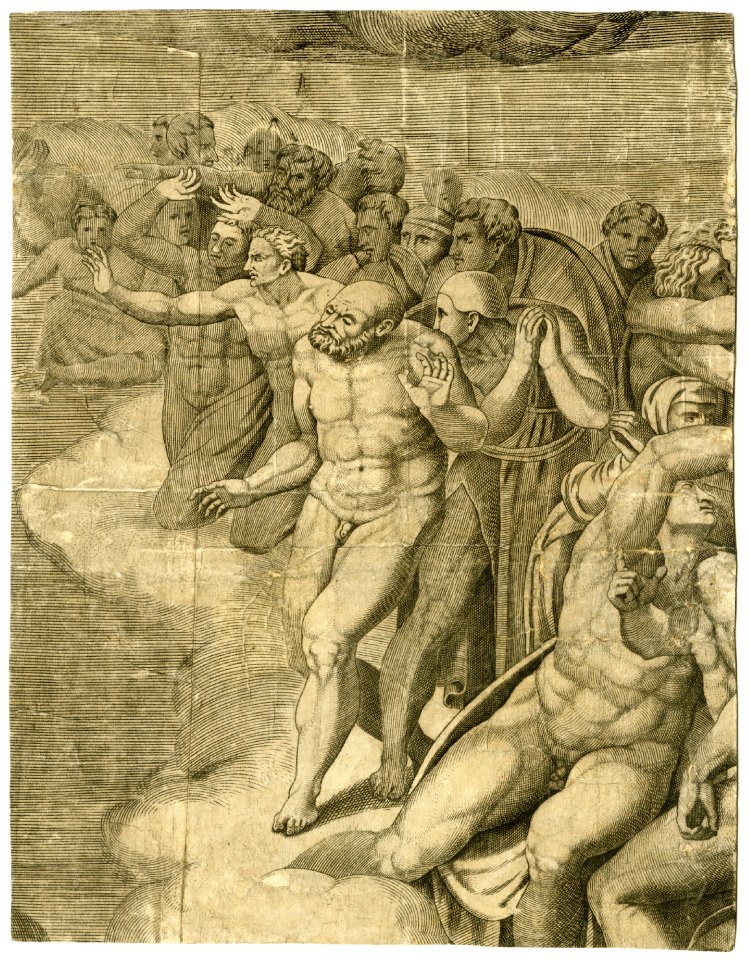
The Last Judgement - Group of Saints adoring Christ
ca. 1543-48
engraving by Niccolò della Casa, after the fresco in the Sistine Chapel
British Museum

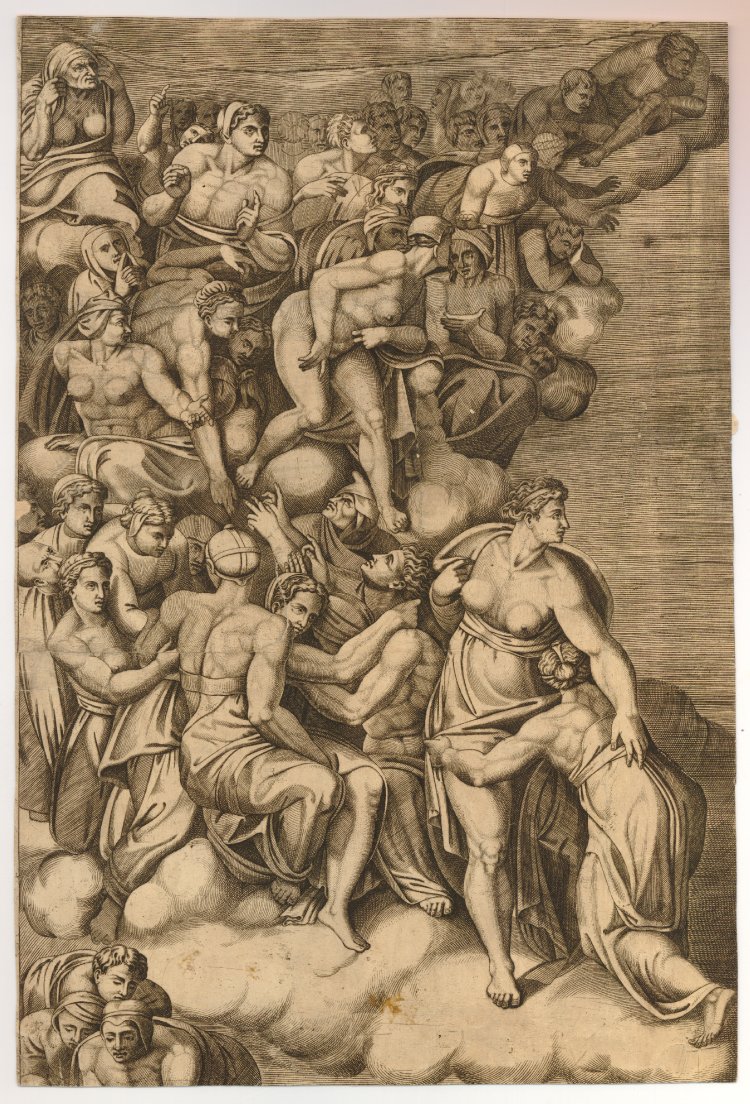
Michelangelo
The Last Judgement - Female Saints adoring Christ
ca. 1543-48
engraving by Niccolò della Casa, after the fresco in the Sistine Chapel
British Museum

Michelangelo
The Last Judgement - the Blessed ascending to Heaven
ca. 1543-48
engraving by Niccolò della Casa, after the fresco in the Sistine Chapel
British Museum

Michelangelo
The Last Judgement - the Blessed ascending to Heaven
1803
stipple-engraving by Conrad Martin Metz
after the fresco in the Sistine Chapel
British Museum

– quoted passages are from the chapter on The Council of Trent and Religious Art in Anthony Blunt's Artistic Theory in Italy, 1450-1600 (Oxford: Clarendon Press, 1940)