Showing posts with label censorship. Show all posts

Friday, December 22, 2017

Onofri, Grimaldi, Sacchi (17th-century drawings)

Crescenzio Onofri
Group of trees
second half of the 17th century
drawing
Teylers Museum, Haarlem

Crescenzio Onofri
Landscape
second half of the 17th century
drawing
British Museum

"Crescenzio Onofri – Landscape painter and etcher, born Rome ca. 1632, died Florence ca. 1712.  He was a pupil of the landscape painter Gaspard Dughet (1615-75, brother-in-law and pupil of Nicolas Poussin) with whom he collaborated on canvases painted for the Salone del Trono in the Palazzo Doria-Pamphilij, Rome.  In 1689 he transferred to Florence where he worked for Grand Duke Cosimo III.  The several paintings by him belonging to the Florentine Galleries bear witness to his long period of service for the Medici."

– biographical notes from the British Museum

Crescenzio Onofri
Landscape with Penitent Magdalene
second half of the 17th century
drawing
Teylers Museum, Haarlem

Crescenzio Onofri
Landscape with river and round tower
second half of the 17th century
drawing
British Museum

Crescenzio Onofri
Landscape with river
second half of the 17th century
drawing
British Museum

Crescenzio Onofri
Landscape
second half of the 17th century
drawing
Teylers Museum, Haarlem

Giovanni Francesco Grimaldi
Angel appearing to Elijah in a landscape
ca. 1640s
drawing
British Museum

". . . beneath a tree, the angel touching Elijah's hand and pointing away to the right.  The study is related to the composition of a fresco on the ceiling of the salone of the Palazzo Santacroce,  Rome, decorated after 1640.  In the fresco the angel brings the sleeping prophet water; the drawing, however, shows a later point in the story, when the angel commands Elijah to arise, eat and drink, and go to Mount Horeb.  Towards the end of his career Grimaldi painted the subject of 'Elijah and the Angel' once more, in a fresco in the Palazzo Nuñez (now Torlonia), Rome, ca. 1668-72."

– from curator's notes at the British Museum

attributed to Giovanni Francesco Grimaldi
River Landscape
before 1680
drawing
Teylers Museum, Haarlem

Giovanni Francesco Grimaldi
Landscape with buildings
before 1680
drawing
Royal Collection, Windsor

Giovanni Francesco Grimaldi
Landscape with Penitent Magdalene
before 1680
drawing
British Museum

Giovanni Francesco Grimaldi
Landscape with Tobias and the Angel
before 1680
drawing
Teylers Museum, Haarlem

Giovanni Francesco Grimaldi
Landscape with two figures in foreground
before 1680
drawing
Royal Collection, Windsor

Andrea Sacchi
Christ administering the host to a dying nun
1650s
drawing, indented for transfer
British Museum

"This is a preparatory study, in reverse and with some slight differences, for one of the series of prints of the life of St. Teresa engraved in the late 1650s by the French engraver Guillaume Chasteau.  (Both Ciro Ferri and Lazzaro Baldi also contributed designs to the series.)  Inscribed in brown ink in the margin below with the censor's permission for the design to be engraved.  Such inscriptions normally begin with the censor's name, followed by the title of his office.  The Master of the Sacred Palace and his two officials ('socii') were Dominican friars, and their overseeing of the publication of books and images in Rome was part of the function of the Congregation of the Holy Office, better known as the Inquisition.  The records of the Master of the Sacred Palace in the Vatican remain secret." 

– from curator's notes at the British Museum

Andrea Sacchi
Magdalene succored by angels and reverenced by kneeling figures
1620s
drawing
British Museum

Andrea Sacchi
Study of an old man
1640s
drawing
British Museum

Andrea Sacchi
The Three Magdalenes
1632-33
drawing
Royal Collection, Windsor

"A drawing of three female saints, two seated and one kneeling upon clouds.  There are three putti between them, and smaller figures of river gods below them.  This is a study for the composition of The Three Magdalenes, formerly in the Cenacolo di S. Salvi.  Andrea Sacchi was one of the most important representatives of a more sober baroque style in seventeenth-century Rome.  He executed many paintings for the Barberini family, including an altarpiece commissioned by Pope Urban VIII for the convent of Santa Maria degli Angeli in Florence, where two of the Pope's nieces were nuns.  The painting, now in the Uffizi, depicts St. Mary Magdalene, the Blessed Mary Magdalene de' Pazzi, and an unidentified Mary Magdalene 'Queen of India or China'.

A painting of St Mary Magdalene, the Blessed Mary Magdalene de' Pazzi, and Mary Magdalene, 'Queen of India or China', seated among clouds, was described by Bellori in his manuscript life of Sacchi as among the works painted for Cardinal Antonio Barberini.  Roberto Longhi first related this description to an altarpiece then in San Salvi, Florence and now in the Uffizi, with a smaller version of the same composition in Palazzo Corsini, Rome.

Mary Magdalene de' Pazzi (1566-1607) had been a nun at the Carmelite convent of Santa Maria degli Angeli in Florence.  She was beatified by Urban VIII in 1626, after which the Carmelites – among whom were two nieces of the Pope – obtained permission to establish a convent dedicated to her, on the site of a monastery at Borgo Pinti.  Building work was paid for by the Pope, his sister-in-law Donna Costanza, and his nephew Cardinal Francesco Barberini.  Among other gifts to the convent, in January 1634 the Pope ' . . . in gratitude for the finger of the Blessed Mary Magdalene de' Pazzi that he had received, sent them a silver cross with a fragment of the wood of the True Cross.  The cross was supported by two angels, with a silver base on an ebony pedestal, and at the sides, relics of the Penitent St. Mary Magdalene and of the Blessed Mary Magdalene, martyr of Japan, with a small empty oval left for a relic of St. Mary Magdalene de' Pazzi.  He also sent them a large painting in which were depicted the aforementioned saints.'

It is probably that the painting sent to Florence in 1634 was that now in the Uffizi.  From early inventories it seems that Sacchi executed a second large version for Antonio Barberini's own collection, which Bellori knew and which is recorded in Rome from around 1645 to 1850 (after which it disappears).  The Florence version is not mentioned in any early guidebooks and may have been placed in the closed part of the convent, though an apparently derivative painting of the three saints by Livio Mehus suggests that Sacchi's altarpiece was known to Florentine artists.  The identity of St. Mary Magdalene of Japan, India or China (depending on the reference) has not been established; Sutherland Harris noted that in the painting 'she holds glowing coals, and was presumably roasted to death, but all the seven Mary Magdalenes martyred in Japan before 1633 were crucified or beheaded.'

The basic layout of the composition is established here, but there are many differences between drawing and painting, most notably the presence in the drawing of three river gods in an indeterminate landscape, and the more spacious composition, akin to Sacchi's Allegory of Divine Wisdom of c. 1630 in Palazzo Barberini.  In the final composition the landscape was eliminated, and the figures increased in scale to fill much of the picture surface."

– text adapted from The Art of Italy in the Royal Collection : Renaissance and Baroque (2007)

Andrea Sacchi
Martyrdom of a Saint
before 1661
drawing
Cooper Hewitt, Smithsonian Design Museum

Wednesday, October 18, 2017

Anthony Blunt on the Inquisition and Veronese

Paolo Veronese
Feast in the House of Levi
1573
oil on canvas
Gallerie dell'Accademia, Venice

"In religious painting the Church did not limit its attention to the exclusion of classical or pagan elements.  It disapproved of the introduction of the secular in any form.  We are lucky enough to have the full details of one incident in which it took action against an artist in this matter, and the account is worth quoting at some length, since it throws light on the official view and on the state of mind of a certain group of artists.  In July 1573 Paul Veronese was summoned before the Tribunal of Inquisition to defend his painting of the 'Feast in the House of Levi' executed for the refectory of SS. Giovanni e Paolo, and now in the Academy in Venice.  The main objections made by the Inquisitors to the painting were that Veronese had introduced into it dogs, dwarfs, a fool with a parrot, men armed in the German manner, and a servant whose nose is bleeding – all details which are not mentioned in the Biblical story and are not suitable to a religious painting.  Veronese at first argues ingeniously that Levi was a rich man and no doubt had servants, soldiers and dwarfs about him, but he is rapidly forced to his real explanation.  When he was asked whom he supposed to have been actually present at this feast, he answered: 'I believe that Christ and the apostles were there.  But, if in a painting there is space left over, I fill it with figures from my imagination.'   And again: 'My commission was to make this picture beautiful according to my judgement, and it seemed to me that it was big and capable of holding many figures.'  His explanations were not accepted and he was ordered to make certain alterations in detail, which he duly carried out.  It is typical of the methods of the Counter-Reformation that the Inquisition in this case was satisfied with certain changes of detail which left the painting exactly as worldly in feeling as it was before.  But the replies of Veronese are even more instructive.  His ideas are entirely those of the Renaissance.  He thinks in terms of beauty not of spiritual truth, and his object was to produce a magnificent pageant painting, not to illustrate a religious story.  The explanation is that, compared with most other parts of Italy, Venice was little affected by the Tridentine phase of the Counter-Reformation.  The Jesuits were never firmly established there and the Inquisition was subject to State control.  Certain painters, like Tintoretto, absorbed the new ideas and their paintings are filled with the turbulent spirituality of the Counter-Reformers, but they were in a minority, and it was still possible in the later sixteenth century for artists like Veronese or Palladio to work on principles which are fundamentally those of the Renaissance."  

– from the chapter on The Council of Trent and Religious Art in Anthony Blunt's Artistic Theory in Italy, 1450-1600 (Oxford: Clarendon Press, 1940)

Paolo Veronese
Feast in the House of Levi (detail)
1573
oil on canvas
Gallerie dell'Accademia, Venice

Paolo Veronese
Feast in the House of Levi (detail)
1573
oil on canvas
Gallerie dell'Accademia, Venice

Paolo Veronese
Feast in the House of Levi (detail)
1573
oil on canvas
Gallerie dell'Accademia, Venice

Paolo Veronese
Feast in the House of Levi (detail)
1573
oil on canvas
Gallerie dell'Accademia, Venice

Tuesday, October 17, 2017

Anthony Blunt on the Counter-Reformation and Michelangelo

Michelangelo
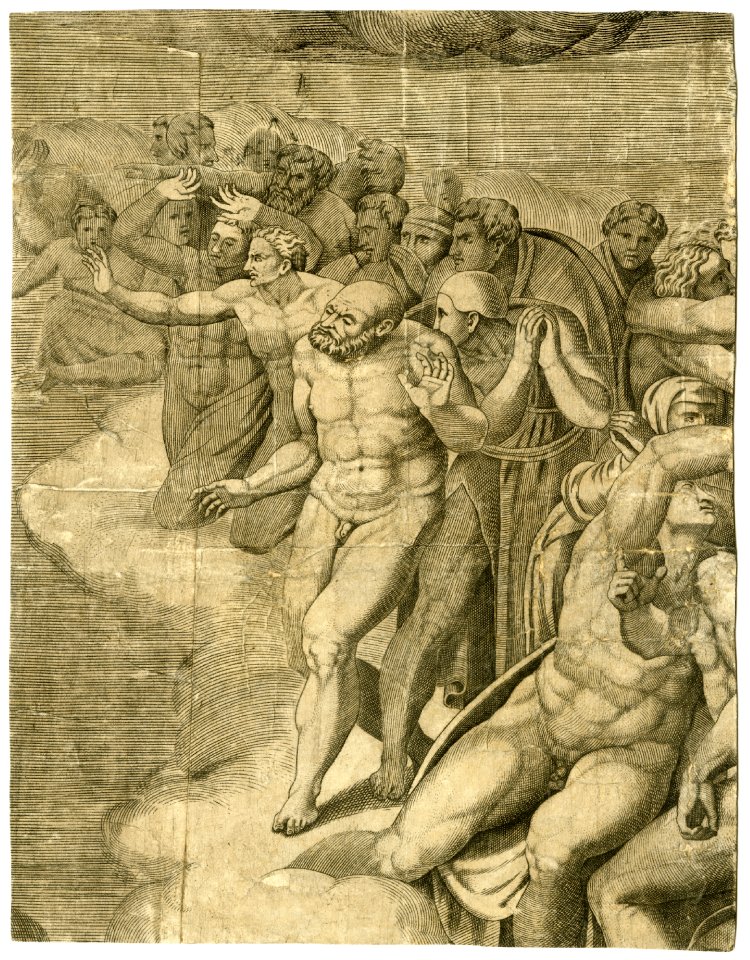
The Last Judgement 
ca. 1790-1800
hand-colored engraving by James Cole, after the fresco in the Sistine Chapel
British Museum

"But from the more general point of view the essential characteristic of the earlier stage of the Counter-Reformation is that it is an attempt to return to the ecclesiastical domination which the Church had held during the Middle Ages.  In the intellectual field this meant that the movement was opposed to all the achievements of Renaissance Humanism.  The individual rationalism of Humanism had played a considerable part in the development of the Reformation, and Humanism was therefore anathema to the Counter-Reformers.  It was their aim to undo all that the Renaissance had achieved, and to get back to a feudal and medieval state of affairs.  The movement was just as much a Counter-Renaissance as a Counter-Reformation, and it set itself to destroy the human scale of values in which the Humanists believed and to replace it once again with a theological scale such as had been maintained during the Middle Ages.  . . . "

"The extraordinary attention which critics and theologians paid to details in religious paintings can best be seen in the censures of Gilio da Fabriano on Michelangelo's Last Judgement or in Borghini's  comments on Florentine Mannerist paintings, particularly on Pontormo's frescoes in S. Lorenzo.  Gilio's criticisms go farther toward the ludicrous than Borghini's, for he was a priest and a professional theologian and took purely doctrinal errors intensely to heart, but Borghini comes very close to him and proves that laymen and not only priests were profoundly influenced by the Tridentine reforms.  A few of Gilio's objections to the Last Judgement are perhaps worth quoting in detail to give the tone of his dialogue.  Michelangelo, he says, has represented the angels without wings.  Certain of the figures have draperies blown about by the wind, in spite of the fact that at the Day of Judgement wind and storm will have ceased.  The trumpeting angels are shown all standing together, whereas it is written that they shall be sent unto the four corners of the earth.  Among the dead rising from the earth some are still bare skeletons, while others are already clothed with flesh, though according to the Biblical version the general Resurrection will take place instantaneously."

Michelangelo-
The Last Judgement - Trumpeting Angels
1545
engraving by Niccolò della Casa, after the fresco in the Sistine Chapel
British Museum

Michelangelo
 The Last Judgement - Resurrecting figures rising from the Earth
ca. 1540-50
anonymous engraving, after the fresco in the Sistine Chapel
British Museum

" . . .  Gilio also protests against the fact that Christ is shown standing, instead of seated upon His throne of glory.  One of the speakers justifies this on the grounds that it is symbolical, but his defence is disallowed by the leader of the argument in a sentence which sums up the whole feeling of the dialogue: 'Your opinion may be right, that he intended to interpret the words of the Gospel mystically and allegorically; but first of all the literal meaning must be taken, whenever this can properly be done, and then the others, keeping to the letter as often as possible.'  This represents not only the attitude of Gilio to Michelangelo but that of his whole generation to the great figures of thirty years before."  


Michelangelo
The Last Judgement - Christ in Judgement
1803
stipple-engraving by Conrad Martin Metz
after the fresco in the Sistine Chapel
British Museum

Michelangelo
The Last Judgement - Christ in Judgement
ca. 1543-48
engraving by Niccolò della Casa, after the fresco in the Sistine Chapel
British Museum

"The reasons why the Counter-Reformers had to fear the worship of classical antiquity have already been explained, and it is not therefore surprising to find Gilio da Fabriano objecting to Michelangelo's introduction of Charon into the Last Judgement.  It is agreed in the dialogue that Michelangelo was here acting on the authority of Dante, but this defence is not allowed to stand, and it is typical of the change in spirit in the Church that what would not have been challenged in the time of Dante could not be risked in 1560." 


Michelangelo
The Last Judgement - Damned carried to Hell in Charon's boat
1803
stipple-engraving by Conrad Martin Metz, after the fresco in the Sistine Chapel
British Museum

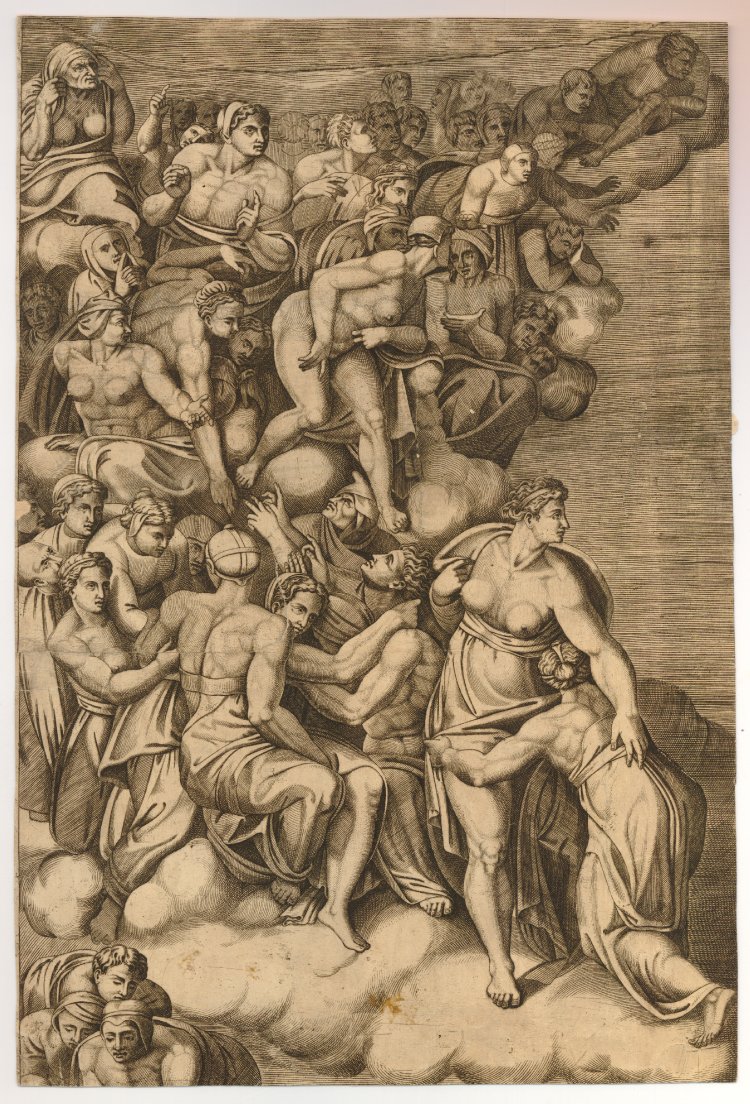
"As in the disputes over heresy, so in those over decency, Michelangelo's Last Judgement came in for the most violent attacks.  Its position in the Sistine Chapel gave it an importance which made it a good test case, and in the question of nudity it provided ample material for discussion.  It was not only exposed to written attacks, but on several occasions was in danger of complete destruction and only escaped with serious mutilation.  Even before it was finished, the master of the ceremonies to Paul III, Biagio da Cesena, protested against it; but the Pope stood by the artist, who took an easy revenge by painting his opponent as Minos in Hell [the figure in the stipple-engraving directly above at bottom right corner, entwined by a serpent which bites his genitals].  Paul IV threatened to destroy the whole fresco and finally ordered Daniele da Volterra to paint draperies over some of the figures.  The violence which Michelangelo's work aroused is shown by a Florentine criticism, quoted by Symonds, in which the artist is described as 'that inventor of filthiness.'  Pius IV was still dissatisfied and had the draperies increased in number, while Clement VIII was only prevented from completely destroying the painting by the appeals of the Academy of St. Luke.  Paul V also had some figures repainted; and it was on this occasion that El Greco offered to replace the whole fresco with one 'modest and decent, and no less well painted than the other.'  Clement XIII had yet more draperies added in 1762, and rumours were current in 1936 that Pius XI intended to continue the work."  


Michelangelo
The Last Judgement - Demons crouching at the gates of Hell
1803
stipple-engraving by Conrad Martin Metz. after the fresco in the Sistine Chapel
British Museum

Michelangelo
The Last Judgement - Group of the Damned descending to Hell
ca. 1543-48
engraving by Niccolò della Casa, after the fresco in the Sistine Chapel
British Museum

Michelangelo
The Last Judgement - Figures of the Damned
ca. 1606-72
drawing by Isaac Fuller after etching by Jan de Bisschop
after drawing by Giorgio Vasari
 after the fresco in the Sistine Chapel
British Museum

Michelangelo
The Last Judgement - Damned Soul set upon by Demons
ca. 1830
lithograph by M. Eichholzer, after the fresco in the Sistine Chapel
British Museum

Michelangelo
The Last Judgement - Group of the Damned descending to Hell
1803
stipple-engraving by Conrad Martin Metz, after the fresco in the Sistine Chapel
British Museum


Michelangelo
The Last Judgement - Group of Saints adoring Christ
ca. 1543-48
engraving by Niccolò della Casa, after the fresco in the Sistine Chapel
British Museum

Michelangelo
The Last Judgement - Female Saints adoring Christ
ca. 1543-48
engraving by Niccolò della Casa, after the fresco in the Sistine Chapel
British Museum

Michelangelo
The Last Judgement - the Blessed ascending to Heaven
ca. 1543-48
engraving by Niccolò della Casa, after the fresco in the Sistine Chapel
British Museum

Michelangelo
The Last Judgement - the Blessed ascending to Heaven
1803
stipple-engraving by Conrad Martin Metz
after the fresco in the Sistine Chapel
British Museum

– quoted passages are from the chapter on The Council of Trent and Religious Art in Anthony Blunt's Artistic Theory in Italy, 1450-1600 (Oxford: Clarendon Press, 1940)

Friday, May 26, 2017

French Art in Japan

Jean-Baptiste Pater
Bathers
before 1736
oil on canvas
Bridgestone Museum of Art, Tokyo

Paul Cézanne
Bathers at rest
ca. 1875-77
watercolor on paper
Bridgestone Museum of Art, Tokyo

From the Japan Weekly Mail (September 3, 1898) –

"It is probable that considerable interest will be aroused by the action of the Home Minister, Count Itagaki, in forbidding sale in Japan of Armand Silvestre's Le Nu au Salon.  The peoples of the Occident have always been in the habit of sitting in solemn judgment on the peoples of the Orient in matters of morality, and it is a distinctly disagreeable slap in the face that a book allowed to be freely sold in Europe should be tabooed by the Japanese as prejudicial to moral health. For our own part, however, we have not the slightest hesitation in endorsing Count Itagaki's judgment.  It is all very well to pretend, as some critics are in the habit of pretending, that the objectionable features of pictures of the nude are purely subjective.  That is a remarkably clever argument.  It silences cavil by constructively convicting the caviller of moral obliquity.  "To the pure all things are pure.  A prude who applies the epithet unclean to anything sanctioned by art merely exposes his own moral uncleanliness."  Veritable despotism of discussion, that.  Not one among us can frankly assert that a book like Le Nu au Salon is without demoralizing influence.  Many of the pictures are beautiful, very beautiful, and a few, a very few, show the wonderful power that a really great artist possesses of subordinating the sensuous to the graceful, and suggesting the refinement of love rather than the coarseness of lust.  But not a single one of them is absolutely beyond ethical criticism, and, in truth, if M. Armand Silvestre had deliberately set himself to expose the evil features of this kind of pictorial art, he could not have succeeded better than by massing together a number of drawings which, when viewed separately, might pass muster as a mere glimpse of the "naughty," but when grouped in phalanx become obtrusively shocking and demoralizing.  It is not a mere question of the nude:  it is a question of motives also.  Many of the motives of these pictures could not be verbally described without outraging the commonest canons of propriety.  The Japanese are at a parting of the ways.  They have to choose the route they will adopt, and we think that Count Itagaki is choosing the right route.  It will be said, no doubt, that since the reality of the nude does not shock the Japanese, they can not consistently object to its pictorial representation.  An argument of that nature hardly deserves serious consideration.  The Japanese have not hitherto condemned the nude under circumstances of expediency or necessity.  They have not carefully secluded women's bathing places from men's – sometimes they do not separate them at all – nor have they required that a labourer in hot weather should encumber himself with garments.  Unquestionably in this matter they have often allowed liberty to lapse into licence.  But the principle of their procedure is purely utilitarian.  There has never been any exposure of the nude for the sake of the nude.  That is the fundamental difference between the sacrifice of modesty that the Japanese make to convenience, and the sacrifice of morality that Western pictures of the nude make to the sensuously attractive.  In the one case the nude is seen but not looked at; in the other, it is put forward expressly to be looked at.  This feature of Western art has become extravagantly prominent.  Of course the general question whether the nude should be banished altogether from the atelier and the salon is outside the range of this particular discussion.  We have to do with a special publication, and since it certainly is not a publication that would be permitted to circulate as an original picture album, we fail to see why its sale should be sanctioned because it is a collection of copies."

Pierre Puvis de Chavannes
Fantasy
1866
oil on canvas
Ohara Museum of Art, Kurashiki, Japan

Jean-François Millet
Spring (Daphnis and Chloë)
1865
oil on canvas
National Museum of Western Art, Tokyo

Claude-Joseph Vernet
Summer evening landscape in Italy
1773
oil on canvas
National Museum of Western Art, Tokyo

Jean-Marc Nattier
Portrait of Marie-Henriette Berthelot de Pléneuf
1739
oil on canvas
National Museum of Western Art, Tokyo

Marie-Gabrielle Capet
Self-portrait
ca. 1783
oil on canvas
National Museum of Western Art, Tokyo

Eugène Boudin
Beach near Trouville
ca. 1865
oil on panel
Bridgestone Museum of Art, Tokyo

Édouard Manet
Self-portrait
1878-79
oil on canvas
Bridgestone Museum of Art, Tokyo

Gustave Moreau
The Sacred Elephant
1882
watercolor, gouache
National Museum of Western Art, Tokyo

Paul Gauguin
Still-life with horse's head
1886
oil on canvas
Bridgestone Museum of Art, Tokyo

Paul Cézanne
Bowl and Milk-Jug
ca. 1873-77
oil on canvas
Bridgestone Museum of Art, Tokyo

Edgar Degas
Three dancers in red costumes
1896
pastel
Ohara Museum of Art, Kurashiki, Japan

Claude Monet
Morning on the Seine
1898
oil on canvas
National Museum of Western Art, Tokyo