Showing posts with label De Young Museum. Show all posts

Saturday, January 12, 2013

De Staebler

Standing Man with Outstretched Arm, 1987

The ceramics and bronzes of Berkeley artist Stephen De Staebler (1933-2011) have been familiar to me and much admired since the seventies – with many examples on view in my own Northern California environment, both in public spaces and museums – even though De Staebler's reputation in the wider world still seems to be fairly slender. The De Young Museum gave him a rather cramped and unsatisfactory retrospective exhibition last year – to mark the occasion of his death – but for all the show's inadequacies, the catalog issued with it (published by University of California Press) was beautifully produced, as these sample images demonstrate.

Torso with Springing Hip, 1987

Walking Woman II, 1988

Winged Woman Walking VI, 1990

Yoke Winged Man, 1994

Winged Woman Walking X, 1995

Winged Figure with Three Legs, 2003

In 2005 De Staebler  was diagnosed with a form of Parkinson's disease and by 2006 was confined to a wheelchair. He hired sculptor Derek Weisberg as studio assistant and pursued a new working trajectory, directing the assemblage of preexisting fragments unearthed from his studio (what he called "the boneyard") as seen below.

Man with Broad Chest, 2010

Standing Woman Leading, 2010

Figure with Gray Shoulder, 2010

Boneyard fragments and sculptures in the artist's Berkeley studio, 2011

Friday, November 9, 2012

Park & Museum


On Wednesday, the most recent warm spell signaled the approach of its own end with an overcast day that yet remained more-or-less unseasonably warm. I walked into Golden Gate Park after finishing work at the library. Near the restored Victorian Conservatory of Flowers another dahlia-blooming season had reached culmination, as I discovered by chance. The oval plot devoted to these tall grotesque flowers was (as always) surrounded by asphalt and parked cars, but I contrived to banish that part of the truth from the picture. And did not pause long there in any case, pursuing my own path toward the De Young Museum – where I took a few fresh looks at a few old friends –

Mark di Suvero Che Faro Senza Eurydice (1959-60)

Larger-than-life marble sculptures of alluring Biblical females and grandiose 19th century landscapes in heavy gilt frames – a gallery of generous proportions devoted to the booty that formerly ornamented the mansions of local Robber Barons.


Showing art to babies is an excellent thing to do. In background, Sean Scully's Wall of Light Horizon (2005).


Cornelia Parker (b. 1956)  Anti-Mass (2005). Charcoal and wire. "This sculpture, Anti-Mass, is constructed from the charred remains of an African American Baptist church in Alabama that was destroyed by arsonists."


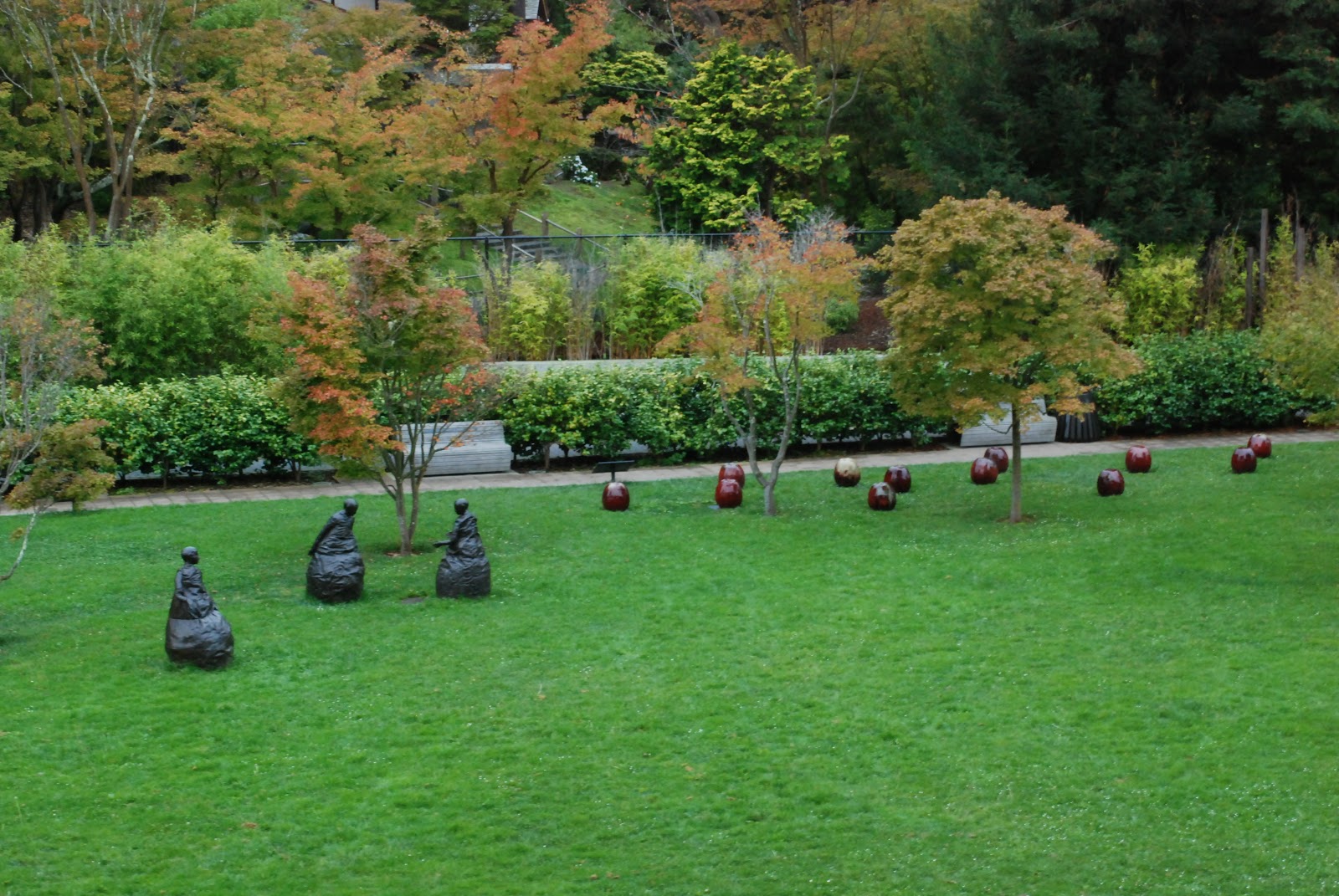
Group at left is Conversation Piece V (2001), three bronzes by Juan Muñoz, who died (far too young) in the same year these figures came into existence. A while back, I made a quite different-looking attempt here to photograph them at closer range. This current view was taken from inside the building, on an upper floor. Because of mild temperatures the autumn colors in San Francisco tend to be more muted than is ordinary elsewhere, an example being  the Japanese maples above (curated by the landscape architect with a high degree of tasteful asymmetry). 


Elsewhere in the De Young's sculpture garden, Claes Oldenburg's Safety Pin (1999) terrorizes a ginkgo hedge. This Chinese tree grows slowly and never blooms, but in this coastal Northern California climate is of all trees the most reliably vivid in autumn.Ginkgo leaves do their brilliant gold-coin color trick even if the weather doesn't get particularly cold.


Finally, a rather incongruous and leftover-looking memorial warrior (in Beaux-Arts mode) from the California Midwinter International Exposition of 1894 (an architectural extravaganza and source of mass entertainment and commerce that took place on this site, according to the inscription on the plinth).


The actual purpose of my visit was to see the Nureyev exhibition, currently on loan from the Centre national du costume de scène in Moulins. In fact I spent little time at this show. It depressed me, as though intended to prove beyond doubt that the living artist was really and truly dead, 20 years after the fact. How tacky stage costumes look off-stage, and how empty.

Saturday, March 3, 2012

Fugitive Successes


If I were a more forthright person I show some of the blurry crooked disasters that made up the better part of yesterday afternoon's work with the new camera inside the De Young Museum. Instead, there are these few non-disastrous ones like the Beaux-Arts marble head of Penelope (1896) by Franklin Simmons.

Robert Motherwell (1915-1991) painted Music Over Music in 1981. It entered the collection at the De Young in 2007.


Friday, March 2, 2012

Sculpture Garden


In the sculpture garden to the west of the De Young Museum this afternoon I saw several small magnolias beginning to bloom near Zhan Wang's 2005 stainless steel Artificial Rock (a while back I wrote briefly and admiringly about this artist here).


Leaving the museum I took a shortcut through the botanical garden where other fantastically beautiful magnolias lured me into getting out the camera all over again and taking a great many more pictures.


Today I had some quality time with the new camera, which I had barely worked with at all as a handheld object unsupported by the crutch of a tripod. What I learned was to abandon the slower shutter speeds/narrower apertures that I often had liked with the tripod, and to concentrate instead on faster shutter speeds/wider apertures. (Of course I had already read this and heard this several times, but it didn't start to click properly until I was acting it out for myself.)

Thursday, December 8, 2011

Masters of Venice

During the 16th century the most aggressive and successful collectors of Italian painting outside Italy were the Hapsburgs who ruled Spain and the Holy Roman Empire and much else besides. In the 19th century much of the art acquired by the Hapsburg Emperors passed to Vienna's Kunsthistorisches Museum, where it has remained. The Hapsburg holdings of Renaissance paintings from the Venetian school were scheduled to be temporarily displaced from their permanent Viennese home this winter to make room for a special exhibition there. San Francisco's De Young Museum managed to persuade about fifty of them to take a vacation in California and occupy their downtime by going on display here.


Mantegna
Saint Sebastian
c. 1457-59


Giorgione
The Three Philosophers
c. 1508-09


Giorgione
Youth with an Arrow
c. 1505


Palma Vecchio
Bathing Nymphs
c. 1525-28


Titian
Lucretia and Her Husband
c. 1515


Titian
Christ and the Woman Taken in Adultery
c. 1512-15


Titian
The Bravo
c. 1520


Titian
Portrait of Isabella d'Este
c. 1534-36


Titian
Danae
c. 1554


Titian
Venus, Mars & Cupid
c. 1560


Paris Bordone
Allegory of Mars, Venus & Cupid
c. 1560


Tintoretto
Susanna and the Elders
c. 1555-56


Tintoretto
Doge Sebastiano Venier
1571


Veronese
Judith with the Head of Holofernes
c. 1580


Veronese
Lucretia
c. 1580-83


Most of these large and fantastically beautiful works have never before in the course of their long lives traveled outside Europe. So there is much reason to get over to the De Young before February 12th when Masters of Venice ends, especially as the galleries have remained almost bizarrely uncrowded during my own recent visits. Probably the people at the De Young are distressed about the low numbers. Museums used to define success in terms of the quality of their offerings, but these days it is wholly defined by the volume of gate receipts, like a racetrack. Ever since moving into its grand new building the De Young in particular has been going in for brainless blockbusters – "King Tut" comes to mind – and cramming the building with as many bodies as the fire marshal will tolerate. Judging by the number of ticketing stations they have set up and the mazes of crowd-control tape, the De Young administrators planned this current show as another such rock concert (Renaissance Painters of Passion and Power is the exhibition's teaser line). But the broader public in its wisdom does not see the point if there is nothing made out of solid gold or with a curse on it.