Showing posts with label Expressionism. Show all posts

Friday, August 21, 2026

Edvard Munch

Edvard Munch
Portrait of Thorvald Torgersen
1882
oil on panel
Nasjonalmuseet, Oslo

Edvard Munch
Inger in Black and Violet
1892
oil on canvas
Nasjonalmuseet, Oslo

Edvard Munch
The writer August Strindberg
1892
oil on canvas
Moderna Museet, Stockholm

Edvard Munch
Madonna
1894
oil on canvas
Hamburger Kunsthalle

Edvard Munch
Madonna
ca. 1895
lithograph
Ohara Museum of Art, Kurashiki, Japan

Edvard Munch
Detachment II
1896
lithograph
Kupferstichkabinett, Staatliche Museen zu Berlin

Edvard Munch
Portrait of painter Paul Hermann and doctor Paul Contard
1897
oil on canvas
Belvedere Museum, Vienna

Edvard Munch
Portrait of Marie Helene Holmboe
1898
oil on canvas
KODE (Art Museums Complex), Bergen, Norway

Edvard Munch
Woman in Red
ca. 1901-1903
oil on canvas
Neue Pinakothek, Munich

Edvard Munch
Women on Bridge
1902
oil on canvas
KODE (Art Museums Complex), Bergen, Norway

Edvard Munch
Marie Linde
1902
lithograph
Kupferstichkabinett,
Staatliche Museen zu Berlin

Edvard Munch
Thuringian Forest
1904
oil on canvas
Dallas Museum of Art

Edvard Munch
Portrait of Harry Graf Kessler
1906
oil on canvas
Neue Nationalgalerie,
Staatliche Museen zu Berlin

Edvard Munch
Portrait of art collector Gustaf Schiefler
1908
oil on canvas
Ateneum Art Museum, Helsinki

Edvard Munch
Portrait of Elsa Glaser
1913
oil on canvas
Kunsthaus Zürich

Edvard Munch
Portrait of Heinrich Frølich
1931
woodcut
Kupferstichkabinett, Staatliche Museen zu Berlin

Even after the development of naturalistic art, the vocabulary of representation shows a tenacity, a resistance to change, as if only a picture seen could account for a picture painted.  The stability of styles in art is sufficiently striking to demand some such hypothesis of self-reinforcement.  It was in the field of landscape painting, where sight counts for so much more than calculation, that these psychological facts were first discovered and discussed.  Eleven years after Fréart de Chambray had told his Poussinist friends of the "paradox" that the good artist must never trust to his vision, the leader of the emergent Rubeniste party, Roger de Piles, pointed to the other side of the case in his Dialogue sur le Coloris (1673).  The bad habits of painters, he says, "even affect their organs, so that their eyes see the objects of nature colored as they are used to painting them."  We have seen the effect of this mutual induction both in the "pathology" of topographic portrayal and in its transformation into an art.  For there is always the credit side to be remembered: nature could never have become "picturesque" for us unless we, too, had acquired the habit of seeing it in pictorial terms.  Richard Payne Knight, a clear-sighted art lover of the eighteenth century, knew very well that the search for picturesque beauty that sent poets and painters to the Lakeland was a search for motifs that reminded the art lover of paintings, preferably those of Claude and Poussin.

We are back at the problem of Constable's achievement, the exact character of those visual discoveries that were characterized by Roger Fry as an "advance toward appearances."  There is no doubt that Constable saw his work in this light.  He rebelled against a public that "looked upon pictures as standards by which nature is to be judged rather than the reverse."  But the very violence of his reaction would be unintelligible if it were not for that inevitable pull which the memory of pictures seen also exercised on his sensitive mind.  The Victoria and Albert Museum possesses a fine study by Constable of Borrowdale in the Lakeland which he made at the age of twenty-two.  On the reverse he wrote the following note to aid his memory: "Fine, blowing day, tone very mellow, like the mildest of Gaspar Poussin and Sir George Beaumont, on the whole deeper toned than this drawing." We can observe how a comparison immediately arises in the painter's mind in front of his motif.  He thinks of Gaspar Poussin, whose grandiose mountain scenes had taught the eighteenth century to see the Lakeland in terms of the picturesque.  . . .  But even when he renounces the picturesque, it is still in terms of pictures that Constable thinks.  Of his native Suffolk he writes: "It is a most delightful landscape for a painter.  I fancy I see Gainsborough in every hedge and hollow tree." 

– E.H. Gombrich, Art and Illusion: a Study in the Psychology of Pictorial Representation (Princeton University Press, 1960)

Saturday, January 10, 2026

Kirchner

Ernst Ludwig Kirchner
Two Heads
ca. 1910
woodcut
High Museum of Art, Atlanta

Ernst Ludwig Kirchner
Neue Secession
(Hercules strangling Serpents)
1910
woodcut (poster)
Graphische Sammlung Albertina, Vienna

Ernst Ludwig Kirchner
The Patient in the Night
ca. 1920-22
oil on canvas
Sprengel Museum, Hannover

Ernst Ludwig Kirchner
Two Women in the Street
1914
oil on canvas
Kunstsammlung Nordrhein-Westfalen, Düsseldorf

Ernst Ludwig Kirchner
The Sisters
1913
oil on canvas
Städel Museum, Frankfurt

Ernst Ludwig Kirchner
Bavarian Forest Lake
1911
oil on canvas
Pinakothek der Moderne, Munich

Ernst Ludwig Kirchner
Cover for Umbra Vitae by Georg Heym
1924
color woodblock print on yellow linen
Kupferstichkabinett, Staatliche Museen zu Berlin

Ernst Ludwig Kirchner
Portrait of Dr Carl Hagemann
ca. 1928-33
oil on canvas
Städel Museum, Frankfurt

Ernst Ludwig Kirchner
Street Scene by Night
1925
oil on canvas
Kunsthalle Bremen

Ernst Ludwig Kirchner
Bathing Woman
ca. 1910-11
oil on canvas
Kunsthalle zu Kiel

Ernst Ludwig Kirchner
Erich Heckel and Model in the Studio
1905
oil on canvas
Brücke Museum, Berlin

Ernst Ludwig Kirchner
Brown Figures in a Cafe
1928-29
oil on canvas
Museum Ludwig, Cologne

Ernst Ludwig Kirchner
Four Wooden Sculptures
1912
oil on canvas
Dallas Museum of Art

Ernst Ludwig Kirchner
Interior with Two Women
1926
oil on canvas
Germanisches Nationalmuseum, Nuremberg

Ernst Ludwig Kirchner
Forest in Winter
ca. 1925-26
oil on canvas
Wallraf-Richartz Museum, Cologne

Ernst Ludwig Kirchner
In a Cafe
1904
color woodblock print
Brücke Museum, Berlin

Pelasgus:  Truly this business is hard to wrestle with, in all sorts of ways; a host of trouble is coming at me like a river in spate.  This is a bottomless sea of ruin, certainly not easily crossable, that I have stepped into, and nowhere is there a safe haven from trouble.  If I do not perform this thing for you, you have threatened me with a pollution terrible beyond compare;* if, on the other hand, I take my stand in front of the sons of Aegyptus, it will indeed be a bitter loss that the ground should be stained with men's blood on account of women.  All the same, there is no alternative but to respect the wrath of Zeus god of suppliants; the fear of him is the greatest fear a mortal can have.  You now, aged father of these maidens, approach the altar, quickly take these boughs in your arms, and place them on the other altars of our native gods, so that all the citizens may see the evidence of this supplication and no hostile words be thrown out against me – for the people are very inclined to criticize their rulers.  Perhaps those who see them will take pity and detest the outrageous behaviour of that band of males, and the people be more friendly towards you.  Everyone has kindly feelings for the underdog. 

[Danaus with the boughs from the altar in his arms, descends from the mound]

Danaus:  We value this highly, to have secured a respectful, beneficent sponsor.  But please send with me some attendants and guides from among the natives, so that we can find the altars in front of the temples of the gods who dwell in the city and their abodes, and so that we may be safe as we walk through the city.  Our form and appearance are not at all similar: the Nile does not breed a race resembling that of the Inachus.** Take care, in case confidence gives birth to fear.  People have been known to kill a friend through ignorance. 

Pelasgus:  Go men, what the stranger says is right.  Take him to the city altars and the abodes of the gods.  And you must not be talkative with those you meet while escorting this man who took sanctuary at the gods' hearth.*** 

– Aeschylus, from Suppliants (ca. 470-460 BC), translated by Alan H. Sommerstein (2008)

*the pollution is that which the Danaids' dead bodes would bring upon the shrine

**principal river of Argos

***plainly implying that he wants the escorts to say nothing about Danaus except that he is a suppliant, which will be obvious anyway from the boughs – Pelasgus does not wish any further information about the affair to become public until he presents it himself at the forthcoming assembly meeting

Wednesday, November 12, 2025

Steichen

Edward Steichen
Self Portrait with Brush and Palette
1902
gum bichromate print
Art Institute of Chicago


Edward Steichen
Midnight, Lake George
1904
gum bichromate over platinum print
Art Institute of Chicago

Edward Steichen
Self Portrait with Camera
1917
platinum print
Art Institute of Chicago

Edward Steichen
Triumph of the Egg
ca. 1921
gelatin silver print
Art Institute of Chicago

Edward Steichen
Miguel Covarrubias
1927
gelatin silver print
Art Institute of Chicago

Edward Steichen
Helen Morgan
1927
gelatin silver print
Art Institute of Chicago

Edward Steichen
Zasu Pitts
1928
gelatin silver print
Art Institute of Chicago

Edward Steichen
Tilly Losch
1930
gelatin silver print
Art Institute of Chicago

Edward Steichen
Rose Hobart
1931
gelatin silver print
Art Institute of Chicago

Edward Steichen
Josef von Sternberg
1931
gelatin silver print
Art Institute of Chicago

Edward Steichen
Lily Pons
ca. 1932
gelatin silver print
Art Institute of Chicago

Edward Steichen
Anna Stein
1932
gelatin silver print
Art Institute of Chicago

Edward Steichen
Lillian Gish in Within the Gates
1934
gelatin silver print
Art Institute of Chicago

Edward Steichen
Katherine Cornell
1934
gelatin silver print
Art Institute of Chicago

Edward Steichen
Dolores del Río
ca. 1934
gelatin silver print
Art Institute of Chicago

Edward Steichen
Elisabeth Bergner
1935
gelatin silver print
Art Institute of Chicago

Edward Steichen
Fashion Shot
1935
gelatin silver print
Art Institute of Chicago

The Porcupine, from De Histrice

Her longer head like a swines snowt doth show;
Bristles like hornes upon her forehead grow.
A fiery heat glows from her flaming eye;
Under her shaggy back the shape doth lye
As 'twere a whelpe: nature all Art hath try'd
In this small beast, so strangely fortified. 
A threatning wood o're all her body stands;
And stiff with Pikes the spectled stalks in bands
Grow to the warre; while under those doth rise
An other troope, girt with alternate dyes
Of severall hue; which while a blacke doth fill
The inward space, ends in a solid quill.
That lessning by degrees, doth in a while,
Take a quick point, and sharpen to a Pile. 
Nor doth her squadrons like the hedghogs stand
Fixt; but shee darts them forth, and at command
Farre off her members aimes; shot through the skie
From her shak'd side the Native Engines flie.
Sometimes retiring, Parthian like, shee'l wound
Her following foe; sometimes intrenching round
In battaile forme, marshalling all her flanks,
Shee'l clash her javelins to affright the ranks
Of her poore enemies: lineing every side
With spears, to which shee is her selfe allied.

– Claudian (AD 370-404), translated by Thomas Randolph (before 1635) 

Tuesday, February 27, 2024

Visual Relics (1909-1912)

Ernst Ludwig Kirchner
Dodo with a Feather Hat
1911
oil on canvas
Milwaukee Art Museum

Fernand Léger
Table and Fruit
1909
oil on canvas
Minneapolis Institute of Art

Fernand Léger
Male Figure
1909
drawing
Milwaukee Art Museum

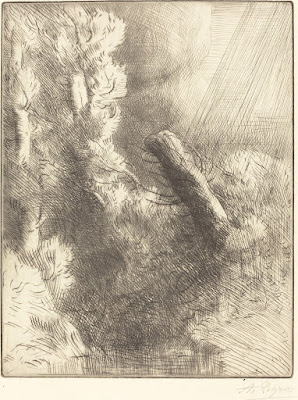
Alphonse Legros
Memories of Fontainebleau in the Rain
ca. 1910
drypoint
National Gallery of Art, Washington DC

Édouard Vuillard
Woman Sewing
ca. 1910
drawing
Musée d'Unterlinden, Colmar

Édouard Vuillard
Woman sitting at a Table
ca. 1910
oil on canvas
Milwaukee Art Museum

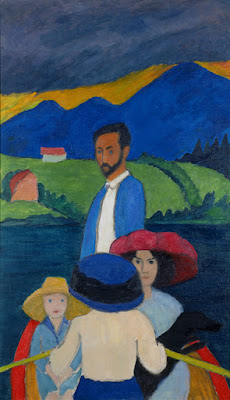
Gabriele Münter
Boating
1910
oil on canvas
Milwaukee Art Museum

Lovis Corinth
Judith and Holofernes
1910
lithograph
Minneapolis Institute of Art

Käthe Kollwitz
Self Portrait 
1910
etching
Milwaukee Art Museum

George Luks
The Wedding Cake
ca. 1910
oil on canvas
Chrysler Museum of Art, Norfolk, Virginia

George Luks
Holiday on the Hudson
ca. 1912
oil on canvas
Cleveland Museum of Art

August Macke
Geraniums before Blue Mountain
1911
oil on canvas
Milwaukee Art Museum

Albert Bloch
Boy with Orange
1911
oil on canvas
Los Angeles County Museum of Art

Ernst Ludwig Kirchner
Dance Hall, Bellevue
ca. 1909
oil on canvas
National Gallery of Art, Washington DC

Wassily Kandinsky
Autumn II
1912
oil on canvas
Phillips Collection, Washington DC

As I fortuned to take my voyage into Thessaly, about certaine affaires which I had to doe (for there myne auncestry by my mothers side inhabiteth, descended of the line of that most excellent person Plutarch, and of Sextus the Philosopher his Nephew, which is to us a great honour) and after that by much travell and great paine I had passed over the high mountaines and slipperie vallies, and had ridden through the cloggy fallowed fields; perceiving that my horse did waxe somwhat slow, and to the intent likewise I might repose and strengthen my self (being weary with riding) I lighted off my horse, and wiping away the sweat from every part of his body, I unbridled him, and walked him softly in my hand, to the end he might pisse, and ease himselfe of his wearinesse and travell: and while hee went grazing freshly in the field (casting his head sometimes aside, as a token of rejoycing and gladnesse) I perceived a little before me two companions riding, and so I overtaking them made the third.

– Apuleius, The Golden Ass, translated by William Adlington (1566)