 |
| Jean-Auguste-Dominique Ingres The Turkish Bath painted 1852-59, modified 1862 oil on canvas, mounted on panel Musée du Louvre |
Anti-Romantic
Ingres was the greatest portraitist of his age. All of French society passed through his studio, from baronesses to bankers. Guardian of an academic artistic tradition, he felt himself obliged to paint ambitious narrative canvases referencing Antiquity – mythological stories were accordingly depicted at regular intervals throughout his career. To a lesser degree he also explored the Middle Ages as a setting, but it is his taste for the perceived exoticism of the Orient (where in fact he never traveled) that informs The Turkish Bath.
The Orient as Destination
Although the French Romantics did sometimes set their scenes in Antiquity, as Delacroix did for the ceilings of the Senate library, they were primarily inspired by the Near East. British Romantics did not share this unique fascination, probably because the British Empire was so much more extensive and varied. In France during the 19th century the voyage to the Orient had become an artistic imperative. There grew up at this time a fashion, focused on the Near East, for pondering the mutability of civilizations, as first encapsulated in The Ruins, or, Meditation on the Revolution of Empires (1791) by Constantin-François de Chassebœuf, comte de Volney, soon reinforced in Travels to Jerusalem and the Holy Land through Egypt (1811) by François-René de Chateaubriand. Writers and painters took it upon themselves to re-enact Chateaubriand's Travels, producing their own variations, appendices, elaborations. This vogue was taken up by Alphonse de Lamartine, Théophile Gautier and Gérard de Nerval; then carried forward to the end of the century by Gustave Flaubert, Maurice Barrès and André Gide.
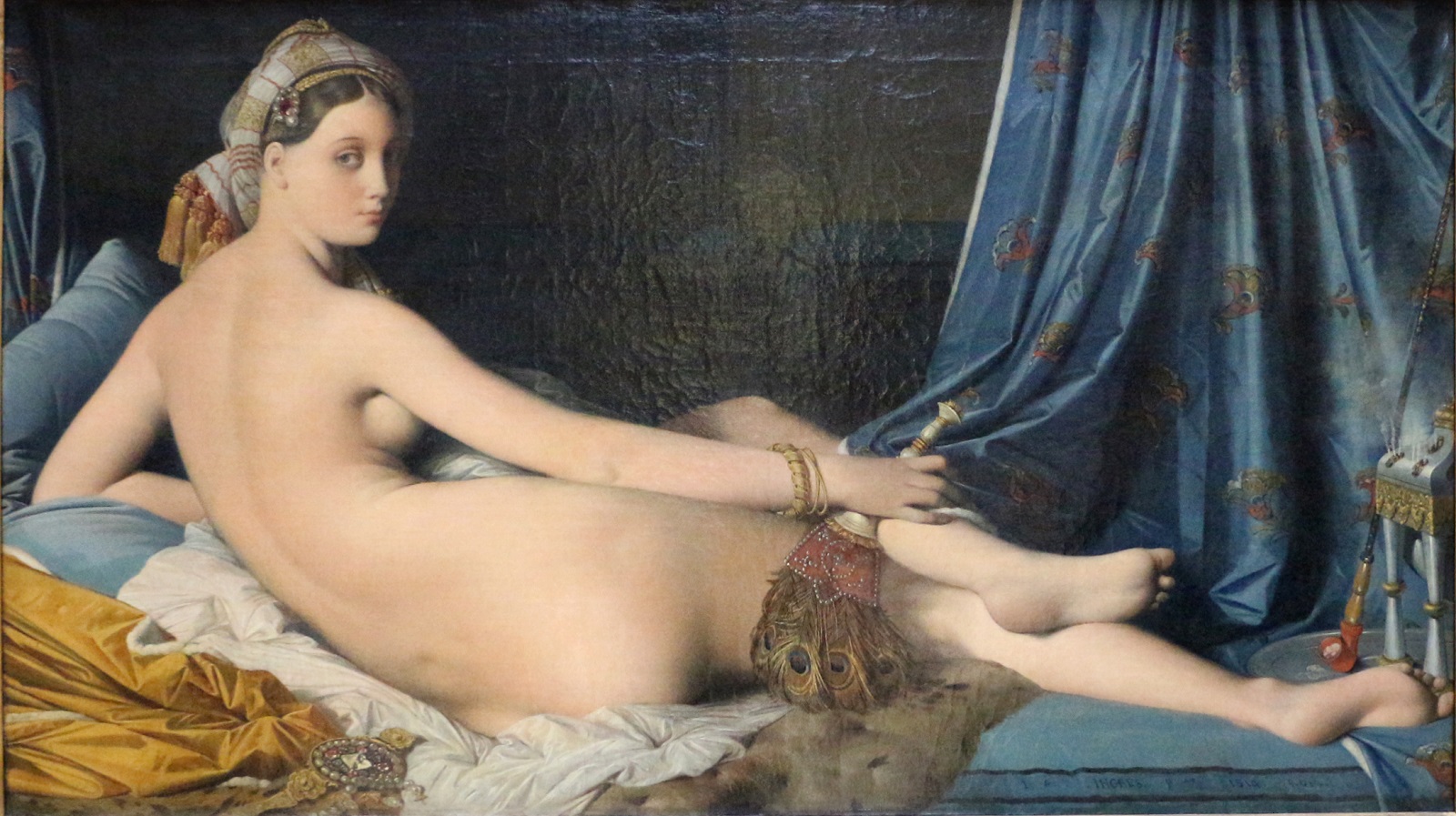 |
| Jean-Auguste-Dominique Ingres La Grande Odalisque 1814 oil on canvas Musée du Louvre |
 |
| Jean-Auguste-Dominique Ingres Sleeping Odalisque ca. 1830-40 oil on canvas Victoria & Albert Museum, London |
Odalisque and Artist's Model
Ingres found the Orientalist fantasy irresistible. His erotic preferences centered on the harem, the seraglio which allowed him to present women as offered up, entirely nude, having been unveiled for the pleasure of their lord and master. In the two Odalisques, as in The Turkish Bath, women wait, idly resting and infinitely available. The master, the turbaned and mustached warrior, can possess them with absolute ease at any time.
We can compare the odalisque to a female model in the studio, posing nude and assuming whatever position was requested at the École des Beaux-Arts, shielded to some extent by the multiple gazes of a group of male art students competing one against another.
 |
| Jean-Auguste-Dominique Ingres Valpinçon Bather 1808 oil on canvas Musée du Louvre |
In The Turkish Bath, all the women are unclothed and disposed in various postures, but the heads of several are ornamented – in the foreground, seen from the back, one wears a turban (which we recognize as identical to that worn by a much earlier Bather). Another wears something like a jeweled crown, not to mention the golden coiffure that flows over the shoulder of the woman in silhouette at lower right. Nude bodies but covered heads, like the last resistance of the Muslim veil amidst this whirlwind of flesh. These women twine around and among one another, as if taunting the viewer – who is, of course, not only viewer, but voyeur.
– translated and adapted from Le Musée imaginaire de Michel Butor: 105 œuvres décisives de la peinture occidentale (Paris: Flammarion, 2019)

