Showing posts with label prostitues. Show all posts

Tuesday, January 13, 2026

Amorous

Jacob Cornelisz van Oostsanen
David encountering Abigail
ca. 1495
oil on panel
Statens Museum for Kunst, Copenhagen


Agostino Carracci after Paolo Fiammingo
Reciproco Amore
ca. 1589-95
engraving
Graphische Sammlung, ETH Zürich

Hendrik Goltzius
The Sense of Smell
(series, The Five Senses)
ca. 1595-96
drawing (print study)
Museum Boijmans Van Beuningen, Rotterdam

Christoph Gertner
Amorous Couple, with Death lurking in the Shadows
ca. 1600
oil on slate
Národní Galerie, Prague

Giovanni Francesco Guerrieri
Lot and his Daughters
1617
oil on canvas
Galleria Borghese, Rome

Jacques de Gheyn II
Allegory of Unequal Love
ca. 1620
oil on canvas
North Carolina Museum of Art, Raleigh

Christoph Gertner
Monk with Harlot and Procuress
1624
drawing
Kupferstichkabinett, Staatliche Kunstsammlungen, Dresden

Abraham Bloemaert
Shepherd wooing Shepherdess in a Landscape
1627
oil on canvas
Landesmuseum, Hannover

Giovanni Francesco Romanelli
Dido accosting the departing Aeneas
ca. 1646
gouache on paper, mounted on canvas
Norton Simon Museum, Pasadena, California

Pieter de Hooch
The Intruder - A Lady at her Toilette surprised by her Lover
1665
oil on canvas
Wellington Collection, Apsley House, London

Pietro Paolini (il Lucchese)
The Procuress (Old Man and Young Woman)
ca. 1670
oil on canvas
Musée de l'Oise

Petr Brandl
Lot and his Daughters
ca. 1700
oil on canvas
Národní Galerie, Prague

Laurent Delvaux
Caunus and Biblis
ca. 1735
marble
Bode Museum, Berlin

Benjamin West
Helen brought to Paris
1776
oil on canvas
Smithsonian American Art Museum, Washington DC

Salomon Gessner
Lovesick Boatman with Cupid
1777
etching
Graphische Sammlung, ETH Zürich

Giovanni Volpato after Francesco Maggiotto
Young Man with Harlot and Procuress
ca. 1780
etching and engraving
Herzog Anton Ulrich Museum, Braunschweig

from Cyclops
 
Thus sweetly sad of old, the Cyclops strove
To soften his uneasie hours of Love.
Then when hot Youth urg'd him to fierce desire,
And Galatea's eyes kindled the raging fire,
His was no common Flame, nor could he move
In the old Arts, and beaten Paths of Love;
Nor Flowers, nor Fruits sent to oblige the Fair,
Nor more to please, curl'd his neglected Hair.
His was all Rage, all Madness; To his Mind
No other Cares their wonted entrance find.
Oft from the Field his Flock return'd alone
Unheeded, unobserv'd: He on some stone,
Or craggy Cliff, to the deaf Winds and Sea
Accusing Galatea's Cruelty;
Till Night from the first dawn of opening Day,
Consumes with inward heat, and melts away.
Yet then a Cure, the onely Cure he found,
And thus apply'd it to the bleeding Wound;
From a steep Rock, from whence he might survey
The Floud, (the Bed where his lov'd Sea-Nymph lay)
His drooping head with Sorrow bent he hung,
And thus his grief calm'd with his mournfull Song.

– Theocritus (early 3rd century BC), translated by Richard Duke (1684)

Monday, November 27, 2023

Visual Relics (1910-1917)

Imogen Cunningham
Self Portrait
ca. 1910
platinum print
Nelson-Atkins Museum of Art, Kansas City, Missouri

Karl Struss
Penn Station, New York
1910
platinum print
Los Angeles County Museum of Art

Heinrich Kühn
Still Life with Fruit
1910
photogravure
Art Institute of Chicago

Frank Eugene
Minuet
ca. 1910
photogravure
Minneapolis Institute of Art

Frank Eugene
Self Portrait on my Roof Garden
1911
autochrome
Nelson-Atkins Museum of Art, Kansas City, Missouri

Paul Haviland
Luna Park at Night
ca. 1910
platinum print
Nelson-Atkins Museum of Art, Kansas City, Missouri

Herbert G. Ponting
The Hut at Cape Evans, Antarctica
ca. 1911
gelatin silver print
Los Angeles County Museum of Art

E.J. Bellocq
Storyville Portrait, New Orleans
ca. 1911-13
modern gelatin silver print from glass-plate negative
Victoria & Albert Museum, London

E.J. Bellocq
Storyville Portrait, New Orleans
ca. 1911-13
modern gelatin silver print from glass-plate negative
Victoria & Albert Museum, London

E.J. Bellocq
Storyville Portrait, New Orleans
ca. 1911-13
modern gelatin silver print from glass-plate negative
Victoria & Albert Museum, London

"E.J. Bellocq took these photographs in Storyville, the notorious district of New Orleans where prostitution was legalised from 1897 to 1917. The only photographs attributed to Bellocq are images of prostitutes and their surroundings. They are remarkable for their relaxed portrayal of nudity. Bellocq's work became widely known when photographer Lee Friedlander bought his damaged glass negatives and made new prints from them. Friedlander's interpretation of this secret archive is now as much a part of the history of these photographs as the scant details known of Bellocq's life. Despite their 'discovery' and promotion, we still do not know why Bellocq made these curious images, and they have lost little of their mystery."

– from curator's notes at the Victoria & Albert Museum

Charles Gerschel
Tamara Karsavina in La Tragédie de Salomé
(Ballets Russes costume and set by Serge Sudeikin)
1913
gelatin silver print
Victoria & Albert Museum, London

Edward Steichen
Isadora Duncan
1913
photogravure
Minneapolis Institute of Art

F. Holland Day
Portrait of Maynard White
ca. 1915
platinum print
Nelson-Atkins Museum of Art, Kansas City, Missouri

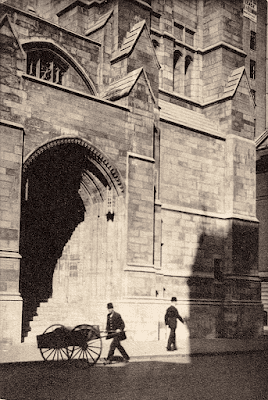
Guy Gayler Clark
St Patrick's Cathedral
ca. 1917
gelatin silver print
Nelson-Atkins Museum of Art, Kansas City, Missouri

Frances Benjamin Johnston
Portrait of a Woman
ca. 1917
platinum print
Princeton University Art Museum

Heinrich Kühn
Roses
ca. 1910
gum bichromate print
Getty Museum, Los Angeles

Tuesday, August 10, 2021

Hans von Aachen (Amorous Fantasies in Paint)

Hans von Aachen
The Judgment of Paris
1590
oil on canvas
Birmingham Museum of Art, Alabama

Hans von Aachen
Pallas Athena, Venus (with Golden Apple) and Juno 
1593
oil on canvas
Museum of Fine Arts, Boston

Hans von Aachen
The Three Graces
ca. 1604
oil on copper
Herzog Anton Ulrich Museum, Braunschweig

Hans von Aachen
Tarquin and Lucretia
ca. 1600
oil on canvas
Kunsthistorisches Museum, Vienna

Hans von Aachen
Jupiter, Antiope and Cupid
ca. 1595-98
oil on copper
Kunsthistorisches Museum, Vienna

Hans von Aachen
The Amazement of the Gods
(Jupiter aloft, embracing his daughter Minerva)
ca. 1590-1600
oil on copper
National Gallery, London

Hans von Aachen
The Triumph of Truth
ca. 1598
oil on copper
Detroit Institute of Arts

Hans von Aachen
Bacchus, Ceres and Cupid
ca. 1595-1605
oil on canvas
Kunsthistorisches Museum, Vienna

Hans von Aachen
Bacchus, Venus and Cupid
ca. 1595-1600
oil on canvas
Kunsthistorisches Museum, Vienna

Hans von Aachen
Venus and Adonis
ca. 1574-88
oil on canvas
Harvard Art Museums

Hans von Aachen
Couple with a Mirror
before 1615
oil on copper
Kunsthistorisches Museum, Vienna

Hans von Aachen
The Procuress
ca. 1605-1610
oil on panel
Kunsthistorisches Museum, Vienna

Hans von Aachen
Two Laughing Men (Self Portrait)
ca. 1574
oil on panel
Olomouc Museum of Art, Kroměříž, Czech Republic

Hans von Aachen
Perseus and Andromeda
ca. 1600-1610
oil on alabaster
Kunsthistorisches Museum, Vienna

Hans von Aachen
Liberation of Andromeda
ca. 1600-1610
oil on alabaster
Kunsthistorisches Museum, Vienna

Hans von Aachen (1552-1615) – German painter from Cologne; trained in the Netherlands.  While working in Florence, he recommended himself to the Emperor Rudolf II in Prague by sending him a portrait of the sculptor Giovanni Bologna.  In 1597 he became official portraitist to Rudolf.  On Rudolf's death in 1612 he remained in the service of the Emperor Matthias.  He is now chiefly remembered for his religious, mythological and allegorical works, in a sophisticated Mannerist style akin to [Bartholomeus] Spranger's, and, through prints, nearly as influential.

– Erika Langmuir and Norbert Lynton, The Yale Dictionary of Art and Artists (2000)

Saturday, July 24, 2021

Ambiguous Praise of the Contract

Ernst Ludwig Kirchner
Street with Red Streetwalker
ca. 1914-25
oil on canvas
Museo Thyssen-Bornemisza, Madrid

Carington Bowles (publisher)
Wantonness Mask'd
1771
hand-colored mezzotint
British Museum

Carington Bowles (publisher)
A Foolish Woman
1780
hand-colored mezzotint
British Museum

For she sitteth at the door of her house on a seat, in the high places of the city. To call passengers, who go right on their ways.  – Proverbs, Ch. IX, verses 14 & 15

Philip-Lorca diCorcia
Mike Miller, 24 years old, Allentown, Pennsylvania, $25
1990-92
C-print
Museum of Modern Art, New York

Philip-Lorca diCorcia
Tim
1990
C-print
Museum of Modern Art, New York

Eugène Atget
Versailles Brothel
1921
albumen print
Getty Museum, Los Angeles

Eugène Atget
La Villette, Rue Asselin
Prostitute waiting in front of her door
1921
albumen print
Musée d'Orsay, Paris

Eugène Atget
Rue Asselin
1924-25
albumen print
Metropolitan Museum of Art, New York

Édouard Manet
Olympia
1867
etching and aquatint
Metropolitan Museum of Art, New York

Mark Morrisroe
I, Mark Morrisroe
1999
posthumous book jacket, designed by Jack Woody
Twin Palms Publishers, Los Angeles

Mark Morrisroe
Self Portrait - To Brent
1980
Polaroid
private collection

Nan Goldin
Yogo in the Mirror, Bangkok, Second Tip Bar
1992
C-print
Museum of Modern Art, New York

Nan Goldin
Yogo putting on Powder
1992
C-print
Museum of Modern Art, New York

Henri de Toulouse-Lautrec
The Sofa
1894-96
oil on cardboard
Metropolitan Museum of Art, New York

Henri de Toulouse-Lautrec
Woman with Black Boa
1892
oil on board
Musée d'Orsay, Paris

Éloge ambigu du contrat  – Ambiguous praise of the contract

     His first image of the contract (the pact) is more or less objective: sign, language, narrative, society function by contract, but since the contract is generally masked, the critical operation consists in deciphering the confusion of reasons, alibis, appearances, in short, the whole of the social natural, in order to make manifest the controlled exchange on which the semantic process and collective life are based.  Yet, at another level, the contract is a bad object: a bourgeois value which merely legalizes a kind of economic talion: making for nothing, says the bourgeois contract: under the praise of bookkeeping, of profit-making, we must therefore read the Base, the Paltry.  At the same time, and at yet another level, the contract is ceaselessly desired, as the justice of a world finally "regular": the preference for the contract in human relations, the security once a contract can be interposed between them, the reluctance to receive without giving, etc.  At this point – since the body intervenes directly here, the model of the good contract is the contract of Prostitution.  For this contract, declared immoral by all societies and by all systems (except the most archaic), liberates in fact from what might be called the imaginary embarrassments of the exchange: what am I to count on in the other's desire, in what I am for him?  The contract eliminates this confusion: it is in fact the only position which the subject can assume without falling into two inverse but equally abhorred images: that of the "egoist" (who demands without caring that he has nothing to give) and that of the "saint" (who gives but forbids himself ever to demand): thus the discourse of the contract eludes two plenitudes; it permits observing the golden rule of any habitation, discerned in the Shikidai* passageway: no will-to-seize and yet no oblation.

* a low, broad step or platform of timber at the threshold of a traditional Japanese house

Roland Barthes by Roland Barthes, translated by Richard Howard (Hill & Wang, 1977)