Showing posts with label brocade. Show all posts

Monday, January 6, 2025

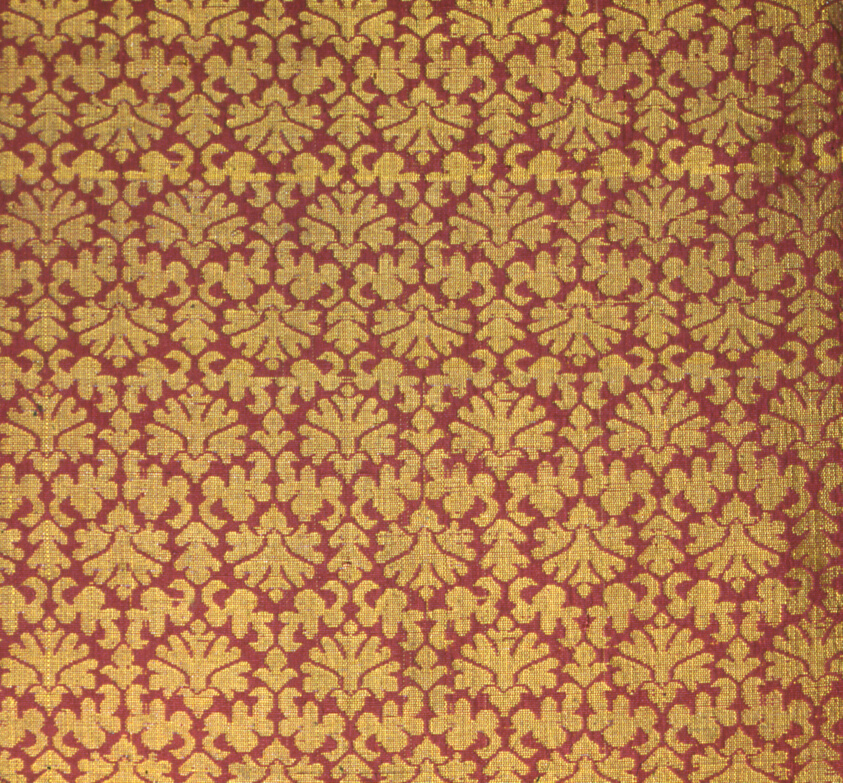
Woven-in Patterning

Anonymous Peruvian Makers
Tunic
AD 900-1400
cotton net with alpaca tassels
Denver Art Museum

Anonymous Italian Makers
Gown for Statuette of the Virgin
ca. 1575-1625
silk brocade with gilt-metal threads
Isabella Stewart Gardner Museum, Boston

Anonymous Italian Makers
Fabric Panel
ca. 1600-1650
silk velvet with gilt-metal threads
Isabella Stewart Gardner Museum, Boston

Anonymous Italian Makers
Fabric Panel
17th century
silk brocade
Art Institute of Chicago

Anonymous Italian Makers
Fabric Panel
17th century
silk-brocade with gilt-metal threads
Art Institute of Chicago

Anonymous Chinese Makers
Hanging
ca. 1600
tapestry-woven silk
National Gallery of Australia, Canberra

Anonymous English Makers
Purse
17th century
silk and wool tapestry-work
Fitzwilliam Museum, Cambridge

Anonymous European Makers
Throw
ca. 1720-25
silk brocade edged in gold lace
Bayerisches Nationalmuseum, Munich

Anonymous French Makers
Fabric Panel
ca. 1735
silk brocade
Art Institute of Chicago

Anonymous French Makers
Fabric Panel
ca. 1740-60
silk satin
Art Institute of Chicago

Anonymous French Makers
Fabric Panel
ca. 1760-70
silk brocade
Art Institute of Chicago

Anonymous French Makers
Fabric Panel
ca. 1762-65
silk brocade
Art Institute of Chicago

Anonymous French Makers
Fabric Panel
ca. 1800-1825
silk satin with moiré stripes
Art Institute of Chicago

Anonymous French Makers
Shawl
1845
wool and cotton
Art Institute of Chicago

Percyval Tudor-Hart (designer)
Le Premier Péché
ca. 1930
wool and silk
(tapestry hanging woven by Léo Belmonte)
Royal Ontario Museum, Toronto

Sonia Delaunay (designer)
Syncopée
ca. 1973-74
wool
(Aubusson tapestry woven at Atelier Pinton)
Queensland Art Gallery, Brisbane

Telemachus' Guilt

Patience of the sort my mother 
practiced on my father
(which in his self-
absorption he mistook
for tribute though it was in fact 
a species of rage – didn't he
ever wonder why he was
so blocked in expressing
his native abandon?): it infected
my childhood. Patiently 
she fed me: patiently
she supervised the kindly
slaves who attended me, regardless
of my behavior, an assumption
I tested with increasing 
violence. It seemed clear to me
that from her perspective
I didn't exist, since
my actions had 
no power to disturb her. I was
the envy of my playmates.
In the decades that followed 
I was proud of my father
for staying away
even if he stayed away for
the wrong reasons:
I used to smile
when my mother wept. 
I hope now she could
forgive that cruelty; I hope
she understood how like
her own coldness it was,
a means of remaining
separate from what
one loves deeply. 

– Louise Glück (1996)

Sunday, January 5, 2025

Fabricators of Reputation

Martin Margiela
Jacket
2000
wool and rayon
Royal Ontario Museum, Toronto

Charles James
Ballgown
1949
silk taffeta and silk satin
Phoenix Art Museum, Arizona

 Lucile, Lady Duff-Gordon
"Happiness" Dinner Dress
1916
silk taffeta, satin, tulle and chiffon
trimmed with ribbons, flowers and lace
Philadelphia Museum of Art

Norman Hartnell
State Gown for Queen Elizabeth
(consort of George VI)
1939
silk satin, lace, gold tissue
Royal Ontario Museum, Toronto

Vivienne Westwood
 Wedding Ensemble
1993
silk
National Gallery of Australia, Canberra

Callot Soeurs, Paris
Afternoon Dress
ca. 1900
printed silk, appliquéd with ribbon and lace
National Gallery of Victoria, Melbourne

Alexandre Benois for Ballets-Russes
Stage Costume - Cloak for Harpist
ca. 1909
cotton embroidered with metallic thread
National Gallery of Australia, Canberra

Manish Malhotra
Evening Gown
2016
pieced cottons and silks
Philadelphia Museum of Art

Emilio Schuberth
Cocktail Dress
ca. 1961
silk faille
Philadelphia Museum of Art

Kansai Yamamoto
Ensemble
(dress and jacket)
1973
wool with punch-needle embroidery
Philadelphia Museum of Art

Iris van Herpen
"Frozen Falls" Evening Gown
2019
silk organza, silk tulle, cotton, polyester
National Gallery of Victoria, Melbourne

Norman Norell
Afternoon Ensemble
1968
silk taffeta (dress) and wool twill (jacket)
Philadelphia Museum of Art

Ralph Rucci
Evening Ensemble
2005
beaded and embroidered silk (blouse)
silk satin (skirt)
Philadelphia Museum of Art

Miss Foley
Evening Gown
ca. 1890
silk satin, silk brocade, cotton net
Phoenix Art Museum, Arizona

Madame Judith
Opera Coat
ca. 1895
cut silk velvet and ostrich feathers
Phoenix Art Museum, Arizona

Carolina Herrera
Wedding Gown
2012
silk satin
Philadelphia Museum of Art

Parable of the Trellis

A clematis grew at the foot of a great trellis.
Despite being
modeled on a tree, the trellis
was a human invention; every year, in May,
the green wires of the struggling vine
climbed the straightforward
trellis, and after many years 
white flowers burst from the brittle wood, like
a star shower from the heart of the garden.

Enough of that ruse. We both know
how the vine grows without
the trellis, how it sneaks
along the ground; we have both seen it
flower there, the white blossoms
like headlights growing out of a snake.

This isn't what the vine wants.
Remember, to the vine, the trellis
was never an image of confinement:
this is not
diminishment or tragedy.

The vine has a dream of light:
what is life in the dirt
with its dark freedoms
compared to supported ascent?

And for a time, 
every summer we could see the vine
relive this decision, thus 
obscuring the wood, structure
beautiful in itself, like 
a harbor or willow tree.

– Louise Glück (1996)

Saturday, January 4, 2025

Museum Menswear

Anonymous Italian Makers
Brigandine
(body armour)
ca. 1500-1530
silk velvet over steel plates fixed with brass rivets
Royal Ontario Museum, Toronto

Anonymous Italian Makers
Brigandine
(body armour)
ca. 1500-1530
silk velvet over steel plates fixed with brass rivet
Royal Ontario Museum, Toronto

Anonymous Italian Makers
Chasuble with Orphrey Band
ca. 1480-1500
silk velvet and silk-embroidered linen
Art Institute of Chicago

Piero Fornasetti
Waistcoat
ca. 1980
printed silk
Philadelphia Museum of Art

Anonymous Japanese Makers
Samurai Coat
19th century
wool lined with silk
Asian Art Museum, San Francisco

Shochiku Costume Company, Tokyo
 Kabuki Actor's Costume
ca. 2000
embroidered silk brocade and silk twill
National Gallery of Australia, Canberra

Anonymous Japanese Makers
Actor's Under-Robe
19th century
resist-dyed silk
Asian Art Museum, San Francisco

Anonymous Japanese Makers
Buddhist Monk's Robe
ca. 1700-1750
silk and gilt-paper brocade
Denver Art Museum

Giorgio de Chirico for Ballets-Russes
Dance Costume
1929
hand-painted wool, cotton and linen 
National Gallery of Australia, Canberra

Anonymous French Makers
Banyan
(robe de chambre)
ca. 1730-40
silk brocade
National Gallery of Victoria, Melbourne

Anonymous Chinese Makers
Cloak of Daoist Priest
ca. 1800
embroidered silk
Ethnologisches Museum, Berlin

Anonymous Indian Maker
Turban Cloth
ca. 1900-1920
cotton
National Gallery of Australia, Canberra

Tagney & Randell, London
Tailcoat
ca. 1935
wool lined with silk
National Gallery of Victoria, Melbourne

(sourced by) January Jansen
Vest worn onstage by Jim Morrison of The Doors
ca. 1965
gold-embroidered velvet
Art Gallery of Ontario, Toronto

Charvet et Fils, New York
 Dressing Gown
ca. 1948
printed silk twill
Philadelphia Museum of Art

Bernhard Willhelm
Ensemble
2016
printed and embroidered cotton-polyester blends
Philadelphia Museum of Art

Rainy Morning

You don't love the world.
If you loved the world you'd have
images in your poems.

John loves the world. He has
a motto: judge not
lest ye be judged. Don't 

argue this point
on the theory it isn't possible
to love what one refuses
to know: to refuse

speech is not
to suppress perception.

Look at John, out in the world,
running even on a miserable day
like today. Your
staying dry is like the cat's pathetic
preference for hunting dead birds: completely

consistent with your tame spiritual themes,
autumn, loss, darkness, etc.

We can all write about suffering
with our eyes closed. You should show people
more of yourself: show them your clandestine
passion for red meat.

– Louise Glück (1996)

Tuesday, December 31, 2024

Swatches

Italian Makers
Fabric Panel
ca. 1450-1500
silk velvet with gilt-metal threads
Art Institute of Chicago

Italian Makers
Fabric Panel
ca. 1480-90
silk velvet with gilt-metal threads
Bayerisches Nationalmuseum, Munich

Italian Makers
Fabric Panel
17th century
silk damask
Isabella Stewart Gardner Museum, Boston

French Makers
Fabric Panel
ca. 1750
silk brocade
Art Institute of Chicago

French Makers
Fabric Panel
ca. 1770-80
silk brocade
Royal Ontario Museum, Toronto

French Makers
Fabric Panel
ca. 1780-90
block-printed and hand-painted cotton
Royal Ontario Museum, Toronto

Netherlandish Makers
Fragment of Table Carpet
ca. 1650-70
wool and silk tapestry-work
Denver Art Museum

Charles Francis Annesley Voysey (designer)
Fabric Panel
ca. 1890
printed cotton-and-silk blend
National Gallery of Australia, Canberra

Constance Irving for William Foxton Ltd.
Fabric Panel
ca. 1925-30
roller-printed cretonne
private collection

Russian Makers
Fabric Panel - "Construction Site"
ca. 1920-30
machine-printed cotton
private collection

House of Scalamandré
Fabric Panel
"Ancient Horses frightened by Voice of the Oracle"

1949
screenprinted cotton
Royal Ontario Museum, Toronto

American Makers
Fabric Panel - "Tumbling Blocks" Patchwork Pattern
ca. 1890-1900
roller-printed cotton
Denver Art Museum

Helen Grey-Smith (designer)
Fabric Panel
ca. 1960
screenprinted cotton
National Gallery of Australia, Canberra

Helen Grey-Smith (designer)
Fabric Panel
ca. 1960
screenprinted cotton
National Gallery of Australia, Canberra

Unknown Maker
Fabric Panel
(Bauhaus Study Sample of Furnishing Fabric)
ca. 1926
wool, cotton, rayon
National Gallery of Australia, Canberra

Lena Bergner (weaver)
Fabric Panel
(Bauhaus Study Sample of Dress Fabric)
ca. 1930
cotton
National Gallery of Australia, Canberra

Penelope's Song

Little soul, little perpetually undressed one,
do now as I bid you, climb
the shelf-like branches of the spruce tree,
wait at the top, attentive, like
a sentry or look-out. He will be home soon,
it behooves you to be
generous. You have not been completely 
perfect either; with your troublesome body
you have done things you shouldn't
discuss in poems. Therefore
call out to him over the open water, over the bright water
with your dark song, with your grasping
unnatural song – passionate,
like Maria Callas. Who
wouldn't want you? Whose most demonic appetite
could you possibly fail to answer? Soon
he will return from wherever he goes in the meantime,
suntanned from his time away, wanting
his grilled chicken. Ah, you must greet him, 
you must shake the boughs of the tree
to get his attention,
but carefully, carefully, lest 
his beautiful face be marred
by too many falling needles. 

– Louise Glück (1996)